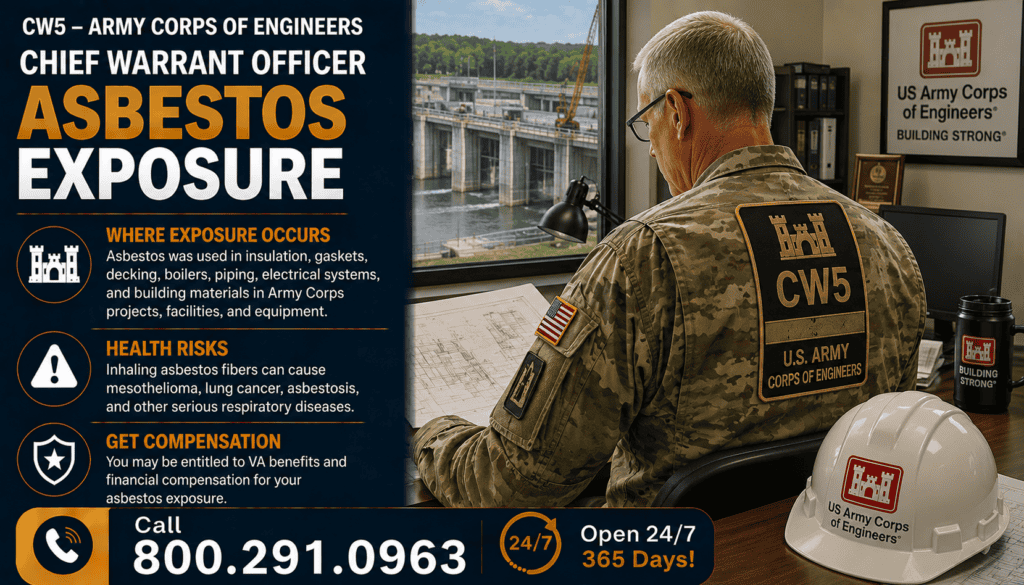
CW5 – Army Corps of Engineers Chief Warrant Officer Asbestos Exposure
A U.S. Army Corps of Engineers Chief Warrant Officer 5 (CW5) may serve as a master-level technical expert and senior advisor in engineering, construction, equipment, maintenance, logistics, facilities, or specialized Army operations. Depending on the assignment and era, a CW5 could work around older buildings, mechanical systems, vehicles, heavy machinery, or construction materials that may require investigation for historical asbestos use.
Rank alone does not establish asbestos exposure. A meaningful exposure reconstruction should focus on the CW5’s military occupational specialty, unit, duty station, project, equipment, building, maintenance activities, dates of service, and the specific materials encountered.
For broader context, see U.S. Army Corps of Engineers Ranks Asbestos Exposure and the main U.S. Army Corps of Engineers Asbestos Exposure guide. Senior technical assignments may also overlap with Army Corps mechanics, maintenance workers, heavy machinery, and Army Corps vehicles.
🎖️ CW5 Roles and Army Corps Assignments
Chief Warrant Officer 5 personnel may provide the highest levels of technical expertise, strategic guidance, oversight, training, planning, troubleshooting, and supervision within their specialty. Actual duties vary by unit, project, field, and service period.
A CW5 might inspect or supervise engineering systems, heavy equipment, vehicles, utilities, mechanical systems, facility work, construction, or maintenance operations. Because asbestos exposure depends on actual duties rather than rank title, records identifying the veteran’s specialty and daily work are especially important.
⚠️ Potential Asbestos Exposure Pathways
Historical asbestos exposure may have occurred when asbestos-containing materials were cut, drilled, removed, repaired, scraped, sanded, demolished, or otherwise disturbed. A CW5 could potentially have direct exposure through technical work or bystander exposure while supervising or working near maintenance and construction activities.
| Activity | Potential Relevance | Evidence to Review |
|---|---|---|
| Equipment inspection or maintenance | Possible contact with historical friction, gasket, sealing, or thermal materials | Technical manuals, maintenance logs, parts records |
| Building renovation | Possible disturbance of older insulation, flooring, wall, ceiling, or mechanical materials | Facility records, project specifications, work orders |
| Mechanical-system oversight | Possible contact with pipe, boiler, HVAC, pump, or valve materials | Plans, specifications, equipment records |
| Supervision near dusty work | Possible bystander exposure if asbestos-containing material was disturbed nearby | Witness statements, duty descriptions, project records |
🧱 Materials and Equipment to Investigate
Depending on the location and era, an exposure investigation may examine historical insulation, pipe covering, boiler materials, gaskets, packing, flooring, roofing, cement products, wall or ceiling materials, friction products, and other heat-resistant components.
Assignments involving Army Corps heavy machinery or Army Corps vehicles may also require review of particular brakes, clutches, gaskets, seals, or thermal components. Not every product or piece of equipment contained asbestos; manufacturer, model, component, supplier, and date should be verified whenever possible.
🏗️ Projects, Facilities, and Work Locations
Army Corps work can occur at military installations, construction sites, waterways, dams, power or mechanical facilities, maintenance shops, warehouses, offices, temporary field locations, and other engineering projects. The relevant setting depends on the CW5’s actual assignment.
The Army Corps projects and facilities asbestos exposure guide provides additional context for investigating where engineering personnel may have worked. Facility age, renovation history, mechanical systems, and project specifications can help narrow the search for possible asbestos-containing materials.
🔧 Maintenance and Repair Exposure
Maintenance can be important when reconstructing historical exposure because asbestos-containing products are more likely to release fibers when disturbed. Tasks may include equipment repair, gasket removal, brake or clutch work, pipe or mechanical-system maintenance, renovation, demolition, or cleanup.
Assignments involving Army Corps mechanics or maintenance workers may help identify the types of work performed around a CW5. Direct participation, proximity, frequency, duration, ventilation, and the identity and condition of the material should all be considered.
📋 Evidence to Investigate
A strong historical exposure reconstruction connects the veteran’s actual duties to identifiable products, equipment, facilities, or projects.
| Evidence | What It May Help Establish |
|---|---|
| DD-214 and personnel records | Service dates, specialty, rank, units, and assignments |
| Duty and evaluation records | Technical responsibilities and supervisory duties |
| Project and facility records | Work locations, construction, renovation, or maintenance activity |
| Technical manuals | Equipment, systems, parts, and maintenance procedures |
| Procurement and product records | Manufacturers and materials used during the relevant period |
| Coworker statements | Daily tasks, proximity, frequency, and work practices |
| Photographs or plans | Equipment, buildings, systems, and project conditions |
| Medical records | Diagnosis and relevant medical history |
🫁 Asbestos-Related Health Risks
Inhalation of asbestos fibers is associated with serious diseases including mesothelioma, lung cancer, and asbestosis. These illnesses can appear decades after exposure, which is why older service and work records may be important after a diagnosis.
A diagnosis does not by itself establish where exposure occurred or identify a particular product, facility, or responsible party. Medical and occupational histories should be evaluated individually.
Need help now? If you are reconstructing a CW5 Army Corps assignment involving older construction materials, machinery, vehicles, mechanical systems, maintenance, or renovation work, Call 800.291.0963, use our 24/7 live chat, or Submit Your Case.
⚖️ Legal and Benefits Investigation
A veteran or worker diagnosed with an asbestos-related disease may be able to investigate legal claims or veterans benefits depending on the individual circumstances. Relevant evidence can include diagnosis, service history, exposure history, product identification, responsible companies, duty locations, jurisdiction, and filing deadlines.
Potential sources of compensation may differ depending on the evidence and responsible parties. CW5 rank, Army Corps service, or an asbestos-related diagnosis alone does not guarantee eligibility for a claim or benefit.
❓ Frequently Asked Questions
Does being a CW5 in the Army Corps prove asbestos exposure?
No. Rank alone does not establish exposure. The veteran’s specialty, duties, work locations, equipment, projects, dates, and specific materials must be investigated.
How could a CW5 have encountered asbestos?
Depending on the assignment, possible pathways may include direct technical work or proximity to maintenance, construction, renovation, demolition, mechanical systems, vehicles, or heavy equipment where asbestos-containing materials were disturbed.
Could a CW5 have bystander exposure while supervising work?
Possibly. Bystander exposure may be relevant when asbestos-containing material was disturbed nearby. Proximity, frequency, duration, ventilation, and work practices matter.
Which Army Corps records can help reconstruct exposure?
Personnel records, duty evaluations, project files, facility records, technical manuals, maintenance logs, procurement records, photographs, and coworker statements may help.
Did all Army Corps buildings and equipment contain asbestos?
No. Asbestos content varied by product, manufacturer, model, facility, component, supplier, and era. Specific evidence should be used whenever possible.
Can asbestos exposure cause lung cancer?
Yes. Asbestos exposure is a recognized cause of lung cancer. Medical questions about an individual’s diagnosis should be addressed by qualified medical professionals.
Why can exposure decades ago still matter?
Mesothelioma and other asbestos-related diseases can have long latency periods, so exposure during earlier military service may remain relevant many years later.
Can a surviving family investigate a claim?
Possibly. Available rights depend on the evidence, responsible parties, jurisdiction, and applicable deadlines. A qualified attorney can evaluate the circumstances.
☎️ Help Investigating CW5 Army Corps Asbestos Exposure
If you or a family member served as an Army Corps of Engineers Chief Warrant Officer 5 and later developed mesothelioma or lung cancer, an investigation can examine military records, specialties, duty stations, projects, facilities, equipment, maintenance work, products, manufacturers, and coworkers to help reconstruct possible exposure.
Call 800.291.0963 to discuss an Army Corps asbestos exposure history. Live chat is available 24/7, 365 days a year. You can also Submit Your Case online.
There is no guarantee that a diagnosis or service history will qualify for compensation or benefits. Eligibility depends on the individual facts, evidence, responsible parties, jurisdiction, and deadlines.
⚕️ Legal & Medical Information Disclaimer
This page provides general educational information and is not medical or legal advice. It does not establish diagnosis, asbestos exposure, causation, liability, eligibility, or compensation. Consult qualified medical and legal professionals for guidance specific to your situation.