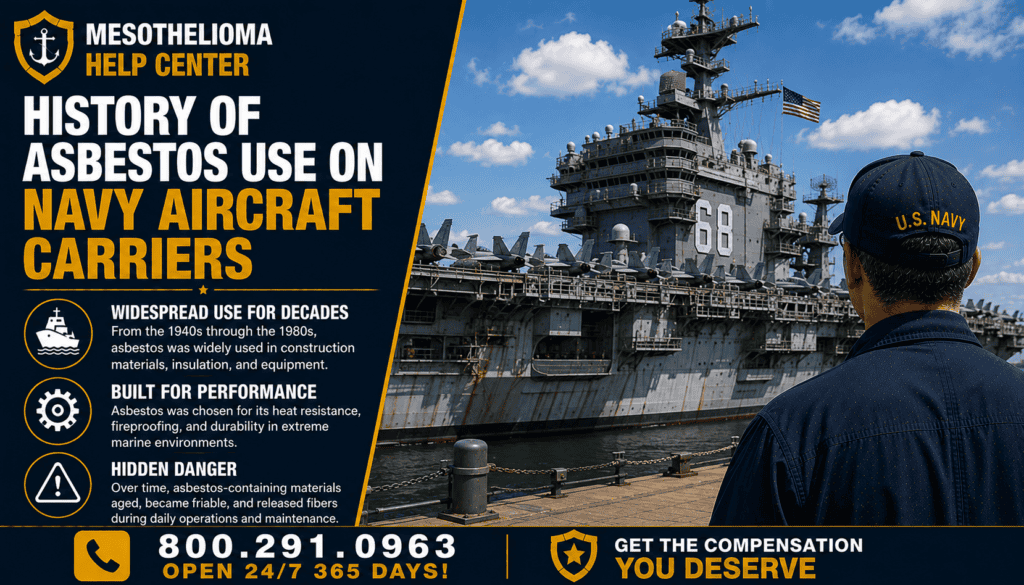
History of Asbestos Use on Navy Aircraft Carriers
The history of asbestos aboard U.S. Navy aircraft carriers spans major changes in ship design, propulsion, aviation, and maintenance. Early carriers were conversions of existing hulls. World War II produced purpose-built fleet and escort carriers in large numbers. Postwar ships grew into conventionally powered supercarriers, followed by nuclear-powered carriers with different propulsion plants but many of the same needs for heat control, fire protection, sealing, and durable machinery.
Those changes matter when researching a veteran’s possible exposure. A material documented for one carrier class, yard period, or equipment system cannot automatically be assigned to another. Historical Navy specifications may establish that an asbestos-containing product category was permitted or purchased during a period, but they do not by themselves prove installation aboard a named carrier—or that a particular sailor encountered disturbed fibers.
This history explains how carrier design eras can guide a careful investigation. For descriptions of individual product categories, see asbestos products used on Navy aircraft carriers. The overview of Navy aircraft carriers and asbestos exposure provides additional vessel and service context.
Early Aircraft Carriers and Converted Hulls
The Navy’s first aircraft carrier, USS Langley (CV-1), began as the collier USS Jupiter (AC-3) and was converted for aviation service. USS Lexington (CV-2) and USS Saratoga (CV-3) were completed as carriers after originally being laid down as battle cruisers. These conversions demonstrate why the original hull, machinery, builder, and conversion specifications must be researched instead of assuming that every early carrier shared a standard arrangement.
Propulsion also varied. A converted carrier could retain or adapt machinery concepts inherited from its earlier design. Later purpose-built carriers, including USS Ranger (CV-4) and the Yorktown class, reflected lessons from flight operations and treaty-era naval construction. Their machinery rooms, uptakes, piping routes, electrical plants, ventilation, fire protection, and living spaces were not identical.
During this era, asbestos was used commercially in various heat-resistant and insulating products. To determine whether a category was used in a particular carrier system, researchers need dated ship specifications, plans, equipment manuals, purchase records, yard correspondence, or manufacturer evidence. The fact that asbestos existed in maritime commerce does not establish its presence aboard a specific hull.
Conversion work itself may be important. Removing equipment, rerouting piping, and building aviation spaces could involve original and new materials. The relevant period may be initial construction, a later conversion, or post-commissioning maintenance, each with different suppliers and records.
World War II Carrier Expansion
World War II accelerated carrier construction and repair. The Essex class became the principal U.S. fleet-carrier design of the war, while light and escort carriers supported a wide range of combat, transport, training, and antisubmarine missions. Carriers damaged in combat could undergo urgent repairs in forward areas or extensive reconstruction at naval and private shipyards.
Conventional steam propulsion created a large network of boilers, turbines, reduction gears, condensers, pumps, valves, and steam piping. Historical asbestos-containing categories potentially relevant to a properly documented wartime carrier include thermal insulation, insulating cement, cloth and tape, gaskets, valve or pump packing, fire-resistant boards, and some electrical or friction components. No single carrier should be said to contain all of these without hull-specific evidence.
Carrier aviation added specialized machinery and shops. Elevators, arresting gear, fueling systems, ventilation equipment, generators, aircraft-maintenance spaces, galleys, and damage-control systems created additional heat, sealing, and fire-protection needs. Exposure research should focus on what work occurred, where it occurred, and whether material was cut, removed, scraped, mixed, deteriorated, or swept up.
Wartime repairs might use Navy-stock materials, builder-furnished parts, equipment-manufacturer components, or repair-facility supplies. One shipyard’s records do not prove what another installed. Even sister ships could differ because of construction timing, damage, substitutions, and modernization.
The article on where asbestos may have been located on aircraft carriers connects these historical systems to shipboard compartments without treating location as proof of product content.
Postwar Modernization and the Rise of Supercarriers
After World War II, many carriers were decommissioned, reactivated, converted, or modernized. Changes such as strengthened flight decks, angled decks, steam catapults, new arresting gear, improved aviation-fuel systems, larger elevators, upgraded radar, and revised island structures supported heavier and faster aircraft. These projects could open machinery spaces, disturb deck and interior materials, replace piping, and remove or reinstall insulation.
The Midway-class carriers bridged wartime and postwar development. Later Forrestal-, Kitty Hawk-, and John F. Kennedy-type conventionally powered carriers represented the supercarrier era. Their main plants still relied on oil-fired boilers producing steam for propulsion turbines. Steam also served shipboard and aviation functions, including catapult systems on relevant configurations.
A larger ship did not merely multiply one standard product list. Manufacturers, specifications, and approved materials changed over decades. A carrier could enter several yards, and original components might be replaced more than once with products of different composition.
Shipyard availabilities are therefore important potential exposure periods, but the word “overhaul” does not prove that asbestos was disturbed near a sailor. Work packages, compartment access, division assignments, equipment records, and witness accounts help determine whether a person was close to insulation removal, gasket scraping, packing replacement, panel work, or cleanup.
Need help reconstructing a carrier’s construction or overhaul history? Call 800.291.0963. Live chat is available 24/7, 365 days a year. You may also Submit Your Case for a review of service dates, duties, shipyard periods, and possible product evidence.
The Nuclear-Carrier Era
USS Enterprise (CVN-65), commissioned in 1961, was the world’s first nuclear-powered aircraft carrier. The Nimitz class established a repeatable nuclear supercarrier design, followed by the Gerald R. Ford class. This transition fundamentally changed the source of propulsion steam, but it did not eliminate turbines, condensers, pumps, valves, piping, electrical equipment, ventilation, aviation machinery, or extensive hotel services.
Nuclear carriers do not use conventional oil-fired main propulsion boilers. It is inaccurate to copy a boiler-room exposure description from a Forrestal-class carrier onto a Nimitz-class carrier. Research for a CVN should identify its reactor-generated steam systems, propulsion and auxiliary machinery, equipment manufacturers, construction date, overhaul history, and the controls governing work in each area.
The beginning of nuclear propulsion also did not create a single date when every asbestos-containing material disappeared. A ship was assembled from thousands of products governed by many specifications and procurement decisions. The date a non-asbestos substitute became available is not necessarily the date it was required, purchased, installed throughout a class, or retrofitted onto an older carrier.
Conversely, an older Navy specification that allowed asbestos cannot prove installation on a later nuclear carrier. Researchers need the revision effective when the product was procured, along with purchase, installation, technical, or removal records.
Personnel history remains central. Machinist’s mates, boiler technicians on conventionally powered carriers, electricians, pipefitters, hull technicians, damage-control personnel, aviation-maintenance workers, and shipyard trades had different possible pathways. The guide to aircraft carrier personnel and asbestos exposure explains why rating alone is a starting point rather than proof.
Maintenance, Replacement, and Asbestos Controls
Installed material could remain in service long after purchasing practices changed. A carrier built in an earlier period might retain older insulation, gaskets, packing, panels, deck materials, or equipment components until repair or replacement. This “legacy material” issue makes the ship’s actual maintenance history more useful than relying on a broad national regulatory date.
Fiber release is generally associated with disturbance or deterioration of asbestos-containing material. Historically relevant tasks can include cutting pipe covering, mixing or chipping insulating cement, stripping lagging, scraping gasket residue, pulling valve packing, drilling panel material, removing deck tile, or cleaning dust after nearby work. Merely serving aboard a ship does not establish that one of these events occurred around a particular person.
As awareness and regulation developed, shipyards adopted exposure controls for asbestos work. OSHA’s shipyard asbestos standard addresses regulated areas, exposure assessment, engineering controls, respiratory protection, protective clothing, hygiene, training, medical surveillance, and waste handling. The presence of a modern control requirement does not prove that an earlier job involved asbestos, but dated abatement records can be powerful evidence of what was removed and where.
Maintenance could also create bystander exposure. A sailor might stand watch, operate adjacent machinery, pass through a work area, or clean afterward. Evaluating that pathway requires evidence about distance, frequency, duration, ventilation, barriers, housekeeping, and material condition. For task-specific discussion, see how exposure could occur during aircraft-carrier service.
Dust could also be carried on work clothing, although an individual secondhand asbestos exposure history must be supported by facts about contaminated work and contact at home.
How Historical Asbestos Evidence Should Be Evaluated
A reliable carrier history separates three propositions that are often blurred together:
- Category evidence: a Navy specification, procurement file, or Qualified Products List may show that an asbestos-containing product category or brand was approved or purchased during a defined period.
- Ship evidence: plans, work orders, invoices, material lists, photographs, equipment manuals, or removal records may connect a product to a named carrier and location.
- Personal exposure evidence: service records, duties, work practices, proximity, witnesses, and material condition may help show whether a veteran encountered fibers released from that product.
Evidence at one level does not automatically prove the next. A later NAVSEA Qualified Products List cannot be projected backward to establish what a World War II shipbuilder installed. Likewise, proof that insulation existed in one machinery room does not show that a sailor assigned to the flight deck entered that space or encountered disturbed material.
Chronology should track the carrier’s construction, commissioning, conversions, repairs, and disposal. Product and personnel evidence can then be matched to the relevant window and potential equipment makers, suppliers, or private yards. Legal options depend on the evidence and applicable law.
Veterans and families exploring options may review veterans mesothelioma claims, asbestos trust funds, and aircraft carrier mesothelioma lawsuits. No historical fact alone guarantees eligibility, benefits, compensation, settlement, or a case result.
Records for Researching a Carrier’s Asbestos History
The National Archives recommends beginning with the ship’s history and then working into technical and administrative records. Depending on the carrier and date, useful sources may include:
- Dictionary of American Naval Fighting Ships histories and other Naval History and Heritage Command materials.
- Bureau of Ships correspondence in Record Group 19, including design, machinery, insulation, piping, alteration, and repair subjects.
- Booklets of General Plans, engineering drawings, piping plans, compartment plans, and machinery arrangements.
- Ship specifications, historical military specifications, material schedules, and dated Qualified Products Lists.
- Shipyard work packages, job orders, contracts, invoices, inspection files, and asbestos survey or abatement records.
- Equipment manuals, allowance parts lists, manufacturer catalogs, nameplates, and replacement-part documentation.
- Service records, muster rolls, deck logs, cruise books, photographs, and statements from shipmates or yard workers.
NARA evidence limitation: Navy deck logs and muster rolls do not provide direct evidence that asbestos was aboard a ship. Muster rolls can help establish assignment. Deck logs can help establish location, major work dates, overhaul periods, and significant activity. Those dates may narrow the search for Bureau of Ships, technical, manufacturer, and shipyard records that address actual materials.
Claims involving health effects also require medical evidence. The Department of Veterans Affairs states that a disability claim generally needs medical records, service records identifying the veteran’s job or specialty, and a medical nexus statement. VA decides asbestos-related claims case by case. Anyone with concerning symptoms should consult a qualified health professional; general history cannot diagnose an asbestos-related disease. Information about mesothelioma symptoms and the mesothelioma diagnosis process can help prepare questions for a clinician.
Authoritative research starting points
- Naval History and Heritage Command: USS Essex and Aircraft Carrier History
- National Archives: Researching Asbestos Aboard U.S. Naval Vessels
- National Archives: Navy Deck Logs Available Online
- NAVSEA: Qualified Products List Documents
- OSHA: Asbestos in Shipyard Employment
- Department of Veterans Affairs: Asbestos Exposure
- National Cancer Institute: Asbestos Exposure and Cancer Risk
Aircraft Carrier Asbestos History FAQs
When did the Navy begin using asbestos on aircraft carriers?
There is no single carrier-wide start date. Early carriers were built or converted when asbestos-containing maritime products were commercially available, but a claim requires dated evidence connecting a product to the specific ship and system.
Did every World War II aircraft carrier use the same asbestos products?
No. Classes, builders, equipment, suppliers, construction dates, battle repairs, and yard practices differed. Even sister ships could have different replacement histories.
Did nuclear propulsion eliminate possible asbestos exposure?
No. Nuclear propulsion eliminated oil-fired main propulsion boilers, not every steam, mechanical, electrical, aviation, or interior system. Product content must still be verified for the particular CVN and date.
Did asbestos stop being relevant after federal regulation increased?
Not necessarily. Older installed material could remain until maintenance or abatement. Researchers should determine what was aboard and whether it was disturbed during the veteran’s service rather than rely on one general cutoff date.
Can a deck log prove asbestos was aboard a carrier?
No. NARA specifically explains that deck logs and muster rolls provide no direct asbestos evidence. They can establish dates, locations, assignments, and some major work periods that focus further technical research.
Get Help Researching Aircraft Carrier Asbestos History
A sound investigation matches the carrier’s design era, hull number, propulsion, equipment, yards, overhaul dates, product records, and the veteran’s actual duties. That history may reveal productive record sources while avoiding unsupported assumptions about an entire class or fleet.
Call 800.291.0963 to discuss a Navy aircraft-carrier asbestos history.
Live chat is available 24/7, 365 days a year.
Submit Your Navy Aircraft Carrier Exposure Case for a no-obligation review. No compensation, VA benefits, eligibility, settlement, or case outcome is guaranteed.
⚕️ Legal & Medical Information Disclaimer
This page provides general educational information and is not legal or medical advice. Laws and filing deadlines vary. Consult a licensed attorney about legal rights and a qualified health professional about symptoms, diagnosis, or treatment.