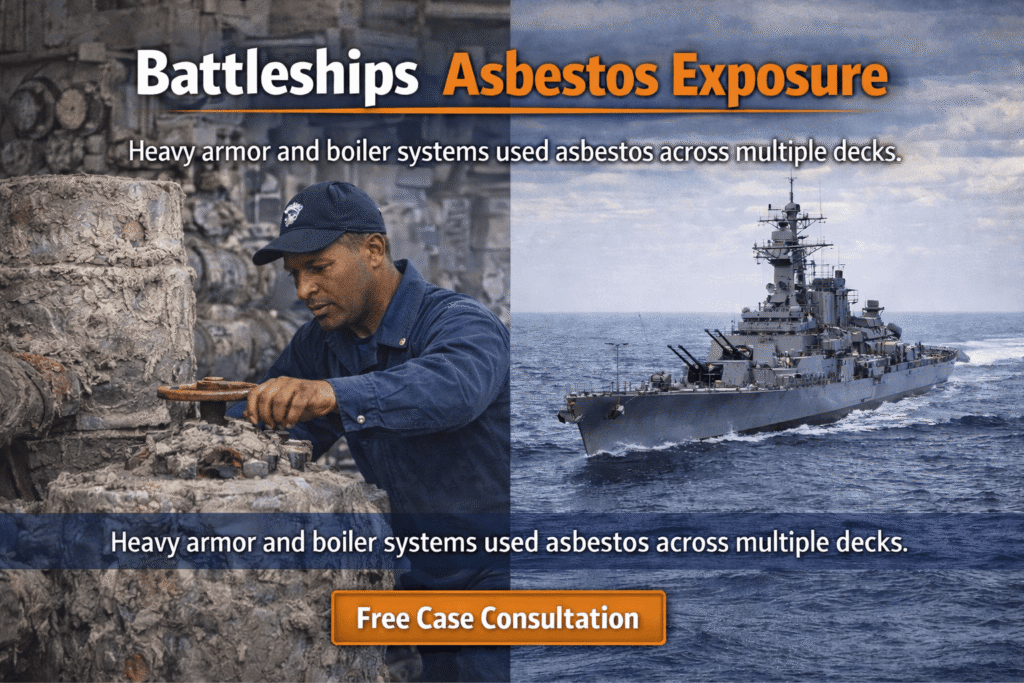
Navy Battleships Asbestos Exposure
Navy veterans who served aboard U.S. battleships may have worked or lived near older insulation, steam piping, boilers, turbines, pumps, valves, electrical systems, ventilation equipment, gaskets, packing, and other shipboard materials historically associated with asbestos use. Exposure circumstances varied by vessel, service period, compartment, rating or officer duties, maintenance work, and whether asbestos-containing materials were damaged or disturbed.
A veteran diagnosed with mesothelioma can begin reconstructing a battleship exposure history by identifying the ship and hull number, dates aboard, department and division, work center, watch stations, living quarters, machinery spaces, equipment maintained, and shipyard or overhaul periods. Personnel files, battleship General Information Books, engineering drawings, specifications, inspection reports, deck logs, photographs, and shipmate statements may help connect service memories with historical records.
Battleship Asbestos Exposure Overview
VA identifies older Navy ships as historical asbestos-exposure settings. Its Veterans Health Library states that asbestos-containing materials were used in engine and boiler rooms and other areas below deck for fire safety and identifies brakes, gaskets, valves, cements, adhesives, floor coverings, and pipe coverings called lagging among historical military asbestos products.
For battleship veterans, the size and complexity of the vessel can make exposure reconstruction especially detailed. Battleships contained propulsion plants, auxiliary machinery, extensive steam and piping systems, electrical networks, ventilation systems, weapons spaces, living quarters, shops, storerooms, and many other compartments. The veteran’s actual movements and duties matter more than the ship type alone.
VA identifies Navy veterans who served on ships whose keels were laid before 1983, shipyard workers during decades of widespread asbestos use, personnel who regularly worked below deck before the early 1990s, and veterans who handled damaged asbestos-containing material among groups with potential historical exposure circumstances.
Those categories do not prove exposure for an individual sailor. A stronger history connects the veteran’s assignment and duties with documented equipment, materials, maintenance events, or overhaul work. The broader Navy ships asbestos exposure and U.S. Navy asbestos exposure sections can help organize that research.
Where Exposure Could Occur
Engineering spaces are an important area to investigate because battleships relied on high-temperature steam and propulsion systems. Boiler rooms, engine rooms, machinery spaces, pump rooms, piping runs, valve stations, and adjacent compartments may have contained heat-resistant insulation, gaskets, packing, and other materials that require vessel-specific research.
Exposure research should not stop at engineering spaces. Piping and ventilation systems extended throughout ships, and maintenance could occur in passageways, living areas, shops, electrical spaces, auxiliary machinery compartments, weapons-support areas, and other locations. Whether asbestos-containing material was present depends on the ship, construction period, specifications, and later repairs.
VA explains that asbestos is most hazardous when asbestos-containing material becomes friable or is damaged or disturbed, allowing fibers to become airborne. For a battleship veteran, the key question is therefore not simply whether asbestos existed somewhere aboard the vessel, but whether the veteran worked with or near material when fibers could have been released.
Record the veteran’s berthing area, work center, watch station, regular passage routes, repair lockers, machinery spaces, shops, and temporary assignments. Include nearby work performed by shipmates, shipyard personnel, or contractors when the veteran remembers dust-producing maintenance.
Veterans can use Navy occupations asbestos exposure to connect ratings and duties to ship spaces and Navy equipment asbestos exposure to organize machinery-specific research.
Battleship Jobs and Duties
A sailor’s rating, division, qualifications, and watch stations can help identify likely exposure circumstances. Engineering personnel may have worked around boilers, turbines, pumps, valves, piping, generators, compressors, and auxiliary machinery. Maintenance personnel could encounter insulation, gaskets, packing, electrical components, flooring, or other materials during repair work.
Exposure was not necessarily limited to the sailor performing the repair. Personnel standing watch, assisting a maintenance team, cleaning a compartment, transporting parts, or working nearby could have been present while older materials were disturbed. Confined below-deck spaces and ventilation conditions can be relevant when reconstructing those events.
For each duty period, record the veteran’s rank or rate, rating, department, division, work center, qualifications, equipment responsibility, maintenance tasks, and frequency of work. A long Navy career may involve very different duties as the veteran advanced or transferred between commands.
Officers may have had different direct-maintenance responsibilities from enlisted personnel, but their exposure history should still be based on actual spaces entered, inspections, casualty response, damage-control duties, shipyard work, and other documented activities rather than rank alone.
Shipmate statements can be useful when they describe the same division, compartment, machinery, maintenance procedure, or overhaul period. Statements are strongest when the witness explains how they know the veteran was present and identifies dates or circumstances that can be corroborated.
Equipment and Materials to Research
VA identifies gaskets, valves, pipe lagging, cements, adhesives, floor coverings, brakes, and other heat- or friction-resistant materials as historical military asbestos products. Battleship research may also involve boilers, turbines, pumps, condensers, generators, motors, compressors, electrical systems, ventilation equipment, and associated insulation or sealing materials.
Do not assume that every component on an older battleship contained asbestos. Product identification should be tied to the vessel, equipment, specification, manufacturer or supplier, and relevant time period. Original equipment and later replacement components may have come from different companies.
National Archives identifies Navy specifications, Bureau of Ships correspondence, engineering drawings, and General Information Books as useful sources for researching ship components. Its asbestos research guidance specifically lists ship engineering drawing material groups such as S39 for insulation and lagging and S48 for piping as potentially relevant, while noting that availability varies.
A useful equipment worksheet records ship, hull number, compartment, machinery type, manufacturer, model, component, suspected material, maintenance task, date range, witnesses, and evidence source. Mark uncertain information as uncertain until it can be verified.
Photographs, technical manuals, nameplates, specifications, overhaul files, purchase records, and manufacturer literature can help identify equipment. None should be treated as proof of a veteran’s personal exposure without a connection to the veteran’s service and work.
Shipyards, Repairs, and Overhauls
Battleships underwent repairs, modernization, inspections, and overhaul work during their service lives. These periods can be important because major work may involve opening machinery, removing insulation, replacing piping, changing electrical or ventilation systems, repairing compartments, and removing or installing equipment.
National Archives recommends beginning Navy asbestos research with a ship’s history because construction, overhaul, and modification dates help researchers determine which Bureau of Ships records may be relevant. For battleships specifically, NARA identifies a Battleship General Information Books series covering 1904–1944 and Battleship Material Inspection Reports and related documentation covering 1940–1978.
Inspection reports can help document the condition of machinery and systems around major conversions, trials, or decommissioning. General Information Books can provide deck-by-deck information about ship arrangements and systems, although the surviving collection is not complete for every vessel.
The Navy shipyards asbestos exposure section can help connect a battleship with a repair facility. When possible, record the yard, arrival and departure dates, availability type, compartments affected, equipment overhauled, contractors present, and whether the veteran remained aboard or participated in ship’s-force work.
Deck logs may help narrow periods of significant work, but National Archives cautions that deck logs do not directly establish asbestos use or presence. Technical, specification, shipyard, and equipment records are needed for that deeper research.
Records for Battleship Exposure Research
Begin with records proving the veteran’s service: DD-214 or separation documents, Official Military Personnel File materials, orders, evaluations or fitness reports, rating or officer designator information, qualifications, training records, and ship assignments.
Next establish the battleship’s history. National Archives recommends identifying construction, overhaul, modification, and disposition periods before searching the Bureau of Ships collections. Hull number is particularly useful because many technical and engineering records are arranged by ship designation.
National Archives identifies Battleship General Information Books in Record Group 19 as a vessel-type-specific research source. General Information Books can describe hull and mechanical systems, propulsion plants, auxiliary machinery, piping, ventilation, heating and air conditioning, power and lighting, communications, weapons-control systems, and other ship arrangements.
Engineering drawings, specifications, Board of Inspection and Survey reports, Bureau of Ships correspondence, photographs, technical manuals, maintenance records, and shipyard files can add detail. The Navy records documentation for asbestos exposure section can help veterans organize these materials.
National Archives states that muster rolls and deck logs provide no direct evidence of asbestos use or presence aboard Navy ships. Muster rolls may help establish assignment, while deck logs may help identify dates of major work. Treat them as supporting timeline records rather than direct product evidence.
Mesothelioma and Health Considerations
VA identifies mesothelioma and lung cancer among serious diseases associated with asbestos exposure. It also explains that health effects can depend on factors including the amount and duration of exposure, smoking, pre-existing lung conditions, and age.
Asbestos-related disease can develop long after military service. Veterans should give health care providers a complete military and civilian occupational history, including battleship service, work spaces, shipyard periods, maintenance tasks, equipment, and later civilian jobs involving possible asbestos exposure.
A veteran diagnosed with mesothelioma should preserve pathology reports, imaging, oncology records, surgical records, treatment summaries, physician notes, and occupational histories. Historical exposure evidence and medical evidence serve different purposes but can be organized together for review.
The Navy medical health asbestos exposure and Navy asbestos exposure health risks resources provide additional health-focused information. Medical diagnosis, screening, and treatment decisions should be made with qualified health care professionals.
Veterans concerned about past military asbestos exposure can discuss their history with a health care provider or VA Environmental Health Coordinator. Do not disturb suspected asbestos-containing material in old ship equipment, artifacts, buildings, or insulation in an attempt to prove exposure.
VA Benefits and Legal Options
VA states that a veteran may be eligible for disability compensation based on asbestos exposure when the veteran has a health condition caused by asbestos and had contact with asbestos during military service. VA decides claims using the evidence in the individual case.
VA identifies medical records stating the health condition, service records listing the veteran’s job or specialty, and a doctor’s statement connecting military asbestos contact to the health condition among evidence required for an asbestos disability claim.
For a battleship veteran, supporting evidence may include ship assignments, ratings or officer duties, qualifications, work spaces, General Information Books, engineering drawings, overhaul records, shipyard records, technical documents, equipment information, photographs, and shipmate statements.
Veterans can review Navy VA benefits for mesothelioma, Navy asbestos legal options, and Navy veterans mesothelioma lawsuit. The documents needed for Navy asbestos claims resource can help organize records.
VA benefits are separate from civil asbestos lawsuits and asbestos bankruptcy trust claims. Civil and trust eligibility depends on additional evidence, applicable law, product or company identification, and filing requirements. Keep copies of prior VA claims, trust submissions, lawsuits, settlements, releases, and exposure statements.
Frequently Asked Questions
Were U.S. Navy battleships built with asbestos-containing materials?
VA confirms historical asbestos use aboard older Navy ships, including in engine and boiler rooms and other below-deck areas. The specific materials aboard a particular battleship should be established through vessel and technical records.
Where could battleship sailors have encountered asbestos?
Potential areas include engineering and machinery spaces, piping systems, maintenance areas, and other compartments where asbestos-containing materials were installed or disturbed. Individual circumstances varied.
Which battleship jobs may warrant closer exposure research?
Engineering, boiler, machinery, pipe, electrical, welding, maintenance, repair, and damage-control duties can warrant review, as can nearby work in confined spaces. Exposure should be documented from actual duties rather than rating alone.
Can battleship General Information Books help document exposure?
They can help identify ship layouts and systems. National Archives maintains a Battleship General Information Books series for 1904–1944, although surviving records are not complete for every vessel.
Can Navy deck logs prove asbestos was aboard a battleship?
No. National Archives states that deck logs provide no direct evidence of asbestos use or presence. They can help narrow dates when major work occurred.
What records should a battleship veteran gather?
Gather personnel and assignment records, ship history, General Information Books when available, engineering drawings, overhaul and shipyard records, technical manuals, photographs, medical records, and credible shipmate statements.
Does serving aboard a battleship prove harmful asbestos exposure?
No. Service aboard an older ship can identify potential exposure circumstances, but individual exposure depends on the materials, condition, disturbance, proximity, duration, and frequency.
Can a battleship veteran with mesothelioma apply for VA disability compensation?
Potentially. VA requires evidence of a health condition caused by asbestos exposure and military asbestos contact, along with supporting medical and service evidence.
What should a battleship veteran diagnosed with mesothelioma do first?
Preserve pathology and treatment records, obtain military personnel records, list ship and hull number, dates aboard, duties and compartments, and identify shipyard periods, maintenance work, equipment, and potential witnesses.
Get Help Reviewing Navy Battleship Asbestos Exposure
A battleship veteran diagnosed with mesothelioma may remember machinery spaces, pipe systems, repair periods, or dusty maintenance without knowing the names of the historical materials involved. Personnel files and battleship-specific technical records can help turn those memories into a more precise exposure history.
Gather pathology and treatment records, DD-214 and personnel files, battleship name and hull number, dates aboard, rating or officer duties, qualifications, work centers, watch stations, General Information Books, engineering drawings, shipyard and overhaul records, maintenance documents, equipment information, photographs, shipmate statements, civilian employment records, VA decisions, trust submissions, lawsuits, settlements, and releases.
Call 800.291.0963 for a no-obligation case evaluation. Talk to a real person 24/7, 365 days a year. You can also submit your case here.
For VA claims, veterans can seek assistance from a VA-accredited representative. For civil or trust claims, ask qualified counsel about product evidence, responsible parties, jurisdiction, filing deadlines, and interactions with prior claims. Mesothelioma Help Center is not a law firm or medical provider and does not determine VA eligibility.
🔗 Confirmed Sources
- U.S. Department of Veterans Affairs — Veterans Asbestos Exposure
- VA Veterans Health Library — Veteran Exposure to Asbestos
- VA WRIISC — Exposure to Asbestos Information Sheet
- National Archives — Researching Asbestos Aboard U.S. Naval Vessels
- National Archives — Logbooks of the U.S. Navy
Disclaimer: General information only—not legal or medical advice. This website is not a law firm. Exposure, VA eligibility, liability and deadlines vary by case and jurisdiction. Do not disturb suspected asbestos. Past results do not guarantee future outcomes.