🛫 Navy Escort Carriers Asbestos Exposure
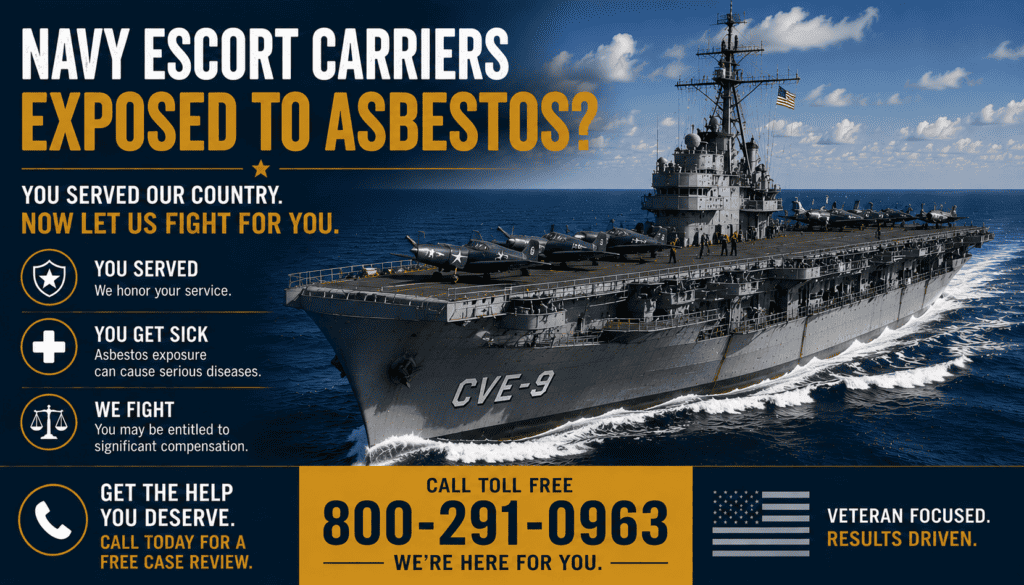
U.S. Navy escort aircraft carriers were smaller carriers developed rapidly during World War II for convoy protection, antisubmarine warfare, aircraft transport, and air support. The Naval History and Heritage Command (NHHC) explains that their designation changed from AVG (Aircraft Escort Vessel) in 1941, to ACV (Auxiliary Aircraft Carrier) in 1942, and finally to CVE (Escort Carrier) in 1943.
Many escort carriers were built from or based on merchant-ship and tanker hulls. They still required propulsion machinery, piping, pumps, valves, electrical equipment, ventilation, and extensive shipboard systems. Historical NAVSEA guidance confirms that past naval shipbuilding programs made extensive use of asbestos materials for installations such as thermal insulation and deck tile and recognizes asbestos in forms including pipe covering and gaskets.
Service aboard a CVE does not by itself prove asbestos exposure. The strongest history connects the specific escort carrier, hull number, service dates, rating, compartment, equipment, maintenance work, material, and repair or overhaul period.
⚓ Escort Carrier History and Classes
NHHC identifies six principal U.S. escort-carrier classes in the CVE series: Long Island, Charger, Bogue, Sangamon, Casablanca, and Commencement Bay. The Casablanca class alone included 50 ships, hull numbers CVE-55 through CVE-104, while the Commencement Bay class was assigned hull numbers CVE-105 through CVE-123.
Escort carriers were often called “baby flattops” or “jeep carriers.” NHHC explains that they were generally smaller, slower, less heavily armed, and less protected than fleet carriers, but they could be built quickly and were well suited to convoy escort and antisubmarine operations. In the Pacific, CVEs also provided close air support for amphibious landings.
Construction histories varied. Long Island (CVE-1), for example, began as the Maritime Commission vessel Mormacmail. Sangamon-class ships were converted from oilers, while many other escort carriers were built on merchant-type hulls.
That variety makes ship-specific research important. The machinery arrangement, conversion history, shipyard, equipment, and materials could differ among classes and individual vessels.
See Navy Ships Asbestos Exposure and U.S. Navy Ships Asbestos Exposure Articles.
⚙️ Machinery Spaces and Propulsion Systems
Even though escort carriers were smaller than fleet carriers, they required complete propulsion and auxiliary systems. Machinery spaces could contain engines or turbines, boilers on steam-powered designs, pumps, valves, generators, heat exchangers, compressors, piping, and ventilation equipment.
High-temperature machinery and steam systems are important in asbestos research because Navy records document historical use of asbestos thermal insulation, pipe covering, gaskets, and packing.
Potential exposure could occur when insulation was damaged or removed to reach equipment, when pumps or valves were opened, when old gaskets were scraped from flanges, or when packing was removed from valves and rotating equipment.
The exact propulsion plant must be researched by class and vessel. A converted oiler, converted merchant hull, and purpose-built Casablanca-class carrier should not be assumed to have identical equipment or asbestos materials.
See Navy Ship Engine Rooms Asbestos Exposure, Navy Boiler Equipment Asbestos Exposure, Navy Pump Equipment Asbestos Exposure, and Navy Valve Equipment Asbestos Exposure.
🔩 Insulation, Piping, Gaskets, and Packing
NAVSEA’s historical records provide primary-source evidence that asbestos-containing materials were used in naval shipbuilding and maintenance. Its asbestos archive includes records for asbestos-fiber thermal insulation, metallic-asbestos spiral-wound gaskets, high-pressure asbestos packing, and compressed asbestos gasket materials.
Materials that may warrant investigation aboard an escort carrier include:
- Thermal insulation around hot machinery and piping.
- Pipe covering or lagging on steam and other heated systems.
- Flange and equipment gaskets.
- Valve, pump, and other mechanical packing.
- Historical deck tile or deck-covering materials.
- Other heat- or fire-resistant materials identified in Navy specifications.
Exposure potential depends heavily on material condition and work activity. Intact material presents a different circumstance from insulation that was cut or stripped, gaskets that were scraped, packing that was pulled, or deck material that was removed during repair.
Not every gasket, insulation product, packing material, or deck product contained asbestos. Technical manuals, specifications, Qualified Products Lists, shipyard files, manufacturer documents, and asbestos surveys can help identify the actual material.
See Asbestos Pipe & Steam Insulation on Ships and Bases and Navy Equipment Asbestos Exposure.
✈️ Aviation and Other Shipboard Spaces
Escort carriers combined ordinary ship systems with aviation operations. Flight decks, hangar or aircraft-handling areas, aviation support spaces, workshops, fuel systems, electrical systems, ventilation, living spaces, and machinery compartments all supported carrier operations.
The aviation mission does not mean every aviation-related component contained asbestos. Research should focus on documented materials and specific maintenance tasks.
Potential exposure could also be indirect. A sailor assigned outside the engineering department might work near a repair team removing insulation, replacing piping components, performing electrical work, or renovating shipboard spaces. Whether this created meaningful exposure depends on the material, disturbance, distance, ventilation, frequency, and duration.
Escort carriers were designed for demanding wartime operations. NHHC records show CVEs supporting convoys, hunting submarines, transporting aircraft, and supporting amphibious assaults. Operational tempo could require maintenance and casualty repairs while vessels remained in service.
For electrical-system research, see Navy Electrical Equipment Asbestos Exposure.
👷 Escort Carrier Occupations at Potential Risk
Rating and actual duty assignment help identify which shipboard systems a veteran likely operated or repaired. Engineering and maintenance personnel deserve particular attention when researching legacy asbestos materials.
- Navy Machinist’s Mates Asbestos Exposure — propulsion machinery, pumps, valves, and engineering spaces.
- Navy Boiler Technicians Asbestos Exposure — boilers, steam systems, insulation, gaskets, and valves on applicable vessels.
- Navy Electricians Asbestos Exposure — generators, motors, switchboards, wiring systems, and machinery spaces.
- Navy Pipefitters Asbestos Exposure — piping, lagging, flanges, gaskets, valves, and packing.
- Navy Welders Asbestos Exposure — structural and piping repairs near legacy materials.
- Navy Hull Maintenance Technicians Asbestos Exposure — piping, valves, insulation, lagging, and structural work.
- Navy Damage Controlmen Asbestos Exposure — firefighting, emergency repair, damaged insulation, and piping work.
Job title alone is not exposure proof. The veteran’s actual work, ship, equipment, compartment, maintenance period, and material evidence should be documented.
🏗️ Repair, Conversion, and Overhaul Exposure
Escort-carrier construction history makes repair and conversion records especially useful. Some early CVEs began as merchant vessels or oilers and were converted for aviation use. Others were purpose-built rapidly during wartime.
Potentially relevant work could include:
- Propulsion machinery overhaul.
- Boiler or steam-system repair where applicable.
- Piping replacement and insulation removal.
- Pump and valve rebuilding.
- Gasket and packing replacement.
- Electrical modernization.
- Ventilation-system repair.
- Deck or compartment renovation.
- Conversion-related removal and installation of equipment.
- Shipyard repair after combat or operational damage.
NAVSEA guidance confirms that historical naval shipbuilding extensively used asbestos materials and that asbestos can occur in pipe covering, gaskets, thermal insulation, and deck tile. That supports targeted research into repair records, but it does not establish exposure from every overhaul event.
See Navy Shipyards Asbestos Exposure and Requesting Shipyard & Base Work Records.
📂 Records for Escort Carrier Exposure
The National Archives recommends combining personnel and ship records with material-specific documentation. Muster rolls can help establish that a sailor was formally attached to a vessel, while deck logs can help identify significant repair or work periods.
NARA specifically cautions that muster rolls and deck logs do not directly prove that asbestos was present in a ship or component. Their value is establishing assignment and chronology so researchers can pursue more detailed Bureau of Ships, shipyard, technical, and manufacturer records.
Useful evidence can include:
- DD-214s, personnel files, rating history, and qualifications.
- Muster rolls and ship assignment records.
- Deck logs identifying significant repair periods.
- Official ship histories and class information.
- Bureau of Ships correspondence and technical manuals.
- NAVSEA specifications and Qualified Products Lists.
- Shipyard conversion, overhaul, and repair records.
- Equipment manuals and manufacturer documents.
- Asbestos surveys or abatement records when available.
- Statements from shipmates and repair personnel.
- Medical records documenting diagnosis and treatment.
Use the Navy Ship Exposure Evidence Guide, Navy Records & Documentation for Asbestos Exposure, and How to Obtain Navy Bureau of Ships Technical Manuals.
⚖️ Health Risks and Legal Options
Asbestos-related diseases can develop many years after exposure. Conditions associated with asbestos include mesothelioma, lung cancer, asbestosis, and pleural abnormalities. Symptoms alone cannot determine whether a disease is asbestos-related, so veterans should discuss their full military and civilian exposure histories with qualified health care providers.
Navy veterans diagnosed with an asbestos-related disease may investigate VA disability benefits. Depending on the exposure evidence and responsible companies, civil lawsuits or asbestos trust fund claims may also be available.
VA asbestos claims generally require medical evidence of the condition, service records showing the veteran’s job or specialty, and medical evidence connecting the condition to military asbestos exposure.
See Navy Asbestos Exposure Health Risks, Navy Ship Mesothelioma & Lung Cancer Lawsuits, Navy Ship Mesothelioma Lawsuit, Navy Ship Asbestos Trust Fund Claims, Navy VA Benefits for Mesothelioma, and Navy Asbestos Legal Options.
No escort-carrier assignment, asbestos record, diagnosis, or exposure history guarantees VA benefits or compensation.
❓ Navy Escort Carrier Asbestos FAQ
What was a Navy escort carrier?
Escort carriers were smaller aircraft carriers used for convoy escort, antisubmarine warfare, aircraft transport, and air support. Their final World War II-era designation was CVE.
Which Navy escort-carrier classes existed?
NHHC lists the Long Island, Charger, Bogue, Sangamon, Casablanca, and Commencement Bay classes in the U.S. CVE series.
Were some escort carriers converted merchant ships or oilers?
Yes. NHHC documents merchant-hull and oiler conversions among early escort carriers, while later classes included purpose-built CVEs.
Could escort carrier machinery spaces contain asbestos materials?
Potentially. NAVSEA documents extensive historical asbestos use in naval shipbuilding, including thermal insulation, pipe covering, gaskets, packing, and deck tile. Vessel-specific evidence is still required.
Does service aboard a CVE prove asbestos exposure?
No. Exposure should be tied to the particular vessel, service period, rating, work area, equipment, material, and circumstances in which material was disturbed.
Can deck logs prove asbestos exposure?
No. NARA states that deck logs do not directly prove asbestos presence. They can identify significant work periods that guide more detailed research.
What records can help identify asbestos-containing materials?
NAVSEA specifications, Qualified Products Lists, Bureau of Ships files, technical manuals, shipyard records, equipment records, asbestos surveys, and manufacturer documents may help.
What should an escort carrier veteran document first?
Start with the carrier name and CVE hull number, dates aboard, rating, compartments, machinery and aviation work areas, repair periods, shipyards, suspected materials, witnesses, and medical records.
🛫 Get Help Reviewing Navy Escort Carrier Asbestos Exposure
If you or a family member served aboard a U.S. Navy escort carrier and has been diagnosed with mesothelioma, asbestos-related lung cancer, asbestosis, or another potentially asbestos-related disease, reconstruct the service history carefully. Carrier name, CVE hull number, service dates, rating, machinery spaces, piping, pumps, valves, insulation, aviation-support areas, overhaul periods, shipyards, technical records, and witnesses can help clarify potential exposure.
Call 800.291.0963 to discuss the Navy escort-carrier service and asbestos exposure history. Live chat is available 24/7, 365 days a year. You can also Submit Your Case. No exposure determination, diagnosis, VA benefit, settlement, trust payment, or legal outcome is guaranteed.
⚕️ Legal & Medical Information Disclaimer
This page provides general educational information and is not legal or medical advice. Historical ship records do not by themselves establish asbestos exposure, diagnosis, causation, VA eligibility, liability, or entitlement to compensation. Consult qualified health care professionals about medical concerns and a licensed attorney or accredited veterans representative about legal or benefits questions.