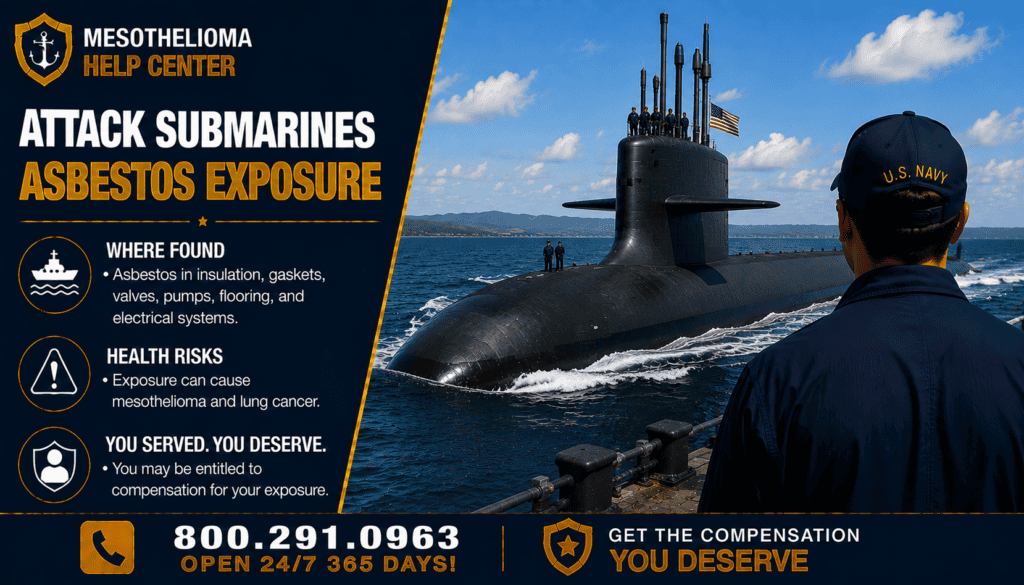
Attack Submarines Asbestos Exposure
Attack submarines, designated SSN, varied by class, commissioning date, and modernization history. Some historical naval materials contained asbestos, but each boat requires a hull-specific timeline. These distinctions matter when repairs changed materials aboard that vessel.
This guide connects attack-submarine machinery and repair spaces with watch duties and completed jobs, helping veterans distinguish potential exposure events from general submarine service. The individual record should determine which questions still need answers.
SSN hull and period
SSN identifies an attack submarine, but class and hull number determine which plans and maintenance files are relevant. Avoid projecting evidence from a different SSN or service decade onto this boat. Identify commissioning, tour, and major refit dates.
A dated work card can narrow a question, yet it may omit who performed the job and which prior material was removed. A drawing can identify intended equipment but may predate a conversion. Each source should be used for the fact it actually supports. Keep page, revision, and archival citation with the relevant statement.
Begin by recording exactly how a record was found. A search result, catalog description, technical drawing, and completed maintenance order have different evidentiary weight. If the source refers to another submarine, label it comparative. A vessel-wide statement should not conceal uncertainty about the compartment, product, or year relevant to one sailor. Keeping those limits in view makes later questions more precise.
For related vessel research, see Navy Submarine Personnel With Asbestos Exposure. Use that topic as context for the named vessel; an article about another work process does not by itself establish the veteran’s individual history.
Start with Navy Ships Asbestos Exposure for the broader vessel record. Navy Submarines provides further research context.
Machinery and crew duties
Machinists, engineering personnel, electricians, and other sailors performed different work aboard attack submarines. A person’s rating guides where to search, but dated work orders and witness accounts better establish a specific repair or nearby duty.
Compare installation and service dates before stating that a sailor encountered a product. If the repair happened after transfer, it does not establish that sailor’s contact. If the product was removed before boarding, later crew members require a separate material history. Mark uncertainty explicitly instead of filling gaps with assumptions.
Write down the ordinary duties and any unusual assignments, including who authorized the job and where it happened. Distinguish a routine equipment watch from opening a component or assisting someone removing a covering. Personnel files can identify a command and rating, while a maintenance log and coworker account may be needed to reconstruct a particular shift. Avoid inferring daily work from the rating alone.
For related vessel research, see How Exposure Occurred During Navy Service On Submarines. Use that topic as context for the named vessel; an article about another work process does not by itself establish the veteran’s individual history.
Historical component materials
Older insulation and some gasket or packing materials in naval systems could contain asbestos. Not every heat-resistant component did. Verify specification, version, procurement, installation, and removal rather than relying on a generic SSN product list.
A manufacturer named on machinery cannot automatically be assigned to expendable parts fitted in later years. Replacement seals and insulation may come from independent suppliers. Preserve part numbers, bills, procurement orders, and any completed work description; broad product categories alone cannot establish the responsible business.
When a technical publication mentions an asbestos-containing material, check its issue date, applicability, and part revision. Approved material does not necessarily equal purchased material; purchased material does not necessarily equal installation. Replacement stock may have changed during the boat’s life. Keep each step in a separate evidence column and identify the old item independently from the replacement listed in a repair record.
For related vessel research, see Nuclear Submarines Asbestos Exposure. Use that topic as context for the named vessel; an article about another work process does not by itself establish the veteran’s individual history.
Repair spaces and nearby tasks
Locate a particular valve, pump, piping run, or compartment. A witness may recall activity but not a supplier. Link personal position to an actual work event, noting restricted access or dates when the sailor was deployed elsewhere.
Firsthand accounts are valuable for identifying a compartment, duty, coworker, and sequence of events. Memories decades later may not identify fiber composition or product supplier. Pair recollections with dated drawings, technical manuals, and maintenance documents and record disagreements rather than silently resolving them.
A useful location description names the compartment and the component rather than only the boat. Where possible, include a deck plan reference, work-order number, date, and the sailor’s location during the job. An equipment diagram may explain a system but say little about actual worker proximity. Note doors, access restrictions, and whether another crew performed the work out of the sailor’s view.
For related vessel research, see Navy Submarine Personnel With Asbestos Exposure. Use that topic as context for the named vessel; an article about another work process does not by itself establish the veteran’s individual history.
Availability and refit records
An availability or overhaul can include many proposed tasks and subcontractors. Seek completed jobs and follow-up surveys, then compare the work dates with orders and watch rosters. Materials could differ before and after modernization.
Shipyard schedules describe planned work; signed completion records can reveal what actually changed. An after-the-fact inspection establishes conditions on its inspection date. A later record should not be projected backward without accounting for intervening repairs, replacements, or removals.
The chronology should include original installation, intermediate repairs, conversion or overhaul, and subsequent surveys. Some documents are plans, while others certify completed work. A survey after a refit cannot be projected back to a prior patrol without checking what changed. It is reasonable to leave the pre-repair condition unknown when the removed material was never identified. Mark the point where evidence becomes indirect.
For related vessel research, see How Exposure Occurred During Navy Service On Submarines. Use that topic as context for the named vessel; an article about another work process does not by itself establish the veteran’s individual history.
Navy Shipyards Asbestos Exposure explains why a yard interval should be linked to an actual work package, not assumed from the vessel’s general maintenance history.
Health and claim questions
Clinical evaluation, VA benefits, bankruptcy trust claims, and lawsuits answer different questions. A health concern deserves medical advice; filing law and liability require individual professional assessment. Do not assume one service period meets every standard.
Health evaluation belongs with a licensed clinician. Legal options depend on medical proof, evidence of contact, the parties involved, and applicable law. VA benefits have separate eligibility requirements. An online inquiry is a request for contact, not a claim filing or a finding of entitlement.
Provide the clinician with a complete work history rather than relying on a website list of illnesses. A medical record answers different questions from a supply record. If legal deadlines may apply, get case-specific advice promptly while preserving pathology and treatment records. A named disease and service on a submarine do not, without other evidence, establish that a particular product or company caused the disease.
See Navy VA Benefits For Mesothelioma for a separate overview of benefits. Medical care and benefits questions should be addressed with qualified professionals using the person’s own records.
Compile an SSN timeline
Prepare a dated SSN timeline with hull number, class, service tour, watch station, component, work event, parts evidence, and medical records. Note gaps and other military or civilian exposures without guessing away competing possibilities.
A careful source ledger can list hull number, document title, creator, revision, covered dates, and what it proves. Requests to archives are more targeted when they include a system or compartment and a narrow date range. Keep unanswered questions visible for further investigation.
Save copies with legible titles and dates, and keep originals when possible. For each asserted link, ask whether the document actually names the hull, product, job, and person. If it names only one or two, identify what further source could resolve the gap. A transparent file can support an informed professional assessment even when a supplier or exact work location remains uncertain.
Consult Navy Records Documentation For Asbestos Exposure and Documents Needed For Navy Asbestos Claims when gathering records. No single source typically documents material composition, completed work, and personal presence.
| Question | Potential source | What remains to verify |
|---|---|---|
| Which vessel and dates? | Personnel file and orders | Actual duty spaces |
| Which material? | Specification and supply file | Hull-specific installation |
| Which event? | Completed work card | Who was present |
| Which health concern? | Clinical and pathology records | Professional evaluation |
Frequently Asked Questions
Does SSN designation prove product content?
No. Verify the named hull.
Can another boat’s record establish installation?
No. It is comparative only.
Why keep watch records?
They help locate duties during repairs.
Can an archive plan establish personal contact?
No. Match material and completed work to the sailor’s actual duties.
Should a person handle old material to identify it?
No. Do not disturb suspected asbestos; rely on records and qualified assessment.
Summary and Next Steps
Identify the named vessel, service dates, component, material, completed work, and the sailor’s actual role. Preserve medical records and mark any gap in the chain. For claim-related questions review Navy Asbestos Legal Options and seek qualified, timely advice.
Ask About a Navy Vessel Service History
For questions about documenting Navy vessel service and potential claim options, call 800.291.0963 or submit your case information. An inquiry does not establish exposure or file a legal claim.
Confirmed Sources
- National Archives: Researching Asbestos aboard U.S. Naval Vessels — guide to vessel-specific archival research.
- NAVSEA: Asbestos Reading Room — Navy technical and historical materials.
- Department of Veterans Affairs: Veterans Asbestos Exposure — VA eligibility and evidence information.
- Naval History and Heritage Command: Ship Abbreviations — vessel designation background.
These general sources guide research; they do not independently prove that a specific product was installed on a named submarine or encountered by one person.
Disclaimer: General information only—not legal or medical advice. This website is not a law firm. Exposure, VA eligibility, liability and deadlines vary by case and jurisdiction. Do not disturb suspected asbestos. Past results do not guarantee future outcomes.