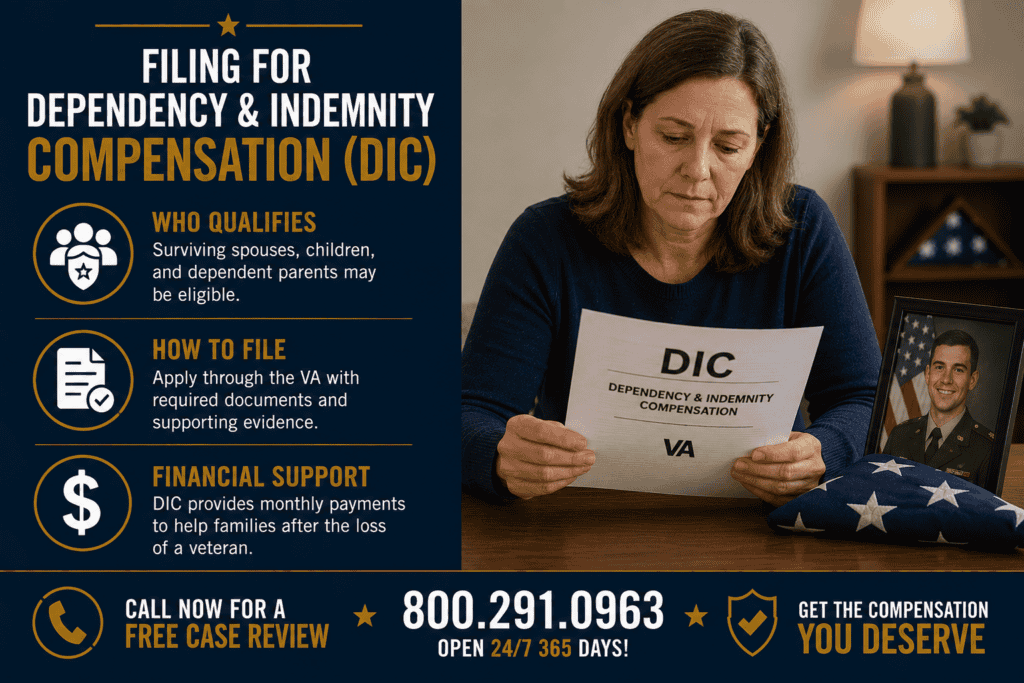
Filing for Dependency and Indemnity Compensation (DIC)
Filing for Dependency and Indemnity Compensation (DIC) may provide eligible surviving spouses, children, or parents with a tax-free VA monetary benefit after a qualifying service member or Veteran dies. For families affected by mesothelioma or another asbestos-related disease, eligibility can depend on survivor requirements and evidence showing that the Veteran’s death was connected to military service or that another qualifying DIC basis applies.
A survivor’s DIC claim can require the Veteran’s service records, death certificate and cause of death, relevant medical evidence, relationship documents, and—when service connection for the fatal disease was not already established—evidence connecting the disease or event that caused or contributed to death with military service. VA uses different application forms depending on whether the claimant is a surviving spouse, child, or parent and whether the death occurred in service.
Filing for Dependency and Indemnity Compensation (DIC)
VA Dependency and Indemnity Compensation, commonly called DIC, is a tax-free monetary benefit that may be available to eligible survivors of a service member who died in the line of duty or a Veteran whose death resulted from a service-related injury or illness. Certain survivors may also qualify when a Veteran died from a non-service-connected cause but had been entitled to VA compensation for a totally disabling service-connected disability for a qualifying period.
For families affected by mesothelioma or another asbestos-related disease, a DIC claim can require evidence about the Veteran’s service, cause of death, and the relationship between the fatal condition and military service. This page is part of the Veterans Asbestos Legal Options hub and should be read separately from a Veteran’s own VA Benefits & Claims for Veterans With Mesothelioma.
Who May Qualify for VA DIC?
VA provides DIC eligibility rules for surviving spouses, dependent children, and qualifying parents. The requirements differ by survivor category. For surviving spouses, VA considers factors including the marriage, cohabitation or qualifying separation, and remarriage rules. Eligible children generally must be unmarried and meet VA’s age or school-attendance requirements. Parent DIC has separate relationship and income requirements.
The underlying death-related requirement can also vary. DIC may be based on a service-connected cause of death, death while serving under qualifying circumstances, or certain cases in which a Veteran had a totally disabling service-connected disability for a specified period before death.
Evidence for an Asbestos-Related DIC Claim
VA’s DIC evidence guidance says relevant documents can include the Veteran’s DD214 or other separation documents, death certificate showing the cause of death, service treatment or personnel records when applicable, and relevant private medical records. When the disease causing death had not already been service connected, evidence may need to establish an in-service disease, injury, or event and a relationship between that service event and the disability that caused or contributed to death.
For an asbestos-related death, the service portion of that evidence may require reconstructing military exposure. The Military Records & Documentation for Asbestos Exposure hub, How to Request Complete Service Records, and Veterans Help With Identifying Asbestos Exposure can help families organize the Veteran’s occupation, duty stations, units, ships, equipment, products, and work history.
How to File a DIC Claim
A surviving spouse or child of a Veteran generally uses VA Form 21P-534EZ, Application for DIC, Survivors Pension, and/or Accrued Benefits. VA lists the current revision date as August 2025 and provides an online application as an alternative to the paper form.
A surviving parent uses VA Form 21P-535. For an in-service death, a surviving spouse or child generally uses VA Form 21P-534a with help from a military casualty assistance officer. VA also permits survivors to seek help from an accredited Veterans Service Organization representative, claims agent, or attorney.
Filing Date and Intent to File
Filing dates can affect when benefits begin. Survivors who are still gathering information may use VA Form 21-0966, Intent to File a Claim for Compensation and/or Pension, or Survivors Pension and/or DIC. VA states that submitting an intent to file can secure the earliest possible effective date for retroactive payments for which the claimant may qualify.
Families should confirm current VA effective-date rules for their particular circumstances rather than assuming that every DIC award begins on the same date. Keep proof of submission and copies of the claim, evidence, and correspondence.
When the Veteran Had a Pending VA Claim
DIC, accrued benefits, and substitution are related survivor issues but are not identical. If a Veteran dies while a VA claim or appeal is pending, an eligible survivor may need to consider whether substitution or accrued benefits apply in addition to a DIC claim.
See What Happens if a Veteran Dies Before Claim Approval? for the separate pending-claim issue. Families should identify what claim or appeal was pending, its status at the time of death, and what evidence had already been submitted.
Getting Help With a DIC Claim
VA allows survivors to work with accredited representatives, claims agents, and attorneys. Families comparing assistance can review VA-Accredited Attorneys vs. Non-Accredited Lawyers and verify a representative’s current accreditation directly with VA.
When the DIC theory depends on asbestos exposure, organize the exposure evidence separately from the survivor-eligibility documents and medical cause-of-death evidence. The VA Mesothelioma Claim Documents guide can provide a useful framework for organizing military and medical records even though a survivor’s DIC claim has its own requirements.
Frequently Asked Questions
What is VA Dependency and Indemnity Compensation?
DIC is a tax-free VA monetary benefit that may be available to qualifying survivors when VA’s eligibility requirements are met.
What form does a surviving spouse or child of a Veteran use?
VA directs surviving spouses and children of Veterans to VA Form 21P-534EZ, Application for DIC, Survivors Pension, and/or Accrued Benefits.
What form does a surviving parent use?
VA Form 21P-535 is the Application for Dependency and Indemnity Compensation by Parent(s).
Does the Veteran need to have filed an asbestos claim before death?
Not necessarily. VA’s 21P-534EZ evidence notice addresses DIC claims based on disabilities VA had not previously determined were service connected or for which the Veteran had not filed a claim during life. Those claims require evidence supporting the service event or disease, the cause of death, and the relationship between them.
Can a survivor use an intent to file for DIC?
Yes. VA Form 21-0966 covers Survivors Pension and DIC claims and can be used while supporting information is being gathered.
Where can families research military asbestos exposure?
Use the Military Records & Documentation hub and Articles for Military Veterans to organize service and exposure research.
Confirmed Sources
Review the DIC Claim Before Filing
Before filing, confirm the survivor’s relationship and eligibility evidence, the Veteran’s service records, death certificate and cause of death, relevant medical records, any evidence connecting the fatal disease to military service, and any records concerning a pending VA claim. For broader survivor and asbestos-related options, return to the Veterans Asbestos Legal Options hub.
Call 800.291.0963 for a no-obligation case evaluation and to speak with a real person 24/7, 365 days a year. Mesothelioma Help Center is not a law firm or medical provider and does not determine VA eligibility.
Disclaimer: General information only—not legal or medical advice. This website is not a law firm. Exposure, VA eligibility, liability and deadlines vary by case and jurisdiction. Do not disturb suspected asbestos. Past results do not guarantee future outcomes.