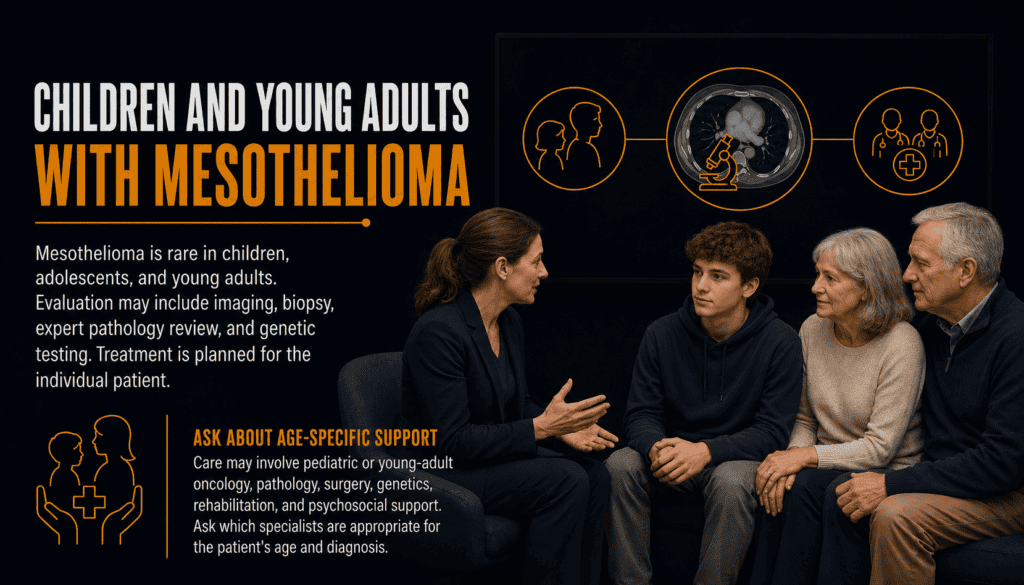
Children and Young Adults With Mesothelioma
Understanding an uncommon diagnosis, careful testing, age-appropriate treatment planning, and support for patients and families.
Mesothelioma is uncommon overall and is especially unusual in children and young adults. A possible diagnosis at a young age deserves careful review because several other conditions can resemble mesothelioma on scans or under a microscope. Families need a clear explanation of what has been confirmed, which questions remain open, and who is coordinating care. This guide addresses young patients without assuming that every case has the same cause, treatment, or outlook.
Medical safety: A child or young adult with severe trouble breathing, fainting, sudden chest pain, or rapidly worsening symptoms needs prompt emergency assessment. This page is not a way to diagnose cancer from symptoms.
Mesothelioma in Children and Young Adults
Most mesothelioma information describes adults with exposure histories extending over decades. Those assumptions do not automatically fit a young patient. The word mesothelioma refers to a tumor involving mesothelial tissue, but the exact diagnosis, cell appearance, anatomic site, and whether a tumor is malignant all matter. An experienced multidisciplinary team can help distinguish malignant mesothelioma from other mesothelial lesions and from cancers that spread to a body cavity.
| Question | Why it matters |
|---|---|
| Has malignancy been confirmed? | A suspicious scan or preliminary report is not the same as a final tissue diagnosis. |
| Which body site is involved? | Pleura, peritoneum, and other sites require different assessments. |
| Has specialist pathology reviewed it? | Uncommon tumors may benefit from additional expert review. |
| What does the patient want to know? | Explanations should reflect age, maturity, and personal preferences. |
Start with the mesothelioma diagnosis overview and ask clinicians to explain their level of certainty in plain language. Young age alone does not establish a particular tumor subtype or cause.
Symptoms and When to Seek Care
Symptoms vary by the affected area and can occur with many noncancerous illnesses. Persistent symptoms deserve assessment, but none of the symptoms below is specific enough to diagnose mesothelioma.
| Possible symptom | What a clinician may investigate |
|---|---|
| Persistent chest discomfort or shortness of breath | Lung, pleural, cardiac, infectious, and other causes. |
| Unexplained abdominal enlargement or pain | Fluid, digestive conditions, inflammatory disorders, and masses. |
| Unexplained fatigue or weight change | Nutrition, anemia, infection, endocrine issues, and other causes. |
| Persistent cough | Respiratory infection, asthma, pleural disease, and other causes. |
Call the treating team about new or progressive symptoms, fever during cancer treatment, inability to drink, or significant pain. Sudden severe breathing difficulty, collapse, or severe chest pain warrants emergency care. A symptom diary can record onset, severity, activity limitations, medications, and what improves or worsens symptoms without interpreting them as proof of cancer.
How Diagnosis Is Confirmed
Diagnosis typically combines a medical history, examination, imaging, and pathology. Imaging can show an abnormality and guide where to sample tissue, but a scan alone cannot reliably determine the tumor type. The pathologist examines appropriate tissue and may use a panel of immunohistochemical markers and other studies to distinguish mesothelioma from look-alike diseases. Test selection depends on the site and clinical situation.
| Step | Purpose | Important limitation |
|---|---|---|
| Clinical evaluation | Review symptoms and examination. | Symptoms overlap with many conditions. |
| Imaging | Locate abnormalities and plan sampling. | Cannot independently confirm mesothelioma. |
| Biopsy | Obtain tissue for diagnosis. | Sample quality and location affect interpretation. |
| Pathology review | Assess morphology and relevant markers. | Some cases remain difficult and need expert consultation. |
| Additional testing | Resolve selected diagnostic questions. | No single biomarker replaces the complete clinical picture. |
Ask for a copy of the final pathology report and whether an experienced mesothelioma pathologist should review slides or blocks. See biopsy information, imaging tests, and second opinions. If a report uses terms such as “suspicious,” “atypical,” or “cannot exclude,” ask what additional evidence is needed before treatment decisions are made.
Types, Location, and Staging
Mesothelioma may arise in the pleura surrounding the lungs or the peritoneum lining the abdomen; rarer locations also exist. Histologic classification and the distinction between malignant and nonmalignant mesothelial conditions require specialist interpretation. Do not assume that a diagnosis involving the abdomen follows the same staging system used for pleural mesothelioma.
| Finding | Question to ask |
|---|---|
| Pleural involvement | Which imaging and staging approach is appropriate for this confirmed tumor? |
| Peritoneal involvement | How will disease extent and surgical options be assessed? |
| Histologic subtype | Has the subtype been confirmed by an experienced pathologist? |
| Uncertain classification | Would additional tissue or an outside pathology review change the plan? |
The mesothelioma stages overview explains general concepts, but a young patient’s actual stage and prognosis must be discussed with the treating specialists. Adult survival statistics may not reliably represent children or young adults, especially when the diagnosis and treatments differ.
Asbestos Exposure and Other Risk Questions
Asbestos is an established cause of mesothelioma, but a young person’s diagnosis should not be treated as proof of a particular exposure. The usual long latency described in adult occupational cases makes careful history-taking especially important in younger patients. Clinicians may ask about household contacts who worked with asbestos, older buildings, environmental exposures, prior radiation treatment, and family cancer history. A history may remain uncertain even after careful review.
| History area | How to document it |
|---|---|
| Home and family | List relevant jobs or known exposures without guessing that exposure occurred. |
| School or buildings | Record only known events, locations, and dates; do not infer asbestos from building age alone. |
| Past medical care | Provide radiation and other treatment records if relevant. |
| Family history | Note relatives and diagnoses accurately; do not assume an inherited mutation. |
Some families may be referred for genetics assessment when personal or family history raises concern for an inherited cancer predisposition, including conditions involving BAP1. This does not mean that every young patient has an inherited mutation or that a tumor finding is automatically hereditary. A genetics professional can explain whether testing is appropriate, possible results, privacy issues, and implications for relatives. Read about genetic testing and biomarkers.
Treatment and Fertility Considerations
Treatment planning depends on the confirmed tumor, location, extent, symptoms, overall health, and the patient’s goals. Because pediatric cases are rare, clinicians may seek input from both a pediatric or adolescent-and-young-adult oncology team and clinicians experienced with mesothelioma. Surgery, systemic therapy, radiation, symptom-focused procedures, and clinical trials may be discussed in selected situations; not every option is appropriate for every patient.
| Discussion | Practical question |
|---|---|
| Specialist team | Who has experience with this specific tumor and the patient’s age group? |
| Surgery | What is the goal, expected recovery, and effect on daily life? |
| Drug treatment | What evidence applies to this diagnosis and age, and what monitoring is required? |
| Radiation | What are potential short- and long-term effects for a growing or young body? |
| Clinical trials | What are the eligibility requirements and alternatives? |
| Supportive care | How will pain, breathlessness, nausea, and nutrition be managed? |
Before treatment that could affect fertility, ask whether referral to a fertility-preservation specialist is appropriate and whether consultation can occur without an unsafe delay. Discuss reproductive health in an age-appropriate and confidential manner. Treatment effects on growth, organs, learning, and later health should be reviewed when relevant; the actual risks depend on the therapy. Explore the treatment overview and request a written plan explaining intended benefits, uncertainty, and follow-up.
Family, School, and Emotional Support
A diagnosis can disrupt schooling, friendships, independence, work, and family routines. Children and young adults differ in how much detail they want and how they participate in decisions. Offer clear, truthful explanations in manageable pieces, invite questions, and revisit conversations as the situation changes. Avoid promising a particular outcome or insisting that the patient stay positive.
| Need | Possible support |
|---|---|
| School or college | Coordinate accommodations, attendance flexibility, and a trusted school contact. |
| Emotional well-being | Ask for pediatric or young-adult counseling and peer support if wanted. |
| Practical needs | Request social-work help with transportation, lodging, and financial resources. |
| Family communication | Agree on what may be shared with relatives and friends. |
| Independence and privacy | Include the young person in decisions and explain consent and confidentiality rules. |
Parents and caregivers may need support of their own. Siblings can benefit from age-appropriate information and reassurance that their questions matter. See helping children understand a parent’s diagnosis for communication principles and talking to family about a diagnosis for planning conversations. These resources address related family situations, not a substitute for advice tailored to a child who is the patient.
Questions and Practical Next Steps
Ask one team member to coordinate referrals and identify the best contact for urgent symptoms. Keep a record of questions and decisions, but do not delay care while gathering a perfect file. A second opinion can help clarify uncommon pathology or compare treatment plans, particularly before a major procedure when timing permits.
| At the next appointment | Question |
|---|---|
| Diagnosis | What exact diagnosis is confirmed, and what evidence supports it? |
| Expert review | Has a specialist pathologist reviewed the tissue? |
| Extent | What is known about disease location and spread? |
| Options | Which treatments are established for this situation, and which are investigational? |
| Age-specific effects | What fertility, growth, school, or long-term risks should we discuss? |
| Coordination | Who will arrange referrals, symptom care, and follow-up? |
Bring the final pathology report, imaging reports and images if requested, treatment history, medication list, and family history. Our medical-records checklist can help. Ask about supportive care early, even while pursuing cancer-directed treatment. For ongoing practical and emotional needs, consult mesothelioma support resources.
Frequently Asked Questions
Can a child develop mesothelioma?
Yes, but it is very uncommon. A suspected diagnosis should be confirmed carefully by specialists familiar with rare tumors.
Does mesothelioma in a young person prove asbestos exposure?
No. Asbestos is an established cause of mesothelioma, but a diagnosis does not prove where or whether a particular exposure occurred.
Can a scan diagnose mesothelioma?
No. Imaging helps locate and characterize abnormalities; a definitive diagnosis generally requires appropriate tissue examination and pathology assessment.
Should we ask for a second pathology opinion?
It is reasonable to ask whether specialist review would help, particularly if the diagnosis is rare, uncertain, or would lead to major treatment.
Is genetic testing necessary for every young patient?
Not automatically. A genetics professional can assess personal and family history and explain whether inherited-risk testing is appropriate.
Are adult survival statistics accurate for children?
Adult population statistics may not apply to a child or young adult. Ask the treating team what evidence is relevant to the specific diagnosis and treatment.
Should fertility be discussed before treatment?
When treatment may affect fertility, ask promptly about age-appropriate counseling and preservation options before therapy begins, if clinically feasible.
How can families help with school and emotional stress?
Ask the oncology social worker about school accommodations, age-appropriate counseling, transportation support, and ways to include the patient in decisions.
Medical Sources and Further Reading
These sources provide background on mesothelioma diagnosis, pediatric cancer care, and genetic risk. Specific treatment decisions require a qualified specialist.
- National Cancer Institute: Mesothelioma — disease and treatment background.
- National Cancer Institute: Childhood Cancers — pediatric cancer care context.
- National Cancer Institute: Cancer Genetics — inherited-risk concepts and counseling.
- National Cancer Institute: Fertility Issues in Women With Cancer — fertility questions before treatment.
- National Cancer Institute: Fertility Issues in Men With Cancer — fertility questions before treatment.
Editorial note: Verify current source destinations and age-specific treatment claims before publication.
Get Help With Your Next Steps
Call 800.291.0963 for assistance. Live chat is available 24/7, 365 days a year. Submit Your Case. No compensation, treatment outcome, or case result is guaranteed.
⚕️ Legal & Medical Information Disclaimer
This page provides general information, not medical or legal advice. A qualified clinician should evaluate diagnosis and treatment; consult a licensed attorney for legal questions. A parent or guardian should discuss care decisions with the treating team and the young patient as appropriate.