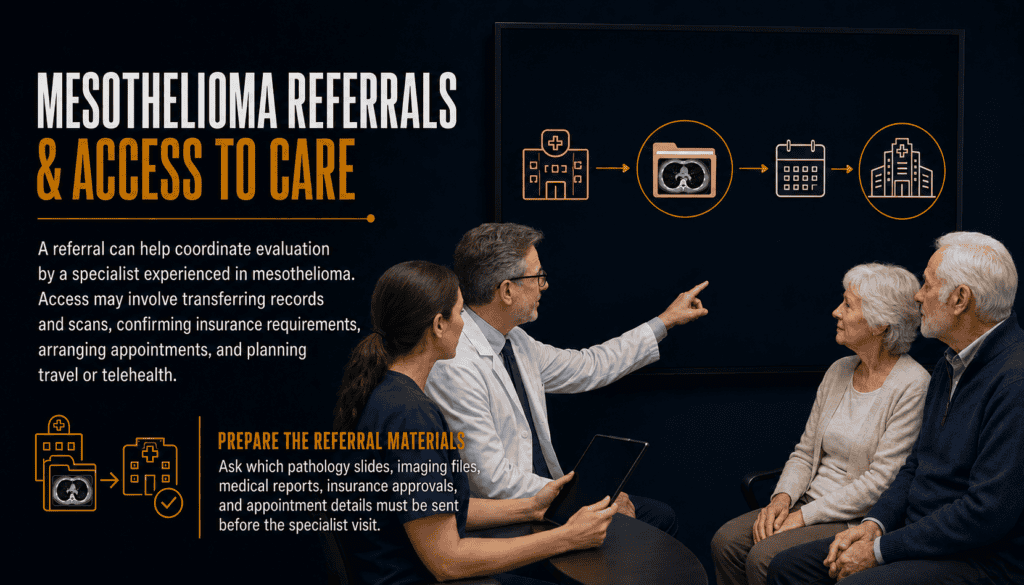
Mesothelioma Referrals & Access to Care
How to reach an experienced care team, organize a referral, and reduce delays without losing continuity of care.
A mesothelioma diagnosis often leads to appointments with several clinicians. Your current doctor can remain involved while a mesothelioma-experienced team reviews pathology, scans and treatment choices. A referral is a request for another clinician or facility to evaluate you; it is not a promise of acceptance, coverage or a particular treatment.
Where to Start: Keep Care Moving
Ask the clinician who diagnosed you who is coordinating the next steps, whether the pathology is final, and which appointment should happen first. If you have worsening shortness of breath, chest pain or another urgent symptom, contact your care team promptly rather than waiting for a referral; seek emergency care for severe or sudden symptoms.
A second opinion can confirm the diagnosis or reveal additional options. The National Cancer Institute (NCI) explains that a second-opinion clinician may review pathology slides, scans and reports and may agree with or revise the initial plan. Read about second opinions for mesothelioma.
| First contact | What to ask |
|---|---|
| Diagnosing doctor | Who will place and track the referral? |
| Receiving center | Do you treat my mesothelioma type and review outside pathology? |
| Insurance plan | Is this clinician and facility in network; is authorization required? |
| Current care team | What care should continue while I wait? |
Which Specialists May Be Involved
The right combination depends on whether the disease affects the pleura, peritoneum or another site, your health and your treatment goals. A specialist consultation does not automatically mean surgery is appropriate.
| Specialist or service | Potential role |
|---|---|
| Medical oncologist | Discusses systemic treatment, side effects and monitoring. |
| Thoracic surgeon | Assesses selected pleural cases for procedures or surgical options. |
| Surgical oncologist experienced in peritoneal disease | Evaluates selected abdominal cases and possible surgery-based approaches. |
| Pathologist with mesothelioma experience | Reviews tissue diagnosis and cell subtype. |
| Radiologist | Interprets imaging and extent of disease. |
| Palliative-care team | Treats pain, breathlessness and other symptoms alongside cancer treatment. |
| Social worker or patient navigator | Helps coordinate appointments, transport and support resources. |
Ask whether the case can be reviewed by a multidisciplinary team. NCI notes that treatment decisions depend on stage, health and preferences, and that a plan may include multiple approaches.
How to Request and Follow Up on a Referral
Tell your current clinician that you would like a consultation with a team experienced in your specific type of mesothelioma. Ask for the referral order, clinical reason, priority, receiving office and a named person who will follow up. You may also contact the receiving hospital to ask whether it accepts patient-initiated appointments.
| Step | Action | Confirmation to obtain |
|---|---|---|
| 1 | Identify appropriate specialty | Name and department |
| 2 | Ask clinician to submit referral | Date sent and destination |
| 3 | Check plan requirements | Authorization or network decision |
| 4 | Send records | Receiving office confirms receipt |
| 5 | Book appointment | Date, format and preparation instructions |
| 6 | Close the loop | Consult note returned to original doctor |
If no appointment is offered, ask whether the referral is missing records, awaiting authorization or pending clinical review. If the proposed wait seems unsafe given your symptoms or treatment timeline, ask the referring clinician to reassess urgency and discuss alternatives.
Records to Transfer Before the Visit
Incomplete records can delay a meaningful review. Request both the written reports and, when requested by the receiving center, the underlying images or pathology materials. Ask the hospitals how they prefer secure transfers; do not mail original materials without instructions.
| Record | Why it matters |
|---|---|
| Pathology report and biopsy slides or tissue blocks | Supports confirmation of diagnosis and cell type. |
| CT, PET/CT or MRI reports and image files | Shows anatomy and helps treatment planning. |
| Operative or procedure reports | Documents prior biopsies, drainage or surgery. |
| Medication and allergy list | Helps assess safety and interactions. |
| Treatment history | Avoids repeating work and supports sequencing decisions. |
| Insurance card and authorization | Supports scheduling and billing. |
Keep a personal copy of your referral, reports, imaging access instructions and contact names. See collecting medical records and PET, CT and MRI scans.
Need help now? Call 800.291.0963 / Live chat available 24/7, 365 days a year / Submit Your Case.
Insurance, Authorizations and Financial Barriers
Before scheduling, ask the insurer and the receiving center about both physician and facility network status. A covered consultation does not necessarily mean every scan, procedure, pathology review or future treatment is covered. Confirm whether prior authorization, a primary-care referral or a single-case agreement is needed. Obtain decisions in writing when possible.
| Barrier | Practical question |
|---|---|
| Out-of-network specialist | Is an exception or single-case agreement possible? |
| Prior authorization pending | Who submitted it, and what is the status? |
| Denied request | What is the reason and what appeal process applies? |
| High out-of-pocket costs | Can a financial counselor estimate the visit and testing costs? |
| Coverage changes | Will planned services remain covered after a plan change? |
Coverage depends on your specific policy and applicable rules; do not assume that Medicare, Medicaid, VA benefits or private insurance automatically pays for every second opinion or out-of-network service. Ask for a financial navigator before incurring substantial travel or treatment expenses. For broader planning, see financial planning after diagnosis.
Travel, Telehealth and Access From Home
Patients may live far from a mesothelioma-experienced center or have difficulty traveling. Ask whether an initial records review or video visit is available and whether local clinicians can perform some testing or administer parts of treatment under the specialist’s direction. Certain examinations, biopsies, procedures and treatments still require in-person care.
| Need | Possible coordination approach |
|---|---|
| Long-distance consultation | Ask about remote initial evaluation and state licensing restrictions. |
| Imaging | Ask whether local scans can be uploaded for review. |
| Travel or lodging | Ask the center’s social worker about available assistance; eligibility varies. |
| Mobility limitations | Request accessible scheduling and transportation guidance. |
| Family participation | Ask whether a caregiver can join a visit with your consent. |
Confirm which team will handle urgent symptoms, prescriptions and results between appointments. A remote consultation should not leave you without a local point of contact.
Connecting Referrals to Treatment and Clinical Trials
The consultation should produce a written plan explaining the diagnosis, treatment goals, available options, anticipated side effects and who is responsible for each next step. NCI describes surgery, systemic treatments and symptom-focused care as options depending on the individual case. An experienced center can assess whether a clinical trial is worth discussing, but a referral does not guarantee eligibility or enrollment.
| Question for the specialist | Reason to ask |
|---|---|
| Has my pathology been reviewed? | Confirm the diagnosis and subtype before major decisions. |
| What is the treatment goal? | Understand disease control, symptom relief and trade-offs. |
| What options fit my health and disease site? | Avoid assuming one plan fits every patient. |
| Are any trials appropriate? | Learn about eligibility, location and extra visits. |
| Who manages symptoms now? | Ensure supportive care is not postponed. |
Explore mesothelioma treatment information and NCI’s mesothelioma treatment trial listings. Trial listings and eligibility change; verify directly with the study team.
A Practical Referral Checklist
Use this checklist with a family member or patient navigator. The goal is to know what has been requested, what has arrived and who owns the next action.
| Before the appointment | Done when |
|---|---|
| Confirm specialty and appointment | You have date, location or video instructions. |
| Confirm network and authorization | You understand likely costs and pending decisions. |
| Send pathology and imaging | Receiving office confirms all required items. |
| Prepare medication and symptom list | List is current and available. |
| Write top three questions | Questions reflect your priorities. |
| Arrange transport or remote access | Logistics are confirmed. |
| Plan follow-up | You know when and how recommendations reach local doctors. |
Bring a notebook or ask permission to record the discussion. Before leaving, ask what happens next, the expected timeframe and which phone number to use if a result or appointment is delayed.
Frequently Asked Questions
These answers address common referral questions; your own care team and insurer can clarify case-specific requirements.
Do I need a referral to see a mesothelioma specialist?
It depends on the specialist, hospital and insurance plan. Ask the receiving office whether self-referral is allowed and ask your insurer whether a clinician referral or authorization is required.
Can I seek a second opinion without changing my oncologist?
Often yes. Ask the specialist to send recommendations to your current oncologist and agree on who will coordinate treatment and urgent care.
What if my pathology slides have not arrived?
Contact the sending pathology department and receiving center. Ask exactly which slides, blocks or reports are required and whether the visit should proceed or be rescheduled.
Will insurance cover an out-of-state consultation?
Coverage varies. Verify network status, prior authorization, physician and facility charges, and any travel-related exclusions with the plan and center.
Can I get a virtual mesothelioma consultation?
Some centers offer remote visits or records review, subject to clinical needs and licensing rules. Ask what must be done in person.
Does a referral guarantee surgery or a clinical trial?
No. Treatment and trial eligibility depend on the diagnosis, disease extent, health, study criteria and the specialist’s assessment.
What if I cannot get an appointment quickly?
Ask the referring clinician to review the medical urgency, check for missing paperwork and discuss another appropriate center. Seek prompt medical advice for worsening symptoms.
Who manages my care after the consultation?
Ask the specialist and your current doctor to identify a lead clinician, share the written plan and clarify who handles treatment, results, prescriptions and urgent symptoms.
Confirmed Medical Sources and Further Reading
- National Cancer Institute: Mesothelioma Diagnosis & Prognosis — diagnosis, records and second opinions.
- National Cancer Institute: Mesothelioma Treatment — treatment planning and supportive care.
- National Cancer Institute: Health Professional Treatment Summary — specialized treatment considerations.
- National Cancer Institute: Treatment Clinical Trials — searchable listings; verify current eligibility.
Get Help After a Mesothelioma Diagnosis
Call 800.291.0963 to discuss mesothelioma-related questions and available assistance. Live chat is available 24/7, 365 days a year. Submit Your Case to request a case review. Medical referrals and appointment availability must be confirmed with healthcare providers; no compensation or treatment outcome is guaranteed.
⚕️ Legal & Medical Information Disclaimer
This page is general information, not individualized medical or legal advice. Consult your treating clinicians about symptoms, referrals and treatment, your insurer about benefits, and a qualified attorney about legal rights and deadlines.