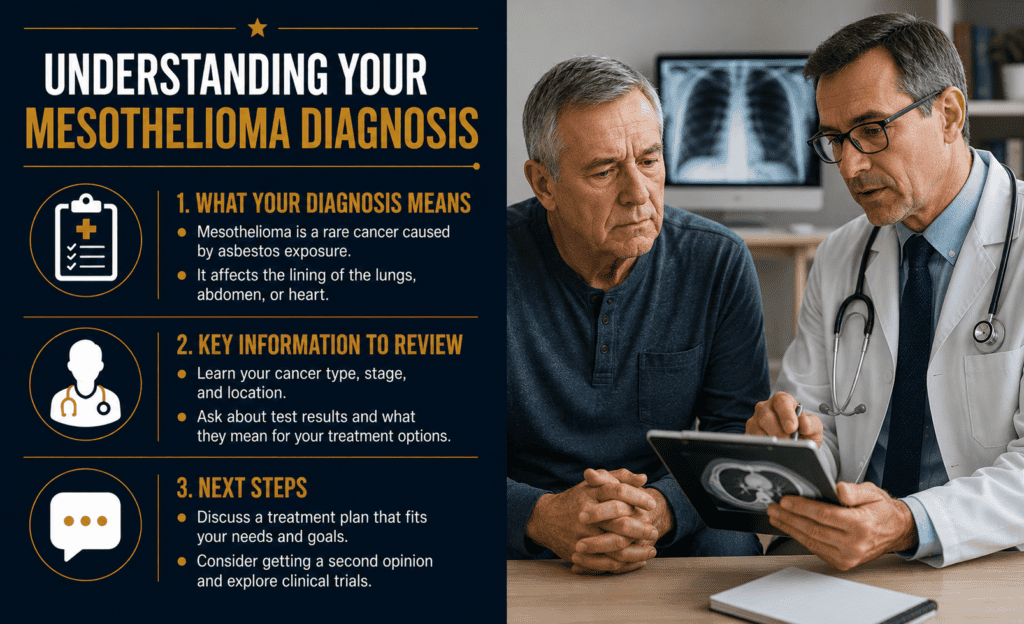
Understanding Your Mesothelioma Diagnosis
A patient-friendly guide to pathology reports, tests, staging, second opinions and the decisions ahead.
Hearing that you have mesothelioma can bring a flood of unfamiliar words and urgent questions. You do not need to understand every medical term in one appointment. This guide explains what is known, what may still be uncertain, and how to prepare for a useful conversation with your cancer team.
Important: If you have severe or suddenly worsening breathing difficulty, new severe chest pain, fainting or another acute emergency, seek emergency medical care. For other new or worsening symptoms, contact your treating team promptly.
What your diagnosis means
Mesothelioma is a cancer of the mesothelium, the thin tissue covering certain organs. The most common locations are the pleura around the lungs and the peritoneum lining the abdomen. The diagnosis describes where the cancer began; it does not by itself establish the stage, treatment plan or an individual prognosis.
Ask your doctor to write down the exact diagnosis and whether it is confirmed by tissue pathology or still suspected. A suspicious scan is not the same as a confirmed cancer diagnosis. The National Cancer Institute describes biopsy and laboratory examination as central to diagnosis.
| Term | Plain-language meaning | Useful follow-up |
|---|---|---|
| Pleural mesothelioma | Cancer arising in the lining around the lungs. | Which side and which areas are involved? |
| Peritoneal mesothelioma | Cancer arising in the lining of the abdomen. | Which abdominal areas are affected? |
| Suspected mesothelioma | Tests raise concern but the diagnosis is not yet confirmed. | What test will clarify the diagnosis? |
| Confirmed mesothelioma | Pathology findings support the diagnosis. | May I have the final report and slides reviewed? |
Learn about the broader mesothelioma diagnosis process and keep a written list of questions for each visit.
Reading your pathology report
A pathologist examines cells or tissue and may use immunohistochemistry—special stains that help distinguish mesothelioma from other cancers. The report may identify an epithelioid, sarcomatoid or biphasic cell type. These labels are medical descriptions, not judgments about you.
Some samples are too small to classify confidently. Fluid cytology can be useful, but a negative fluid result does not rule out mesothelioma. Your team may recommend a larger tissue sample or a specialist review. Ask whether the report is final or whether additional stains or consultation are pending.
| Report item | Why it matters | Question to ask |
|---|---|---|
| Specimen and site | Shows where tissue or fluid was collected. | Was the sample taken from the suspicious area? |
| Final diagnosis | States what the pathologist concluded. | Is this definite or preliminary? |
| Histologic subtype | Describes tumor-cell appearance. | Was there enough tissue to identify the subtype? |
| Immunohistochemistry | Helps separate mesothelioma from look-alike cancers. | Which results support this diagnosis? |
| Additional testing | May clarify uncertain findings. | Are more tests or an expert review needed? |
Read our guide to why pathology reviews matter and ask for a copy of the report rather than relying on memory.
Understanding your test results
Different tests answer different questions. Imaging shows where abnormalities are located; tissue examination helps establish what the abnormality is; other tests assess overall health and treatment readiness. No single blood test or scan independently confirms or excludes mesothelioma.
| Test | What it can help show | Important limitation |
|---|---|---|
| Chest X-ray | Fluid or other chest abnormalities. | Cannot establish a mesothelioma diagnosis. |
| CT scan | Anatomy, tumor location and possible spread. | An abnormal appearance is not a tissue diagnosis. |
| PET/CT or MRI | Additional information about extent in selected situations. | Findings need clinical interpretation. |
| Fluid cytology | Whether abnormal cells appear in collected fluid. | A negative sample does not exclude cancer. |
| Tissue biopsy | Allows microscopic and marker testing. | A small or unrepresentative sample may be inconclusive. |
| Blood tests | General health and selected biomarkers. | Cannot diagnose mesothelioma alone. |
See imaging tests for mesothelioma, thoracoscopy and laparoscopy and blood tests and biomarkers for details. Ask your clinician which test answers the specific unanswered question in your case.
Stage, type and treatment decisions
Type, cell subtype, extent of disease, symptoms, overall health and personal goals all influence treatment discussions. For pleural mesothelioma, clinicians commonly describe extent using the TNM system and stages I through IV. Peritoneal disease is evaluated differently; do not assume a pleural stage chart applies to it.
| Concept | What it tells you | What it does not tell you |
|---|---|---|
| Primary site | Where the cancer started. | Whether treatment will work. |
| Histologic subtype | What the tumor cells look like. | Your exact lifespan. |
| Clinical stage | Estimated extent from available tests. | Every microscopic site of disease. |
| Treatment goal | Whether a plan aims to control disease, relieve symptoms or both. | A guaranteed outcome. |
Review mesothelioma stages and mesothelioma treatment options with your specialist. Published survival figures describe groups of patients, not how long one person will live.
Building your care team
Mesothelioma is uncommon, so a second opinion from a team experienced in this disease can be valuable. Your care may involve a medical oncologist, surgeon, radiation oncologist, pulmonologist, pathologist, symptom-management specialist, nurses and social workers. The right mix depends on your disease and treatment plan.
| Team member | Typical role | Ask about |
|---|---|---|
| Medical oncologist | Coordinates systemic treatment. | Options, expected benefits and side effects. |
| Pathologist | Interprets biopsy findings. | Diagnostic confidence and subtype. |
| Surgeon | Assesses whether surgery is appropriate. | Potential benefit, risks and recovery. |
| Palliative-care clinician | Treats symptoms and supports quality of life. | Breathing, pain, appetite and sleep. |
| Social worker or navigator | Helps with practical barriers. | Travel, costs and caregiver resources. |
A second opinion may confirm the plan or identify another approach. Ask the receiving center which pathology slides, scans and reports it needs.
Your first 30 days
There is no universal timetable for every patient. The checklist below is an organizing tool, not a reason to delay urgent tests or treatment. Your clinical team should determine the timing of care.
| When | Practical task | Why |
|---|---|---|
| As soon as feasible | Confirm whom to call for urgent symptoms. | Avoid uncertainty outside office hours. |
| Before the next visit | Request pathology, imaging and visit notes. | Make the next discussion more productive. |
| At your next visit | Clarify site, subtype, extent and remaining tests. | Separate confirmed facts from open questions. |
| When discussing treatment | Ask about goals, side effects, alternatives and trials. | Support an informed choice. |
| As needed | Arrange a specialist review and practical assistance. | Address questions and barriers early. |
Use our guide to collecting medical records and consider bringing a trusted person to appointments. If your team has recommended urgent action, follow its instructions rather than waiting to finish a checklist.
Symptoms, family and practical support
Symptoms deserve attention even while the team is completing staging or planning treatment. Tell your clinicians about worsening breathlessness, pain, abdominal swelling, appetite changes, fever, fatigue or new functional difficulties. Symptom-directed care can be provided alongside cancer treatment; it is not reserved for the final stage of illness.
Decide how much information you want to share with family and who may attend visits or help organize medications and transportation. It is reasonable to set boundaries and revisit them later. For more, see talking to family about your diagnosis and mesothelioma support.
| Concern | Helpful first step | Who may help |
|---|---|---|
| Pain or breathlessness | Report changes and ask for a symptom plan. | Oncology and palliative-care teams. |
| Confusing information | Request a written summary and definitions. | Clinician or nurse navigator. |
| Work and treatment costs | Collect bills and insurance details. | Social worker or financial counselor. |
| Emotional strain | Ask about counseling or peer support. | Mental-health professional or support service. |
| Future appointments | Keep one updated record and medication list. | Caregiver or patient navigator. |
Our financial-planning guide addresses organizing expenses; it does not replace individualized financial or legal advice.
Questions and answers
These answers are general information. Your own medical team can interpret the exact findings in your records.
Does a CT scan prove that I have mesothelioma?
No. CT can show suspicious findings and help guide procedures, but a tissue biopsy and pathology evaluation are generally needed for confirmation.
Can a negative fluid test rule out mesothelioma?
No. Fluid cytology can miss cancer; clinicians may recommend tissue sampling when suspicion remains.
What does epithelioid, sarcomatoid or biphasic mean?
These are histologic subtypes describing the appearance of tumor cells. Ask your team how the subtype affects the treatment discussion.
Should I request a pathology second opinion?
It is reasonable to discuss specialist review, particularly for a rare cancer or uncertain report. Ask how slides and tissue blocks can be transferred.
Is stage the same as prognosis?
No. Stage describes extent of disease; prognosis also depends on many other factors and cannot predict one individual’s outcome.
Do I need every possible scan?
Not necessarily. Your clinician selects tests according to the unanswered questions, your health and the treatment being considered.
Can I get help with symptoms before treatment starts?
Yes. Ask your team about symptom management and supportive or palliative care during diagnosis and treatment planning.
What should I bring to my next appointment?
Bring your medication list, symptoms and questions, pathology and imaging reports if available, and a support person if you wish.
Get help and reliable sources
For trustworthy medical background, consult the National Cancer Institute: Mesothelioma Diagnosis & Prognosis, the American Cancer Society: Detection, Diagnosis and Staging, and the American Cancer Society: Understanding Your Pathology Report. These sources explain why diagnosis may require imaging, tissue testing and specialist interpretation.
Continue with long-term follow-up care and testing when your treating team establishes a monitoring plan.
Get Help With Your Next Steps
Call 800.291.0963 to discuss asbestos-related questions. Live chat is available 24/7, 365 days a year. Submit Your Case using the form below.
Eligibility, filing options and any compensation depend on individual facts and applicable law. No compensation or outcome is guaranteed.
⚕️ Legal & Medical Information Disclaimer
This page provides general information, not medical diagnosis, treatment recommendations or legal advice. Consult qualified medical and legal professionals about your circumstances. Seek emergency medical care for urgent symptoms.