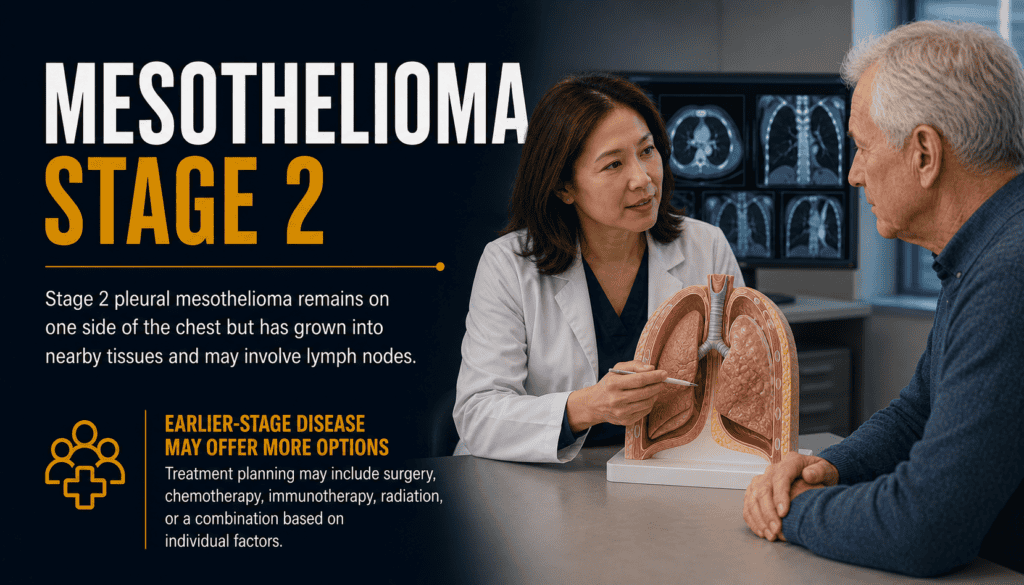
Stage 2 Mesothelioma
What a stage II pleural mesothelioma diagnosis means, how it is confirmed, and how treatment decisions are made.
Stage 2 mesothelioma describes a specific extent of pleural mesothelioma, a cancer of the lining around the lungs. In the staging system described by the National Cancer Institute (NCI), stage II includes cancer on one side of the chest with involvement of certain nearby lymph nodes, without distant metastasis. The exact stage depends on the tumor, lymph-node findings and whether distant spread is present. A stage alone cannot tell an individual how long they will live or which treatment is appropriate.
Start with our Stages overview for the broader picture, or review Stage 1 to understand how the categories differ. Important: the pleural TNM stages described here should not automatically be applied to Peritoneal mesothelioma.
What Stage 2 Mesothelioma Means
Stage is an anatomical description, not a measure of how a person feels. A person with stage II disease may have relatively mild symptoms, while another may be very uncomfortable from pleural fluid or pain. The cancer team also evaluates cell type, general health, breathing capacity, and patient priorities before proposing treatment.
| Term | Plain-language meaning |
|---|---|
| Pleura | Thin tissue lining the chest and covering the lungs. |
| Stage II | A defined pattern of pleural tumor with regional lymph-node involvement and no distant metastasis under the NCI-described system. |
| Regional lymph nodes | Nearby immune-system structures that can contain cancer cells. |
| Metastasis | Cancer spread to a distant part of the body. |
Ask your team whether your report says clinical stage (estimated using examinations and scans) or pathological stage (informed by tissue obtained during surgery). These may differ as more information becomes available.
| What stage tells you | What it does not tell you |
|---|---|
| Anatomic extent at the time of assessment | An exact survival time |
| Regional lymph-node status | Whether a particular treatment will work |
| Whether distant spread was detected | Whether every tumor deposit is visible |
| A common language for care planning | Whether surgery is appropriate by itself |
Stage 2 TNM Classification
TNM stands for T (primary tumor), N (regional nodes) and M (distant metastasis). In the NCI’s published AJCC eighth-edition grouping, stage II malignant pleural mesothelioma is T1 N1 M0 or T2 N1 M0. Confirm which edition your center uses; staging definitions can be updated.
| Stage II combination | Meaning |
|---|---|
| T1 N1 M0 | Tumor limited to specified pleural surfaces; involved regional nodes; no distant metastasis. |
| T2 N1 M0 | Pleural tumor with invasion of diaphragmatic muscle or underlying lung tissue; involved regional nodes; no distant metastasis. |
| Letter | Question for your clinician |
|---|---|
| T | Which pleural surfaces or nearby tissues are involved? |
| N | Which nodes are involved, and how was that established? |
| M | What tests were used to check for distant spread? |
For the full definitions, consult the NCI stages guide and its clinician PDQ staging tables. The terms in a pathology report may be more detailed than a simple stage number.
Symptoms and Warning Signs
Symptoms overlap across stages and may be caused by fluid buildup, the tumor, another medical condition, or treatment. A symptom cannot establish stage II without medical testing. Common concerns include breathlessness, chest discomfort, persistent cough and fatigue.
| Symptom | Possible explanation | What to report |
|---|---|---|
| Shortness of breath | Pleural fluid or restricted lung expansion | New or worsening breathlessness, especially at rest. |
| Chest discomfort | Pleural irritation or another cause | Location, severity, onset and associated symptoms. |
| Persistent cough | Airway or pleural irritation; other causes possible | Duration, changes and any blood. |
| Fatigue | Cancer, sleep disruption, anemia or other causes | Changes in daily function and new weakness. |
Call emergency services for severe sudden breathing difficulty, fainting or new crushing chest pain. Contact your care team promptly about new symptoms rather than assuming they are part of stage II disease. See the Symptoms guide for related topics.
| Situation | Action |
|---|---|
| Mild but persistent new cough | Arrange a medical assessment. |
| Increasing breathlessness over days | Contact the cancer team promptly. |
| Sudden severe chest pain or severe breathing difficulty | Seek emergency care. |
How Doctors Confirm the Stage
Doctors establish a diagnosis with tissue evaluation and then assess extent with imaging and, when needed, sampling of suspicious lymph nodes. Imaging alone cannot reliably replace a diagnostic biopsy for every patient.
| Test | Typical purpose | Limitation |
|---|---|---|
| CT scan | Shows pleural thickening, fluid and nearby anatomy. | May not confirm microscopic nodal spread. |
| PET/CT | Helps identify metabolically active sites and possible spread. | Inflammation can also cause uptake. |
| MRI | May clarify selected local tissue boundaries. | Not needed in every case. |
| Biopsy and pathology | Confirms tumor type and cell characteristics. | Sampling may not represent every area. |
| Report item | Why ask about it |
|---|---|
| Histologic subtype | Epithelioid, sarcomatoid and biphasic tumors can behave differently. |
| Nodal evidence | Clarifies whether N1 is based on imaging or tissue. |
| Distant disease assessment | Explains the M0 designation and test limitations. |
| Performance and lung function | Helps weigh treatment risks and benefits. |
Learn more about Diagnosis, Imaging tests and Biopsy. Ask for a copy of the final pathology and staging reports and whether a mesothelioma-experienced multidisciplinary team has reviewed them.
Treatment Options and Specialist Review
Treatment is individualized. NCI groups stage II with more advanced stages when discussing systemic treatment, but this does not mean every stage II patient receives identical care. Treatment selection depends on tumor anatomy, cell type, overall health, goals and specialist assessment.
| Approach | Potential role | Key discussion |
|---|---|---|
| Immunotherapy | An option for some patients with pleural mesothelioma. | Benefits, immune-related side effects and eligibility. |
| Platinum–pemetrexed chemotherapy | A systemic treatment option. | Expected benefit, blood counts and kidney function. |
| Chemoimmunotherapy | May be considered in appropriate settings. | Availability, suitability and adverse effects. |
| Surgery | Considered only for carefully selected patients following specialist review. | Resectability, risks, alternatives and uncertain survival benefit. |
| Symptom-focused treatment | Goal |
|---|---|
| Pleural fluid drainage | Relieve breathlessness from fluid when appropriate. |
| Pleurodesis or indwelling catheter | Help manage recurrent pleural fluid. |
| Pain and supportive care | Improve comfort and daily functioning. |
| Clinical trial discussion | Determine whether an appropriate study is available. |
See our Treatments resource. The NCI treatment guide describes systemic therapies and symptom-directed care; the NCI clinician PDQ discusses evidence and the limitations of surgery studies. A second opinion at an experienced center can help clarify options.
Prognosis and Factors That Matter
Stage II is one part of prognosis, but a single stage number cannot produce an accurate personal life-expectancy estimate. Published studies may involve different treatment eras, patient selection and staging definitions; figures from one study should not be treated as a promise for another person.
| Factor | Why it matters |
|---|---|
| Cell subtype | Different histologic types can respond and behave differently. |
| Lymph-node involvement | Reflects regional spread and may affect treatment planning. |
| General health and lung function | Influence which treatments can be tolerated. |
| Treatment response | Can change the plan after therapy begins. |
Ask your clinician for a personalized explanation using your pathology, imaging and current health. Be cautious about websites that present one stage II survival figure without identifying the study population and time period.
Preparing for Appointments and Daily Life
Prepare a short symptom diary and bring a companion if helpful. Request written explanations of the TNM findings and what each treatment aims to accomplish. Palliative care can be provided alongside cancer-directed treatment; it is not the same thing as hospice.
| Before the visit | Helpful preparation |
|---|---|
| Collect records | Bring pathology, imaging reports and medication list. |
| Track symptoms | Record breathlessness, pain, appetite and fatigue changes. |
| Identify priorities | Explain what matters most in daily life. |
| Ask about support | Discuss nutrition, transportation and caregiver needs. |
| Question | Reason |
|---|---|
| What exactly makes my case stage II? | Clarifies tumor and node findings. |
| Has my pathology been reviewed by a specialist? | Checks diagnostic confidence. |
| Am I a candidate for a clinical trial? | Explores additional options. |
| How will we know treatment is helping? | Sets expectations for follow-up. |
Our Support resource addresses practical and emotional needs. Treatment plans can change when new information emerges; ask how often scans and clinical reassessments are planned.
Frequently Asked Questions
Is stage 2 mesothelioma considered early or advanced?
Stage II has regional lymph-node involvement in the NCI-described pleural TNM grouping. NCI includes stages II–IV in its discussion of advanced-disease treatments, but individual treatment decisions remain more nuanced than the label.
Does stage 2 mean the cancer has spread throughout the body?
No. The stage II grouping specifies M0, meaning distant metastasis was not identified in the staging assessment. Regional lymph-node involvement is different from distant spread.
Can stage 2 mesothelioma cause fluid around the lung?
Yes. Pleural fluid may occur, but it is not exclusive to stage II and cannot establish the stage on its own.
Can doctors diagnose stage 2 from a chest X-ray?
No. A full diagnosis and staging assessment generally require pathology and appropriate imaging; additional nodal sampling may be considered.
Is surgery always recommended for stage 2?
No. Surgery is considered only in selected circumstances after a specialist weighs anatomy, fitness, risks and uncertain benefits.
What treatments might be discussed?
Depending on the case, clinicians may discuss immunotherapy, chemotherapy, combinations, clinical trials and treatments that relieve symptoms.
Does stage 2 have a fixed survival time?
No. Stage, cell type, health and treatment response differ substantially. Ask the oncology team for a personalized discussion rather than relying on an unsourced average.
Is peritoneal mesothelioma stage 2 the same thing?
No. This article explains the pleural TNM stage II grouping. Peritoneal mesothelioma is evaluated differently, so do not transfer the stage definition automatically.
Confirmed primary medical sources
Get Help and Explore Your Options
Call 800.291.0963 to discuss questions about mesothelioma and possible legal options. Live chat is available 24/7, 365 days a year. Submit Your Case using the form below.
Compensation and eligibility depend on individual facts; no recovery is guaranteed.
⚕️ Legal & Medical Information Disclaimer
This article provides general information, not medical diagnosis, treatment advice or legal advice. Consult qualified medical and legal professionals about your circumstances.