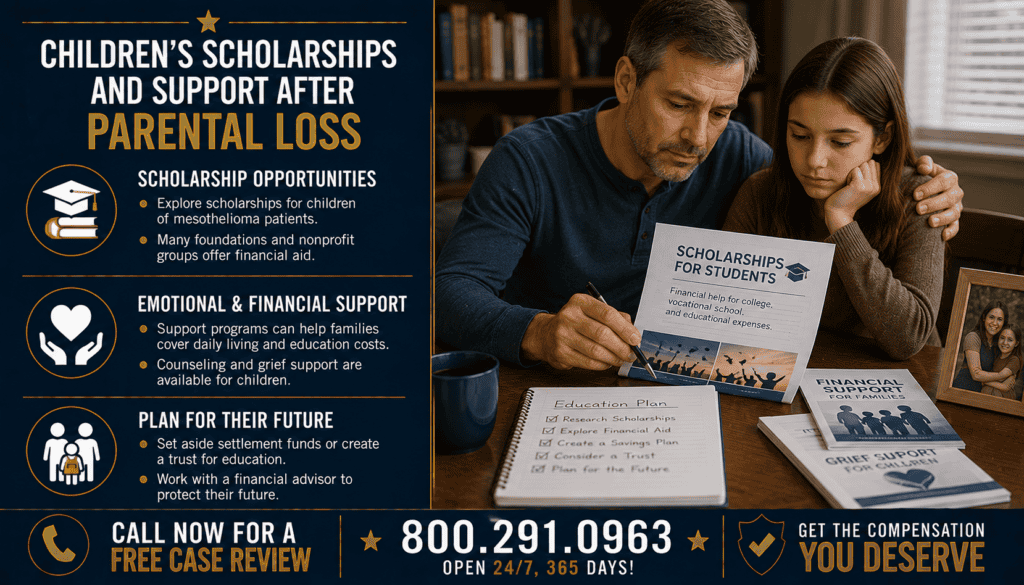
Children’s Scholarships and Support After Parental Loss
When a parent dies from mesothelioma, children and their caregivers may face grief alongside sudden questions about school, household finances and future education. This guide explains where to start looking for scholarships, survivor benefits and emotional support—without promising that any particular family will qualify for funding.
First steps after a parent dies
Begin with immediate stability: identify a trusted adult who can coordinate school communications, preserve the child’s routine where possible, and keep copies of the death certificate, school records and benefit correspondence. Ask the school counselor about confidential support and accommodations. No child should be expected to manage applications or financial decisions alone.
| Priority | Practical action | Who can help |
|---|---|---|
| School continuity | Tell a designated counselor about the loss and ask about attendance flexibility | Guardian or caregiver |
| Basic needs | Ask the school social worker about meals, transportation and supplies | School district |
| Documents | Store records securely; share only what an application requires | Authorized adult |
| Emotional support | Ask about bereavement counseling without forcing participation | Pediatrician or counselor |
Scholarships and education funding
Scholarships specifically for bereaved children exist, but eligibility varies by program, location, age, enrollment and cause of death. Some programs focus on cancer-related losses; others assist children of workers, veterans or families with financial need. Verify each program’s official rules and current application cycle before applying. Do not assume that a mesothelioma diagnosis automatically qualifies a child for a particular award.
| Funding path | What to verify | Important limitation |
|---|---|---|
| Bereavement scholarships | Relationship, age, school status and deadlines | Awards may be geographically restricted |
| Cancer-family programs | Whether parental cancer death qualifies | Some support patients’ children only during treatment |
| School foundation awards | District residency and graduation requirements | Availability differs by school |
| Community foundations | Local eligibility and financial need | Funding may change annually |
| College financial aid | FAFSA and institutional aid requirements | Aid depends on individual circumstances |
Survivor benefits and financial assistance
Children may qualify for Social Security survivor benefits based on a deceased parent’s covered work history and other eligibility rules. The Social Security Administration makes individual determinations. Families connected to military service may also explore VA survivor programs, but eligibility depends on service and benefit-specific criteria. State programs, school meal programs and community assistance can address immediate needs. Apply through official agencies rather than paying someone who promises guaranteed approval.
| Program | Starting point | Check before applying |
|---|---|---|
| Social Security survivors | SSA survivor benefits information | Child age, relationship and deceased parent’s work record |
| VA survivor programs | U.S. Department of Veterans Affairs | Service connection and program eligibility |
| School-based assistance | School district social worker | Residency and household circumstances |
| Local benefits | State or county benefits office | Income and household rules |
College, trade school and FAFSA planning
For a student approaching college, contact the financial aid office about the FAFSA and whether a recent parental death or financial change supports a review of aid circumstances. Schools can explain documentation, professional judgment reviews, grants, work-study and payment plans. Trade schools and community colleges may have separate emergency grants and scholarships. A financial aid appeal is not a promise of additional funding.
| Planning step | Question to ask | Document to prepare |
|---|---|---|
| FAFSA | Which parent information and dependency rules apply? | Requested tax and family records |
| Aid adjustment | Can the school review a recent change in family finances? | Evidence of changed circumstances |
| Emergency grants | Is short-term student assistance available? | School-specific application |
| Trade programs | Which grants and accredited programs qualify? | Program cost and accreditation details |
Organizing scholarship applications
Create a simple tracker with the program name, official URL, eligibility, deadline, essay requirement and submission status. An adult can help younger applicants write an accurate description of their circumstances without sharing unnecessary medical details. Avoid paying application fees unless an official program clearly requires them; investigate requests for banking credentials, gift cards or guaranteed awards.
| Tracker field | Example entry | Why it matters |
|---|---|---|
| Eligibility | Dependent child; specific age range | Prevents wasted applications |
| Deadline | Official date and time zone | Avoids missed submissions |
| Evidence | Enrollment or relationship document | Keeps requests manageable |
| Essay | Student’s own experience, only if comfortable | Protects privacy and authenticity |
| Status | Draft / submitted / decision | Simplifies follow-up |
Grief support at school and at home
Bereavement can affect concentration, attendance, sleep and friendships, but children respond differently. A school counselor can discuss flexible deadlines, a trusted check-in person and a plan for difficult days. Ask the child what they want teachers and classmates to know. A pediatrician or licensed mental health professional can help when distress persists or interferes with daily life. Seek urgent help if a child is in immediate danger or expresses intent to harm themselves.
| Possible need | Support option | Who to contact |
|---|---|---|
| Difficulty concentrating | Temporary assignment adjustments | Teacher or counselor |
| Feeling isolated | Optional peer bereavement group | School or hospice program |
| Strong ongoing distress | Individual assessment | Pediatrician or licensed clinician |
| Immediate safety concern | Emergency services or crisis support | 911 or 988 in the U.S. |
Caregiver planning and privacy
Clarify who is authorized to sign school and medical forms, manage benefits and communicate with scholarship programs. Legal guardianship and authority vary by state and situation; consult a qualified professional when unclear. Keep a shared calendar for applications and appointments, with access limited to appropriate adults. Never publish a child’s diagnosis-related family history or photographs without considering privacy and consent.
| Responsibility | Suggested owner | Safeguard |
|---|---|---|
| School contact | Authorized caregiver | Confirm school authorization |
| Benefit applications | Eligible representative | Use official agency portals |
| Scholarship records | Student and trusted adult | Limit sensitive disclosures |
| Emotional check-ins | Trusted adult | Respect the child’s preferences |
Official resources and next steps
Start with official agencies and established nonprofit support organizations. Check program details directly because funding and eligibility change. The links below are starting points, not confirmations of scholarship availability or eligibility. Families may also ask a hospital social worker or hospice bereavement team for local referrals.
| Resource | Potential help | Official website |
|---|---|---|
| Social Security Administration | Survivor benefit eligibility and applications | ssa.gov |
| Federal Student Aid | FAFSA and aid guidance | studentaid.gov |
| U.S. Department of Veterans Affairs | Survivor and dependent benefits | va.gov |
| National Cancer Institute | Family and cancer-related coping information | cancer.gov |
| 988 Lifeline | U.S. urgent emotional crisis support | 988lifeline.org |
Official starting points: SSA survivor benefits; Federal Student Aid; VA family and caregiver benefits; NCI coping resources; 988 Lifeline. Verify the current program rules directly.
Frequently Asked Questions
Are there scholarships specifically for children who lost a parent to mesothelioma?
Some private and community scholarships support bereaved children or families affected by cancer, but eligibility and funding vary. Review current official criteria; do not assume a disease-specific award exists or is open.
Can a child receive Social Security survivor benefits?
Possibly, depending on the deceased parent’s work record and the child’s eligibility. Contact the Social Security Administration for an individual determination.
Does a parent’s veteran status create scholarship eligibility?
It may open certain survivor or dependent benefit paths, but each VA or other program has its own service and eligibility requirements.
What if the family’s income changed after the parent died?
Ask the college financial aid office whether a review of changed financial circumstances is available and what evidence it needs.
What documents should we gather?
Programs may request proof of relationship, death certificate, enrollment and financial information. Follow each official application’s instructions and share only what is necessary.
Should a child write about the death in every scholarship essay?
Only when relevant to the prompt and when the child is comfortable. Honest, age-appropriate writing is preferable to disclosing intimate medical details.
How can a school help a grieving child?
Counselors may coordinate academic flexibility, check-ins, bereavement referrals and practical assistance. Available services vary by school.
Where can families get immediate emotional help?
Contact a trusted clinician or local emergency service for immediate safety concerns. In the U.S., call or text 988 for crisis support.
Related Resources
For broader help, visit Mesothelioma Support, Grief Support and Bereavement Resources for Families, Communicating With Children About Terminal Illness, Emotional Healing After Losing a Loved One, and Protecting Family Finances After Diagnosis.
Get Support for Your Family
Call 800.291.0963 · Live chat 24/7, 365 days a year. Submit Your Case using the form below.
⚕️ Legal & Medical Information Disclaimer
This information is educational and does not replace medical, mental health, legal or financial advice. Scholarship and benefit eligibility depends on individual circumstances and current program rules. Consult qualified professionals and official agencies.