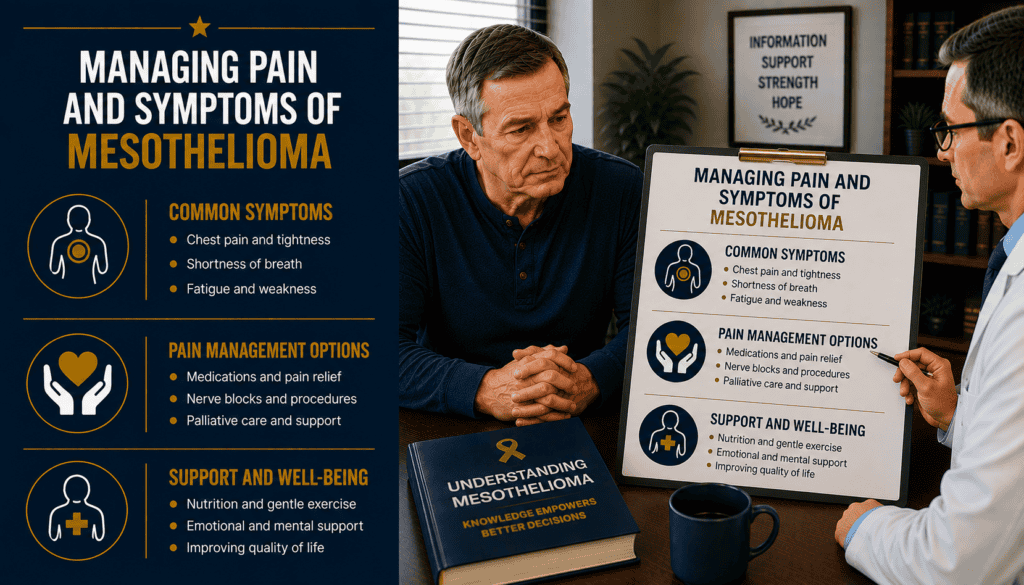
Managing Pain and Symptoms of Mesothelioma
Mesothelioma symptoms can include chest or abdominal discomfort, breathlessness, fatigue, appetite changes, and sleep disruption. A symptom-management plan should be individualized by the treating oncology and palliative-care teams.
Pain relief is not limited to medication. Procedures, rehabilitation, practical home adjustments, and emotional support may help, but worsening or new symptoms require medical assessment rather than self-treatment.
Understanding Different Sources of Pain
Pain may arise from tumor involvement, inflammation, procedures, muscle strain, or unrelated conditions. Location, intensity, timing, and associated symptoms help the care team decide whether imaging or a change in treatment is needed.
Good decisions begin with a specific question, the relevant dates, and the best available records. General information cannot determine what happened to one person or replace advice from a qualified professional familiar with that person’s circumstances. Write down what is known, what is uncertain, and which questions need answers before choosing a next step. It can help to separate immediate priorities from longer-term planning. A practical first conversation might focus on symptoms, safety, or current needs; a later conversation may address records, insurance, financial concerns, or family communication. This approach reduces pressure to resolve every uncertainty at once and makes follow-up more manageable. Identify who can answer each question, which records matter, and when to follow up. Personal circumstances should guide decisions.
Related reading: Mesothelioma Prognosis — Additional background for readers reviewing this issue; and Mesothelioma Symptoms — Information to help organize follow-up questions and records.
Breathing Problems and Fluid Buildup
Breathlessness may have several causes, including pleural fluid, lung restriction, anemia, infection, or treatment effects. A clinician may consider oxygen assessment, imaging, drainage, or other interventions based on the cause rather than symptoms alone.
It can help to separate immediate priorities from longer-term planning. A practical first conversation might focus on symptoms, safety, or current needs; a later conversation may address records, insurance, financial concerns, or family communication. This approach reduces pressure to resolve every uncertainty at once and makes follow-up more manageable. Keep copies of significant reports, correspondence, and appointment summaries in a place that authorized family members can find. If information conflicts, ask the responsible clinician or professional to explain the difference. Avoid treating online anecdotes or an isolated statistic as proof of what will happen in an individual case. Identify who can answer each question, which records matter, and when to follow up. Personal circumstances should guide decisions.
Related reading: Mesothelioma Support — Additional background for readers reviewing this issue; and What Is Mesothelioma? — Information to help organize follow-up questions and records.
Medication and Safety Conversations
Pain medicines can be effective but may cause drowsiness, nausea, constipation, or interactions. Patients should follow the prescribed plan, report side effects, and avoid abruptly changing opioid doses without medical guidance.
Keep copies of significant reports, correspondence, and appointment summaries in a place that authorized family members can find. If information conflicts, ask the responsible clinician or professional to explain the difference. Avoid treating online anecdotes or an isolated statistic as proof of what will happen in an individual case. Families often benefit from identifying one person to maintain a question list and another to organize documents, while respecting the patient’s preferences. The aim is to support informed choices, not to substitute a family member’s judgment for the patient’s. Ask for interpretation or accessibility assistance when needed. Identify who can answer each question, which records matter, and when to follow up. Personal circumstances should guide decisions.
Related reading: Secondhand Asbestos Exposure — Additional background for readers reviewing this issue; and Mesothelioma Lawsuits — Information to help organize follow-up questions and records.
Procedures and Non-Drug Approaches
Depending on the problem, teams may discuss physical therapy, positioning, breathing techniques, nerve blocks, drainage procedures, or radiation for symptom control. Any procedure requires individualized discussion of potential risks and benefits.
Families often benefit from identifying one person to maintain a question list and another to organize documents, while respecting the patient’s preferences. The aim is to support informed choices, not to substitute a family member’s judgment for the patient’s. Ask for interpretation or accessibility assistance when needed. Good decisions begin with a specific question, the relevant dates, and the best available records. General information cannot determine what happened to one person or replace advice from a qualified professional familiar with that person’s circumstances. Write down what is known, what is uncertain, and which questions need answers before choosing a next step. Identify who can answer each question, which records matter, and when to follow up. Personal circumstances should guide decisions.
Related reading: Asbestos Exposure in High-Risk Jobs — Additional background for readers reviewing this issue; and Asbestos Exposure in Job Sites — Information to help organize follow-up questions and records.
Fatigue Sleep and Appetite
Fatigue may reflect disease, poor sleep, anemia, medication effects, or emotional distress. Small planned activities, rest, nutritional support, and treatment of reversible causes may be considered with the clinical team.
Good decisions begin with a specific question, the relevant dates, and the best available records. General information cannot determine what happened to one person or replace advice from a qualified professional familiar with that person’s circumstances. Write down what is known, what is uncertain, and which questions need answers before choosing a next step. It can help to separate immediate priorities from longer-term planning. A practical first conversation might focus on symptoms, safety, or current needs; a later conversation may address records, insurance, financial concerns, or family communication. This approach reduces pressure to resolve every uncertainty at once and makes follow-up more manageable. Identify who can answer each question, which records matter, and when to follow up. Personal circumstances should guide decisions.
Related reading: Asbestos Exposure in Buildings — Additional background for readers reviewing this issue; and Military Veterans Asbestos Exposure — Information to help organize follow-up questions and records.
When Symptoms Need Urgent Attention
Sudden severe breathlessness, chest pain, fainting, new confusion, or uncontrolled pain needs urgent assessment. Patients should follow emergency instructions from their care team rather than waiting for a routine appointment.
It can help to separate immediate priorities from longer-term planning. A practical first conversation might focus on symptoms, safety, or current needs; a later conversation may address records, insurance, financial concerns, or family communication. This approach reduces pressure to resolve every uncertainty at once and makes follow-up more manageable. Keep copies of significant reports, correspondence, and appointment summaries in a place that authorized family members can find. If information conflicts, ask the responsible clinician or professional to explain the difference. Avoid treating online anecdotes or an isolated statistic as proof of what will happen in an individual case. Identify who can answer each question, which records matter, and when to follow up. Personal circumstances should guide decisions.
Related reading: Mesothelioma Treatment — Additional background for readers reviewing this issue; and Mesothelioma Diagnosis — Information to help organize follow-up questions and records.
Preparing a Symptom Diary
A simple diary can record symptom severity, triggers, medicines taken, relief, sleep, bowel changes, and questions. This can reveal patterns and make it easier to explain changes during short appointments.
Keep copies of significant reports, correspondence, and appointment summaries in a place that authorized family members can find. If information conflicts, ask the responsible clinician or professional to explain the difference. Avoid treating online anecdotes or an isolated statistic as proof of what will happen in an individual case. Families often benefit from identifying one person to maintain a question list and another to organize documents, while respecting the patient’s preferences. The aim is to support informed choices, not to substitute a family member’s judgment for the patient’s. Ask for interpretation or accessibility assistance when needed. Identify who can answer each question, which records matter, and when to follow up. Personal circumstances should guide decisions.
Related reading: Asbestos Exposure in Equipment — Additional background for readers reviewing this issue; and Asbestos Exposure in Machinery — Information to help organize follow-up questions and records.
Caregiver Support and Care Planning
Caregivers can assist with scheduling, medication lists, transport, and communication while respecting independence. Ask clinicians about palliative-care referrals and social-work support early rather than waiting for a crisis.
Families often benefit from identifying one person to maintain a question list and another to organize documents, while respecting the patient’s preferences. The aim is to support informed choices, not to substitute a family member’s judgment for the patient’s. Ask for interpretation or accessibility assistance when needed. Good decisions begin with a specific question, the relevant dates, and the best available records. General information cannot determine what happened to one person or replace advice from a qualified professional familiar with that person’s circumstances. Write down what is known, what is uncertain, and which questions need answers before choosing a next step. Identify who can answer each question, which records matter, and when to follow up. Personal circumstances should guide decisions.
Related reading: Asbestos Trust Funds — Additional background for readers reviewing this issue; and Mesothelioma Lawsuits in All 50 States — Information to help organize follow-up questions and records.
❓ Frequently Asked Questions
Should I report pain even if I already take medication?
Yes. Changes in pain may indicate a need to adjust care or investigate another cause. Good decisions begin with a specific question, the relevant dates, and the best available records. General information cannot determine what happened to one person or replace advice from a qualified professional familiar with that person’s circumstances. Write down what is known, what is uncertain, and which questions need answers before choosing a next step.
Can palliative care be provided during treatment?
Yes. It can complement cancer-directed treatment. Good decisions begin with a specific question, the relevant dates, and the best available records. General information cannot determine what happened to one person or replace advice from a qualified professional familiar with that person’s circumstances. Write down what is known, what is uncertain, and which questions need answers before choosing a next step.
What symptoms require emergency care?
Sudden severe breathing difficulty, chest pain, fainting, or new confusion warrants emergency evaluation. Good decisions begin with a specific question, the relevant dates, and the best available records. General information cannot determine what happened to one person or replace advice from a qualified professional familiar with that person’s circumstances. Write down what is known, what is uncertain, and which questions need answers before choosing a next step.
Can I change pain medicine myself?
Discuss dose changes and side effects with the prescribing clinician. Good decisions begin with a specific question, the relevant dates, and the best available records. General information cannot determine what happened to one person or replace advice from a qualified professional familiar with that person’s circumstances. Write down what is known, what is uncertain, and which questions need answers before choosing a next step.
Additional related information: Mesothelioma Compensation — General background on questions families may want to discuss with a qualified professional.
Keep a written list of practical concerns and revisit it as circumstances change. This can make conversations with healthcare professionals, relatives, and other qualified advisers more productive and less overwhelming.
Authoritative Health and Safety Resources
For current evidence and individualized care, consult National Cancer Institute mesothelioma information, American Cancer Society, and CDC/NIOSH asbestos resources. These organizations provide general information; a treating clinician should interpret medical questions in context.
📞 Get the Mesothelioma Help & Compensation You Deserve — Contact Us Today!
If you or a loved one has been diagnosed with mesothelioma, help is available to discuss possible asbestos exposure and questions about compensation. A diagnosis does not by itself establish legal eligibility.
Our team has 25+ years of experience helping veterans, workers, and families find information and explore next steps.
📲 Contact Us Today — Three Easy Ways!
CALL: 800.291.0963 for a free case review.
LIVE CHAT: Available 24/7/365.
CONTACT FORM: Complete the form below.
Disclaimer: This information is not be considered as legal or medical advice. Mesothelioma Help Center is not a law firm or medical provider and does not determine legal or VA eligibility.