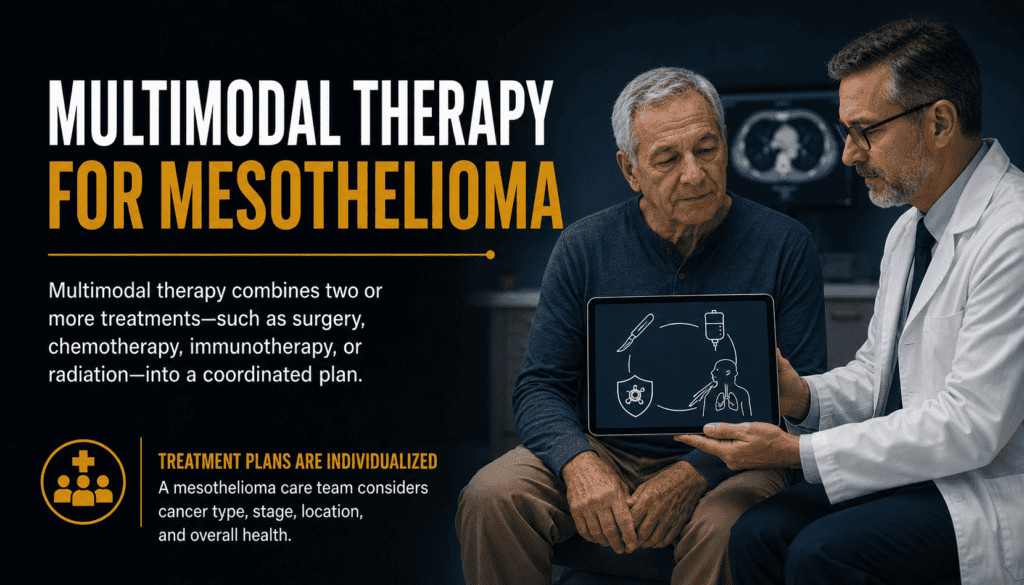
Multimodal Therapy for Mesothelioma: Combining Treatments
A patient-focused guide to coordinated treatment plans, realistic goals, and decisions with a mesothelioma specialist.
Multimodal therapy means using more than one type of cancer treatment in a coordinated plan. For mesothelioma, a team may consider surgery alongside systemic medicines, radiation, or symptom-directed procedures. The combination is not automatically better for every patient: the cancer’s location and extent, pathology, overall health, and personal priorities determine whether a combined approach makes sense. This guide explains the options and the questions to discuss with your clinicians.
What Is Multimodal Therapy?
“Multimodal” describes a strategy, not a single drug or standard recipe. A multidisciplinary team decides which treatments have a meaningful role, the order in which they should be delivered, and when to reassess. Treatment can be intended to remove visible disease in carefully selected cases, control cancer that cannot be removed, or ease symptoms. Even after extensive surgery, microscopic cancer may remain.
| Term | What it means | Important distinction |
|---|---|---|
| Local treatment | Surgery or radiation directed at a particular area. | Local treatment does not necessarily address disease elsewhere. |
| Systemic treatment | Medicines such as chemotherapy or immunotherapy that act throughout the body. | Benefits and adverse effects vary by regimen and patient. |
| Multimodal plan | Two or more modalities used as part of one coordinated strategy. | The sequence and intent should be documented. |
| Supportive care | Treatment of pain, breathlessness, nutrition and other needs. | Appropriate alongside anticancer treatment at any stage. |
Read the broader mesothelioma treatments overview for an introduction to each modality.
Who May Be Considered?
Doctors first confirm the diagnosis and histologic subtype, assess the extent of disease, and review whether the patient can safely tolerate each component. Surgical candidacy depends on more than age or a scan: functional status, heart and lung function, other conditions, anatomy, and the expertise of the treating center matter. Some people benefit more from systemic treatment and symptom relief than from major surgery.
| Assessment | Why the team checks it | Question to ask |
|---|---|---|
| Expert pathology review | Confirms mesothelioma and cell type; excludes look-alike cancers. | Has a mesothelioma-experienced pathologist reviewed my slides? |
| Imaging and staging | Maps the disease and checks for spread. | What is known, and what remains uncertain? |
| Functional evaluation | Estimates ability to tolerate surgery or medicines. | What tests are needed for my heart, lungs and overall fitness? |
| Patient goals | Clarifies acceptable risks and desired outcomes. | How does each option affect daily life and recovery? |
For background on the diagnostic process, see mesothelioma diagnosis and obtaining a second opinion.
Common Treatment Combinations
Possible combinations differ by site, stage, histology and prior treatment. A regimen used for one patient should not be assumed suitable for another. In particular, immunotherapy is an important systemic option for some patients, but adding it to surgery or radiation is not universally established as the best sequence.
| Possible approach | How components may fit together | Key consideration |
|---|---|---|
| Systemic therapy followed by reassessment | Chemotherapy or immunotherapy may be used before a decision about local treatment. | Response does not guarantee later surgery is appropriate. |
| Surgery plus systemic therapy | Selected patients may receive medicines before or after an operation. | Ask whether the combination is standard at the center or part of a trial. |
| Surgery plus radiation | Radiation may be considered for selected local-control or symptom goals. | Radiation fields and toxicity require careful planning. |
| Systemic therapy plus symptom-directed procedures | Cancer medicines may be paired with drainage, pleurodesis or other supportive interventions. | Symptom procedures are not necessarily cancer-removing surgery. |
| Clinical-trial combination | A research protocol may test a new sequence or drug combination. | Understand eligibility, alternatives and research-specific risks. |
Explore the treatment overview and discuss current regimen-specific evidence with your oncology team rather than assuming all combinations have proven survival benefits.
How Treatment Is Sequenced
The order of treatment matters. “Neoadjuvant” means treatment given before a planned operation; “adjuvant” means treatment given afterward. These terms describe timing, not proof that an approach will work. A team should establish checkpoints where imaging, symptoms, and adverse effects are reviewed before moving to the next phase.
| Phase | Typical decision | What may change the plan |
|---|---|---|
| Before treatment | Confirm pathology, stage, fitness and treatment intent. | New biopsy or staging findings. |
| First modality | Begin agreed systemic or local treatment. | Unexpected toxicity or rapid symptom changes. |
| Reassessment | Review scans, examination and patient priorities. | Progression, response or declining fitness. |
| Next modality | Proceed only if expected benefit still justifies risk. | A switch to another drug, trial or supportive approach. |
| Follow-up | Monitor recurrence, complications and quality of life. | New symptoms or imaging findings. |
Ask for a written schedule that identifies the lead clinician and explains whom to call between appointments. For help preparing, see questions to ask at every appointment.
Need help now? Call 800.291.0963 / Live chat available 24/7, 365 days a year / Submit Your Case.
Potential Benefits and Trade-Offs
The rationale for combining treatments is to address disease in different ways, but more treatment also brings more appointments, recovery time and potential toxicity. Evidence varies across combinations, and studies may enroll highly selected patients. Comparing outcomes from different groups without accounting for those differences can be misleading.
| Potential objective | Possible downside | Discussion point |
|---|---|---|
| Improve local control in selected disease | Major surgery or radiation can cause substantial complications. | What benefit is expected in my specific case? |
| Treat disease beyond the visible tumor | Systemic medicines can cause serious adverse effects. | How will side effects be monitored and treated? |
| Reduce symptoms | Procedures can require hospitalization or repeat treatment. | Which option offers the most practical relief? |
| Provide additional options through research | Trial participation may add visits and uncertainty. | What is established care outside the trial? |
Ask for both best-case and realistic outcomes, including recovery time and the possibility of stopping a planned component. Supportive care can improve comfort and decision-making regardless of whether anticancer therapy continues.
Pleural vs. Peritoneal Treatment
Pleural mesothelioma arises in the lining around the lungs; peritoneal mesothelioma arises in the abdominal lining. Their treatment pathways are not interchangeable. For selected patients with peritoneal disease, specialized centers may consider cytoreductive surgery with heated intraperitoneal chemotherapy (HIPEC). This is a distinct approach that requires careful evaluation and is not appropriate for everyone.
| Disease location | Options a specialist may evaluate | Important caution |
|---|---|---|
| Pleural | Systemic therapy, selected operations, radiation or symptom procedures. | Extensive surgery is not routine for every stage or patient. |
| Peritoneal | Systemic therapy or, in selected cases, cytoreductive surgery with HIPEC. | Eligibility depends on distribution of disease and operative risk. |
| Other rare sites | Individualized assessment at a specialty center. | Do not extrapolate pleural or peritoneal protocols. |
Learn more about pleural mesothelioma and peritoneal mesothelioma.
Specialist Team and Second Opinions
Multimodal care requires coordination among medical oncology, thoracic or abdominal surgery, radiation oncology when relevant, pathology, radiology, nursing, rehabilitation and supportive-care professionals. A specialist center can clarify whether an aggressive local approach is appropriate or whether another plan better fits the diagnosis and goals. A second opinion need not mean changing every member of the existing care team.
| Team member | Useful role | Ask |
|---|---|---|
| Medical oncologist | Plans and monitors systemic treatment. | Who coordinates the entire treatment sequence? |
| Surgeon with site-specific experience | Evaluates feasibility and operative risks. | How many similar procedures does your team perform? |
| Radiation oncologist | Assesses whether radiation offers a suitable benefit. | What tissue could be affected? |
| Pathologist and radiologist | Confirm diagnosis and assess disease extent. | Have my slides and images been reviewed? |
| Palliative/supportive-care team | Addresses symptoms, stress and quality of life. | Can support start during active treatment? |
Questions and Planning Checklist
Bring a written list and, with the patient’s permission, a family member who can take notes. Request copies of the pathology report, imaging, treatment recommendations and medication list. Make sure the plan distinguishes established treatment from research and clearly identifies the goal of each step.
| Ask your team | Why it matters |
|---|---|
| What is the goal of combining these treatments? | Clarifies whether the aim is control, symptom relief or another outcome. |
| Which evidence supports this sequence for my disease type? | Avoids treating an experimental combination as settled care. |
| What happens if I cannot complete the second treatment? | Creates a realistic contingency plan. |
| What complications could affect independence or breathing? | Supports informed consent and recovery planning. |
| Is a clinical trial or second opinion appropriate? | Identifies other reasonable options. |
| Who handles urgent symptoms between treatments? | Prevents gaps in coordinated care. |
Appointment checklist: confirm the diagnosis and site; review stage and functional status; ask about alternatives and adverse effects; discuss costs and travel; request a written sequence; agree on a reassessment date. Additional planning resources include collecting medical records and financial planning after diagnosis.
Frequently Asked Questions
Does multimodal therapy mean everyone needs surgery?
No. A coordinated plan can use systemic therapy and symptom-directed care without major surgery. Surgery is considered only when its likely benefits justify its risks.
Is combining treatments always more effective than one treatment?
No. Benefits depend on the specific combination and patient population. Some combinations are studied in trials, and added treatment can increase toxicity.
Can immunotherapy be part of a multimodal plan?
It may be considered in certain individualized plans or research protocols. Ask which regimen is supported for your diagnosis and whether its sequence is established or investigational.
What does neoadjuvant treatment mean?
It is treatment given before a planned operation. Adjuvant treatment is given afterward. The terms describe timing, not a guaranteed outcome.
Can people with peritoneal mesothelioma receive HIPEC?
Some carefully selected patients may be evaluated for cytoreductive surgery with HIPEC at an experienced center. Not every patient is eligible.
What if my scans show progression during treatment?
The team should reassess the original plan, symptoms and goals. Options may include changing systemic treatment, considering a trial, or prioritizing supportive care.
Should I seek a second opinion before a major operation?
A review at a mesothelioma-experienced center can help clarify diagnosis, candidacy, alternatives and the expected risks and benefits.
Can palliative care be used with active cancer treatment?
Yes. Palliative care addresses symptoms and quality of life and can be provided alongside anticancer treatment; it is not limited to end-of-life care.
Medical Sources and Further Reading
These resources explain mesothelioma treatment, multidisciplinary care and clinical trials. Treatment choices should be confirmed with a qualified specialist using current guidance.
Get Help After a Mesothelioma Diagnosis
Call 800.291.0963 to discuss your situation. Live chat is available 24/7, 365 days a year. Submit Your Case to request information about potential legal options. Treatment decisions belong with your medical team; eligibility for any legal claim or compensation depends on individual facts and applicable law. No result or compensation is guaranteed.
⚕️ Legal & Medical Information Disclaimer
This page provides general information, not medical or legal advice. Consult qualified clinicians about treatment and a licensed attorney about legal rights and deadlines.