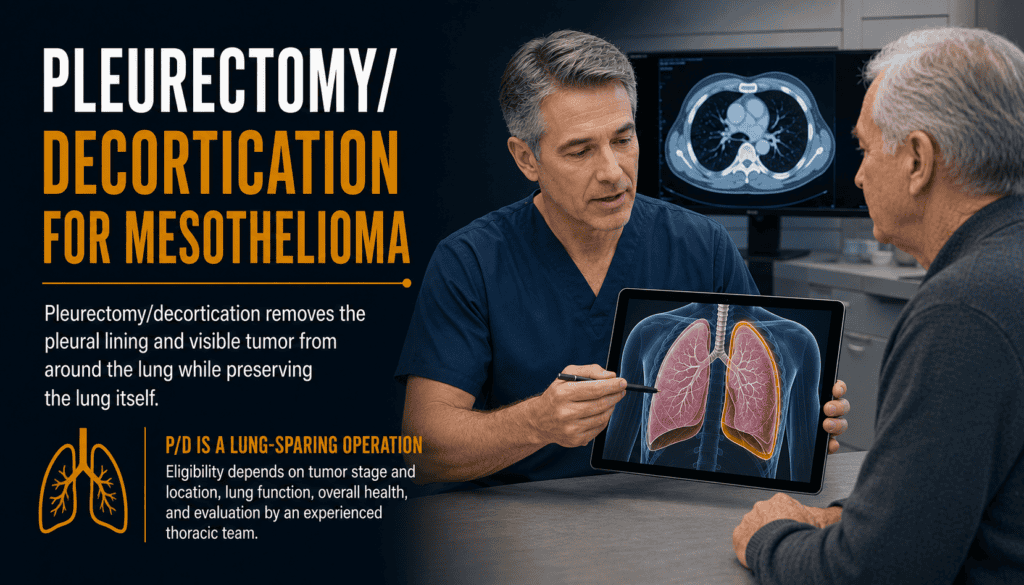
Pleurectomy/Decortication for Mesothelioma
A patient and caregiver guide to lung-sparing surgery for pleural mesothelioma.
Pleurectomy/decortication is a major operation that may be considered for certain patients with pleural mesothelioma. This guide explains the procedure, selection process, risks, recovery, and questions to discuss with an experienced specialist.
What Is Pleurectomy/Decortication?
Pleurectomy/decortication (P/D) is an operation used in selected people with malignant pleural mesothelioma, a cancer arising in the lining around the lungs. The surgeon removes affected pleural tissue and attempts to remove visible tumor while preserving the lung. P/D is not appropriate for everyone, and surgery alone is not assumed to eliminate microscopic disease. A mesothelioma-experienced multidisciplinary team should explain whether the potential benefits justify the risks in your particular case.Unlike extrapleural pneumonectomy (EPP), which removes the affected lung along with other tissue, lung-sparing P/D aims to keep that lung in place. Preserving the lung does not make P/D a minor procedure: it can be a major operation with substantial recovery and complications.
| Term | Meaning |
|---|---|
| Pleura | Thin membranes covering the lung and lining the chest |
| Pleurectomy | Removal of affected pleural tissue |
| Decortication | Careful separation of tumor from the lung surface |
| Lung-sparing | The affected lung is generally retained |
P/D Versus Extended P/D
Terminology varies among surgical teams and published studies. In general, P/D removes involved parietal and visceral pleura and visible tumor without intentionally removing the lung. Extended P/D also involves removing and reconstructing the diaphragm and/or pericardium when necessary. Ask your surgeon which structures they expect to remove, which might need reconstruction, and how that changes risks.Because tumor may be attached to nearby structures, the planned operation can change after the chest is examined. Patients should understand the surgeon’s contingency plan and whether a different procedure could be considered.
| Procedure | Typical scope |
|---|---|
| P/D | Pleural removal and visible tumor removal with lung preservation |
| Extended P/D | P/D plus diaphragm and/or pericardium removal and reconstruction if required |
| EPP | Removal of the affected lung and other involved tissues; a different operation |
Who May Be Considered for Surgery?
Eligibility depends on more than a diagnosis. A specialist considers disease distribution, imaging, cell type, overall health, lung and heart function, symptoms, patient goals, and whether visible tumor appears removable. Surgery may not be advised if the disease is too extensive or the expected harm outweighs the potential benefit. A second opinion from a center experienced in mesothelioma can clarify options.Age alone should not substitute for a full assessment. Some people may be better served by systemic treatment, symptom-relieving procedures, or a clinical trial rather than a major operation.
| Assessment | Why it matters |
|---|---|
| CT/PET and other staging tests | Help define the extent of disease |
| Pulmonary and cardiac testing | Assess ability to tolerate surgery |
| Pathology review | Confirms diagnosis and cell type |
| Functional status and preferences | Clarify realistic recovery and personal goals |
Preparing for the Operation
Ask the team to explain the surgical plan, likely hospital stay, pain-control strategy, and expected support at home. They may review medications, blood-thinning drugs, nutrition, exercise tolerance, smoking status, and preoperative breathing exercises. Never stop a prescribed medication without instructions from its prescriber.Arrange transportation and a caregiver, organize medication and allergy lists, and discuss advance directives if you wish. If travel is required, confirm where follow-up visits will take place and how complications will be handled after you return home.
| Before surgery | Question or action |
|---|---|
| Medication review | Which medicines should I take or hold? |
| Home support | Who can help with meals, transport, and mobility? |
| Recovery expectations | What limitations should I expect? |
| Contact plan | Who do I call day or night? |
What Happens During Surgery and Hospitalization?
P/D is performed under general anesthesia. The surgeon accesses the chest, separates diseased pleura and tumor from the lung and chest wall, and removes visible disease where feasible. The precise incision and technique depend on the surgical plan. Extended P/D may require reconstruction of the diaphragm or pericardium. Chest drains are commonly used afterward to remove air and fluid while the lung recovers.Hospital teams monitor breathing, oxygen needs, pain, bleeding, heart rhythm, fluid balance, and signs of infection. Physical therapy, supported coughing, and gradual walking may be recommended as appropriate. The duration of hospitalization varies substantially; ask your team for an individualized estimate rather than relying on a fixed number of days.
| Stage | What to expect |
|---|---|
| Before | Anesthesia assessment and final consent |
| During | Removal of affected pleura and visible tumor |
| Immediately after | Close monitoring, pain management, and chest drains |
| Hospital recovery | Breathing support and progressive mobility |
Risks and Warning Signs
Potential complications include bleeding, infection, pneumonia, prolonged air leak, abnormal heart rhythm, blood clots, respiratory failure, and—in rare cases—death. Risks vary by health status, disease extent, surgical approach, and center experience. Ask for the center’s procedure-specific complication and mortality data, including how its patient population compares with yours.Seek emergency help for sudden or severe breathlessness, chest pain, fainting, or signs of stroke. Contact the surgical team promptly for fever, worsening breathing, increasing incision redness or drainage, uncontrolled pain, or new leg swelling. Follow the personalized discharge instructions even if they differ from this general list.
| Symptom | Action |
|---|---|
| Sudden severe breathlessness or chest pain | Seek emergency medical help |
| Fever or worsening wound drainage | Contact the surgical team promptly |
| New swollen or painful leg | Seek urgent medical advice |
| Pain not controlled by the prescribed plan | Call the care team |
Recovery, Rehabilitation, and Follow-Up
Recovery is individual and can take weeks to months. Fatigue, discomfort, reduced stamina, and changes in breathing may persist. Your team may recommend breathing exercises, walking, pulmonary rehabilitation, nutrition support, and a gradual return to activities. Do not increase activity or lift heavy objects beyond your surgeon’s instructions.Follow-up typically includes symptom review and imaging to assess disease status. Surgery may be combined with chemotherapy, immunotherapy, or other treatment in selected circumstances, but the best sequence is not the same for every patient. Ask how the care team will evaluate whether additional treatment is appropriate and how side effects will be managed.
| Recovery focus | Practical approach |
|---|---|
| Breathing | Use only the exercises recommended by the team |
| Mobility | Build activity gradually within restrictions |
| Pain | Follow the prescribed plan and report poor control |
| Appointments | Keep imaging and specialist follow-up visits |
Questions to Ask and Other Options
A useful decision is based on your specific disease, expected benefits, complications, and goals—not on the name of a procedure alone. Ask whether the intent is to remove visible disease, improve symptoms, or both; how likely it is that visible tumor can be removed; and what alternatives exist if surgery is not recommended.Options may include systemic therapy, clinical trials, and procedures to control pleural fluid or breathlessness. Palliative care can help with pain, breathing symptoms, and decision-making alongside cancer-directed treatment. It is not limited to end-of-life care.
| Ask your team | Why it helps |
|---|---|
| What is the goal of this operation? | Clarifies expected benefit |
| Why P/D rather than another approach? | Explains individual selection |
| What are my complication risks? | Supports informed consent |
| What if I do not have surgery? | Clarifies reasonable alternatives |
Frequently Asked Questions
Is P/D a cure for mesothelioma?
No operation guarantees a cure. P/D aims to remove visible disease in selected patients, but microscopic cancer may remain and recurrence is possible.
Does P/D remove the lung?
P/D generally preserves the affected lung. Extended P/D can remove and reconstruct other structures, such as the diaphragm or pericardium.
How is P/D different from EPP?
P/D generally preserves the lung; extrapleural pneumonectomy removes the affected lung and additional tissue. Eligibility and risks differ.
Who decides whether I qualify?
A multidisciplinary team with mesothelioma experience reviews disease extent, pathology, lung and heart function, health, and your goals.
How long does recovery take?
Recovery varies widely and may take weeks to months. Your surgeon can estimate your expected course based on the procedure and your health.
Will I need chemotherapy or immunotherapy afterward?
Possibly, but not everyone receives the same combination or sequence. Your oncology team should explain the evidence and plan for your situation.
What symptoms require urgent help after surgery?
Sudden severe breathing difficulty, chest pain, fainting, or stroke symptoms warrant emergency help. Follow discharge instructions for other warning signs.
Can palliative care help if I choose surgery?
Yes. Palliative care can support pain relief, breathing symptoms, emotional well-being, and family needs alongside cancer-directed treatment.
Medical Sources and Further Reading
These independent medical resources offer additional context. Confirm treatment recommendations with your own care team.
Get Help Understanding Your Options
Call 800.291.0963 to discuss available help. Live chat is available 24/7, 365 days a year. Submit Your Case.
Compensation is not guaranteed. Eligibility depends on individual facts and applicable law.
⚕️ Legal & Medical Information Disclaimer
This page is general information, not medical or legal advice. Discuss surgery, treatment, and urgent symptoms with qualified medical professionals; consult a qualified attorney about legal questions.