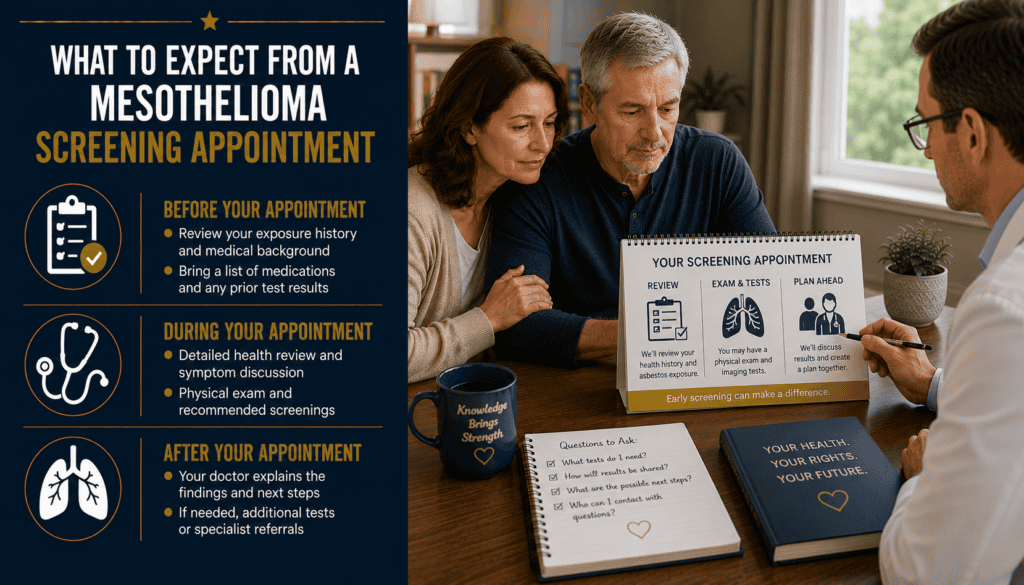
How to Talk to Your Doctor About Past Asbestos Exposure
A practical conversation guide for patients and families: what to remember, what to document and what to ask next.
If you worked around insulation, construction materials, ship equipment or other potentially asbestos-containing products decades ago, tell your doctor—even if you feel unsure about the material or cannot remember exact dates. Asbestos-related illnesses can appear many years after exposure. A clear history helps your clinician consider relevant conditions and decide whether symptoms need further evaluation. Exposure history alone does not diagnose mesothelioma, and many exposed people never develop it.
Why telling your doctor about asbestos matters
The National Cancer Institute advises people who were exposed—or suspect exposure—at work, at home or in the environment to tell their doctor and report symptoms. A doctor can interpret the history alongside your examination and other findings. Asbestos exposure is associated with mesothelioma, lung cancer and certain noncancerous lung and pleural conditions; these illnesses are not interchangeable.
| What your history helps with | What it does not establish |
|---|---|
| Identifying possible occupational or household hazards | Proof that a particular product contained asbestos |
| Considering asbestos-related and unrelated explanations for symptoms | A cancer diagnosis without appropriate testing |
| Choosing appropriate evaluation or specialist consultation | A guarantee that screening will prevent disease |
| Documenting a history for continuity of care | A reliable estimate of the dose you inhaled |
Even if you have already received a mesothelioma diagnosis, tell your cancer team about your history so it is documented accurately. For a broader overview, see how mesothelioma is diagnosed.
A simple way to start the conversation
You do not need technical vocabulary or proof of exposure to raise a concern. Explain what you remember and distinguish facts from guesses. You might say:
“I worked as a mechanic from about 1975 to 1988. I regularly handled older brake components and worked near dusty repairs. I do not know whether the materials contained asbestos. I have developed a persistent cough and would like you to record this history and advise me on an appropriate evaluation.”
| Tell the doctor | Example of useful detail |
|---|---|
| Your concern | “I may have been around asbestos at a former job.” |
| Time period | “Approximately 1978–1986; I am unsure of exact dates.” |
| Tasks and nearby work | “Removed old insulation” or “worked beside pipe repairs.” |
| Protection and conditions | “I recall visible dust; I do not remember respiratory protection.” |
| Current symptoms | “Breathlessness began in March and is becoming more frequent.” |
If you do not remember a detail, say so. Avoid filling gaps with assumptions or declaring that a specific material contained asbestos unless you have evidence.
Build a useful exposure timeline
Write a rough chronological record before the visit. A few honest notes are more useful than an elaborate history built from uncertain recollections. The clinician may ask about first exposure, frequency, duration, activities and how long ago exposure occurred.
| Approximate dates | Place or setting | Task or nearby activity | What you actually remember |
|---|---|---|---|
| 1969–1972 | Navy shipyard | Worked near insulation removal | Dust during repairs; material not identified |
| 1973–1985 | Industrial plant | Maintained pumps and valves | Replaced gaskets; composition unknown |
| 1986–1990 | Home renovation | Removed old flooring | No product label retained |
These are illustrative examples, not a patient’s actual history. Include periods when you had no known exposure if that helps establish a timeline. Bring employment records or old job descriptions if available, but do not delay a medical visit while searching for them.
Remember work, military, home and neighborhood settings
Asbestos exposure can occur through direct work, nearby work or fibers brought home on clothing. Some people may also have encountered disturbed materials in older buildings or lived near relevant industrial operations. Describe the setting and activity rather than assuming every older product contained asbestos.
| Possible setting | Details worth discussing |
|---|---|
| Construction and renovation | Building age, insulation, demolition, ceiling or flooring work |
| Shipbuilding and military service | Vessel or facility, job rating, maintenance and nearby trades |
| Industrial or mechanical work | Boilers, pipe insulation, pumps, valves, gaskets and repair activities |
| Automotive work | Dates, tasks, brake or clutch components and ventilation |
| Household contact | Family member’s work, dusty clothing, home laundering or shared vehicle |
| Environmental exposure | Residence near a mine or industrial site; dates and known events |
Tell the doctor about tobacco use and other medical conditions as well. Smoking and asbestos together substantially increase lung-cancer risk, but smoking does not appear to increase mesothelioma risk in the same way. Your history should be complete, not shaped around a presumed diagnosis.
Describe symptoms clearly—and know when to seek urgent care
Describe when symptoms began, whether they are worsening, what makes them better or worse, and how they affect daily activities. Chest symptoms can have many causes. Do not assume that an asbestos history means every symptom is mesothelioma.
| Symptom or observation | What to tell your clinician |
|---|---|
| Breathlessness | At rest or with activity; onset and progression |
| Cough or hoarseness | Duration, change and whether blood is present |
| Chest or abdominal pain | Location, severity, timing and associated symptoms |
| Unexplained weight loss or fatigue | Approximate amount and time course |
| Abdominal swelling | When it began and whether it is progressing |
Urgent safety note: Seek emergency care for severe or sudden difficulty breathing, severe chest pain, fainting or coughing up substantial blood. For persistent or worsening symptoms, contact a clinician promptly rather than waiting for a routine follow-up.
Ask what tests or referrals make sense for you
After reviewing your history and symptoms, a clinician may recommend examination, imaging, pulmonary function testing or specialist assessment. The choice depends on individual findings; no single scan or blood test can establish mesothelioma. A tissue biopsy evaluated by a pathologist is commonly important when mesothelioma is suspected.
| Possible next step | Useful question |
|---|---|
| Physical examination and review | “What conditions are you considering besides asbestos-related disease?” |
| Chest X-ray or CT | “What would this test show, and why is it appropriate for me?” |
| Pulmonary function testing | “Would measuring my breathing help evaluate these symptoms?” |
| Pulmonologist or cancer specialist | “Should I see someone experienced with asbestos-related disease?” |
| Biopsy or pathology review, if indicated | “How would the diagnosis be confirmed?” |
A normal chest X-ray does not prove that past exposure did not occur, and imaging cannot see individual asbestos fibers. There is no established screening test that reliably detects mesothelioma early in every asymptomatic asbestos-exposed person. Ask your doctor about an individualized follow-up plan. Read about mesothelioma imaging tests, pathology reviews and specialist referrals and access to care.
Questions to ask at the appointment
Bring this checklist on paper or your phone. You can ask a family member to take notes with your permission.
| Question | Why it helps |
|---|---|
| Could my symptoms be related to past exposure, or is another cause more likely? | Keeps the evaluation broad |
| Which details of my work and home history should I add to my chart? | Improves documentation |
| Do I need testing now, and what would the results change? | Clarifies benefits and limitations |
| What symptoms should prompt an earlier call or emergency care? | Creates a safety plan |
| Should I see a pulmonologist, occupational medicine clinician or mesothelioma specialist? | Clarifies referrals |
| When and how will I receive results? | Avoids missed follow-up |
| Should family members with possible household exposure speak to their own doctors? | Addresses separate exposure histories |
| Can I get a copy of my visit note and test reports? | Supports continuity of care |
For a broader printable appointment guide, visit what to ask your mesothelioma doctor at every appointment.
After the appointment: document the plan
Before leaving, confirm which tests are ordered, who will arrange them, when results are expected and whom to call if symptoms worsen. Ask that your exposure history appear in your medical record and correct any factual errors in the history through the clinic’s normal process.
| Action | Practical follow-through |
|---|---|
| Save a copy of the visit summary | Check that the exposure timeline and symptoms are represented accurately |
| Track tests and referrals | Record appointment dates and contact numbers |
| Keep results together | Save imaging reports, pathology reports and clinician notes |
| Update your timeline | Add newly remembered facts and label uncertain items |
| Arrange follow-up | Ask when to return even if initial tests are reassuring |
If the diagnosis or treatment plan remains unclear, discuss getting a second opinion. You can also use our guide to collecting medical records and the mesothelioma doctors overview. Do not postpone urgent care to collect employment records or investigate possible legal claims.
Frequently Asked Questions
What if I cannot prove that a product contained asbestos?
Tell your doctor what you observed: the job, dates, task, material appearance and dust conditions. Clearly identify what is uncertain. Medical evaluation should not wait for product identification.
Should I mention exposure from 30 or 40 years ago?
Yes. Asbestos-related illnesses can develop after long delays. Approximate dates and tasks are useful even when exposure was decades ago.
Can a doctor tell how much asbestos I inhaled?
Usually not with precision. A history can describe likely exposure circumstances, but imaging and routine medical tests do not reconstruct an exact historical dose.
Does asbestos exposure mean I have mesothelioma?
No. Exposure increases risk, but most exposed people do not develop mesothelioma. Symptoms require evaluation because they can have many causes.
Should I request a CT scan if I have no symptoms?
Ask your clinician to assess your individual history and risk. There is no universally established mesothelioma screening test for all asymptomatic exposed people, and imaging has potential harms and limitations.
What if my doctor does not ask about my old jobs?
Bring up your concern directly and offer a written timeline. Ask whether the history should change the evaluation or warrant an occupational medicine or pulmonary referral.
Should I tell the doctor about a family member’s dusty work clothes?
Yes, if you may have encountered fibers brought home on clothing or equipment. Explain who worked where and what contact you remember without assuming exposure was confirmed.
What if my tests are normal but symptoms continue?
Ask what the results do and do not rule out, which symptoms require prompt reassessment and when follow-up is appropriate. Seek urgent help for severe or sudden symptoms.
Confirmed medical sources and further reading
- National Cancer Institute: Asbestos Exposure and Cancer Risk Fact Sheet — exposure history, latency and symptoms.
- National Cancer Institute: Mesothelioma Causes and Risk Factors — asbestos and other risk factors.
- National Cancer Institute: Mesothelioma Diagnosis and Prognosis — diagnostic tests and second opinions.
- CDC: Mesothelioma Basics — symptoms and exposure settings.
These resources provide general medical information; individual evaluation and testing decisions belong with your healthcare team.
Get help understanding your options
Call 800.291.0963. Live chat is available 24/7, 365 days a year. Submit Your Case to request information about potential options. No compensation or case outcome is guaranteed.
⚕️ Legal & Medical Information Disclaimer
This page is educational and is not medical advice, a diagnosis or legal advice. Consult qualified healthcare and legal professionals about your circumstances. Do not delay emergency or necessary medical care.