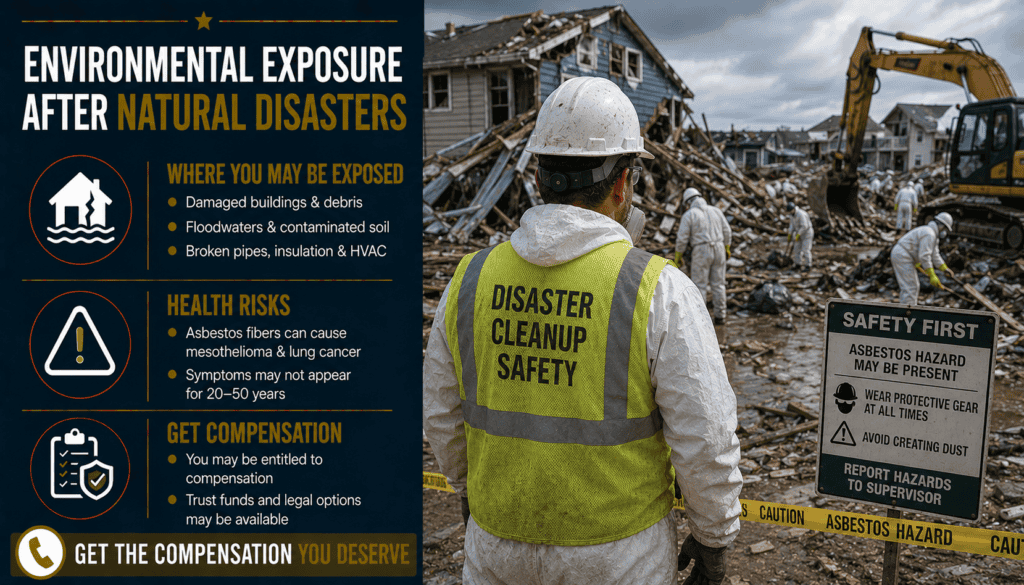
Environmental Asbestos Exposure After Natural Disasters
Hurricanes, floods, wildfires, earthquakes, tornadoes and other disasters can damage older homes, commercial buildings and industrial facilities. When building materials that contain asbestos are broken, crushed, cut or otherwise disturbed, fibers may be released into dust and debris. This can create concerns for residents, workers, emergency responders and cleanup crews.
A natural disaster does not make every damaged building an asbestos hazard, and visible dust cannot confirm asbestos. The practical approach is to recognize older materials that may require special handling, avoid unnecessary disturbance, follow public-health and environmental instructions, and document relevant exposure facts without collecting suspect material yourself.
🌪️ Why Natural Disasters Can Create Asbestos Exposure Concerns
EPA warns that cleanup of damaged buildings can involve hazardous building materials, including asbestos. Its disaster guidance advises that suspected asbestos-containing material should not be disturbed and that public-health authorities or specially trained contractors should be consulted when damaged materials may contain asbestos.
EPA’s disaster-debris guidance addresses hurricanes, earthquakes, tornadoes, volcanoes, floods, wildfires and winter storms because each can generate large quantities of mixed building debris.
For the broader topic, visit the Asbestos Exposure Lawsuit child hub.
🏚️ Disasters and Building Damage
Different disasters disturb buildings in different ways. Wind can tear roofing and siding from structures. Flooding can lead to extensive removal of walls and flooring. Fire can leave damaged structures and ash. Earthquakes and tornadoes can partially or completely collapse buildings. Heavy equipment used during demolition can further break building materials.
| Event | Potential disturbance | Investigation focus |
|---|---|---|
| Hurricane/tornado | Roof, siding, wall and structural damage | Age of structure, debris handling, cleanup tasks |
| Flood | Removal of wet flooring, walls and insulation | Materials removed and how work was performed |
| Wildfire | Burned structures, ash and mixed debris | Pre-fire building materials and cleanup activity |
| Earthquake | Collapsed or cracked structures | Demolition, debris and responder activity |
🧱 Where Asbestos May Be Found in Disaster Debris
EPA lists asbestos-containing disaster debris examples such as pipe wrap, insulation, siding, and ceiling and floor tiles. Its damaged-building guidance also identifies boiler and pipe insulation, fireproofing, floor tiles, roofing and certain transite products as materials that may contain asbestos.
These examples are screening clues, not proof. A floor tile, roof shingle or pipe covering cannot be identified as asbestos-containing merely from age or appearance. See Common Myths About Asbestos Safety and Testing.
💨 How Fibers Can Become Airborne
Asbestos is most concerning when fibers are released into the air and inhaled. Disaster damage and recovery can break materials that were previously intact. Demolition, cutting, crushing, shoveling, sweeping and movement of mixed debris can create airborne dust.
EPA specifically notes that heavy equipment running over or demolishing debris can rupture building materials and potentially release asbestos. In controlled demolition situations involving asbestos, wetting is an important method used to reduce airborne migration.
For additional exposure context, see Airborne Asbestos Fiber Levels: What’s Considered Safe?.
👷 Who May Encounter Disaster-Related Asbestos
- Residents returning to damaged homes
- Property owners and maintenance workers
- Firefighters and emergency responders
- Demolition and construction workers
- Utility and public-works crews
- Debris-removal and waste workers
- Volunteers participating in cleanup
- Contractors repairing roofs, walls, floors or mechanical systems
Presence at a disaster site alone does not establish asbestos exposure. The analysis should identify the structure, material, work activity, proximity, duration and evidence that the disturbed material actually contained asbestos.
🏠 Returning to a Damaged Home or Business
CDC advises people to wait until local authorities say it is safe before entering a damaged building. Disaster cleanup can involve structural, electrical, chemical, biological and respiratory hazards in addition to possible asbestos.
If older materials are damaged and asbestos is suspected, avoid breaking, cutting, sweeping or removing them simply to inspect them. EPA recommends seeking help from public-health authorities and trained contractors when suspected asbestos materials have been damaged or will be disturbed.
🧹 Cleanup and Debris Handling
Follow local debris-management instructions because communities may require construction debris and hazardous materials to be separated. EPA advises following local-government guidance for curbside disaster debris.
General disaster masks should not be confused with asbestos-specific occupational respiratory protection. CDC’s general cleanup guidance recommends at least a NIOSH-approved N95 for many dusty or mold-related cleanup situations, while current NIOSH wildfire-cleanup guidance says that when asbestos is known or suspected, workers should use a NIOSH-approved elastomeric half-mask respirator or higher level respirator with a particulate filter as part of an appropriate respiratory-protection program.
🔥 Wildfire Cleanup
Wildfire debris can contain ash, metals, silica, asbestos-containing building materials and other hazards depending on what burned. NIOSH advises workers to obtain information about potential hazards before cleanup and states that filtering facepiece respirators do not provide adequate protection against asbestos dust when asbestos is known or suspected.
Do not sift through burned building debris to retrieve suspected asbestos material as evidence. Photograph conditions from a safe location when permitted and preserve pre-fire property records, inspection reports, renovation records and other documentation instead.
🌊 Floods and Hurricanes
Flood and hurricane recovery often involves removing damaged walls, flooring, insulation, roofing and mechanical components. EPA warns that damaged building materials may contain asbestos and should not be disturbed when asbestos is suspected.
Flooded structures also present mold, sewage, chemical and electrical hazards. CDC recommends appropriate protective equipment during cleanup and stresses that people should follow local emergency information. Asbestos precautions should therefore be part of a broader disaster-safety plan rather than considered in isolation.
🌎 Earthquakes, Tornadoes and Structural Collapse
Structural collapse can turn previously installed materials into mixed debris. EPA’s earthquake guidance specifically warns people involved in demolition, removal and cleanup to be aware of asbestos and handle asbestos-containing materials properly.
Never enter an unstable building simply to identify possible asbestos products. Immediate structural safety takes priority, and inspection of unsafe structures belongs with trained emergency and environmental professionals.
🚒 Emergency Responders and Cleanup Workers
Responders and cleanup workers may encounter mixed hazards under urgent conditions. EPA’s catastrophic-emergency asbestos guidance specifically addresses exposure concerns for responders and people in the immediate area, cleanup and disposal of contaminated debris, demolition and renovation, and transport and disposal.
For an occupational history, document the agency or contractor, assignment, dates, location, work performed, protective equipment, debris handled and any exposure monitoring or incident reports that may exist.
📸 Documenting Possible Exposure
If it is safe and lawful to do so, document conditions before cleanup changes them. Photographs and videos can help establish the condition of a property, but they cannot determine asbestos content by appearance.
| Document | What to preserve |
|---|---|
| Photos/video | Original files, date/context, building areas and debris conditions |
| Property records | Construction date, renovations, surveys and permits |
| Work records | Employer, assignment, location, dates and tasks |
| Cleanup records | Contractor, scope of work, disposal and inspection documents |
| Testing reports | Lab, sample location, collection method and result |
| Witness information | People who directly observed conditions or work |
🔬 Inspection and Testing
Do not break or scrape damaged materials to obtain a sample yourself. Sampling can disturb material and create exposure. Qualified professionals can evaluate whether sampling is appropriate and use methods designed to minimize disturbance.
Preserve the complete laboratory report and information showing where and how a sample was collected. A positive sample from one location should not automatically be generalized to every similar-looking material throughout a disaster area.
⚖️ When Environmental Exposure Raises Legal Questions
A natural disaster itself does not automatically create legal liability for asbestos exposure. Legal questions can involve product manufacturers, premises owners, employers, contractors, cleanup companies or other parties depending on the facts and governing law.
Important questions include whether asbestos-containing material was present, who controlled the relevant work or property, what duties applied, what warnings or precautions were required, how the person encountered the material and whether a compensable disease is established.
📁 Evidence for a Later Exposure Investigation
Preserve original photographs, inspection reports, contractor documents, employment records, incident reports, cleanup assignments, medical records and witness contact information. Record exact locations and dates while memories are fresh.
For broader evidence guidance, see How to Document Your Asbestos Exposure History.
🚫 What Disaster Evidence Does Not Automatically Prove
- Visible dust does not prove asbestos was present.
- An older building does not prove every damaged material contained asbestos.
- A photograph cannot establish asbestos content by appearance alone.
- Presence in a disaster zone does not establish personal asbestos exposure.
- A positive sample from one material does not prove all debris contained asbestos.
- A mesothelioma diagnosis does not by itself identify which disaster, product or party caused an exposure.
- Current cleanup guidance does not automatically establish the legal duty that applied during a past disaster.
✅ Post-Disaster Asbestos Safety and Documentation Checklist
- Wait for authorities to say a damaged structure is safe to enter.
- Avoid disturbing suspect older building materials.
- Follow local disaster-debris instructions.
- Use qualified asbestos professionals when inspection or sampling is appropriate.
- Do not collect suspect material yourself as evidence.
- Preserve original photographs and videos.
- Record the property address and exact damaged area.
- Save building-age, renovation and asbestos-survey records.
- For workers, record employer, assignment, dates and tasks.
- Preserve PPE, training and exposure-monitoring records when available.
- Save contractor, demolition and disposal documentation.
- Keep complete laboratory reports and sample-location information.
- Record firsthand witnesses and their contact information.
- Keep medical records separate from exposure evidence.
- Check filing deadlines promptly if a legal claim is being considered.
❓ Frequently Asked Questions
Can a hurricane or earthquake release asbestos?
It can disturb asbestos-containing building materials, potentially allowing fibers to become airborne during damage, demolition or cleanup.
Does every older damaged building contain asbestos?
No. Older buildings may be more likely to contain certain asbestos materials, but age alone cannot confirm asbestos content.
Can I tell whether disaster debris contains asbestos by looking at it?
No. Visual appearance alone is not a reliable asbestos identification method.
Should I collect a piece of damaged material for testing?
Do not disturb suspect material yourself. Qualified professionals can determine whether sampling is appropriate and collect it safely.
Is an N95 enough for known asbestos cleanup?
General disaster guidance often recommends N95 respirators for dust or mold, but current NIOSH wildfire-cleanup guidance says that when asbestos is known or suspected, workers should use an elastomeric half-mask or higher-level NIOSH-approved respirator with a particulate filter under an appropriate respiratory-protection program.
Can wildfire ash contain asbestos?
Debris from burned structures can contain asbestos-containing building material when asbestos was present before the fire. The contents of a particular ash or debris pile require site-specific evaluation.
What should cleanup workers document?
Employer, assignment, location, dates, tasks, debris handled, protective equipment, training, monitoring and any incident reports can all be useful.
Can a photograph prove asbestos exposure?
No. A photograph may document conditions or materials, but asbestos content and personal exposure require additional evidence.
What if my home was flooded and needs demolition?
Follow local authorities and qualified contractors. EPA advises caution with damaged materials that may contain asbestos and provides separate requirements and guidance for demolition and debris management.
Can disaster exposure lead to an asbestos lawsuit?
Potential legal claims depend on disease, exposure evidence, potentially responsible parties, governing law and filing deadlines. Disaster presence alone is not enough.
What if exposure happened in several cleanup locations?
Document each location, date, employer or assignment and task separately so the exposure history can later be evaluated accurately.
Should I wait for symptoms before preserving exposure records?
No. Preserving accurate work and incident records can be useful regardless of whether a future legal claim develops. Exposure and disease are separate questions.
📞 Request a Case Evaluation
If you or a family member has been diagnosed with mesothelioma and previously worked in disaster response, demolition or cleanup, gather the disaster name and date, employer or agency, work locations, assignments, debris handled, protective equipment, coworkers and any environmental or asbestos testing records.
Call 800.291.0963 for a no-obligation case evaluation. Talk to a real person 24/7, 365 days a year. There are no out-of-pocket legal fees for a contingency-fee claim unless compensation is recovered. Submit your case here.
📝 Summary
Natural disasters can damage older building materials and create asbestos concerns during demolition and cleanup. Hurricanes, floods, wildfires, earthquakes and tornadoes can generate mixed debris in which asbestos-containing materials may be present. Safe response starts with structural safety, avoiding unnecessary disturbance, following local debris instructions and using qualified professionals for asbestos inspection or sampling. For later exposure investigations, preserve accurate location, work, testing, cleanup and witness records without assuming that visible dust or an older building proves asbestos exposure.
🔗 Confirmed Sources
- U.S. EPA — Dealing With Debris and Damaged Buildings
- U.S. EPA — Planning for Natural Disaster Debris
- U.S. EPA — What Is in Disaster Debris
- U.S. EPA — Catastrophic Emergency Situations Involving Asbestos
- CDC — Guidelines for Cleaning Safely After a Disaster
- NIOSH — Hazards During Wildland Fire Cleanup
Disclaimer: General information only—not legal or medical advice. This website is not a law firm. Disaster conditions can involve immediate structural, electrical, chemical, biological and respiratory hazards. Follow emergency authorities and qualified professionals. Exposure, liability, workers’ compensation and filing rules vary by jurisdiction and facts and can change. No prior result guarantees a future outcome.