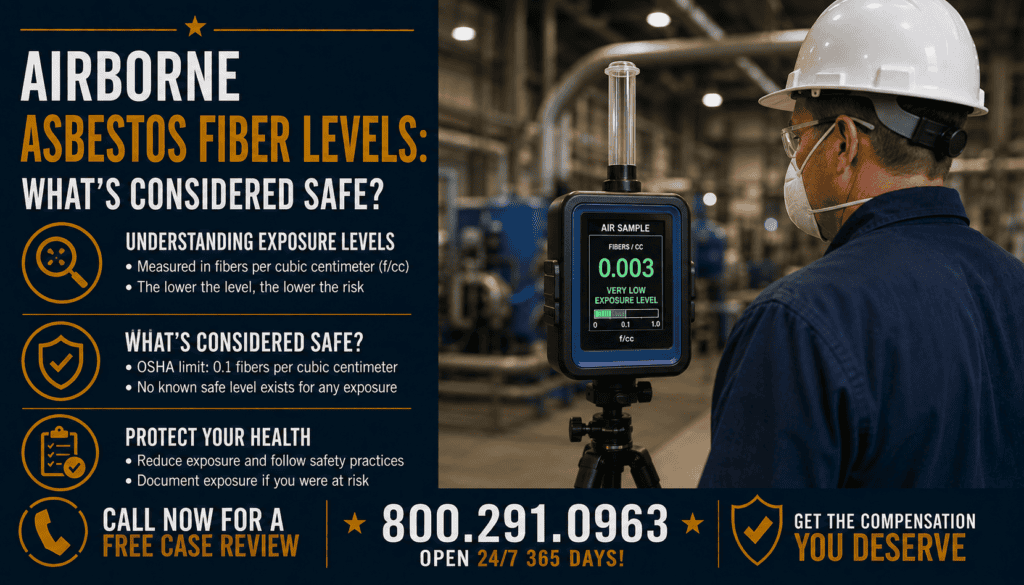
Airborne Asbestos Fiber Levels: What’s Considered Safe?
People often ask what concentration of airborne asbestos is “safe.” The answer requires an important distinction: a regulatory exposure limit is not the same thing as a guarantee of zero health risk. In U.S. workplaces covered by OSHA’s asbestos standards, employers generally must keep employee exposure at or below specified permissible exposure limits. Those limits are occupational-control standards used to trigger protective measures; they should not be interpreted as a medical promise that exposure below the number cannot contribute to disease.
Air-sampling results also require context. The sampling method, duration, location, worker task, material being disturbed and analytical technique all affect what a number means. A single measurement should not automatically be treated as a person’s lifetime dose or as proof that every worker in a building experienced the same concentration.
⚠️ Is Any Airborne Asbestos Level Completely Safe?
Public-health agencies advise avoiding asbestos exposure. ATSDR describes asbestos as dangerous and explains that disease risk depends on factors including how much asbestos is in the air, how often and how long exposure occurs, how much time has passed since exposure began, and individual factors.
For occupational regulation, OSHA sets enforceable numerical limits. These numbers answer the question “what exposure must an employer control under the standard?” They do not answer the different medical question “what concentration guarantees that no exposed person will ever develop disease?”
For the broader topic, visit the Asbestos Exposure Lawsuit hub.
📏 Understanding Fibers per Cubic Centimeter
Occupational asbestos concentrations are commonly reported as fibers per cubic centimeter of air, abbreviated f/cc. A result describes the concentration measured under a specified sampling and analytical method.
The number should always be read with its averaging period. For example, 0.1 f/cc as an eight-hour time-weighted average is not the same measurement as 0.1 f/cc during a short task.
⚖️ OSHA’s Current Workplace Limits
| OSHA limit | Current level | Averaging period |
|---|---|---|
| Permissible exposure limit (PEL) | 0.1 fiber per cubic centimeter (f/cc) | 8-hour time-weighted average |
| Excursion limit | 1.0 f/cc | 30-minute sampling period |
These limits appear in OSHA’s general-industry, construction and shipyard asbestos standards. The standards also contain monitoring, regulated-area, engineering-control, respiratory-protection, training and other requirements.
🕗 The 8-Hour Time-Weighted Average
OSHA’s current asbestos PEL is 0.1 f/cc averaged over an eight-hour workday. A time-weighted average combines concentrations over time rather than describing only the highest momentary concentration.
This matters because an employee may perform several tasks during one shift. A brief high-exposure activity and a longer low-exposure period can contribute differently to the full-shift average.
⏱️ The 30-Minute Excursion Limit
OSHA separately limits short-term exposure to 1.0 f/cc averaged over 30 minutes. Representative short-term sampling is intended to address operations most likely to produce exposure above the excursion limit.
An eight-hour average below the PEL therefore does not automatically establish compliance with the 30-minute excursion limit.
📊 Action Levels and Exposure Monitoring
OSHA’s standards use exposure monitoring to determine employee exposure and whether additional protective requirements apply. In general industry, representative measurements are based on breathing-zone samples representing full-shift and short-term exposures for employees in relevant job classifications and work areas.
Sampling should match the employee and task being evaluated. A stationary sample on the other side of a building is not automatically equivalent to a breathing-zone sample collected on the worker performing the dusty operation.
🚫 Why a PEL Is Not the Same as a Zero-Risk Level
A permissible exposure limit is an occupational regulatory limit. It establishes a maximum exposure allowed under the standard and helps determine required controls. It should not be described as a threshold below which asbestos becomes harmless.
ATSDR emphasizes prevention and recommends reducing exposure. Risk varies with concentration, frequency, duration and other factors. Accordingly, “below the OSHA PEL” and “no possible health risk” are not interchangeable statements.
This distinction is also important when reviewing historical litigation evidence. Compliance with a numerical limit may be relevant, but it does not by itself resolve medical causation, legal duty or the person’s total exposure history.
🫁 What Affects Asbestos-Related Health Risk
ATSDR identifies several factors that influence risk, including the amount of asbestos in the air, how often exposure occurs, how long exposure continues and how much time has passed since exposure began. Individual health and smoking history can also matter for some asbestos-related outcomes.
Not everyone exposed to asbestos develops disease. Likewise, the absence of immediate symptoms does not establish that an exposure was harmless because some asbestos-related diseases have long latency periods.
See Understanding the Difference Between Exposure and Disease.
🔨 When Fibers Become Airborne
Asbestos becomes an inhalation concern when fibers are released into air. ATSDR explains that disturbing asbestos-containing materials can release microscopic fibers. Activities such as cutting, sanding, crushing, demolition, renovation and handling deteriorated materials can create airborne fibers.
Material that remains intact and undisturbed can present a very different exposure situation from the same material being aggressively cut or removed.
🧱 Friable vs. Nonfriable Materials
OSHA describes friable material as material that can be crumbled with hand pressure and is therefore more capable of releasing fibers when disturbed. Sprayed-on insulation and fireproofing are examples of materials that may readily release fibers when damaged.
Some intact nonfriable products generally release fewer fibers under normal conditions but can release airborne fibers when cut, sawed, sanded, ground, broken or otherwise aggressively disturbed.
🔬 How Air Sampling Works
Personal occupational sampling commonly uses a pump to draw a known volume of air through a filter positioned in or near the employee’s breathing zone. The filter is analyzed and the measured fiber concentration is related to the sampled air volume.
A useful report should identify the employee or location, date, task, sampling start and stop times, flow rate, analytical method and result. Without this context, a bare number can be misleading.
🔍 PCM, TEM and Measurement Limitations
Phase contrast microscopy (PCM) is used in OSHA’s reference method for occupational asbestos monitoring. PCM counts fibers meeting specified dimensional criteria but does not identify every counted fiber by mineral composition.
Transmission electron microscopy (TEM) can provide more detailed fiber identification and detect much smaller structures. The methods answer somewhat different analytical questions, so results should not be compared casually without understanding the method and counting rules.
📸 Why One Air Sample Is Only a Snapshot
Airborne concentrations can change dramatically with task, material condition, ventilation, wet methods, cleanup, weather and distance from the source. One sample reflects the circumstances during its sampling period.
A sample collected after work stops cannot automatically reconstruct the concentration while material was being cut. Likewise, a high reading from one dusty task should not automatically be assigned to every employee for an entire shift or career.
🏠 Clearance and Reoccupancy Measurements
Post-abatement or clearance testing serves a different purpose from personal occupational exposure monitoring. Depending on the project and governing rules, clearance may evaluate whether a controlled work area satisfies specified criteria before containment is removed or the area is reoccupied.
A clearance result after cleanup does not establish what concentrations existed before or during removal work.
🌎 Workplace Limits vs. Environmental Exposure
OSHA PELs apply to covered occupational exposure. They should not automatically be used as residential, school, community or environmental “safe levels.” Environmental agencies and public-health programs may use different sampling approaches, risk models and cleanup criteria.
For international differences in occupational and public-health regulation, see Asbestos Public Health Regulations Worldwide.
🕰️ Historical Exposure Limits
Today’s OSHA limits should not automatically be projected backward onto employment from earlier decades. Federal occupational asbestos standards and exposure limits changed over time. Historical investigations should identify the rule, measurement method and industry standard that applied during the actual exposure period.
A modern PEL can provide current safety context, but it does not by itself establish whether an employer complied with or violated a historical duty.
📁 Using Air-Sampling Records in Exposure Investigations
Historical air-monitoring records can be valuable when they correspond to the worker’s job classification, department, task and time period. Preserve the complete report—not only the final concentration.
| Record detail | Why it matters |
|---|---|
| Date and shift | Connects the measurement to the correct period |
| Employee/job classification | Shows whom the sample was intended to represent |
| Task | Identifies the activity generating the measured conditions |
| Sampling duration | Distinguishes full-shift from short-term results |
| Location | Shows proximity to the source |
| Analytical method | Explains how fibers were counted or identified |
| Controls in use | Documents ventilation, wet methods or other measures |
For broader documentation, see How to Document Your Asbestos Exposure History.
🚫 What an Air-Sampling Result Does Not Automatically Prove
- A result below the OSHA PEL does not mean asbestos is medically harmless.
- A result above a PEL does not by itself prove that a particular disease was caused by that exposure.
- One area sample does not establish every worker’s personal exposure.
- A 30-minute sample should not automatically be treated as an eight-hour average.
- A post-cleanup clearance result does not reconstruct pre-cleanup exposure.
- PCM fiber counts do not automatically identify every counted fiber as asbestos.
- A current regulatory limit does not establish the historical limit decades earlier.
- One measurement does not represent an entire employment history without supporting evidence.
✅ Questions to Ask About an Asbestos Air Sample
- Who collected the sample?
- Was it personal breathing-zone or area sampling?
- What date and shift were sampled?
- What task was occurring?
- How long did sampling last?
- What material was being disturbed?
- Where was the sampler relative to the source?
- Were wet methods or ventilation being used?
- Was respiratory protection being worn?
- What analytical method was used?
- What fiber-counting criteria applied?
- Was the result an 8-hour TWA, 30-minute result or another measurement?
- Which employees or job classifications was it intended to represent?
- Are laboratory sheets and field notes available?
- Does the sample correspond to the claimant’s actual work period?
❓ Frequently Asked Questions
What is OSHA’s current asbestos exposure limit?
For covered workplaces, OSHA generally limits asbestos to 0.1 f/cc as an eight-hour time-weighted average and 1.0 f/cc averaged over 30 minutes.
Does 0.1 f/cc mean asbestos is safe below that number?
No. It is an occupational regulatory limit, not a guarantee of zero health risk.
What does f/cc mean?
It means fibers per cubic centimeter of air, a unit commonly used for occupational airborne fiber concentrations.
Why is there a separate 30-minute limit?
Short-duration tasks can produce concentrations that a full-shift average may not reveal. OSHA therefore has a separate excursion limit.
Can asbestos fibers be seen in the air?
Individual asbestos fibers are microscopic. Visible dust cannot be identified as asbestos simply by looking at it.
Does intact asbestos always release fibers?
No. Release depends heavily on material condition and disturbance. Cutting, sanding, grinding, demolition and deterioration can increase airborne release.
Is an area sample the same as a worker’s personal sample?
No. An area sample measures a location; a personal breathing-zone sample is designed to better represent air near the employee’s breathing zone during work.
What is PCM?
Phase contrast microscopy is a commonly used occupational fiber-counting method and is part of OSHA’s reference approach.
What is TEM?
Transmission electron microscopy provides more detailed identification and can detect smaller structures than PCM. Results depend on the analytical protocol and purpose.
Can a sample taken after asbestos removal show what workers breathed during removal?
Not necessarily. Conditions after cleanup can be very different from conditions during disturbance.
Do OSHA limits apply to homes and neighborhoods?
OSHA limits are occupational standards. Environmental and residential evaluations may use different regulatory and risk frameworks.
Can old air-monitoring records help prove exposure?
They can be useful when tied to the correct workplace, task, employee group and period, but they should be interpreted with the complete sampling context.
📞 Request a Case Evaluation
If you or a family member has been diagnosed with mesothelioma and historical asbestos air-monitoring records may exist, preserve the complete reports along with employer names, job sites, dates, tasks, departments, products, equipment and coworker information.
Call 800.291.0963 for a no-obligation case evaluation and to talk to a real person 24/7, 365 days a year. Many mesothelioma law firms handle qualifying cases on a contingency-fee basis; confirm the fee agreement and terms directly with the firm you retain. Submit your case here.
📝 Summary
OSHA currently limits occupational asbestos exposure in covered workplaces to 0.1 f/cc as an eight-hour time-weighted average and 1.0 f/cc over 30 minutes. These are enforceable workplace limits—not declarations that lower concentrations are completely risk-free. Air-sampling results must be interpreted according to sampling duration, location, task, material, analytical method and the worker represented. Historical investigations should also use the standards in force during the relevant period rather than automatically applying today’s limits to decades-old work.
🔗 Confirmed Sources
- OSHA — 29 CFR 1910.1001, General Industry Asbestos Standard
- OSHA — 29 CFR 1926.1101, Construction Asbestos Standard
- OSHA — 29 CFR 1915.1001, Shipyard Asbestos Standard
- ATSDR — Health Effects of Asbestos
- ATSDR — Preventing Asbestos Exposure
Disclaimer: General information only—not legal or medical advice. This website is not a law firm. Regulatory exposure limits are occupational-control standards and should not be interpreted as guarantees of zero health risk. Sampling results, historical standards, causation and legal responsibility require case-specific evaluation. No prior result guarantees a future outcome.