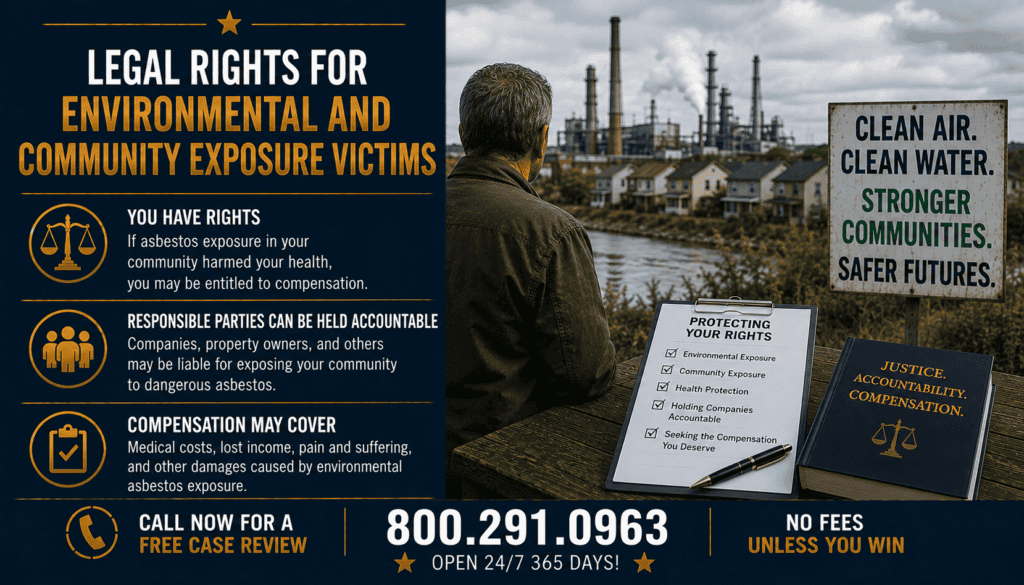
Legal Rights After Environmental Asbestos Exposure
Environmental asbestos exposure can occur outside a traditional workplace when fibers are released from industrial sites, waste disposal, demolition, contaminated soil, deteriorating asbestos-containing materials or naturally occurring deposits. ATSDR explains that asbestos fibers can enter the air when old materials or natural deposits are disturbed, and inhalation is the primary exposure pathway of public-health concern.
Legal rights after environmental exposure depend on more than proving that asbestos existed somewhere in a community. A claim generally requires evidence connecting the claimant to a meaningful exposure pathway, identifying potentially responsible parties, establishing applicable legal duties and linking the exposure to a compensable injury under the governing law.
⚖️ Environmental Asbestos Exposure & Legal Rights
Environmental exposure describes asbestos encountered in the community rather than solely through a person’s own occupational work. Potential pathways can include airborne fibers from industrial operations, waste sites, demolition, contaminated neighborhoods, transported dust or naturally occurring asbestos.
Exposure Alone and a Legal Claim Are Different
A history of living near a facility can be an important starting point, but proximity alone does not necessarily establish exposure dose, causation or legal responsibility. Site history, release evidence, environmental testing, residence dates and individual activity patterns can all matter.
Mesothelioma Has a Long Latency
ATSDR states that mesothelioma signs may not appear until 30 to 40 years after asbestos exposure. That latency can make historical environmental records especially important.
Rights Are State- and Fact-Specific
Potential causes of action, eligible plaintiffs, damages, proof standards and filing deadlines vary by jurisdiction. Government cleanup authority and a private damages claim are also separate legal questions.
🏭 Common Environmental Exposure Sources
EPA states that asbestos contamination addressed at Superfund sites can result from past industrial operations or improper waste disposal. It also identifies manufacturing and processing facilities, deteriorating asbestos products, demolition and naturally occurring asbestos as potential environmental contexts.
| Potential source | Evidence worth investigating |
|---|---|
| Industrial facility | Operations, emissions, waste practices and historical permits |
| Asbestos mine or processing site | Production history, waste areas, transport routes and environmental studies |
| Improper disposal | Waste manifests, dumping records, site investigations and cleanup documents |
| Demolition | Building surveys, abatement records, demolition permits and enforcement files |
| Contaminated soil | Sampling results, maps, disturbance history and remediation records |
| Naturally occurring asbestos | Geologic maps, soil studies and activity-related exposure assessments |
Disturbance Matters
ATSDR notes that fibers become airborne when asbestos-containing materials or natural deposits are disturbed. Relevant factors include the material, location, weather, moisture and intensity of the disturbing activity.
Environmental Exposure Can Be Intermittent
A person may have lived, attended school, recreated or worked near a source for only part of the relevant period. A useful exposure history should therefore identify dates, locations and activities rather than assuming continuous exposure.
🏢 Identifying Potentially Responsible Parties
Environmental asbestos cases can involve more than one entity. Potential responsibility must be evaluated separately for each defendant.
Facility Owners and Operators
Historical ownership and operational control can be important, but ownership by itself does not automatically establish tort liability. The governing legal duty and conduct must be evaluated.
Manufacturers and Processors
A company that manufactured or processed asbestos-containing material may be relevant when records connect its operations or waste to the environmental pathway at issue.
Contractors and Waste Handlers
Demolition, abatement, transportation or disposal contractors can become relevant if evidence shows conduct that released or improperly managed asbestos and if applicable law supports liability.
Successor and Bankrupt Entities
Historical companies may have merged, reorganized or entered bankruptcy. Corporate-successor law and asbestos trust procedures are separate issues that require defendant-specific research.
Government Involvement Does Not Automatically Create Government Liability
A government agency’s investigation or cleanup of a site does not necessarily mean the government caused the contamination or is liable for a private claimant’s injury.
📂 Evidence Needed to Document Exposure
Environmental claims often require reconstruction of both the source and the claimant’s pathway to that source.
| Evidence category | Examples |
|---|---|
| Residence history | Addresses, leases, deeds, school records and utility records |
| Source history | Facility operations, waste disposal, demolition and ownership records |
| Environmental evidence | Air, soil or dust sampling and agency investigations |
| Pathway evidence | Distance, wind/dust patterns, activities and routes of contact |
| Witnesses | Neighbors, workers, family members and community residents |
| Medical evidence | Diagnosis, pathology and relevant medical history |
| Government records | EPA, ATSDR, state and local environmental files |
Testing Must Be Interpreted Carefully
A modern sample showing asbestos at a location does not automatically establish the concentration or exposure conditions decades earlier. Historical records and expert analysis may be needed to evaluate past conditions.
Maps Can Help Build a Timeline
Plot residences, schools, workplaces, contaminated sites and relevant dates. Geographic proximity becomes more useful when paired with evidence showing when releases or disturbances occurred.
Do Not Discard Original Records
Preserve original photographs, letters, maps, reports and other records along with information about where they came from. Authentication and provenance can matter later.
🏛️ EPA, Superfund & Public Records
EPA’s Superfund program can address abandoned hazardous-waste sites and can clean up sites, compel responsible parties to perform cleanup or seek reimbursement for EPA-led cleanup under CERCLA. EPA specifically states that environmental asbestos resulting from industrial operations or improper disposal may be addressed through Superfund.
Cleanup Records Can Be Valuable Evidence
Site profiles, remedial investigations, removal-action reports, sampling data, responsible-party documents and public-health assessments can help reconstruct contamination history. Their legal significance in an individual tort case must still be evaluated.
ATSDR Public-Health Evaluations
ATSDR evaluates environmental exposures at specific sites, including asbestos associated with natural deposits, mining operations, buildings and processed asbestos products. Its reports can provide historical context, but the agency cautions that older reports reflect information available when issued.
CERCLA Citizen Suits Are Narrower Than Personal-Injury Claims
EPA explains that CERCLA §310 permits specified citizen suits concerning violations of CERCLA standards, requirements, orders or failures to perform nondiscretionary duties, subject to notice and other statutory restrictions. That enforcement mechanism is different from an individual state-law claim seeking damages for mesothelioma.
Cleanup Does Not Resolve Every Private Claim
A government remediation action can reduce ongoing exposure while leaving separate questions about historical exposure, causation, damages and private liability.
📝 Potential Legal Claims & Compensation
Depending on the jurisdiction and facts, environmental asbestos litigation can involve negligence, premises liability, product liability, nuisance or other legal theories. No single theory applies automatically to every contaminated site.
Personal Injury Claims
A person diagnosed with mesothelioma may investigate whether environmental exposure can be linked to legally responsible defendants and whether the evidence satisfies applicable causation standards.
Wrongful Death Claims
If the exposed person has died, state wrongful-death and survival laws determine who may file, what damages may be available and the applicable deadlines.
Property and Cleanup Claims
Claims involving contaminated property or remediation costs can raise different legal issues from a personal-injury case. Ownership, contamination, response costs and statutory environmental remedies may require separate analysis.
Community Cases Still Require Individual Proof
Several residents may share evidence about a source or contamination event, but an individual disease claim generally still requires claimant-specific exposure, medical and damages evidence.
Explore Community Lawsuits Holding Polluting Companies Accountable and Legal Rights for Environmental and Community Exposure Victims.
⏳ Filing Deadlines & Jurisdiction
Environmental asbestos claims can involve events decades before diagnosis, making statutes of limitations and choice-of-law issues particularly important.
Diagnosis and Discovery Rules
Many jurisdictions have special accrual or discovery principles for latent injuries, but the exact rule varies. Do not assume a deadline begins on the date of original exposure.
Wrongful Death May Have a Separate Deadline
A death can trigger a distinct wrongful-death limitations period. It should not be assumed that the deceased person’s personal-injury deadline and the family’s wrongful-death deadline are identical.
Multiple States Can Be Involved
A claimant may have lived near contamination in one state, later moved elsewhere and filed in another jurisdiction. Courts can apply choice-of-law rules to determine which substantive law governs particular issues.
Government Claims Can Have Special Procedures
If a government entity is a potential defendant, statutes can impose administrative presentment or notice requirements in addition to ordinary limitations periods.
🧭 Steps to Take After Suspected Exposure
- Do not disturb suspected asbestos. ATSDR recommends avoiding disturbance of materials that may contain asbestos and consulting appropriate environmental authorities or trained professionals when material is deteriorating or must be removed.
- Write down the exposure history. Record addresses, dates, nearby facilities, demolition activity, dusty conditions and household activities that may have created contact.
- Preserve records. Save photographs, property records, news notices, agency letters, sampling reports and community communications.
- Locate government files. Check EPA, ATSDR, state environmental agencies and local health or building departments for site-specific records.
- Identify witnesses. Record names and contact information for neighbors, former workers and others with firsthand knowledge.
- Discuss health concerns with a medical provider. ATSDR advises people concerned about exposure to provide a detailed exposure and medical history so a clinician can determine whether further evaluation is appropriate.
- Review legal deadlines promptly after diagnosis. Do not wait for a cleanup investigation to finish before checking a potentially applicable filing deadline.
Avoid Self-Collection That Creates New Exposure
Do not scrape, sweep, sand or collect suspected asbestos material without appropriate professional guidance. Disturbance can release fibers and create additional exposure.
❓ Frequently Asked Questions
What is environmental asbestos exposure?
It generally refers to exposure occurring through the surrounding community or environment rather than solely from the person’s own occupational handling of asbestos.
Can living near an asbestos site support a legal claim?
Potentially, but proximity alone is usually not enough. Evidence should address the contamination source, exposure pathway, timing, medical injury and responsible parties.
Can asbestos in soil become an exposure concern?
Yes. ATSDR explains that disturbing soil containing natural asbestos or old asbestos-containing products can release fibers into the air.
Can EPA clean up asbestos contamination?
EPA states that Superfund can address asbestos contamination resulting from circumstances such as past industrial operations or improper waste disposal, subject to CERCLA authority and site-specific conditions.
Does a Superfund designation prove a company caused my mesothelioma?
No. A site designation or cleanup record can provide important environmental evidence, but an individual claim still requires claimant-specific causation and liability analysis.
Can community members use the same evidence?
They may share source and site-history evidence, but each person’s residence history, exposure pathway, medical evidence and damages can differ.
Should old environmental reports be preserved?
Yes. Historical reports can be important, but their date, methodology and limitations should be retained so they can be interpreted accurately.
Can a citizen suit under CERCLA provide personal-injury damages?
CERCLA’s citizen-suit provision is an enforcement mechanism with specific statutory requirements. It should not be treated as the same thing as a state-law personal-injury action.
When does the filing deadline start?
That depends on the jurisdiction and claim. Latent-disease, discovery and wrongful-death rules can differ.
What should someone do if they are currently worried about asbestos exposure?
Avoid disturbing suspected asbestos, follow environmental-health guidance and discuss the exposure history with an appropriate medical provider.
📞 Request a Case Evaluation
If mesothelioma may be connected to environmental asbestos, begin documenting where the person lived, worked, attended school or regularly spent time; nearby industrial or disposal sites; relevant dates; government investigations; environmental testing; witnesses; and medical records.
Call 800.291.0963 for a no-obligation case evaluation and to talk to a real person 24/7, 365 days a year. Many mesothelioma law firms handle qualifying cases on a contingency-fee basis; confirm the fee agreement and terms directly with the firm you retain. Submit your case here.
📝 Summary
Environmental asbestos exposure can arise from industrial operations, waste disposal, demolition, contaminated soil, deteriorating materials and naturally occurring deposits. A legal claim requires more than showing that asbestos existed in the community: the evidence should reconstruct the source, pathway, claimant’s presence, responsible parties, medical injury and applicable legal duties. EPA, ATSDR and state or local records can provide important historical evidence, while state law determines private liability, damages and filing deadlines.
🔗 Confirmed Sources
- ATSDR — Asbestos and Your Health
- ATSDR — Preventing Asbestos Exposure
- U.S. EPA — Asbestos at Superfund Sites
- U.S. EPA — Asbestos Laws and Regulations
Disclaimer: General educational information only—not legal, environmental, medical or remediation advice. Environmental exposure, causation, responsible-party liability, CERCLA remedies, state-law claims, damages and filing deadlines depend on jurisdiction and case-specific facts. Do not disturb suspected asbestos-containing material without appropriate professional guidance. Past results do not guarantee future outcomes.