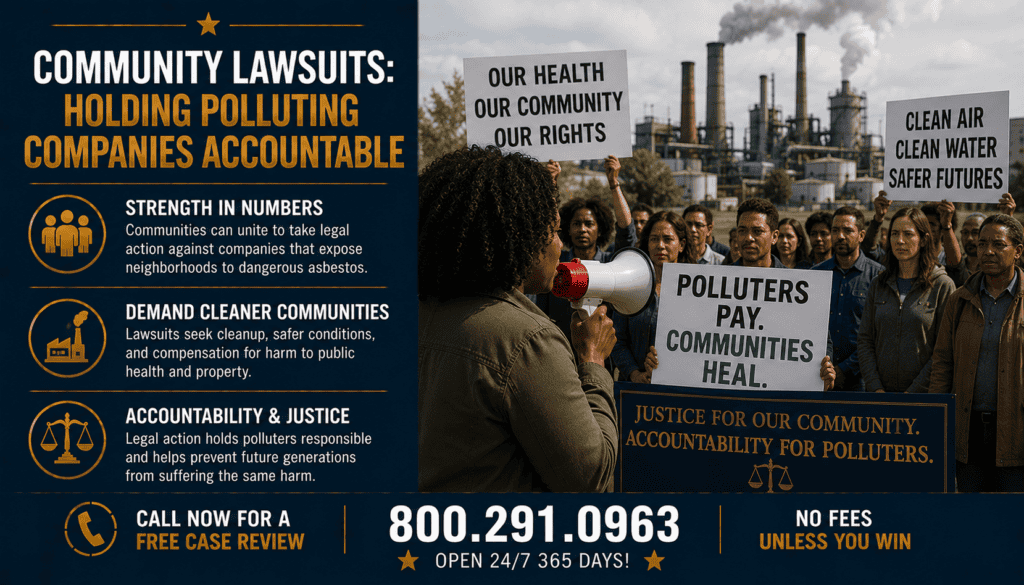
Community Lawsuits: Holding Polluting Companies Accountable for Asbestos Exposure
Community asbestos cases can arise when people allege exposure outside a traditional workplace—for example, from industrial emissions, demolition or renovation activity, waste handling, contaminated property, neighborhood dust, or asbestos carried beyond a facility. A lawsuit can seek to determine whether a particular company had a legal duty, violated that duty, caused the claimed exposure and injury, and owes damages under applicable state law.
Environmental regulation and personal-injury litigation are related but distinct. EPA and other agencies can enforce asbestos emission, demolition, waste or cleanup requirements, while an individual civil claim generally requires claimant-specific evidence of exposure, causation, defendant responsibility and damages. A regulatory violation can be important evidence, but it does not automatically establish every element of a mesothelioma lawsuit or prove that every nearby resident was exposed.
🏘️ What a Community Asbestos Lawsuit Can Involve
A “community lawsuit” is not one single legal cause of action. The term can describe claims by residents or families who allege asbestos exposure from activities occurring beyond their own occupational work. Depending on the facts and jurisdiction, theories can involve negligence, premises liability, product liability, nuisance, trespass or other state-law claims.
Some disputes involve one claimant and one defendant; others can involve many residents, companies or exposure sources. Procedural devices such as joinder, consolidation or class treatment have separate legal requirements and should not be assumed merely because several people lived near the same facility.
🏭 Potential Sources of Community Exposure
Potential community exposure sources should be investigated specifically rather than described as generic “pollution.” EPA’s asbestos NESHAP regulates asbestos emissions and work practices in covered demolition and renovation operations, waste handling and certain industrial activities. The rules are intended to minimize asbestos-fiber releases.
| Potential source | Evidence questions |
|---|---|
| Industrial facility | What asbestos materials or processes existed, and were fibers released beyond the work area? |
| Demolition/renovation | Was asbestos inspected, removed, wetted, contained and disposed of as required? |
| Waste handling | Where was asbestos waste generated, transported and disposed? |
| Contaminated property | What testing or historical records establish asbestos contamination? |
| Neighborhood dust | What evidence links the dust to asbestos and to a specific source? |
| Take-home pathway | Did a household member bring asbestos fibers home from covered work? |
🔎 Evidence Needed for Individual Exposure
Living near an industrial facility does not by itself prove asbestos exposure. A claimant’s history should identify the residence or community location, years lived there, distance and direction from alleged sources, observed dust or releases, nearby activities, household members’ occupations and other potential exposure pathways.
Environmental sampling, historical air-monitoring data, facility records, permits, inspection reports, photographs, property records, government investigations and witness testimony can help evaluate whether asbestos was released and whether a plausible pathway reached the claimant.
Medical evidence establishes diagnosis and treatment but generally does not identify the responsible company by itself. Exposure-source evidence should be developed separately.
See How Attorneys Build an Asbestos Exposure Timeline and Building a Strong Mesothelioma Case From Limited Records.
⚖️ Identifying Legally Responsible Companies
A civil lawsuit requires a legally supportable theory against each defendant. Depending on applicable law, an investigation may examine facility owners or operators, product manufacturers, contractors, waste handlers, transporters or other entities connected to the alleged release.
Corporate ownership can change over decades. A current company may not necessarily be legally responsible for conduct of a former operator, and a historical company may have reorganized, dissolved or entered bankruptcy. Corporate-successor and bankruptcy issues require separate legal analysis.
| Question | Why it matters |
|---|---|
| Who controlled the facility or activity? | Helps identify potentially relevant duties and conduct. |
| What asbestos source is alleged? | Connects the defendant to a specific exposure theory. |
| When did the conduct occur? | Ownership, products and regulations can change over time. |
| What evidence shows a release? | Distinguishes documented contamination from assumption. |
| How did exposure reach the claimant? | Supports claimant-specific exposure and causation analysis. |
🌎 Environmental Rules and Asbestos Emissions
EPA’s asbestos National Emission Standards for Hazardous Air Pollutants, or NESHAP, establish work practices for covered demolition and renovation activities. EPA states that regulated operations can require a thorough inspection, notification, asbestos-emission controls, wetting, leak-tight waste handling and proper disposal.
EPA also conducts compliance monitoring with state and local air programs. Inspectors can review notification documents, inspect job sites and collect physical evidence to document compliance or noncompliance.
These federal rules do not cover every possible asbestos situation in the same way. For example, EPA describes a limited residential-building exclusion, while larger commercial or public demolition projects can bring residential structures within NESHAP coverage. State and local asbestos rules can impose additional requirements.
🏛️ Government Enforcement vs. Private Lawsuits
Government enforcement is different from a resident’s personal-injury lawsuit. EPA and the Department of Justice can pursue Clean Air Act asbestos violations and other environmental enforcement matters. A recent example is United States v. Applied Partners, LLC, in which DOJ reported that the company pleaded guilty to Clean Air Act violations involving regulated asbestos-containing material during demolition and was sentenced in June 2026.
That enforcement action illustrates that asbestos work-practice violations can lead to government penalties, but it should not be generalized to unrelated companies or communities. A private mesothelioma claimant must still establish the elements required by the applicable civil law.
CERCLA, or Superfund, provides another distinct enforcement framework for hazardous-substance cleanup. EPA can identify potentially responsible parties, order or negotiate cleanup and recover qualifying response costs. Superfund cleanup liability should not be confused with proving personal-injury damages in an asbestos tort case.
🧩 Multiple Companies and Shared Responsibility
A community exposure history can involve more than one industrial source, facility operator, contractor or product. When evidence supports claims against several defendants, each company’s connection should be evaluated independently.
Allocation rules vary by state. A jurisdiction may use joint and several liability, several liability or a modified system, and settlement credits or contribution rules can affect how responsibility is ultimately divided. There is no nationwide asbestos rule that simply divides damages equally by the number of defendants.
See How Multi-Defendant Mesothelioma Lawsuits Work and Understanding Shared Liability in Multi-Company Asbestos Cases.
💵 Damages and Other Forms of Relief
A successful personal-injury claim may allow legally recoverable economic and noneconomic damages under the governing state law. Economic damages can include documented medical expenses and lost earnings where recoverable. Noneconomic damages can address legally recognized nonfinancial harm, subject to state rules.
Environmental litigation can also seek forms of relief that differ from individual mesothelioma damages. Government actions can require cleanup, compliance measures, penalties or reimbursement of response costs. Certain environmental statutes also contain citizen-suit provisions, but those provisions have specific jurisdictional, notice and procedural requirements and should not be treated as substitutes for a personal-injury lawsuit.
See Mesothelioma Claims.
⏳ Filing Deadlines and Long-Latency Disease
Community exposure can occur decades before mesothelioma is diagnosed. State law determines when a personal-injury or wrongful-death claim accrues and how long a claimant has to file. Discovery rules, statutes of repose and other provisions can differ substantially.
Environmental enforcement and citizen-suit deadlines are separate from personal-injury statutes of limitations. Filing a complaint with an environmental agency should not be assumed to preserve a mesothelioma lawsuit deadline.
See Mesothelioma Deadlines & Statute of Limitations and Mesothelioma Lawsuits in All 50 States.
❓ Frequently Asked Questions
What is a community asbestos lawsuit?
It generally describes a civil claim involving alleged non-occupational or neighborhood asbestos exposure. The actual legal causes of action depend on state law and the facts.
Does living near an asbestos-related facility prove exposure?
No. A claimant generally needs evidence supporting a pathway from an asbestos source to the person, along with the other elements required by applicable law.
Can a company be liable for asbestos released during demolition?
Potentially. Liability depends on the company’s role, the release, applicable duties and regulations, claimant-specific exposure, causation and state law.
Does violating EPA asbestos rules automatically prove a mesothelioma lawsuit?
No. A regulatory violation may be relevant evidence, but a personal-injury claimant still must establish the required civil-law elements.
Can EPA make a polluting company pay for cleanup?
Under CERCLA and other authorities, EPA can pursue potentially responsible parties for qualifying hazardous-site cleanup work or costs. That is separate from an individual damages claim.
Can several companies share responsibility for community asbestos exposure?
Potentially. Multiple defendants can be involved when evidence supports separate claims, but allocation and contribution rules depend on jurisdiction.
Can residents bring an environmental citizen suit?
Some federal environmental laws contain citizen-suit provisions, but standing, notice, jurisdiction and statutory requirements must be satisfied. A citizen suit is not automatically a mesothelioma damages action.
Does an environmental agency complaint extend a mesothelioma filing deadline?
Not necessarily. Agency enforcement, environmental citizen suits and personal-injury litigation use different legal procedures and deadlines.
📞 Submit Your Case
If you or a loved one developed mesothelioma after suspected community or environmental asbestos exposure, preserve the location and exposure history now. Record residences, nearby facilities, dates, household occupations, visible dust events, demolition or industrial activity, witnesses and any government testing or enforcement records. These details can help distinguish a documented exposure pathway from assumptions based only on proximity.
Call 800.291.0963 for a no-obligation case evaluation. Live chat is available 24/7, 365 days a year. Submit your case here.
📝 Summary
Community asbestos lawsuits can address alleged exposure from industrial operations, demolition, waste, contaminated property or other non-occupational pathways, but each claim requires evidence supporting the claimant’s exposure and the defendant’s legal responsibility. EPA’s asbestos NESHAP regulates covered asbestos emissions from demolition, renovation and waste handling, while government enforcement can impose compliance obligations and penalties. CERCLA provides separate cleanup and cost-recovery authorities. These public enforcement systems can create useful evidence, but they do not automatically establish an individual mesothelioma damages claim.
🔗 Confirmed Sources
- U.S. EPA — Asbestos National Emission Standards for Hazardous Air Pollutants
- U.S. EPA — Overview of the Asbestos NESHAP
- U.S. EPA — Asbestos Demolition and Renovation Compliance Monitoring
- U.S. EPA — Superfund Enforcement Authorities
- U.S. EPA — Superfund Liability
- U.S. Department of Justice — Environmental Enforcement Section
- U.S. Department of Justice — United States v. Applied Partners, LLC
- Cornell Legal Information Institute — 42 U.S.C. §6972, RCRA Citizen Suits
This page provides general information, not legal or medical advice. This website is not a law firm. Community asbestos exposure, regulatory violations, environmental liability, defendant responsibility, causation, damages, citizen-suit rights and filing deadlines depend on individual facts and applicable law. Living near an industrial site does not by itself establish asbestos exposure or liability against a particular company. Government enforcement does not automatically establish a private mesothelioma claim. No settlement, verdict, cleanup recovery or other outcome is guaranteed.