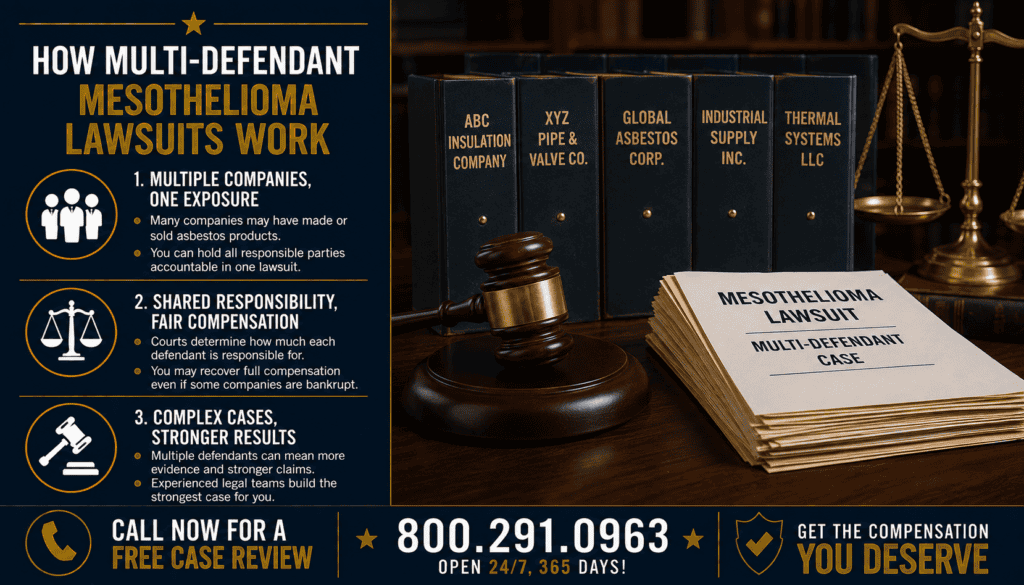
How Multi-Defendant Mesothelioma Lawsuits Work
A mesothelioma exposure history can involve asbestos-containing products, equipment, contractors, premises, employers or suppliers connected to different periods of a person’s working life. When the evidence supports legally distinct claims against more than one responsible entity, a lawsuit may name multiple defendants. Each defendant still must be evaluated separately; being named alongside another company does not automatically establish exposure, liability or damages.
Multi-defendant litigation can become complex because defendants may possess different records, raise different defenses and resolve claims at different times. Discovery can proceed across several parties, while settlements may remove some defendants before trial. State substantive law controls important questions involving fault allocation, contribution, setoffs and damages, while procedural rules determine how claims and parties are managed in the particular court.
🏭 Why One Case May Name Multiple Defendants
Asbestos exposure may have occurred at more than one jobsite or through more than one product. A worker might have encountered insulation during one period, pumps or valves during another, and asbestos-containing replacement components at a later employer. A multi-defendant complaint can reflect that history when evidence supports claims against multiple entities.
The purpose is not to name every company historically associated with asbestos. A defensible case should connect each defendant to evidence relevant to the claimant’s actual exposure history and the legal theory asserted against that defendant.
| Potential entity | Evidence questions |
|---|---|
| Product manufacturer | Was its product present during the relevant time and connected to the claimant’s work? |
| Equipment manufacturer | What equipment/components were present and what evidence links them to exposure? |
| Supplier/distributor | What records show supply of the relevant product to the jobsite? |
| Premises owner | What duty and control existed under applicable state law? |
| Contractor | What work did it perform and how does that work relate to the claimed exposure? |
🔎 Identifying Defendant-Specific Exposure
The exposure timeline should be built before defendant-specific theories are treated as established. Employment records, Social Security information, jobsite records, invoices, equipment documents, product catalogs, photographs and coworker testimony can help connect particular companies to particular periods.
A strong timeline separates documented facts from recollection and unresolved questions. Evidence that a company’s product existed somewhere in a large facility is not necessarily evidence that the claimant encountered that product. Frequency, location, task, timing and the circumstances of disturbance can all become disputed factual issues.
See How Attorneys Build an Asbestos Exposure Timeline and Building a Strong Mesothelioma Case From Limited Records.
⚖️ How Multiple Defendants Can Be Joined
In federal court, Rule 20 of the Federal Rules of Civil Procedure permits multiple defendants to be joined in one action when the asserted right to relief arises out of the same transaction, occurrence, or series of transactions or occurrences and a question of law or fact common to all defendants will arise in the action. State procedural rules can differ.
Joinder does not erase the distinctions among defendants. Rule 20 also allows a court to issue protective measures, including separate trials, to address delay, expense, embarrassment or prejudice associated with the inclusion of a party.
Rule 42 gives federal courts additional case-management authority when actions involve common questions of law or fact. A court can consolidate appropriate matters or order separate trials for convenience, to avoid prejudice, or to expedite and economize proceedings.
📂 Discovery in a Multi-Defendant Case
Discovery can be especially important when evidence is distributed among several defendants. Federal Rule 26 generally permits discovery of nonprivileged information relevant to a party’s claim or defense and proportional to the needs of the case.
In covered federal cases, initial disclosures can include individuals likely to have discoverable information, documents or electronically stored information that a party may use to support its claims or defenses, and a computation of claimed damages with supporting material. Each defendant may therefore produce different records and identify different witnesses.
| Discovery target | Possible subject |
|---|---|
| Manufacturer | Product specifications, historical sales, warnings and corporate records |
| Supplier | Invoices, purchase orders and customer/jobsite records |
| Premises entity | Facility specifications, maintenance records and contractor files |
| Coworkers/witnesses | Products, work practices, locations and overlapping employment |
| Claimant | Employment, exposure, medical history and damages evidence |
🧩 Each Defendant Can Raise Its Own Defenses
Defendants do not necessarily share the same defense. One may dispute product identification, another may dispute whether its product contained asbestos during the relevant years, another may challenge causation, and another may raise a jurisdiction, limitations or duty issue.
A defendant can also point to other alleged exposure sources. That makes defendant-specific evidence important throughout the case. The existence of multiple potential sources does not automatically establish or eliminate any particular defendant’s liability; the governing causation and allocation rules depend on applicable law and evidence.
🤝 Defendants May Settle at Different Times
Multi-defendant cases do not necessarily resolve through one global settlement. One defendant may settle while another continues discovery or prepares for trial. A settlement with one party generally resolves the claims against that settling party according to the agreement; it does not automatically resolve claims against every remaining defendant.
Settlement timing can depend on evidence, litigation posture, insurance, bankruptcy status, jurisdiction and each defendant’s evaluation of risk. There is no guaranteed sequence or amount, and a claimant should not assume that one settlement predicts what another defendant will offer.
📊 Allocation and Setoffs Depend on State Law
When several entities may share responsibility, state law becomes critical. Jurisdictions differ in how they allocate fault or responsibility, when joint or several liability applies, whether contribution is available among defendants, and how settlements with one defendant affect claims or judgments involving others.
Because these rules vary, there is no universal formula such as dividing damages equally by the number of defendants. A company’s share may depend on the state’s substantive law, the evidence, jury findings, settlement credits and other case-specific factors.
🏛️ What Happens if Multiple Defendants Remain for Trial
If defendants remain when a case reaches trial, the court determines how claims and issues will be presented under the governing procedural rules. Federal Rule 42 permits consolidation where common questions exist and also permits separate trials of issues or claims when appropriate for convenience, avoiding prejudice, or efficiency.
The jury instructions and verdict form can depend on the jurisdiction and claims. They may require findings specific to individual defendants rather than a single undifferentiated conclusion about all companies. Some defendants may have settled or otherwise left the case before trial, which can further affect how the remaining issues are presented under state law.
See What to Expect if the Case Goes to Trial vs. Settlement.
🏦 Asbestos Trusts and Solvent Defendants
A multi-source exposure history can also include companies that entered bankruptcy and established asbestos trusts. Trust claims are generally administered separately from lawsuits against solvent defendants, even though some of the underlying work-history and exposure evidence may overlap.
Bankruptcy trust evidence, disclosures and payments can interact with civil litigation in ways that vary by jurisdiction and case. They should therefore be coordinated carefully rather than treated as completely unrelated files or assumed to produce a universal dollar-for-dollar reduction.
Federal multidistrict litigation is another distinct concept. Under 28 U.S.C. §1407, civil actions pending in different federal districts that share common factual questions can be transferred for coordinated or consolidated pretrial proceedings when the statutory requirements are met. That is not the same thing as simply having multiple defendants in one mesothelioma lawsuit.
❓ Frequently Asked Questions
Why can a mesothelioma lawsuit name multiple defendants?
Because a claimant’s asbestos exposure history may involve products, equipment, premises or activities connected to more than one legally relevant entity.
Does naming a company mean that company is automatically liable?
No. Liability must be supported under the governing law and evidence. Each defendant can dispute exposure, causation, duty, damages or other elements.
Can several defendants be included in one federal lawsuit?
Potentially. Federal Rule 20 permits joinder when its transaction-or-occurrence and common-question requirements are satisfied. State rules can differ.
Does every defendant see the same evidence?
Discovery obligations and protective orders govern information exchange. Different defendants may possess and produce different company-specific evidence.
Can one defendant settle while the others continue litigating?
Yes. Claims against defendants can resolve at different times, subject to the settlement terms and applicable law.
Are damages divided equally among all defendants?
Not necessarily. Allocation, fault, contribution and settlement-credit rules vary by jurisdiction and case.
Can asbestos trust claims exist alongside lawsuits against solvent companies?
Yes, potentially. Trust claims and civil lawsuits are separate processes, though exposure evidence, disclosures and payment-credit rules can interact.
Will every multi-defendant case go to one trial?
No. Courts have case-management authority, and defendants can settle or otherwise leave the case before trial. Procedural rules can also permit consolidation or separate trials in appropriate circumstances.
📞 Submit Your Case
If a mesothelioma exposure history spans several employers, jobsites, products or decades, preserve records before deciding which companies may be legally relevant. Employment records, Social Security information, invoices, photographs, equipment documents, coworker names and military records where applicable can help build a defendant-specific exposure timeline.
Call 800.291.0963 for a no-obligation case evaluation. Live chat is available 24/7, 365 days a year. Submit your case here.
📝 Summary
Multi-defendant mesothelioma lawsuits can arise when evidence connects a claimant’s exposure history to more than one entity. Each defendant remains a separate party with its own evidence and defenses. Federal procedural rules provide mechanisms for joining appropriate defendants, conducting proportional discovery, consolidating common matters and ordering separate trials when necessary. Individual defendants may settle at different times, while state law controls important allocation, setoff, contribution and damages questions. Asbestos trust claims can also coexist with litigation against solvent defendants.
🔗 Confirmed Sources
- Cornell Legal Information Institute — Federal Rule of Civil Procedure 20, Permissive Joinder of Parties
- Cornell Legal Information Institute — Federal Rule of Civil Procedure 26, Discovery
- Cornell Legal Information Institute — Federal Rule of Civil Procedure 42, Consolidation and Separate Trials
- Cornell Legal Information Institute — 28 U.S.C. § 1407, Multidistrict Litigation
This page provides general information, not legal or medical advice. This website is not a law firm. Joinder, exposure evidence, causation, defendant liability, discovery, settlement credits, fault allocation, contribution, asbestos trust coordination, filing deadlines and damages depend on individual facts, the court and applicable law. Naming multiple defendants does not establish liability against any particular company. No settlement, verdict, trust payment, timeline or outcome is guaranteed.