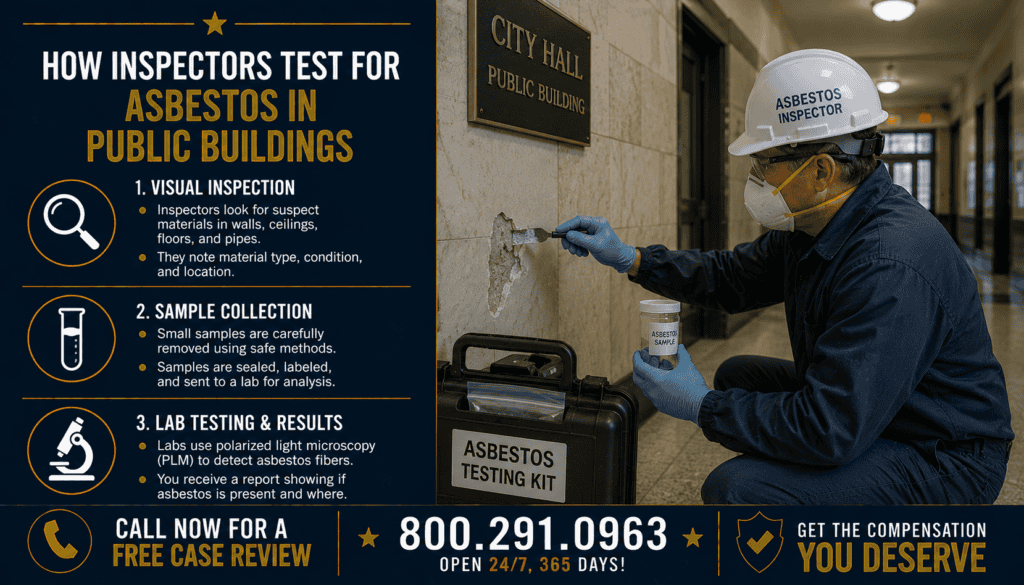
🔬 How Inspectors Test for Asbestos in Public Buildings
Asbestos cannot be reliably identified just by looking at a building material. In public buildings, a professional asbestos investigation may involve reviewing historical records, inspecting suspect materials, documenting their locations and condition, collecting representative bulk samples when appropriate, and having those samples analyzed by a qualified laboratory.
The exact inspection process depends on why the building is being evaluated, the applicable federal, state and local requirements, the building type and whether renovation or demolition is planned. This page explains the general process and should not be used as a do-it-yourself sampling guide.
For broader information about government facilities, see Government, Municipal & Public Buildings Asbestos Exposure and the main Buildings Asbestos Exposure resource.
🔍 How Asbestos Inspections in Public Buildings Work
A professional asbestos inspection is designed to answer several different questions: What suspect materials are present? Where are they located? What condition are they in? Will planned work disturb them? Has laboratory testing confirmed or ruled out asbestos in sampled materials?
A typical investigation may include:
- Reviewing available asbestos surveys and building records.
- Reviewing construction dates, renovations, drawings and specifications.
- Walking through the building to locate suspect materials.
- Grouping similar materials into appropriate areas for evaluation.
- Documenting material location, quantity and condition.
- Collecting representative bulk samples when required or appropriate.
- Submitting samples to a qualified laboratory.
- Preparing an inspection or survey report.
- Using the results to plan maintenance, renovation, abatement or demolition work.
Federal requirements vary by setting. AHERA imposes specific inspection and management requirements on covered school buildings. Public and commercial buildings outside that school context are not automatically subject to the same recurring AHERA inspection program, although other federal, state or local requirements may apply. OSHA’s construction asbestos standard also establishes requirements for identifying and communicating information about ACM and presumed ACM before covered work.
📋 Records Review and Visual Inspection
An inspector may begin by reviewing information already available about the property. Existing records can reduce uncertainty and help focus the physical inspection.
Potential records include:
- Previous asbestos inspection and survey reports.
- Asbestos operations and maintenance records.
- Architectural drawings and building specifications.
- Renovation and capital-improvement records.
- Abatement project documents.
- Maintenance work orders.
- Contractor records.
- Historical material or product information.
The physical inspection then focuses on locating suspect building materials and documenting their condition and distribution. Inspectors may examine mechanical rooms, ceilings, floors, walls, utility spaces, roofs and other accessible areas relevant to the survey’s scope.
A visual inspection alone does not necessarily establish asbestos content. Materials that look alike can have different compositions, and suspect material generally requires records or appropriate analysis before a definitive conclusion is made.
🧪 How Inspectors Collect Bulk Material Samples
When bulk sampling is needed, trained asbestos inspectors collect representative portions of suspect building materials for laboratory analysis. Sampling strategy depends on the type of material, how it is distributed through the building and the regulatory purpose of the inspection.
EPA’s asbestos accreditation framework requires appropriately accredited inspectors for regulated asbestos inspections. EPA also states that a person conducting an environmental assessment that identifies and assesses asbestos-containing building materials in a public or commercial building must be properly trained and accredited as an inspector under the applicable Model Accreditation Plan requirements.
OSHA provides a specific way to rebut the presumption that certain presumed asbestos-containing materials contain asbestos. Under that provision, testing includes analysis of bulk samples collected using the referenced federal sampling procedures, with sample collection and evaluation performed by an accredited inspector or certified industrial hygienist and analysis by a laboratory or person demonstrating appropriate proficiency.
Do not cut, scrape, drill, sand or break suspect building materials to collect your own sample. Disturbing a material can release fibers if asbestos is present. Building owners and occupants should use appropriately qualified professionals and follow applicable federal, state and local requirements.
🔬 How Laboratories Analyze Asbestos Samples
After bulk samples are collected, they are labeled and submitted for laboratory analysis. The laboratory determines whether asbestos is present and, depending on the method and purpose, may identify asbestos type and estimate or quantify its percentage in the material.
Polarized light microscopy, commonly called PLM, is widely used for analysis of bulk building-material samples. More specialized analytical methods may be used in some circumstances depending on the material, applicable requirements and the question being answered.
Laboratory results should be interpreted together with the inspector’s field documentation. A result applies to the material represented by the sample; it should not automatically be extended to visually different materials or unrelated portions of a building.
This distinction matters in older public facilities that have undergone multiple renovations. Flooring, ceiling systems, pipe insulation or wall materials that appear similar may have been installed during different projects and may not have the same composition.
🌬️ When Air Monitoring May Be Used
Bulk material testing and air monitoring answer different questions. Bulk testing evaluates whether a sampled material contains asbestos. Air monitoring measures airborne fiber concentrations under specified conditions and may be required or used for worker-exposure assessment, regulated asbestos work, perimeter monitoring or project clearance depending on the circumstances and applicable rules.
OSHA requires employee exposure monitoring in covered situations and bases exposure determinations on breathing-zone air samples representative of an employee’s eight-hour time-weighted average and short-term exposure. OSHA’s reference method specifies procedures for collecting and analyzing air samples.
An air sample that does not show elevated fibers at one point in time does not, by itself, prove that asbestos-containing material is absent from a building. Likewise, finding ACM in a building does not establish that every occupant inhaled asbestos fibers. Material presence, condition, disturbance and the person’s location and activities all matter.
For historical exposure investigations, records of air monitoring performed during a renovation or abatement project may be useful when they can be tied to the relevant building, dates, work areas and activities.
📂 Inspection Reports, Results and Building Records
A useful asbestos inspection report should make the findings understandable in the context of the building. Depending on the survey and jurisdiction, records may identify:
- Building and inspection date.
- Inspector or consulting firm.
- Areas inspected.
- Suspect materials evaluated.
- Material locations and quantities.
- Sample identifiers and locations.
- Laboratory analytical results.
- Material condition or assessment information.
- Plans or recommendations for management or project work.
EPA’s building O&M guidance emphasizes maintaining asbestos-management records such as inspection and assessment reports, O&M plans, work procedures, project records and documentation of work that may affect ACM.
OSHA also requires building owners to retain written records of certain notifications concerning the identification, location and quantity of ACM and presumed ACM for the duration of ownership and transfer those records to successive owners.
For public facilities, related information may also survive in facilities departments, capital-project files, public contracts, bid documents, abatement records and agency archives.
🧩 How Inspection Records May Help Document Asbestos Exposure
An asbestos survey can be valuable in a historical exposure investigation because it may document that a particular material was present in a particular building or area. But the survey is only one part of the evidence.
A stronger reconstruction connects:
Person → Public Building → Work Area → Dates → Job/Activity → Confirmed or Presumed Material → Disturbance
For example, a laboratory report showing asbestos in pipe insulation becomes more relevant when records also show that the person worked in the same mechanical area during a pipe-repair or renovation project that disturbed that insulation.
Useful supporting evidence can include:
- Asbestos inspection and survey reports.
- Laboratory bulk-sample results.
- Building plans showing material or system locations.
- Maintenance work orders.
- Renovation specifications and contracts.
- Abatement records.
- Air-monitoring records.
- Employment or contractor records.
- Photographs.
- Coworker, supervisor or contractor testimony.
See Steps to Prove Asbestos Exposure in Older Buildings and Common Asbestos Materials Found in Pre-1970s Buildings.
❓ Questions About Testing Public Buildings for Asbestos
Can an inspector identify asbestos just by looking at a material?
Not reliably. Visual inspection helps identify suspect materials and their condition, but records or appropriate laboratory analysis are generally needed to establish asbestos content.
What is a bulk asbestos sample?
It is a representative portion of a suspect building material collected by an appropriately qualified professional and submitted for laboratory analysis.
Should a building owner collect asbestos samples personally?
DIY sampling is not recommended. Cutting or breaking suspect material can create an exposure hazard if asbestos is present, and applicable inspection work may require accredited professionals.
What is PLM asbestos testing?
Polarized light microscopy is a commonly used analytical method for identifying asbestos in bulk building-material samples.
Is air testing the same as testing building material?
No. Bulk testing evaluates a material sample, while air monitoring evaluates airborne fibers under specified conditions.
Does a clean air sample prove a building has no asbestos?
No. Air monitoring reflects conditions during the sampling period and does not establish that every building material is asbestos-free.
Are all public buildings required to follow the same asbestos inspection rules as schools?
No. AHERA imposes specific requirements on covered school buildings. Other public and commercial buildings can be subject to different OSHA, EPA, state and local requirements depending on the activity and jurisdiction.
Can old asbestos inspection reports help prove historical exposure?
Potentially. They can identify ACM locations and sample results, but exposure evidence is stronger when those records are connected to the person’s work area, dates, tasks and a disturbance event.
📞 Use Inspection Records to Reconstruct a Public Building Exposure History
If an asbestos survey, laboratory report or renovation file identifies ACM in a public building where you or a loved one worked, the next step is connecting that information to the person’s location, dates, occupation, tasks and disturbance history.
Call 800.291.0963 now, use live chat 24/7/365, or Submit Your Case for a free, confidential case review.
Compensation is not guaranteed. Potential legal options depend on the diagnosis, exposure evidence, potentially responsible parties, applicable law and filing deadlines.
⚕️ Legal & Medical Information Disclaimer
This page provides general educational information and is not legal, medical, industrial-hygiene or asbestos-inspection advice. Inspection, sampling and asbestos work should be performed by appropriately qualified professionals under applicable federal, state and local requirements. The presence of ACM does not by itself establish exposure, disease causation, liability or claim eligibility.