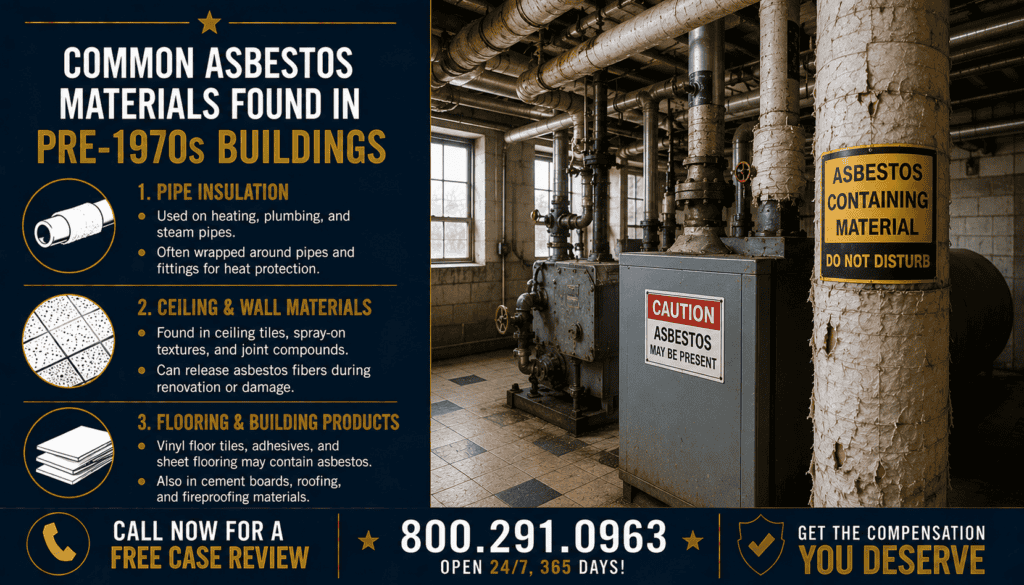
🧱 Common Asbestos Materials Found in Pre-1970s Buildings
Buildings constructed or renovated before the 1970s may contain older materials that warrant investigation for asbestos, including certain thermal insulation, surfacing materials, flooring, ceiling products, roofing, siding and cement products. However, building age or visual appearance alone does not prove that a particular material contains asbestos.
This guide explains the major categories of historical building materials worth researching and how records, qualified inspection and appropriate testing can help determine whether asbestos-containing material (ACM) was actually present.
For the broader research framework, see Historic Buildings, Renovation & Public Building Asbestos Research.
🏛️ Why Older Building Materials Require Investigation
An older building can contain materials from several construction eras. Original products may remain in one area while later additions, renovations and repairs introduced different materials elsewhere. That makes building-specific evidence more useful than broad assumptions based on a construction date.
EPA groups building ACM into three broad categories:
- Surfacing materials — materials applied to building surfaces for purposes such as acoustical treatment or fireproofing.
- Thermal-system insulation — ACM applied to pipes, boilers, tanks, ducts and similar systems to reduce heat loss or gain or control condensation.
- Miscellaneous ACM — a broad category that can include asbestos-containing ceiling or floor tiles, cement panels, siding, roofing materials, and electrical or sound insulation materials.
The fact that a historical product type was sometimes manufactured with asbestos does not establish that the material in a particular building contained asbestos. Surveys, specifications, sampling records, abatement documents and other reliable evidence can help make that determination.
🌡️ Thermal-System Insulation and Mechanical Areas
Mechanical spaces can be important in older-building investigations because heating and utility systems may include pipes, boilers, tanks, ducts and related components. EPA and OSHA both recognize thermal-system insulation as a major asbestos building-material category.
Materials and locations worth investigating can include:
- Pipe insulation and pipe fitting insulation.
- Boiler insulation and associated thermal materials.
- Tank insulation.
- Duct insulation.
- Mechanical-room insulation systems.
- Utility corridors and service spaces.
OSHA defines thermal-system insulation (TSI) as ACM applied to pipes, fittings, boilers, breeching, tanks, ducts or other structural components to prevent heat loss or gain.
Under OSHA’s construction asbestos standard, thermal-system insulation and surfacing material found in buildings constructed no later than 1980 are treated as presumed asbestos-containing material (PACM), unless the presumption is properly rebutted under the standard.
Potential disturbance can occur during boiler replacement, pipe repair, valve work, HVAC modernization, demolition or other projects that contact installed insulation.
🏢 Flooring, Ceilings, Walls and Surfacing Materials
Interior finishes can represent several different material categories. Investigation should focus on the exact product, installation period, manufacturer or specification when available.
| Building Component | Historical Material to Investigate | Work That May Disturb It |
|---|---|---|
| Floors | Certain resilient floor tiles, sheet flooring, backing and mastics | Removal, cutting, scraping, renovation |
| Ceilings | Certain ceiling tiles, panels, acoustical or applied materials | Removal, drilling, ceiling access, demolition |
| Walls | Certain wallboard systems, compounds, plasters and panels | Cutting, drilling, demolition, remodeling |
| Structural surfaces | Certain sprayed or troweled surfacing/fireproofing materials | Repair, scraping, renovation, demolition |
| Sound-control areas | Certain historical sound-insulation materials | Renovation or removal |
OSHA’s Class II asbestos-work definition specifically includes removal of asbestos-containing wallboard, floor tile and sheeting, roofing and siding shingles, and construction mastics.
OSHA requires asphalt and vinyl flooring material installed no later than 1980 to be considered asbestos-containing unless the employer or building owner makes the determination allowed by the standard. OSHA also prohibits sanding asbestos-containing flooring and establishes specific work practices for its removal.
These regulatory presumptions and work rules should not be misread as proof that every older floor, wall or ceiling material contains asbestos. They are worker-protection requirements that guide how specified materials are handled until asbestos content is properly determined.
🏠 Roofing, Siding and Exterior Building Materials
EPA identifies asbestos-containing roofing materials, siding and asbestos-cement panels among examples of miscellaneous ACM. Older-building research may therefore include exterior materials as well as interior finishes and mechanical systems.
Materials worth investigating can include:
- Certain historical roofing materials.
- Certain siding shingles or panels.
- Certain asbestos-cement sheets or panels.
- Roof penetrations and mechanical-equipment areas.
- Exterior utility or service structures.
Potential disturbance may occur during reroofing, siding replacement, exterior renovation, mechanical upgrades, storm repair or demolition. OSHA’s construction asbestos standard includes specific requirements for removal of asbestos-containing roofing materials.
Exterior appearance alone is not sufficient to identify asbestos content. Product records, professional inspection and appropriate analysis can be important when the material’s composition is unknown.
🔨 Renovation, Repair and Demolition Disturbance
The presence of intact ACM does not by itself establish that a person inhaled asbestos fibers. Exposure investigations should determine whether a specific material was disturbed and whether the person was in a location where that disturbance created a plausible exposure pathway.
Projects worth investigating include:
- Pipe and boiler repair or replacement.
- HVAC and utility-system modernization.
- Flooring removal.
- Ceiling replacement and above-ceiling work.
- Wall demolition and partition changes.
- Electrical and communications upgrades.
- Roofing and siding replacement.
- Large-scale remodeling.
- Partial or complete building demolition.
OSHA’s asbestos construction standard applies to covered demolition, removal, construction, alteration, repair, maintenance and renovation involving asbestos. It defines Class III asbestos work as repair and maintenance operations where ACM, including TSI, surfacing ACM and PACM, is likely to be disturbed.
See Historic Building Renovation Job Sites Asbestos Exposure and Building Demolition Sites Asbestos Exposure.
🔬 How Asbestos-Containing Materials Are Identified
It is generally not reliable to identify asbestos content simply by looking at a building material. A material’s age, texture, color or location may help determine whether further investigation is appropriate, but those characteristics alone do not establish asbestos content.
Useful methods and evidence can include:
- Historical asbestos surveys and inspection reports.
- Original architectural specifications.
- Product labels or manufacturer information.
- Abatement plans and closeout documents.
- Operations and maintenance records.
- Qualified building inspections.
- Bulk-sample results analyzed using recognized methods.
OSHA allows the PACM designation to be rebutted through specified procedures, including a qualifying inspection or testing performed under the standard’s requirements. Data used to demonstrate that PACM is not asbestos-containing must be retained as required by OSHA.
For older public or commercial buildings, surviving asbestos-management records can be especially useful because they may identify exact rooms, mechanical systems or material locations.
📂 Records and Evidence for Older Building Exposure
A useful investigation should connect the material research to the person’s actual history:
Person → Place/Building → Dates → Work/Task → Material → Disturbance
- Identify the exact building and historical address.
- Identify the floor, room, mechanical area, wing or work zone.
- Establish employment or contractor dates.
- Describe the person’s trade and specific tasks.
- Identify renovation, repair or demolition projects.
- Locate surveys, specifications and sample results.
- Identify the material and its exact location.
- Determine how the material was disturbed.
- Identify contractors, supervisors and coworkers.
- Compare other possible occupational, military and product exposures.
OSHA assigns building owners information and retention duties because owners are often important sources of information about previously installed building materials. Written records of required ACM/PACM notifications must be maintained for the duration of ownership and transferred to successive owners.
Other potentially useful evidence includes maintenance logs, work orders, permits, architectural drawings, renovation plans, contracts, abatement files, historical photographs, employment records and witness statements.
❓ Common Asbestos Materials in Older Buildings — Questions
Did every pre-1970s building contain asbestos?
No. The age of a building can justify investigation, but it does not prove that asbestos-containing material was installed.
What building-material categories does EPA identify?
EPA building guidance identifies surfacing materials, thermal-system insulation and miscellaneous ACM as three broad categories.
What does OSHA mean by PACM?
PACM means presumed asbestos-containing material. Under OSHA’s construction standard, it includes thermal-system insulation and surfacing material found in buildings constructed no later than 1980, unless the presumption is properly rebutted.
Were older floor tiles always made with asbestos?
No. OSHA requires specified older resilient flooring to be treated as asbestos-containing unless properly determined otherwise, but that regulatory treatment does not mean every individual historical floor product actually contained asbestos.
Can I identify asbestos by looking at a material?
Visual appearance alone generally cannot establish asbestos content. Historical records, qualified inspection and appropriate sampling or analysis may be necessary.
Why are boiler rooms and mechanical areas important?
They can contain pipes, boilers, tanks, ducts and other systems where thermal insulation may have been installed. The actual material should still be documented rather than assumed.
Does the presence of asbestos prove exposure?
No. Exposure analysis should also examine the material’s condition, how it was disturbed, when the disturbance occurred and whether the person was in an affected area.
Can materials from a demolished building still be researched?
Potentially. Surveys, specifications, abatement records, demolition files, photographs, contracts and witness accounts may identify materials even after the building is gone.
🚀 Identify the Building Material, Work Area and Disturbance
📞 Build a Stronger Historical Exposure Record
If you or a loved one worked around older building materials and later developed mesothelioma or asbestos-related lung cancer, a focused investigation can help determine whether asbestos-containing material was documented at the property.
- Building — name, historical address, floor, room or mechanical area.
- Dates — employment, contractor and renovation periods.
- Material — insulation, flooring, ceilings, walls, roofing, siding or other documented ACM.
- Disturbance — cutting, drilling, scraping, removal, repair or demolition.
- Evidence — surveys, samples, specifications, work orders, abatement records and witnesses.
Call 800.291.0963 now, use live chat 24/7, 365 days a year, or Submit Your Case for a free, confidential case review.
Compensation is not guaranteed. Potential legal options depend on the diagnosis, exposure evidence, potentially responsible parties, applicable law and filing deadlines.
⚕️ Legal & Medical Information Disclaimer
This page provides general educational information and is not legal or medical advice. A building’s age or the presence of a historical material does not by itself prove asbestos content, exposure, disease causation, legal liability or eligibility for compensation.