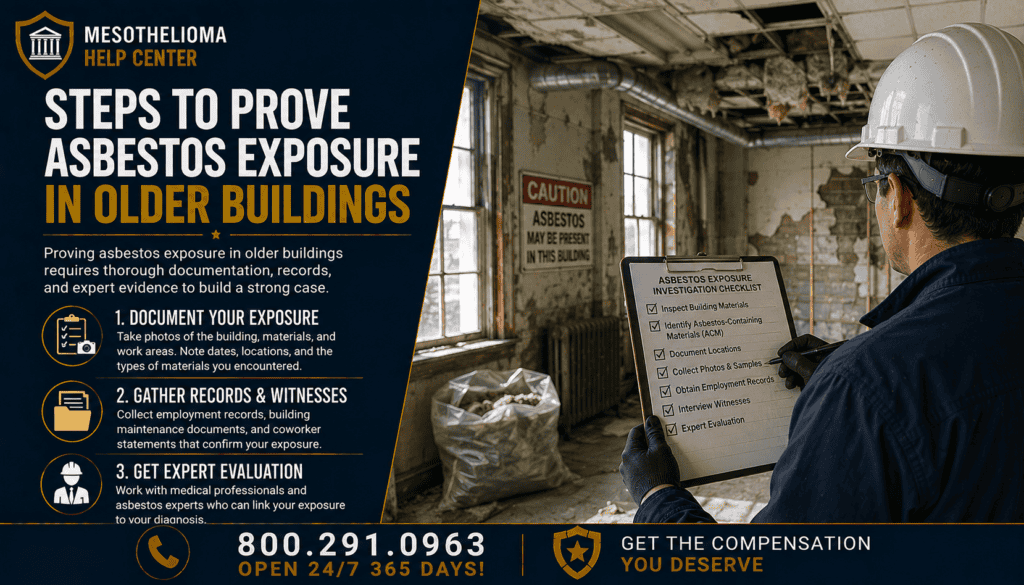
Steps to Prove Asbestos Exposure in Older Buildings
Buildings, Workers & Claims
Some older older buildings where former workers are reconstructing renovation dates, product identity and occupational contact may have contained asbestos in insulation, flooring, fireproofing or mechanical components. Exposure concerns depend on the specific material and whether work released airborne fibers, not simply on the age or name of a facility.
For people diagnosed with mesothelioma, a careful review of older buildings where former workers are reconstructing renovation dates, product identity and occupational contact can help connect employment and maintenance history with relevant documents. The information below distinguishes possible exposure routes from evidence required to support an individual claim.
Buildings and Historical Materials
Asbestos was used historically in some thermal insulation, pipe coverings, flooring, ceiling products, fireproofing and other building materials because of its resistance to heat. Whether a particular property contained any of those materials depends on its construction, additions, product selections and later alterations. A building name or age is not proof that every material contained asbestos.
When examining older buildings where former workers are reconstructing renovation dates, product identity and occupational contact, separate the building envelope from the equipment installed inside. A boiler gasket, pipe insulation and vinyl floor tile may have different manufacturers, installation dates and maintenance histories. Each potential source should be described independently.
Material composition also changed as manufacturers revised their products. An old catalog can be informative, but it must match the product and period under review. Modern replacement parts may be asbestos-free even where earlier parts were not. The relevant evidence is the material that was actually installed or disturbed.
Buildings and equipment are not interchangeable sources of exposure. In a government facility, asbestos-containing pipe covering may have been installed by a mechanical contractor, while floor tile came from a separate supplier. Procurement records may be retained by different agencies or archives. Understanding that distinction can help identify what evidence exists without asserting that the government itself manufactured the material.
Areas and Work That Could Release Fibers
Exposure concerns arise most clearly when asbestos-containing material is disturbed, rather than simply because an older building exists. Cutting, scraping, drilling, sanding, demolition and some cleanup activities can generate dust. The amount inhaled depends on material condition, task, duration, ventilation and proximity.
For older buildings where former workers are reconstructing renovation dates, product identity and occupational contact, relevant tasks may include reconstructing renovation projects, comparing work shifts, identifying material suppliers and documenting dust-producing tasks. A person working alongside a contractor could encounter airborne dust without directly handling the underlying material. Such a possibility needs evidence about the work actually performed.
A useful exposure account describes how the work unfolded: who removed the material, whether it was broken or scraped, where the dust went, and how long others remained nearby. Repeated tasks may differ from a single brief event. Avoid converting a possible scenario into a claim that exposure definitely occurred.
Workers and Other Potential Exposure Routes
Different people in the same building can have very different work histories. Maintenance employees may open mechanical systems regularly, while visitors may only pass through common areas. A contractor could spend weeks in an enclosed renovation zone, whereas a clerk might work in another part of the facility.
People whose histories deserve careful consideration include former occupants, maintenance employees, tradespeople, witnesses and family members collecting records. Job titles alone do not establish asbestos exposure. Ask about specific materials, frequency of work, who performed repairs and whether dusty activity occurred nearby.
Interview coworkers individually when practical. One may remember equipment and supplies, while another remembers the schedule of repairs. Different accounts can be compared with payroll, service logs and photographs. A precise description of observed tasks is more useful than a broad assumption that everyone in the building faced the same conditions.
Building Maintenance and Renovation
Older buildings may have been remodeled repeatedly. A later asbestos survey can describe materials remaining at the inspection date but may not identify products removed decades earlier. Renovation records, therefore, can be important even when a current inspection shows no asbestos in the affected room.
EPA explains that asbestos operations and maintenance programs can help owners manage materials in place. Suspected materials should not be disturbed for the purpose of documenting a claim. Inspection, sampling and removal should be handled by qualified professionals under applicable rules.
EPA and OSHA rules can apply to renovation and demolition, but their requirements depend on the setting and activity. Building managers should seek qualified advice about surveys and control procedures. People reviewing old exposure should rely on existing records rather than trying to collect samples themselves or entering restricted work areas.
Managing Materials Without Unnecessary Disturbance
Intact asbestos-containing material may be managed in place under an appropriate operations and maintenance program. Removal is not automatically the safest or legally required response in every situation. The building owner and qualified professionals should evaluate material condition, planned work, regulatory requirements and potential for fiber release before selecting a control strategy.
Records That May Help Identify Exposure
A reliable account distinguishes what a witness remembers from what documents establish. Useful sources may include building permits, asbestos surveys, invoices, employment files, witness accounts and contemporaneous photographs. Product labels, dated invoices and work orders can be especially informative when they identify a component and the period of use.
A building permit may confirm renovation dates without proving a particular product contained asbestos. Likewise, an asbestos survey may identify material without identifying who installed it. Combining multiple independent records can help clarify those gaps.
Organize evidence by year and location. Keep a separate column for the person who supplied each detail, and mark whether a statement is a document, direct recollection or an inference. That distinction helps avoid confusing a plausible exposure source with a confirmed one, especially when records span several decades.
Evidence That Helps Distinguish Building and Product Sources
A building inventory may show the presence of insulation, while a purchase record may identify the supplier. Neither alone necessarily identifies the person who handled it. Dated photographs, witness statements and maintenance assignments can help explain the circumstances. Be precise about what each record supports and about uncertainties that remain.
Mesothelioma Diagnosis and Exposure Timeline
Mesothelioma can develop many years after asbestos exposure. A medical diagnosis is not a substitute for determining where a person worked or which asbestos-containing materials were present. Pathology and treatment records establish clinical facts, while employment and building records address different questions.
An exposure timeline should start with the earliest relevant jobs and continue through later positions, military service and possible household exposure. A person may have encountered more than one source; avoid selecting a single building as the cause without sufficient evidence.
A clinician can explain diagnostic findings and treatment options. Legal representatives may use medical records alongside job histories, but should not alter clinical conclusions. People may have worked in several industries before diagnosis, so the chronology should cover the whole career rather than focusing only on the most memorable location.
Lawsuits and Potential Compensation Options
Possible legal paths can include personal-injury litigation, certain bankruptcy trust claims, wrongful-death actions or other benefits, depending on individual facts and jurisdiction. A diagnosis alone does not establish that a building owner, contractor or product manufacturer is legally responsible.
An attorney may review the dates, relevant employers, identified products, responsible entities and applicable state deadlines. Trust claims and civil lawsuits have different eligibility and disclosure rules. No compensation amount, filing deadline or case result should be assumed from the building category alone.
Legal deadlines vary, and the proper jurisdiction is not always the state where the building stands. Relevant considerations can include residence, work locations, defendants and the nature of the claim. A case review should explain fees and costs and whether different claim processes could interact; it cannot guarantee an outcome.
Practical Steps for Workers and Families
Families can begin with a simple chronology: names and addresses of facilities, employment periods, specific rooms, tasks, coworkers and any remembered products. Mark approximate dates clearly. If a worker is receiving treatment, a family member can help gather documents with permission and avoid repeated stressful interviews.
For older buildings where former workers are reconstructing renovation dates, product identity and occupational contact, start with building permits, asbestos surveys, invoices, employment files, witness accounts and contemporaneous photographs. Keep originals, record the source of each copy and distinguish confirmed facts from possible leads. Ask a qualified attorney which records are most useful and which deadlines could affect the ability to file.
If someone remembers only part of a building name or an approximate date, record it as such. Old directories, maps and public records may help narrow the possibilities. Do not delay medical care while looking for evidence. A focused, accurate summary can make the first discussion with a legal professional more productive.
Questions to Bring to a Case Review
Ask which exposure locations appear most relevant, whether additional employment or military records are needed, what deadlines might apply, and whether a particular company or trust has a documented connection to the materials. Also ask who will handle the matter, how fees are calculated and how the family will receive updates. Answers should be specific to the case rather than promises based on the building type.
A practical distinction for this location is that an asbestos-containing product, an exposure event and a legally responsible party are three different questions. A building record may help answer the first, while work schedules and witness accounts may help with the second. Responsibility requires additional facts and applicable law. Keep the dates, sources and uncertainties visible in every summary. This helps families avoid treating a plausible workplace scenario as a confirmed claim and allows professionals to evaluate what additional evidence may be needed.
❓ Frequently Asked Questions
Did every older building contain asbestos?
No. Asbestos use varied by material, construction date and renovation history. A property-specific assessment is needed.
Can workers be exposed without installing asbestos products?
Potentially. People nearby may inhale dust when others disturb asbestos-containing materials, depending on actual conditions.
What records help identify asbestos in a building?
Surveys, specifications, purchase records, maintenance logs, photographs and credible witness accounts may help.
Does mesothelioma establish which building caused exposure?
No. Diagnosis and exposure-source identification are separate medical and factual questions.
Can a building still contain legacy asbestos?
Yes. Older materials may remain, and qualified professionals should assess suspected materials before disturbance.
Are legal deadlines the same in every state?
No. Deadlines and claim requirements vary by jurisdiction and circumstances.
Should families collect suspected asbestos samples themselves?
No. Do not disturb suspected materials. Qualified professionals should handle assessment and sampling.
Does a building exposure automatically qualify for compensation?
No. Legal responsibility, medical diagnosis, exposure evidence and eligibility requirements must be evaluated individually.
Sources and References
EPA — Building Owners and Managers; EPA — Operations and Maintenance Programs; OSHA — Asbestos in Construction; EPA — Asbestos Renovation and Demolition Rules. These references address general risks and requirements, not whether a named facility contained a particular product.
📞 Get the Mesothelioma Help & Compensation You Deserve — Contact Us Today!
After a mesothelioma diagnosis, we can help you organize exposure information and explore potential compensation options. Eligibility and results depend on individual facts and applicable rules.
For 25+ years, we have helped veterans, workers, and families understand possible next steps.
📲 Contact Us Today — Three Easy Ways!
CALL: 800.291.0963 for a free case review.
LIVE CHAT: Available 24/7/365 through the website.
CONTACT FORM: Use the form below.
Disclaimer: This information is not be considered as legal or medical advice. Mesothelioma Help Center is not a law firm or medical provider and does not determine legal or VA eligibility.