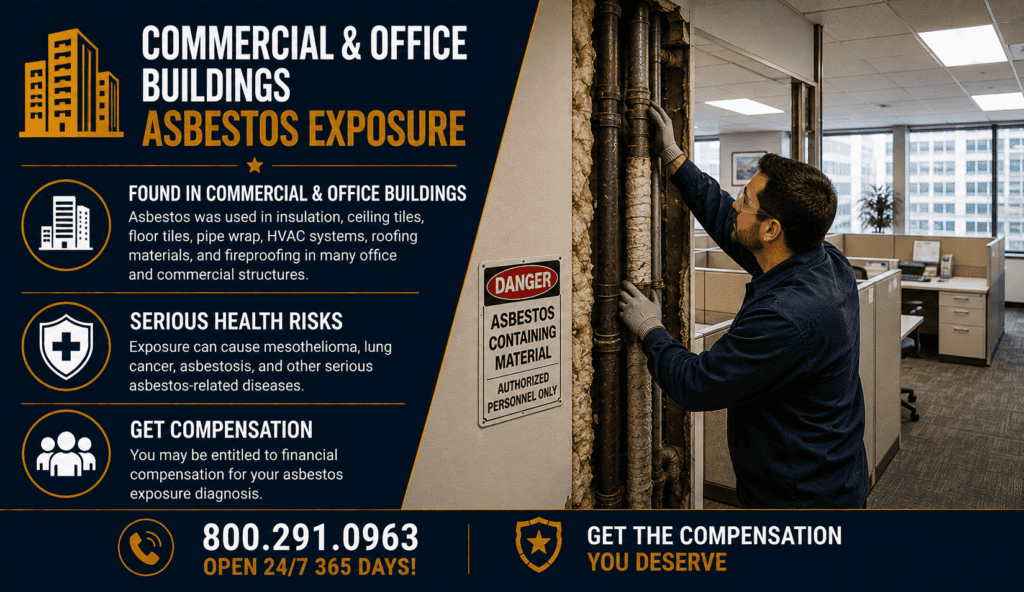
🏢 Commercial & Office Buildings Asbestos Exposure
Commercial and office properties can include office towers, retail stores, shopping malls, banks, restaurants, supermarkets, theaters, hotels, entertainment venues and many other buildings where people worked, provided services or performed construction and maintenance. Some older commercial properties remained in use for decades while undergoing repeated tenant improvements, mechanical upgrades and interior renovations.
Depending on a building’s age, construction history and installed products, some commercial and office buildings may have contained asbestos-containing materials. Working in, leasing or visiting an older commercial property does not by itself prove asbestos exposure. A useful investigation connects the person to a specific property, floor or work area, dates, job or activity, material and disturbance event.
This hub is part of the broader Buildings Asbestos Exposure resource and provides a starting point for investigating commercial, retail, entertainment and office properties.
🏢 Asbestos Exposure in Commercial and Office Buildings
Potential exposure depended on whether asbestos-containing material was actually present and whether it was damaged or disturbed. Commercial buildings can have especially complicated histories because ownership, property managers, tenants and contractors may change many times.
Activities worth investigating include:
- Tenant build-outs and office remodeling.
- Removing or replacing flooring and ceilings.
- Repairing boilers, piping and mechanical equipment.
- HVAC and ventilation upgrades.
- Electrical, lighting, communications and data-system work.
- Opening walls and ceilings for new utilities.
- Store, restaurant or bank remodeling.
- Roof repairs and replacement.
- Building additions, major renovations and demolition.
EPA’s current building guidance specifically identifies office buildings, shopping centers and similar facilities as settings where asbestos-containing materials may be managed through an operations and maintenance program when appropriate. An O&M program is intended to maintain ACM in good condition and minimize exposure to asbestos fibers.
🏬 Commercial and Office Building Types to Investigate
🏢 Office Buildings
Office properties may contain individual suites, common corridors, mechanical floors, basements, utility spaces and suspended ceilings. Repeated tenant turnover can result in many generations of remodeling.
🛍️ Retail Stores and Shopping Malls
Retail properties can undergo frequent store build-outs involving floors, ceilings, partitions, electrical systems and HVAC connections.
🏦 Banks and Financial Offices
Older bank properties may include public banking floors, offices, vault areas, basements and mechanical rooms that were modernized over time.
🍽️ Restaurants and Food-Service Buildings
Restaurant renovations can affect kitchens, dining rooms, ventilation systems, floors, ceilings, plumbing and electrical service.
🎭 Entertainment and Recreation Buildings
Theaters, sports facilities, bowling alleys, music studios and similar buildings can contain large public spaces plus backstage, utility, mechanical and service areas.
🛒 Supermarkets and Department Stores
Large retail buildings may have extensive flooring, ceilings, refrigeration or mechanical systems, stock areas and service spaces that were renovated repeatedly.
Other commercial properties can include auto dealerships, auto body shops, beauty salons, gyms, museums, lodges, ice rinks, golf clubhouses, gas stations, broadcast facilities and other specialized businesses.
🧱 Asbestos-Containing Materials and Building Systems
No commercial building material should be identified as asbestos-containing merely because a property is old. Historical specifications, asbestos surveys, professional inspection or appropriate material analysis provide stronger evidence.
| Commercial Building Area | Material or System to Investigate | Potential Disturbance |
|---|---|---|
| Boiler and mechanical rooms | Pipe, boiler, tank and duct insulation | Repair, removal or replacement |
| Offices, stores and corridors | Certain flooring and ceiling materials | Tenant improvements or replacement |
| Walls and partitions | Certain compounds, plasters and panels | Cutting, drilling or demolition |
| Structural areas | Certain surfacing and fireproofing materials | Renovation or demolition |
| HVAC and utility systems | Certain thermal insulation and associated materials | Maintenance and upgrades |
| Roofs and exteriors | Certain historical roofing or cement products | Repair, tear-off or replacement |
EPA’s O&M guidance classifies ACM into categories including surfacing material, thermal-system insulation and miscellaneous materials. OSHA’s asbestos construction standard defines thermal-system insulation to include material applied to components such as pipes, fittings, boilers, tanks and ducts.
For broader historical building-material information, see Common Asbestos Materials Found in Pre-1970s Buildings.
👷 Workers, Tenants and Contractors Potentially at Risk
Potential exposure can vary substantially by occupation. Building engineers, maintenance employees and construction trades who directly disturbed installed materials may have had different exposure opportunities from office employees, retail workers or customers occupying finished areas.
- Building engineers — boilers, steam systems, HVAC equipment and mechanical spaces.
- Maintenance workers — floors, ceilings, walls, piping and building systems.
- Custodial workers — floor care, cleaning and work near maintenance or renovation areas.
- Plumbers and pipefitters — piping, valves and mechanical spaces.
- Electricians and communications installers — walls, ceilings, electrical rooms and tenant improvements.
- HVAC technicians — ducts, air-handling equipment and mechanical rooms.
- Carpenters, drywall workers and remodelers — partitions, ceilings and tenant build-outs.
- Flooring workers — removal or alteration of historical floor systems.
- Roofers — repair or removal of historical roofing systems.
- Construction and demolition contractors — major renovations, additions and removals.
- Office, retail and service workers — potential exposure requires evidence that ACM was disturbed in or near their work areas.
For broader occupation-specific information, see High-Risk Jobs for Asbestos Exposure.
🔨 Maintenance, Renovation and Tenant-Improvement Exposure
Tenant improvements are an important issue in commercial buildings because suites and stores can be remodeled repeatedly as occupants change. Projects may involve removing partitions, replacing flooring and ceilings, rerouting utilities, upgrading HVAC systems and installing new lighting, electrical or communications equipment.
EPA recommends that owners have a trained and accredited inspector evaluate a building when establishing an asbestos O&M program. If ACM is present, EPA recommends maintaining an inventory and reviewing asbestos inspection and assessment records before renovation, remodeling or utility-system replacement that could disturb the material.
OSHA’s asbestos construction standard regulates covered demolition, alteration, repair, maintenance and renovation involving asbestos. Before covered work, building and facility owners have duties concerning the presence, location and quantity of ACM and presumed ACM and communication of that information to specified parties.
Projects worth investigating include:
- Office-suite build-outs.
- Store and restaurant remodeling.
- Flooring and ceiling replacement.
- Boiler and piping work.
- HVAC modernization.
- Electrical, data and communications upgrades.
- Elevator or common-area renovations.
- Roof replacement.
- Major redevelopment or demolition.
EPA also notes that larger asbestos repair or abatement projects should be handled by trained and accredited asbestos professionals. State and local rules may be more stringent than federal requirements.
See Historic Building Renovation Job Sites Asbestos Exposure for additional renovation-related information.
📂 Commercial Building Records and Exposure Evidence
Commercial properties can change names, owners, managers and tenants repeatedly. An exposure investigation may therefore require records from several different sources rather than a single employer.
A useful reconstruction moves beyond “I worked in an old office building” toward:
Person → Commercial Property → Floor/Suite/Area → Job/Task → Material → Disturbance → Date
- Identify the building and historical address.
- Identify the employer, tenant, store or business.
- Record the floor, suite, department or work area.
- List employment or contractor dates.
- Identify renovations and tenant-improvement projects.
- Look for asbestos surveys and inspection records.
- Locate architectural plans and project specifications.
- Review facilities work orders and property-management records.
- Identify general contractors, subcontractors and abatement firms.
- Locate coworkers, building engineers or other witnesses.
Potential record holders can include current and former property owners, property-management firms, facilities departments, tenants, architects, general contractors and asbestos consultants. OSHA also requires written records of certain building-owner ACM/PACM notifications to be maintained for the duration of ownership and transferred to successive owners.
See Steps to Prove Asbestos Exposure in Older Buildings for a broader evidence framework.
❓ Commercial & Office Buildings Asbestos Exposure Questions
Did every older commercial building contain asbestos?
No. Building age can justify investigation, but it does not prove that any particular material contained asbestos.
Why can office remodeling create an asbestos concern?
Tenant improvements can disturb older floors, ceilings, walls, fireproofing, insulation and mechanical systems if ACM is present.
Which commercial-building workers may have had more direct exposure opportunities?
Building engineers, maintenance workers, custodians, plumbers, electricians, HVAC technicians, carpenters, flooring workers, roofers and renovation contractors may have directly worked on building materials and systems.
Could office or retail employees have been exposed?
Potentially, if asbestos-containing material was disturbed in or near occupied areas. Working in an older office or store alone does not prove exposure.
Why do ownership and tenant histories matter?
They can help identify who controlled the property, who ordered renovations, which contractors performed the work and where relevant records may now be located.
What records may help document commercial-building exposure?
Asbestos surveys, property-management files, work orders, architectural plans, tenant-improvement records, contracts, abatement files, photographs and witness accounts may help reconstruct exposure.
Can a demolished or redeveloped commercial building still be investigated?
Potentially. Historical property records, surveys, plans, permits, contractor documents, photographs and witness accounts may survive after redevelopment or demolition.
🚀 Turn a Commercial Building Work History Into a Clear Exposure Record
📞 Review the Property, Tenant, Work Area, Projects and Evidence
If you or a loved one worked in a commercial or office building and later developed mesothelioma or asbestos-related lung cancer, a focused review can help identify possible exposure sources and surviving records.
- Property — building name, address, floor, suite and dates.
- Work — employer or tenant, occupation, duties, maintenance and renovations.
- Exposure — insulation, flooring, ceilings, fireproofing, piping and mechanical systems.
- Evidence — surveys, property-management records, plans, work orders, contracts, abatement files and witnesses.
Call 800.291.0963 now, use live chat 24/7/365, or Submit Your Case for a free, confidential case review.
Compensation is not guaranteed. Potential legal options depend on the diagnosis, exposure evidence, potentially responsible parties, applicable law and filing deadlines.
⚕️ Legal & Medical Information Disclaimer
This page provides general educational information and is not legal or medical advice. Working in, leasing or visiting a commercial or office building does not by itself prove asbestos exposure, disease causation, legal liability or eligibility for compensation.