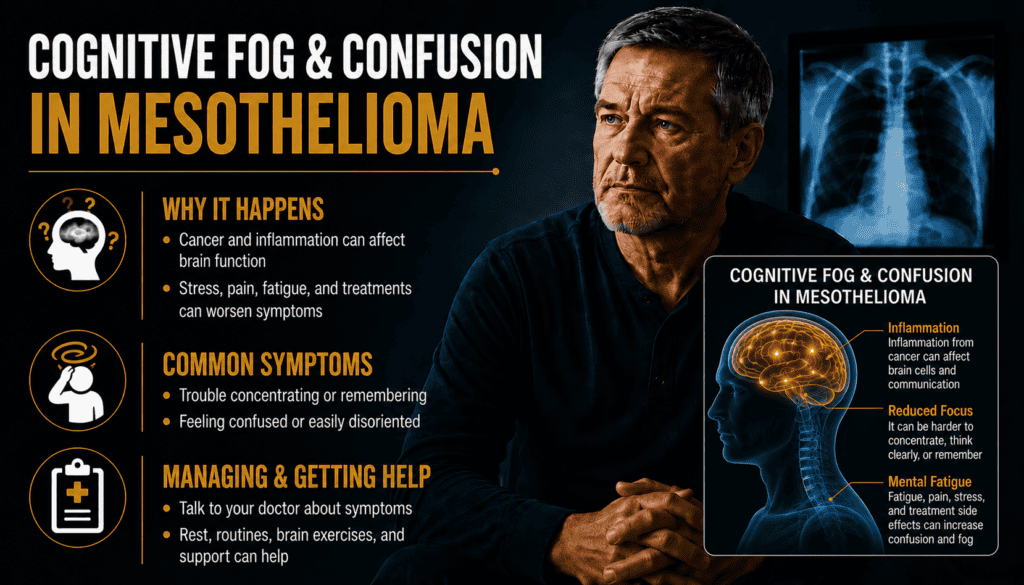
Cognitive Fog and Confusion in Mesothelioma
Understand changes in memory and attention, recognize sudden confusion, and prepare for a medical evaluation.
People living with mesothelioma may describe “brain fog” as losing their train of thought, struggling to concentrate, or needing more time to complete familiar tasks. A new episode of disorientation or markedly altered behavior is different: it may signal delirium or another urgent medical problem. Neither brain fog nor confusion should automatically be attributed to mesothelioma itself. The cause may involve treatment, medication, poor sleep, infection, dehydration, low oxygen, or another condition that needs assessment.
Urgent safety note: Call 911 for sudden or unexplained confusion, difficulty waking, new trouble speaking, one-sided weakness, a seizure, or severe breathing difficulty. Do not leave a suddenly confused person alone or let them drive. For milder but new or worsening changes, contact the cancer care team promptly.
What cognitive fog and confusion mean
“Brain fog” is a patient description rather than a specific diagnosis. It can involve attention, memory, mental speed, or organizing tasks. Delirium is an acute change in awareness and thinking that may develop over hours or days and fluctuate. These experiences overlap, but the distinction matters because delirium warrants prompt evaluation for potentially treatable causes.
| Experience | What a person might notice | Practical response |
|---|---|---|
| Mild cognitive fog | Slower reading or difficulty multitasking | Tell the oncology team; record onset and effect on daily life |
| Forgetfulness | Missing a recent appointment or losing a thought | Use reminders; discuss new or worsening changes |
| Disorientation | Not knowing where they are or what day it is | Seek immediate medical assessment, especially if sudden |
| Fluctuating alertness | Clear at breakfast, very drowsy or agitated later | Report the change urgently; consider delirium |
The National Cancer Institute (NCI) discusses cognitive impairment during and after cancer treatment, while its delirium guidance describes a more sudden disturbance of thinking and awareness. The NCI’s mesothelioma symptom overview is useful for comparing other symptoms, but confusion is not a diagnostic sign unique to mesothelioma.
Possible causes and contributing factors
Several factors can coexist. Clinicians look for a change from the person’s usual thinking, not just a single symptom. Some causes are reversible when recognized early; others need longer-term support.
| Possible factor | How it may relate | What to tell the team |
|---|---|---|
| Medication effects | Opioids, sedatives and some other medicines may contribute to delirium | Bring every prescription, over-the-counter product and supplement |
| Dehydration or poor intake | Fluid loss and inadequate intake can affect alertness | Report drinking, vomiting, diarrhea and urine changes |
| Infection | An infection can cause acute confusion even without obvious symptoms | Mention fever, cough, urinary symptoms or recent procedures |
| Low oxygen or breathing problems | Reduced oxygen may impair thinking | Report breathlessness and any measured oxygen readings |
| Sleep disruption and fatigue | Poor sleep and exhaustion can worsen attention | Describe sleep duration, nighttime waking and daytime naps |
| Additional consideration | Why evaluation matters |
|---|---|
| Blood chemistry changes | Sodium, calcium, glucose and kidney or liver problems may contribute |
| Pain and distress | Uncontrolled symptoms can interfere with attention and rest |
| Recent treatment or hospitalization | Treatment effects, anesthesia, illness and unfamiliar settings can contribute |
| Neurologic illness | Stroke, seizure or another neurologic problem requires its own assessment |
Related symptom guides address severe fatigue, difficulty sleeping, shortness of breath and loss of appetite. These connections are possibilities, not proof of the cause in any individual patient.
Symptoms and patterns to recognize
Note what changed, when it began, whether it comes and goes, and whether the person can still perform familiar tasks. A family member’s description of baseline behavior is often valuable.
| Pattern | Example | Significance |
|---|---|---|
| Attention | Cannot follow a conversation or finish a sentence | Can occur with fog or delirium |
| Memory | Repeats questions or forgets recent events | Needs assessment if new or worsening |
| Awareness | Does not recognize a familiar setting | Urgent if new or sudden |
| Behavior | New agitation, unusual quietness or hallucinations | Can be part of delirium |
| Sleep–wake changes | Awake at night and unusually sleepy by day | Report alongside other thinking changes |
| Questions to document | Example answer |
|---|---|
| When did it begin? | “Yesterday afternoon, after a medication change” |
| Does it fluctuate? | “More confused at night, clearer in the morning” |
| Any accompanying symptoms? | “Fever, poor intake and worsening cough” |
| Any new medicines or doses? | “Pain medication increased two days ago” |
Gradual trouble concentrating can still affect medication safety, finances and appointments. Sudden confusion is not something to monitor at home for several days.
When to seek urgent medical care
Call 911 now for sudden confusion or an unexplained change in mental status, particularly with stroke-like symptoms, seizure, loss of consciousness or severe trouble breathing. A person who cannot be awakened normally also needs emergency care. These are general medical emergency signs, not mesothelioma-specific diagnostic criteria.
| Situation | Action |
|---|---|
| Sudden unexplained confusion or inability to recognize surroundings | Call 911; stay with the person |
| New facial droop, weakness, speech or vision changes | Call 911 immediately |
| Seizure, fainting or inability to awaken | Call 911 immediately |
| New mild forgetfulness without emergency features | Contact the oncology team promptly for guidance |
| Confusion after a new medication | Call the prescribing team urgently; do not independently stop prescribed drugs |
Do not assume that a person is “just tired” or that confusion necessarily means cancer progression. Delirium can have treatable triggers. If emergency services are needed, bring an updated medication list and a description of the last time the person was acting normally.
How clinicians evaluate thinking changes
A clinician will assess safety first, then compare current behavior with baseline, review the medication list, check vital signs and look for possible causes. Testing is tailored to the examination and symptoms rather than following one universal checklist.
| Evaluation component | What it can clarify |
|---|---|
| History from patient and caregiver | Timing, fluctuation and baseline function |
| Medication review | Recent starts, dose changes, interactions or withdrawal |
| Physical and neurologic examination | Breathing, hydration, focal neurologic findings and infection clues |
| Blood or urine tests when indicated | Glucose, electrolytes, organ function or infection |
| Imaging or other testing when indicated | Neurologic concerns or other suspected causes |
| Bring to the visit | Why it helps |
|---|---|
| Current medicine and supplement list | Supports an accurate interaction and dose review |
| Symptom timeline | Shows whether change was sudden, gradual or fluctuating |
| Fluid and food intake notes | May reveal dehydration or nutrition concerns |
| A family member who knows the baseline | Can describe changes the patient may not recognize |
For broader cancer testing context, see mesothelioma diagnosis. A cognitive evaluation does not, by itself, diagnose mesothelioma or show whether the cancer has progressed.
Treatment and symptom management
Treatment depends on the cause. The care team may address dehydration or infection, adjust medicines, improve symptom control, or recommend additional testing. Do not change pain medicine, oxygen settings or other prescribed treatment without clinical guidance.
| Approach | Who guides it | Important limit |
|---|---|---|
| Treat a reversible trigger | Oncology or emergency team | Requires identifying the trigger |
| Review medication regimen | Prescriber or pharmacist | Do not stop or change doses independently |
| Address pain and sleep | Cancer and supportive-care clinicians | Balance relief against medication side effects |
| Cognitive rehabilitation or occupational strategies | Appropriate rehabilitation specialists | Useful for persistent functional problems, not a substitute for emergency assessment |
| Supportive measure | How to use it safely |
|---|---|
| Regular light and dark cues | Open curtains by day; keep nighttime calm |
| Clock, calendar and familiar objects | Offer gentle orientation without arguing |
| Glasses and hearing aids | Make communication easier when normally used |
| Short instructions | Give one step at a time and allow response time |
Ask about pain and symptom management and mesothelioma treatment options when planning care. The NCI notes that delirium management can involve treating causes and a calm, familiar environment; medicines for severe symptoms require clinician oversight.
Daily strategies and caregiver support
Caregivers can notice changes early, reduce injury risk and help the patient communicate with clinicians. A supportive environment helps, but it cannot replace medical assessment of new confusion.
| At home | Practical step |
|---|---|
| Medication safety | Use a clinician-approved organizer; double-check doses |
| Fall prevention | Clear walkways and assist with mobility as needed |
| Appointments | Write down questions and bring a trusted companion |
| Communication | Use calm, simple sentences and allow time to answer |
| Driving and decisions | Avoid driving during confusion; ask the care team about decision-making support |
| What to track | Example |
|---|---|
| Mental clarity | “Could follow conversation until 2 p.m.” |
| Sleep | “Awake three times overnight” |
| Hydration and meals | “Drank less than usual; skipped lunch” |
| Associated symptoms | “More short of breath today” |
Explore mesothelioma support resources and early versus late symptom patterns for related context. Confusion alone cannot establish a stage or predict how long someone will live.
| Care-team question | Reason to ask |
|---|---|
| Could this be delirium? | Clarifies urgency and evaluation |
| Are medication effects possible? | Prompts a full medication review |
| What should trigger an emergency call? | Creates a specific safety plan |
| Daily task | Possible accommodation |
|---|---|
| Remembering appointments | Shared calendar and reminder calls |
| Following written instructions | Short steps and large-print notes |
| Tracking symptoms | One-page log reviewed with caregiver |
| Do | Avoid |
|---|---|
| Report a sudden change immediately | Assuming confusion is an inevitable cancer symptom |
| Bring medication bottles or a complete list | Changing prescribed doses without advice |
| Provide calm supervision while seeking help | Leaving a disoriented person to drive alone |
Frequently asked questions
Is brain fog a common defining symptom of mesothelioma?
No. Brain fog is not a defining diagnostic symptom of mesothelioma. People with cancer can experience cognitive problems for many reasons, including treatment, fatigue, sleep problems and other illnesses.
Can mesothelioma treatment cause memory or concentration problems?
Cancer treatments and other medications can contribute to cognitive changes in some patients. A clinician should review the timing and all medicines before attributing symptoms to one treatment.
Is sudden confusion the same as ordinary forgetfulness?
No. Sudden confusion or a major change in awareness can be delirium or another emergency. Call 911 for sudden unexplained confusion.
Can dehydration make someone confused?
Yes. Dehydration is one possible cause of confusion and delirium, particularly when intake is poor or fluid losses occur. The medical team should assess the person rather than assuming dehydration is the only cause.
Could low oxygen contribute to cognitive changes?
Low oxygen can contribute to confusion. New breathing problems or sudden mental-status changes require prompt medical assessment; severe breathing difficulty is an emergency.
Does confusion mean mesothelioma has reached an advanced stage?
Not necessarily. Confusion has many possible causes, including reversible ones. It cannot establish stage or prognosis without clinical evaluation.
What should caregivers record before calling the doctor?
Record the last known normal time, changes in behavior and alertness, medication changes, fluid intake, fever, breathing symptoms and any falls. Call emergency services first when emergency signs are present.
Can cognitive fog improve?
It may improve when contributing factors such as sleep problems, medication effects, dehydration or infection are addressed, but the outlook depends on the underlying cause. Discuss persistent problems with the oncology team.
Confirmed medical references
Get help and discuss your options
Call 800.291.0963 to discuss mesothelioma-related questions. Live chat is available 24/7, 365 days a year. Submit Your Case using the form below. For a medical emergency, call 911; this service does not provide emergency medical care.
Legal options depend on individual facts, applicable law and deadlines. No compensation or case result is guaranteed.
⚕️ Legal & Medical Information Disclaimer
This page provides general information, not medical diagnosis, treatment or legal advice. Consult licensed medical professionals about symptoms and an attorney about legal rights and deadlines.