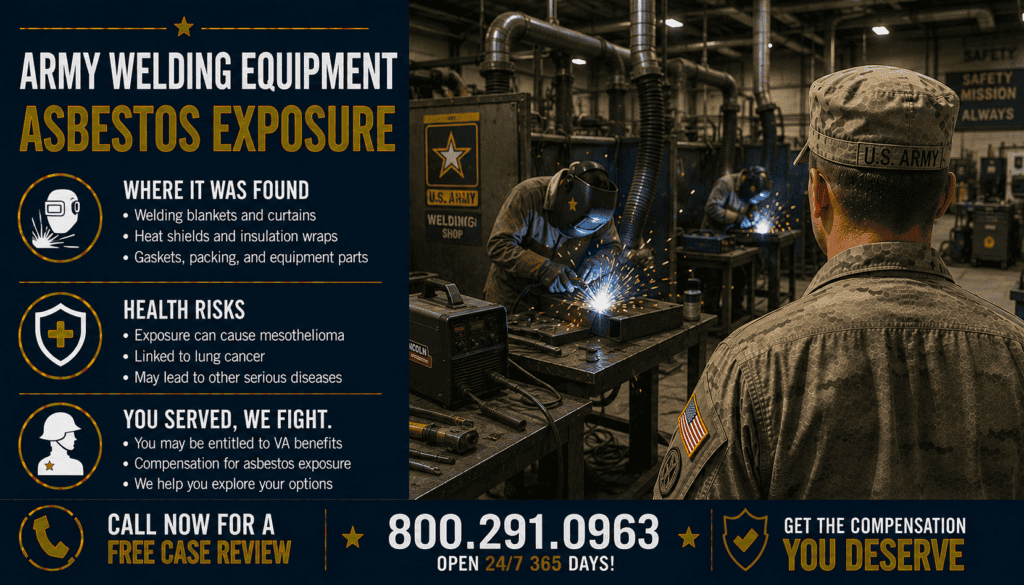
Army Welding Equipment Asbestos Exposure
U.S. Army welders have performed fabrication, cutting, grinding, vehicle repair, heavy-equipment maintenance, construction, and depot work for generations. VA specifically identifies welders among service members who may have experienced asbestos exposure, while historical military asbestos use included heat-resistant fabrics, gaskets, valves, lagging, cements, adhesives, and friction products that could be encountered during repair work.
This guide explains how to research Army welding equipment asbestos exposure without assuming that welding itself or every welding accessory contained asbestos. It covers older heat-resistant materials, gaskets and insulation, welding and grinding around existing asbestos-containing products, work-area records, VA disability evidence, and other potential compensation options for Army veterans diagnosed with mesothelioma.
Army Welding Equipment Asbestos Exposure Overview
U.S. Army welding and cutting operations have supported vehicle repair, heavy-equipment maintenance, fabrication, construction, depot overhaul, utilities, engineering, and installation maintenance. Veterans researching possible asbestos exposure should separate the ordinary hazards of welding fumes, heat, sparks, and ultraviolet radiation from a different question: whether welding, cutting, grinding, or repair work disturbed an asbestos-containing product or material in the work area.
VA Veterans Health Library specifically lists welders among service members who may have had military asbestos exposure. VA also identifies historical military asbestos use in friction products and heat-resistant fabrics, including brakes, gaskets, valves, cements, adhesives, and pipe coverings called lagging. These sources support careful investigation of older work areas and components, but they do not establish that every welding machine, blanket, glove, cable, electrode holder, or welding accessory contained asbestos.
Current Army welding guidance emphasizes modern protective equipment and work practices. Army Technical Circular 9-237 recommends leather or other suitable flame-resistant protective materials, while the Army Corps safety manual describes leather, aluminized, aramid, and synthetic protective materials. These current sources should not be used to infer asbestos content in modern welding PPE.
This page is part of the Army equipment asbestos exposure hub and connects welding research with Army heavy machinery asbestos exposure, Army maintenance buildings asbestos exposure, and the broader U.S. Army asbestos exposure section.
Army Welding and Cutting Work
Army welding can include shielded metal arc welding, gas welding, brazing, cutting, heating, grinding, chipping, and fabrication. These processes may be performed in fixed maintenance shops, motor pools, depots, construction sites, engineering facilities, power and utility spaces, or field environments. The equipment and surrounding materials vary substantially by location and era.
The U.S. Army Combat Readiness Center directs Army personnel to OSHA welding, cutting, and brazing standards and the Army Corps of Engineers Safety and Health Requirements Manual. Army guidance requires welders and cutters to be trained in safe equipment operation, welding and cutting practices, respiratory protection, and fire protection.
At Anniston Army Depot, Army safety guidance describes welding work that also involves grinding operations and requires appropriate respiratory, eye, face, hearing, hand, foot, and flame-resistant protection. This illustrates that welding work frequently occurs alongside mechanical preparation and finishing tasks that can disturb existing coatings, gaskets, insulation, or other materials.
Welding-related exposure research may overlap with Army heavy machinery asbestos exposure, Army electrical equipment asbestos exposure, Army boiler equipment asbestos exposure, and Army generator equipment asbestos exposure.
Potential Asbestos-Containing Materials
Historical welding research should focus on documented asbestos-containing materials around the work rather than assume asbestos was inherent in the welding process. VA identifies heat-resistant fabrics, gaskets, valves, cements, adhesives, lagging, brakes, and other friction products among historical military asbestos uses. Welders may have worked near some of these materials while repairing equipment or structures.
Examples worth investigating can include thermal insulation on pipes or equipment near hot-work areas, gaskets removed before welding or fabrication, friction components on vehicles and machinery undergoing repair, asbestos-containing building materials affected by cutting or renovation, and historical heat-resistant fabrics where records specifically identify asbestos content.
The U.S. Army Corps of Engineers asbestos-control manual documents Army procedures for controlled removal and repair of asbestos-containing materials. The Army Combat Readiness Center also maintains asbestos guidance linked to OSHA’s asbestos standards, sampling methods, medical surveillance, and brake-and-clutch work practices.
Evidence should be product and location specific. Technical manuals, shop records, parts catalogs, National Stock Numbers, building asbestos surveys, environmental assessments, abatement records, manufacturer literature, procurement documents, photographs, and laboratory results can provide stronger support than assumptions based only on a veteran’s job title.
Welding, Grinding, and Material Disturbance
VA Public Health states that asbestos-containing material can present a serious health risk when disturbance releases particles and fibers into the air. In welding environments, the asbestos question may arise when workers grind, cut, chip, scrape, remove, or otherwise disturb an older material before or during repair.
Potentially relevant historical scenarios include removing a gasket before welding a flange or equipment housing, cutting near insulated piping, grinding a surface adjacent to suspect insulation, repairing vehicles or machinery with asbestos-containing friction components, removing older building material during fabrication work, or working nearby while asbestos-containing material is disturbed by another trade.
Welding itself creates separate occupational hazards. Army safety guidance addresses hazardous fumes and gases, ultraviolet and infrared radiation, sparks, molten metal, fire, and respiratory hazards. Those hazards should not be confused with asbestos exposure. A historical asbestos account should identify the material that may have contained asbestos and explain how the welding-related task disturbed it.
Useful details include the exact work area, equipment or structure, component, preparation method, grinding or cutting activity, visible dust or debris, ventilation, protective equipment, proximity, frequency, and duration. Veterans should not disturb old materials today to determine whether they contain asbestos.
Welders and Nearby Army Personnel
VA Veterans Health Library specifically identifies welders among service members potentially at risk for military asbestos exposure. Army welding operations may also place mechanics, machinists, engineers, vehicle repairers, heavy-equipment repairers, maintenance workers, utility personnel, inspectors, helpers, and contractors near hot-work activities.
A welder performing fabrication on new steel can have a very different exposure history from a welder repairing older insulated piping or machinery. A mechanic may remove gaskets or insulation before a welder begins work. Helpers can perform grinding and surface preparation, while supervisors and inspectors may have intermittent proximity to multiple jobs.
The Army jobs and occupations asbestos exposure section can help organize occupational histories, including Army maintenance workers asbestos exposure and Army engineers asbestos exposure. Welding performed on vehicles can also connect with Army motor pools asbestos exposure.
The U.S. Army ranks asbestos exposure section can help reconstruct changes in hands-on and supervisory duties. Rank or welding qualification alone does not prove asbestos exposure; the material, task, disturbance, proximity, frequency, and duration provide more useful evidence.
Records for Documenting Exposure
Begin with military records establishing the veteran’s unit, installation, MOS, dates, and welding or maintenance duties. Useful documents can include the DD-214, Official Military Personnel File, assignment orders, evaluation reports, welding certifications, training records, unit histories, duty rosters, shop assignments, photographs, and statements from personnel who performed similar work.
Job-specific evidence can include welding procedure records, work orders, repair orders, equipment technical manuals, parts catalogs, fabrication drawings, building plans, asbestos surveys, environmental assessments, abatement files, maintenance records, depot overhaul documents, procurement records, component packaging, manufacturer literature, and historical photographs.
Work-area records are especially important because the asbestos source may have been adjacent to the welding equipment rather than part of it. A building survey may identify pipe insulation, mechanical insulation, flooring, wall systems, fireproofing, or other materials in the same shop or mechanical space. Equipment records may identify gaskets, friction products, or insulation removed during repair.
Create a chronology listing installation, shop or field location, unit, dates, rank, MOS, welding process, equipment or structure repaired, suspect material, preparation task, disturbance method, dust conditions, ventilation, proximity, frequency, duration, and witnesses. The Army asbestos exposure timeline can provide broader historical context.
Mesothelioma, Health, and VA Benefits
VA Public Health states that symptoms of asbestos-related diseases often do not appear until 20 to 50 years after exposure. This latency can make old personnel records, welding certifications, work orders, equipment manuals, building surveys, photographs, and coworker statements important when reconstructing Army welding work decades later.
VA states that veterans may be eligible for disability compensation when they have a health condition caused by asbestos and had contact with asbestos during military service. VA identifies medical records showing the condition, service records listing the veteran’s job or specialty, and a doctor’s statement connecting military asbestos contact with the health condition as relevant evidence.
VA Veterans Health Library identifies welders among potentially exposed military occupations, but occupation alone does not establish a particular veteran’s exposure. The strongest history connects the veteran’s duties to a documented asbestos-containing material and describes how that material was disturbed.
Army veterans can review Army VA benefits for mesothelioma. Veterans concerned about historical welding-related exposure should discuss their complete military and civilian occupational histories with a qualified health care provider or VA Environmental Health Coordinator.
Army Veterans’ Compensation Options
VA disability compensation is separate from private asbestos litigation and bankruptcy trust claims. Depending on the complete exposure history, different processes may examine military welding and repair work, civilian employment, equipment manufacturers, gasket or insulation manufacturers, contractors, premises, building-product companies, or other possible asbestos sources.
The Army asbestos legal options section provides Army-specific information about VA benefits and other potential compensation pathways. Eligibility requirements, evidence standards, trust criteria, potential defendants, and filing deadlines vary by process, jurisdiction, and individual circumstances.
Keep factual exposure histories consistent across medical records, VA submissions, trust claims, and civil litigation. Do not identify a welding machine, welding blanket, glove, cable, Army facility, gasket, insulation product, manufacturer, contractor, or supplier as an asbestos source unless reliable evidence supports that conclusion.
Veterans and families considering civil claims should obtain advice from a qualified attorney concerning applicable deadlines and individual circumstances. Mesothelioma Help Center is not a law firm and does not determine VA eligibility, liability, or filing deadlines.
Frequently Asked Questions
Does welding itself create asbestos exposure?
Not necessarily. Welding has its own fume, radiation, heat, and fire hazards. Asbestos exposure requires contact with asbestos-containing material, usually when that material is disturbed and fibers become airborne.
Does VA identify welders as a potentially exposed military occupation?
Yes. VA Veterans Health Library lists welders among service members who may have been exposed to asbestos during military service.
What materials around welding work may warrant research?
Depending on the location and period, research may include documented heat-resistant fabrics, gaskets, pipe insulation, lagging, valves, friction products, equipment insulation, and asbestos-containing building materials.
Did every Army welding blanket or glove contain asbestos?
No. Product-specific evidence is necessary. Current Army guidance identifies leather and modern fire-resistant or synthetic protective materials, so asbestos should not be assumed from the fact that an item was heat resistant.
Could grinding or cutting disturb asbestos?
Potentially, if the material being ground, cut, scraped, or disturbed contains asbestos. The actual product or building material should be documented whenever possible.
What Army personnel may have worked around welding operations?
Welders, mechanics, machinists, engineers, equipment repairers, maintenance workers, helpers, inspectors, utility personnel, and contractors may have worked in or around welding areas.
What records can help document welding-related exposure?
Personnel files, MOS records, welding certifications, work orders, technical manuals, parts records, building asbestos surveys, environmental assessments, photographs, and witness statements may help.
Can an Army veteran with mesothelioma seek VA disability compensation?
Potentially. VA requires evidence of a health condition caused by asbestos and military contact with asbestos, supported by applicable medical and service evidence.
Why can old welding and shop records matter?
VA states that symptoms of asbestos-related diseases often do not appear until 20 to 50 years after exposure, making historical work-area and maintenance documentation potentially important.
Review Your Army Welding Work History
If you or a family member has been diagnosed with mesothelioma after Army welding, cutting, grinding, fabrication, or repair work, gather the DD-214, personnel file, MOS records, assignment orders, welding certifications, unit histories, shop and building information, equipment technical manuals, parts records, work orders, fabrication drawings, asbestos surveys, environmental assessments, abatement files, depot records, photographs, witness statements, pathology reports, treatment records, VA correspondence, and civilian occupational history. Reconstruct each potentially relevant welding assignment and material disturbance separately.
Call 800.291.0963 for a no-obligation case evaluation. Talk to a real person 24/7, 365 days a year. You can also submit your case here.
Many mesothelioma law firms handle qualifying civil cases on a contingency-fee basis; confirm fees and expenses with the firm you retain. Mesothelioma Help Center is not a law firm and does not provide legal or medical advice.
🔗 Confirmed Sources
- U.S. Army Combat Readiness Center — Welding
- U.S. Army — TC 9-237 Welding Theory and Application
- U.S. Army — Proper PPE and Procedures for Anniston Army Depot Welders
- U.S. Army Corps of Engineers — EP 1110-1-11 Asbestos Control
- U.S. Army Combat Readiness Center — Workplace Asbestos
- VA Veterans Health Library — Veteran Exposure to Asbestos
- U.S. Department of Veterans Affairs — Veterans Asbestos Exposure
- VA WRIISC — Exposure to Asbestos Information Sheet
- VA Public Health — Asbestos
Disclaimer: General information only—not legal or medical advice. This website is not a law firm. Exposure, VA eligibility, liability and deadlines vary by case and jurisdiction. Do not disturb suspected asbestos. Past results do not guarantee future outcomes.