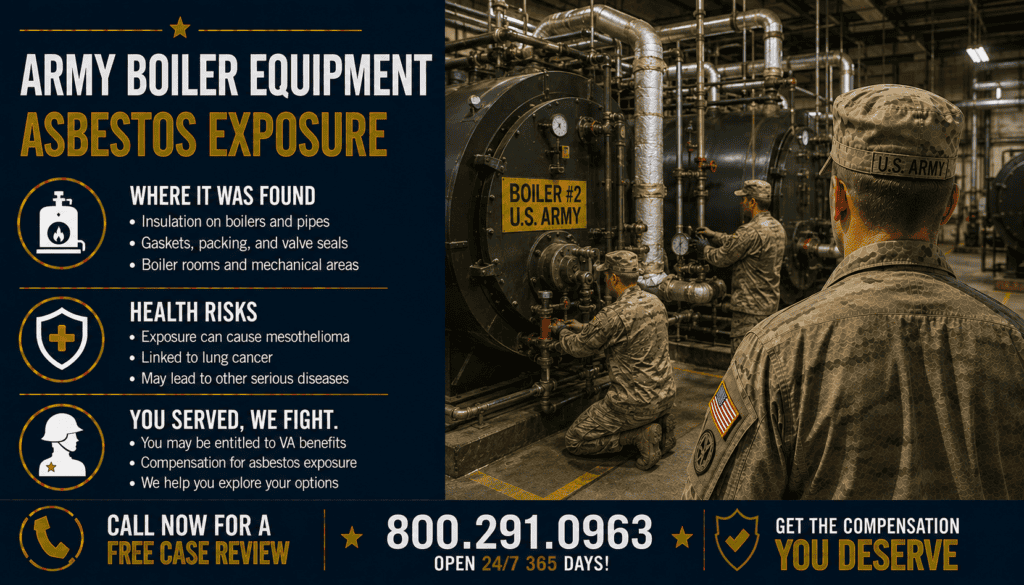
Army Boiler Equipment Asbestos Exposure
U.S. Army boiler equipment has supplied steam, hot water, process heat, and building heat at installations for generations. Official Army and federal records document historical asbestos in some boiler firebox insulation, thermal-system insulation, boiler breeching, piping, gaskets, valves, and related heat-resistant materials, making boiler work an important area for veterans reconstructing possible occupational exposure.
This guide explains how to research Army boiler equipment asbestos exposure, including boiler and pipe insulation, breeching, firebox materials, gaskets and valves, maintenance and repair work, boiler operators and utility personnel, military and facility records, VA disability evidence, and other potential compensation options for Army veterans diagnosed with mesothelioma.
Army Boiler Equipment Asbestos Exposure Overview
U.S. Army installations have relied on boilers and associated heating equipment to provide steam, hot water, process heat, and building heat in barracks, hospitals, shops, warehouses, administrative buildings, housing areas, power facilities, and other structures. Veterans researching possible asbestos exposure around Army boiler equipment should identify the actual boiler, building, piping system, component, maintenance task, and service period rather than assume that every Army boiler contained asbestos.
Official records provide strong reasons to investigate older boiler systems. OSHA defines thermal-system insulation as asbestos-containing material applied to pipes, fittings, boilers, breeching, tanks, ducts, or other structural components to prevent heat loss or gain. A U.S. Army Corps of Engineers asbestos-control manual specifically describes procedures for removing asbestos-containing boiler firebox insulation. VA also identifies pipe coverings, gaskets, valves, and boiler operators among relevant historical military asbestos contexts.
Army records can provide installation-specific evidence. A Camp Stanley environmental assessment documented asbestos-containing material associated with boiler breeching and piping, while a U.S. Army Corps of Engineers briefing for the former SM-1A facility identified thermal-system insulation including pipe and boiler insulation, stack insulation, and turbine insulation.
This page is part of the Army equipment asbestos exposure hub and connects boiler research with Army power plants asbestos exposure and the broader U.S. Army asbestos exposure section.
Army Boiler and Heating Systems
Boiler systems can include the boiler vessel, burner or firebox, breeching and flues, steam and hot-water piping, valves, pumps, condensate systems, fittings, controls, tanks, ducts, and associated mechanical equipment. Army installations may have used central heating plants as well as smaller boilers serving individual buildings or groups of structures.
The age and configuration of these systems can vary widely. Older boilers may have been replaced while portions of original piping, valves, insulation, or mechanical-room materials remained. Renovations can also introduce newer components alongside older materials, so the installation date of the boiler alone may not resolve the asbestos question.
Army Environmental Command identifies construction and operation of boilers and power plants among Army activities subject to air-management requirements and separately notes remediation and demolition of asbestos-containing structures. Modern Army boiler specifications prohibit asbestos-containing products, illustrating that present-day systems should not automatically be treated as equivalent to historical equipment.
Veterans whose work involved central utility systems may also review Army power plants asbestos exposure. Those whose boilers were located in shops or facility mechanical areas may find Army maintenance buildings asbestos exposure useful for organizing location evidence.
Potential Asbestos-Containing Boiler Materials
Thermal insulation is a central area of historical boiler research. OSHA’s asbestos standards define thermal-system insulation to include asbestos-containing material applied to boilers, pipes, fittings, breeching, tanks, ducts, and related components to prevent heat loss or gain. Historically, these applications could include molded or wrapped insulation, insulating cement, block insulation, lagging, and other heat-resistant materials.
VA Veterans Health Library identifies gaskets, valves, cements, adhesives, and pipe coverings called lagging among historical military asbestos uses. These categories are relevant to boiler rooms because boilers depend on piping, valves, flanges, pumps, and other joints that require sealing and thermal control.
The U.S. Army Corps of Engineers’ asbestos-control manual contains a specific response-action procedure for removal of boiler firebox insulation. The procedure directs trained personnel to isolate the flue, remove firebrick, wet exposed insulation, remove asbestos-containing insulation behind the firebrick, use HEPA cleaning, and perform clearance procedures.
These records establish that asbestos was historically encountered in some boiler-related systems, but they do not prove asbestos content in every Army boiler. Building surveys, analytical results, specifications, maintenance files, abatement records, technical manuals, and dated photographs are stronger evidence for a particular installation or piece of equipment.
Boiler Maintenance and Disturbance
Potential exposure is most relevant when asbestos-containing material is disturbed and fibers become airborne. VA Public Health states that asbestos can become a serious health risk when asbestos-containing material is disturbed so particles and fibers become airborne. The condition of insulation and the nature of the work therefore matter.
Potentially relevant historical boiler work can include opening fireboxes, removing firebrick, repairing or replacing insulation, working on breeching, removing pipe covering, opening flanges, replacing gaskets or packing, repairing valves and pumps, cutting or modifying insulated piping, cleaning mechanical spaces, or assisting with boiler replacement and demolition.
Army Corps guidance for boiler firebox insulation demonstrates the controls used for recognized asbestos work: containment, wet methods, controlled removal, HEPA cleaning, encapsulation, inspection, and final air clearance. Those modern or formalized procedures should not be assumed to describe the conditions under which every veteran historically worked.
A useful exposure history records the exact task, component, material condition, dust generation, ventilation, protective equipment, proximity, frequency, and duration. It should distinguish firsthand recollection from later assumptions and should never encourage disturbing suspected asbestos today to identify a historical product.
Boiler Operators and Maintenance Personnel
VA Veterans Health Library specifically identifies boiler operators among service members who may have had asbestos exposure. Other potentially relevant Army personnel can include plumbers, pipefitters, utility workers, maintenance mechanics, engineers, electricians, HVAC personnel, power-plant workers, facility maintenance staff, construction personnel, inspectors, and contractors.
Exposure circumstances can differ considerably. A boiler operator monitoring controls may have a different history from a mechanic removing insulation or replacing gaskets. A pipefitter may work directly on insulated lines and valves, while a supervisor could experience intermittent proximity to multiple repair jobs.
The Army jobs and occupations asbestos exposure section can help organize occupational histories, including Army maintenance workers asbestos exposure and Army engineers asbestos exposure. Equipment stored or issued through installation facilities may also connect with Army warehouses asbestos exposure.
The U.S. Army ranks asbestos exposure section can help reconstruct changes in hands-on and supervisory duties. Rank or job title alone does not prove exposure; the boiler system, material, disturbance, proximity, frequency, and duration are more useful evidence.
Records for Documenting Boiler Exposure
Begin with military records establishing where and when the veteran served and what work was performed. Useful evidence can include the DD-214, Official Military Personnel File, MOS records, assignment orders, evaluation reports, training records, unit histories, duty rosters, facility assignments, photographs, and statements from personnel who performed similar work.
Boiler-specific evidence can include building numbers, mechanical-room locations, real-property records, boiler specifications, architectural and mechanical drawings, piping diagrams, technical manuals, preventive-maintenance records, work orders, asbestos surveys, environmental assessments, abatement records, renovation and demolition files, procurement records, contractor documents, and historical photographs.
Installation environmental records can be especially valuable. Camp Stanley’s environmental assessment, for example, listed asbestos-containing material associated with boiler breeching and piping. Army Corps records for the former SM-1A facility identified thermal-system insulation that included pipe and boiler insulation. Evidence of this kind can help establish what was present at a specific location and period.
Create a chronology listing installation, building, dates, rank, MOS, boiler or system, component, task, disturbance method, material condition, dust, ventilation, proximity, frequency, duration, and witnesses. The Army asbestos exposure timeline can provide broader historical context while individual records support the specific account.
Mesothelioma, Health, and VA Benefits
VA Public Health states that symptoms of asbestos-related diseases often do not appear until 20 to 50 years after exposure. This latency can make decades-old building surveys, mechanical drawings, work orders, personnel records, maintenance documents, photographs, and witness statements important when reconstructing Army boiler work.
VA states that veterans may be eligible for disability compensation when they have a health condition caused by asbestos and had contact with asbestos during military service. Evidence includes medical records showing the condition, service records listing the veteran’s job or specialty, and a doctor’s statement connecting military asbestos contact with the health condition.
Veterans Benefits Administration guidance states that evidence of in-service asbestos exposure may include military occupational specialty and where the veteran was stationed. VA decides asbestos-related compensation claims case by case, and exposure alone is not a condition subject to service connection; a related disease or disability must be claimed and supported.
Army veterans can review Army VA benefits for mesothelioma. Veterans concerned about historical boiler exposure should discuss their complete military and civilian occupational histories with a qualified health care provider or VA Environmental Health Coordinator.
Army Veterans’ Compensation Options
VA disability compensation is separate from private asbestos litigation and bankruptcy trust claims. Depending on the complete exposure history, different processes may examine military boiler work, civilian employment, insulation or gasket manufacturers, equipment suppliers, contractors, premises, power facilities, or other potential asbestos sources.
The Army asbestos legal options section provides Army-specific information about VA benefits and other potential compensation pathways. Eligibility requirements, evidence standards, trust criteria, potential defendants, and filing deadlines vary by process, jurisdiction, and individual circumstances.
Keep factual exposure histories consistent across medical records, VA submissions, trust claims, and civil litigation. Do not identify a particular Army boiler, installation, manufacturer, insulation product, gasket, valve, contractor, or supplier as an asbestos source unless reliable evidence supports that conclusion.
Veterans and families considering civil claims should obtain advice from a qualified attorney concerning applicable deadlines and individual circumstances. Mesothelioma Help Center is not a law firm and does not determine VA eligibility, liability, or filing deadlines.
Frequently Asked Questions
Did every Army boiler contain asbestos?
No. Asbestos use varied by boiler, installation, component, manufacturer, renovation history, replacement material, and service period. Boiler- and building-specific evidence is important.
Where could asbestos have been associated with boiler equipment?
Historical research may involve boiler and pipe insulation, breeching, firebox insulation, gaskets, packing, valves, fittings, ducts, tanks, and other thermal-system materials where records support their presence.
Does official Army documentation show asbestos in boiler systems?
Yes. Army and Army Corps records document asbestos-containing boiler firebox insulation, boiler and pipe insulation, and installation-specific asbestos associated with boiler breeching and piping.
Could gasket or valve work be relevant?
Potentially. VA identifies gaskets and valves among historical military asbestos uses. The actual component and product should be documented whenever possible.
Why is damaged boiler insulation important?
VA states that disturbed asbestos-containing material can release fibers into the air. Condition, disturbance, proximity, frequency, and duration therefore matter in an exposure history.
What Army personnel may have worked around boiler equipment?
Depending on the installation, boiler operators, plumbers, pipefitters, maintenance mechanics, utility workers, engineers, HVAC personnel, power-plant workers, electricians, and contractors may have worked in or around boiler systems.
What records can help document Army boiler exposure?
Personnel files, MOS records, building plans, mechanical drawings, boiler specifications, work orders, asbestos surveys, environmental assessments, abatement files, maintenance records, photographs, and witness statements may help.
Can an Army veteran with mesothelioma seek VA disability compensation?
Potentially. VA requires evidence of a health condition caused by asbestos and military contact with asbestos, supported by applicable medical and service evidence.
Why can old boiler records matter decades later?
VA states that asbestos-related disease symptoms often do not appear until 20 to 50 years after exposure, making historical building and maintenance documentation potentially important.
Review Your Army Boiler Equipment History
If you or a family member has been diagnosed with mesothelioma after Army boiler, heating, utility, or mechanical-system work, gather the DD-214, personnel file, MOS records, assignment orders, unit histories, installation and building numbers, boiler specifications, mechanical drawings, piping diagrams, technical manuals, maintenance logs, work orders, asbestos surveys, environmental assessments, abatement and demolition records, contractor documents, photographs, witness statements, pathology reports, treatment records, VA correspondence, and civilian occupational history. Reconstruct each potentially relevant boiler assignment and maintenance task separately.
Call 800.291.0963 for a no-obligation case evaluation. Talk to a real person 24/7, 365 days a year. You can also submit your case here.
Many mesothelioma law firms handle qualifying civil cases on a contingency-fee basis; confirm fees and expenses with the firm you retain. Mesothelioma Help Center is not a law firm and does not provide legal or medical advice.
🔗 Confirmed Sources
- U.S. Army Corps of Engineers — EP 1110-1-11, Asbestos Control: Boiler Firebox Insulation
- U.S. Army Camp Stanley — Environmental Assessment: Asbestos Materials
- U.S. Army Corps of Engineers — SM-1A: Pipe, Boiler, Stack, and Turbine Insulation
- U.S. Army Environmental Command — Air Compliance: Boilers, Power Plants, and Asbestos Remediation
- U.S. Army Combat Readiness Center — Workplace Asbestos
- U.S. Department of Veterans Affairs — Veterans Asbestos Exposure
- Veterans Benefits Administration — Asbestos Exposure Compensation
- VA Public Health — Asbestos
- OSHA — Asbestos Standard: Thermal System Insulation
Disclaimer: General information only—not legal or medical advice. This website is not a law firm. Exposure, VA eligibility, liability and deadlines vary by case and jurisdiction. Do not disturb suspected asbestos. Past results do not guarantee future outcomes.: 9.8/10 (editorial content assessment, not a Google or Bing measurement)