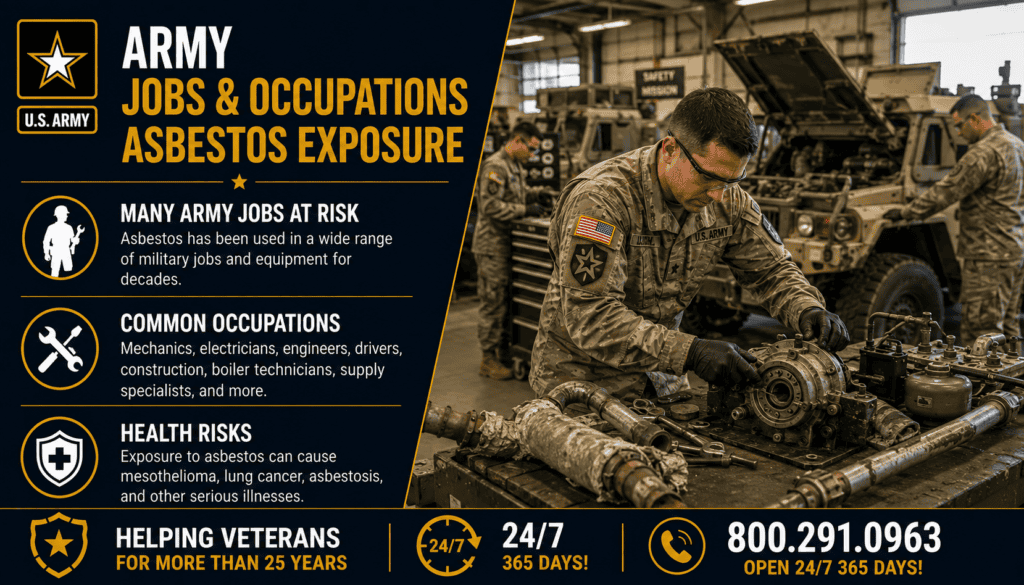
Army Jobs Occupations Asbestos Exposure
U.S. Army jobs and occupations have included construction, engineering, vehicle maintenance, welding, boiler operations, utilities, electrical work, HVAC service, demolition, equipment repair, and other duties that could place some soldiers around older asbestos-containing materials. VA specifically recognizes several of these occupational categories when describing potential military asbestos exposure.
This Army occupations hub explains how job duties can help reconstruct asbestos exposure without assuming that a military occupational specialty alone proves contact. It covers maintenance and mechanical work, construction and engineering, utilities, boilers and HVAC, vehicle and heavy-equipment occupations, service records, VA evidence, and occupational histories for Army veterans diagnosed with mesothelioma.
Army Jobs Occupations Asbestos Exposure Overview
U.S. Army asbestos exposure can be closely connected to a soldier’s military occupational specialty, assigned duties, installation, equipment, and work environment. VA identifies construction, carpentry, demolition, insulation work, manufacturing and installation of certain building products, and servicing friction products such as clutch facings and brake linings among occupational circumstances that may have involved asbestos exposure.
VA Veterans Health Library also identifies pipefitters, welders, boiler operators, and building renovation and demolition specialists among service members who may have encountered asbestos. These categories are particularly relevant to Army work involving facilities, utilities, maintenance shops, motor pools, engineering units, and older buildings.
Job title alone does not prove exposure. Two soldiers with the same MOS can have very different histories depending on their unit, installation, era, equipment, specific tasks, building assignments, and whether asbestos-containing material was actually disturbed. Exposure reconstruction should therefore combine occupational records with location, component, product, and maintenance evidence.
This hub organizes occupational research within the broader U.S. Army asbestos exposure section and connects job histories with Army bases asbestos exposure, Army equipment asbestos exposure, and Army vehicles asbestos exposure.
Army Jobs With Potential Asbestos Exposure
VA’s asbestos guidance identifies several occupational categories that can be relevant to military service: construction, carpentry, demolition, insulation work, pipefitting, welding, boiler operation, and servicing friction products. Army duties can overlap with these categories even when the formal MOS title uses different terminology.
Army occupational records show the breadth of maintenance and engineering work. Current Army career classifications include maintenance mechanics, air-conditioning equipment mechanics, heating and boiler-plant equipment mechanics, boiler-plant operators, utility-system operators, fuel-distribution-system operators, engineering-equipment operators, tractor operators, and crane operators. Modern classifications do not prove historical exposure, but they illustrate the kinds of Army functions that can involve facilities and equipment.
Army Ordnance descriptions likewise show that construction-equipment repairers maintain earthmoving, grading, compaction, lifting, loading, quarrying, crushing, concrete, pumping, compression, and related machinery. Maintenance supervisors can oversee tracked and wheeled vehicles, construction equipment, power generation, air-conditioning and refrigeration systems, and other support equipment.
For exposure research, occupational categories should be treated as starting points. The next step is identifying what the veteran actually handled, repaired, removed, installed, cleaned, cut, ground, inspected, or worked around during the relevant assignment.
Maintenance and Mechanical Occupations
Army maintenance personnel can work around vehicles, machinery, generators, pumps, valves, engines, electrical systems, heating equipment, and building systems. Historical asbestos questions may involve friction products, gaskets, packing, insulation, heat-resistant materials, or asbestos-containing building materials disturbed during repair.
VA specifically identifies clutch facings and brake linings as friction products relevant to asbestos exposure. Army safety guidance also links its workplace asbestos program to OSHA’s brake-and-clutch repair requirements. Maintenance histories should therefore document brake, clutch, gasket, insulation, and cleanup tasks separately rather than simply record that the veteran was a mechanic.
Potentially relevant work can include removing brake drums or shoes, replacing clutch components, scraping gaskets, rebuilding engines, servicing pumps or valves, repairing generators, opening insulated equipment, replacing electrical components, cleaning dusty shops, or assisting other trades during overhaul.
Related location and equipment pages include Army maintenance buildings asbestos exposure, Army motor pools asbestos exposure, Army heavy machinery asbestos exposure, and Army welding equipment asbestos exposure.
Construction, Engineering, and Building Trades
VA lists carpentry, construction, demolition of old buildings, insulation work, and installation of products such as flooring, roofing, cement sheet, pipes, and insulation among work circumstances associated with potential asbestos exposure. Army engineering and facility-maintenance missions can overlap directly with these categories.
Building work may involve renovation, demolition, wall and ceiling access, flooring removal, roofing, pipe work, insulation repair, ductwork, utility upgrades, or structural alterations. The asbestos question depends on whether asbestos-containing material was present and whether the task damaged or disturbed it.
Army installation guidance illustrates this concern. Army asbestos-management materials require trained operations-and-maintenance workers when asbestos-containing material is disturbed, while environmental assessments have recommended asbestos operations-and-maintenance plans for older Army facilities and certified workers for removal, encapsulation, and disposal.
Veterans researching construction or engineering assignments should identify building numbers, project dates, work orders, drawings, renovation files, asbestos surveys, environmental records, contractors, and coworkers. Related site research can include Army barracks asbestos exposure and Army training facilities asbestos exposure.
Utilities, Boilers, HVAC, and Electrical Work
Utility occupations can involve boilers, steam and hot-water piping, pumps, valves, generators, HVAC systems, electrical equipment, and mechanical rooms. VA specifically identifies boiler operators and pipefitters among service members who may have experienced asbestos exposure, while historical military asbestos products included gaskets, valves, heat-resistant materials, and pipe coverings called lagging.
Boiler and HVAC work can involve thermal-system insulation, flange gaskets, valve packing, piping, pumps, ducts, and mechanical equipment. Electrical work can involve older insulated wiring or work in mechanical and utility spaces where asbestos-containing materials were present. Generator work can overlap with engine gaskets, exhaust systems, electrical components, and adjacent insulation.
Army Environmental Command identifies boilers, power plants, emergency generators, refrigerant systems, materiel maintenance, and demolition of asbestos-containing structures among regulated Army activities. This does not establish exposure for an individual veteran but shows how utilities, maintenance, and asbestos management can intersect at Army installations.
Equipment-specific research can continue through Army boiler equipment asbestos exposure, Army HVAC equipment asbestos exposure, Army electrical equipment asbestos exposure, and related installation records.
Vehicle and Heavy-Equipment Occupations
Army vehicle and heavy-equipment occupations can include wheeled-vehicle mechanics, tracked-vehicle maintainers, construction-equipment repairers, recovery personnel, equipment operators, maintenance supervisors, and motor-pool staff. Potential asbestos concerns can arise from friction products, gaskets, insulation, and other documented components during maintenance.
Army Ordnance descriptions show construction-equipment repairers working on earthmoving, grading, compaction, lifting, loading, quarrying, crushing, asphalt, concrete, water-pumping, air-compression, and powered-bridging equipment. Maintenance supervisors can oversee tracked and wheeled vehicles as well as power-generation and utility equipment.
Exposure reconstruction should distinguish operation from maintenance. Driving or operating a machine does not by itself establish asbestos exposure. Removing brakes, servicing clutches, scraping gaskets, rebuilding engines, cleaning dust, or working nearby during those tasks can present a different factual history.
Veterans can connect occupational records with Army vehicles asbestos exposure, Army heavy machinery asbestos exposure, Army fuel system equipment asbestos exposure, and Army motor pools asbestos exposure.
Records for Documenting Occupational Exposure
Begin with records that establish what the veteran did and where the work occurred. Useful documents can include the DD-214, Official Military Personnel File, MOS history, assignment orders, evaluation reports, training certificates, unit histories, duty rosters, shop assignments, project records, photographs, and statements from soldiers who performed similar duties.
Then connect the occupation to the suspected source. Equipment-related evidence can include technical manuals, parts catalogs, National Stock Numbers, maintenance logs, work orders, overhaul files, procurement documents, and manufacturer literature. Building-related evidence can include asbestos surveys, mechanical drawings, specifications, renovation files, demolition records, environmental assessments, and abatement documents.
A detailed chronology can list unit, installation, building or field location, dates, rank, MOS, actual task, equipment or building system, suspected material, disturbance method, visible dust, ventilation, protective equipment, proximity, frequency, duration, and witnesses. This structure is more useful than a general statement that the veteran worked in a high-risk occupation.
The U.S. Army ranks asbestos exposure hub can help reconstruct how responsibilities changed as a soldier advanced. Rank can affect whether duties were primarily hands-on, supervisory, inspection-oriented, or administrative, but rank itself does not establish exposure.
Mesothelioma, Health, and VA Benefits
VA Public Health states that symptoms of asbestos-related diseases often do not appear until 20 to 50 years after exposure. The long latency makes historical MOS records, unit assignments, building files, technical manuals, photographs, and witness statements potentially important when reconstructing occupational exposure decades later.
VA states that a veteran may be eligible for disability compensation based on asbestos exposure when the veteran has a health condition caused by asbestos and had contact with asbestos while serving in the military. VA specifically requests medical records, service records listing the veteran’s job or specialty, and medical evidence connecting military asbestos contact with the health condition.
Veterans Benefits Administration guidance states that evidence of in-service exposure may include the veteran’s military occupational specialty and where the veteran was stationed. It also emphasizes that exposure by itself is not a condition subject to service connection; a related disease or disability must be claimed and supported.
Veterans concerned about historical occupational exposure should discuss their military and civilian work histories with a qualified health care provider or VA Environmental Health Coordinator. A complete history should include nonmilitary employment because exposure may have occurred in more than one setting.
Frequently Asked Questions
Which Army jobs may have involved asbestos exposure?
VA identifies occupational categories including construction, carpentry, demolition, insulation work, pipefitting, welding, boiler operation, and servicing friction products. Individual Army exposure depends on actual duties, location, materials, and service period.
Does an Army MOS prove asbestos exposure?
No. An MOS can help establish the type of work performed, but exposure requires evidence connecting the veteran to asbestos-containing material or a work environment where asbestos was disturbed.
Could Army mechanics have encountered asbestos?
Potentially. VA identifies clutch facings and brake linings as relevant friction products, while maintenance can also involve gaskets, packing, insulation, and other components that require product-specific research.
Could Army construction personnel have been exposed?
Potentially. VA identifies construction, carpentry, demolition, insulation work, flooring, roofing, pipes, and related building products as occupational circumstances associated with asbestos exposure.
Are welders and boiler operators specifically identified by VA?
Yes. VA Veterans Health Library identifies pipefitters, welders, boiler operators, and building renovation and demolition specialists among service members who may have had asbestos exposure.
Can equipment operators have different exposure histories from mechanics?
Yes. Operating a vehicle or machine differs from removing brakes, replacing clutches, scraping gaskets, rebuilding equipment, or cleaning maintenance dust. Actual tasks matter.
What records can help document Army occupational exposure?
Personnel files, MOS histories, assignment orders, unit records, work orders, technical manuals, building surveys, environmental records, photographs, and witness statements may help reconstruct the history.
Can an Army veteran with mesothelioma seek VA disability compensation?
Potentially. VA requires evidence of a health condition caused by asbestos and military contact with asbestos, supported by applicable medical and service evidence.
Why can old occupational records matter?
VA states that symptoms of asbestos-related diseases often do not appear until 20 to 50 years after exposure, so records created decades earlier can be important when reconstructing service duties.
Review Your Army Occupational History
If you or a family member has been diagnosed with mesothelioma after Army service, gather the DD-214, personnel file, MOS history, assignment orders, evaluation reports, unit histories, training records, shop or building assignments, equipment manuals, maintenance logs, work orders, asbestos surveys, environmental records, project files, photographs, witness statements, pathology reports, treatment records, VA correspondence, and civilian occupational history. Reconstruct each potentially relevant job, assignment, task, and work location separately.
Call 800.291.0963 for a no-obligation case evaluation. Talk to a real person 24/7, 365 days a year. You can also submit your case here.
Many mesothelioma law firms handle qualifying civil cases on a contingency-fee basis; confirm fees and expenses with the firm you retain. Mesothelioma Help Center is not a law firm and does not provide legal or medical advice.
🔗 Confirmed Sources
- VA Public Health — Asbestos and Occupational Exposure
- VA Veterans Health Library — Veteran Exposure to Asbestos
- U.S. Department of Veterans Affairs — Veterans Asbestos Exposure
- Veterans Benefits Administration — Asbestos Exposure Compensation
- VA WRIISC — Exposure to Asbestos Information Sheet
- U.S. Army Combat Readiness Center — Workplace Asbestos
- U.S. Army — Construction, Engineering, and Infrastructure Career Field
- U.S. Army Ordnance Corps — Maintenance and Equipment Occupations
- U.S. Army Environmental Command — Army Regulated Activities and Asbestos Demolition
Disclaimer: General information only—not legal or medical advice. This website is not a law firm. Exposure, VA eligibility, liability and deadlines vary by case and jurisdiction. Do not disturb suspected asbestos. Past results do not guarantee future outcomes.