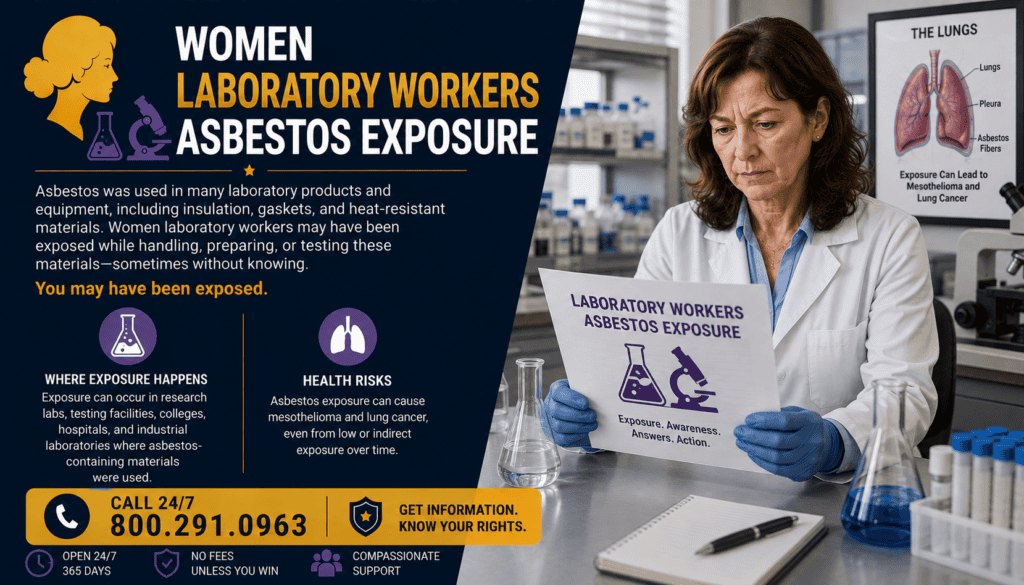
Women Laboratory Workers Asbestos Exposure
Women who worked in research, industrial, environmental, hospital, university or materials-testing laboratories may have encountered asbestos under particular circumstances. Potential pathways include handling asbestos-containing bulk samples, analyzing air-monitoring samples, working with older asbestos-containing laboratory materials, or being present during building maintenance and renovation. Laboratory employment alone does not establish asbestos exposure; the specific facility, task, material and time period should be documented.
Laboratory exposure histories require careful separation of direct sample work from incidental building exposure. OSHA regulates occupational asbestos exposure and also maintains a Laboratory Standard for hazardous-chemical work in qualifying laboratories. Asbestos sample collection and analysis have additional technical controls and quality requirements. This guide explains which records can help reconstruct a woman’s work, identify potential asbestos sources and preserve useful medical and legal evidence.
🔬 Women Laboratory Workers: Exposure Overview
OSHA’s general-industry asbestos standard applies broadly to occupational asbestos exposures outside construction and shipyard work, while OSHA’s Laboratory Standard applies to qualifying laboratory use of hazardous chemicals. The Laboratory Standard requires employers to control exposures to regulated substances and maintain a Chemical Hygiene Plan with safe-work procedures, controls, training and related protections.
Start with the Women’s Occupations & Workplace Asbestos Exposure hub. Record the employer, laboratory type, department, job title, dates, materials handled and whether the work involved asbestos identification, sample preparation, microscopy, industrial hygiene or building maintenance.
| Question | Details to document |
|---|---|
| Where? | Employer, laboratory, department and building |
| When? | Employment dates and specific project periods |
| What task? | Sample collection, preparation, analysis or cleanup |
| What material? | Bulk sample, air sample, building material or equipment component |
🏥 Laboratory Settings and Workplaces
Laboratories differ substantially. A clinical laboratory may have had no direct asbestos-testing function, while an environmental, industrial-hygiene or materials laboratory may have received samples specifically for asbestos analysis. University and industrial laboratories can also occupy older buildings where asbestos-containing construction materials were historically used.
For hospital or clinical settings, see Women Healthcare Workers Asbestos Exposure. Do not infer asbestos exposure simply from the word “laboratory”; identify the actual work and facility conditions.
| Setting | Exposure question |
|---|---|
| Environmental/materials lab | Were asbestos samples received or prepared? |
| Industrial hygiene lab | Were asbestos air samples analyzed? |
| University/research lab | Were asbestos materials used or was the building affected? |
| Clinical/hospital lab | Was there a documented building or maintenance source? |
🧪 Asbestos Samples and Analytical Work
Direct asbestos laboratory work may involve bulk building-material samples or air-monitoring samples. OSHA requires laboratories used for asbestos monitoring analysis to have quality-assurance programs meeting specified requirements. EPA notes that NIST’s National Voluntary Laboratory Accreditation Program accredits laboratories for asbestos analysis using polarized light microscopy and transmission electron microscopy.
Sample collection is a separate task from laboratory analysis. OSHA has stated that obtaining bulk samples from asbestos-containing or presumed asbestos-containing material is a disturbance operation under its construction asbestos standard and requires specified controls. A worker’s history should therefore distinguish who collected samples, who received them, who prepared them and who performed the analysis.
| Activity | Useful records |
|---|---|
| Bulk sampling | Field notes, project file, sample log and training |
| Sample preparation | SOP, method, workstation and control records |
| Microscopy/analysis | Bench sheets, method, accreditation and QA records |
| Air monitoring | Sampling forms, analytical results and project reports |
🔥 Historical Laboratory Equipment and Materials
Some historical laboratories used heat-resistant equipment or building components that warrant investigation, but an old laboratory should not automatically be characterized as containing asbestos. Potential leads can include heat-resistant surfaces, insulation associated with furnaces or ovens, pipe or mechanical-system insulation and specialized historical equipment.
Product manuals, equipment specifications, purchasing records, maintenance files and asbestos surveys are more reliable than visual appearance. The key question is whether the particular material or component used in that laboratory during the relevant period can be documented as asbestos-containing.
🏢 Laboratory Buildings and Renovation Exposure
A woman may also have worked in a laboratory located within an older university, hospital, government or industrial building containing asbestos materials. Building exposure is different from direct laboratory sample work. Renovation, maintenance or deterioration may be relevant when documented asbestos-containing material was disturbed.
See Women Working in Asbestos-Containing Buildings. Useful evidence can include asbestos surveys, floor plans, renovation specifications, work orders, abatement records and maintenance files.
| Record | Potential value |
|---|---|
| Asbestos survey | Identifies documented ACM and location |
| Renovation file | Shows work near the laboratory |
| Abatement report | Documents removal area and dates |
| Work order | May identify damaged or repaired material |
🗂️ Employment and Exposure Evidence
Build a chronological work history connecting the employee to specific laboratories, projects and tasks. Preserve personnel records, payroll records, job descriptions, training files, Chemical Hygiene Plans, standard operating procedures, sample logs, quality-assurance records, project reports, exposure-monitoring records and coworker names when available.
The Mesothelioma Lawsuit Evidence & Documentation hub provides additional guidance. Distinguish records showing that a laboratory analyzed asbestos from evidence showing that a particular employee personally handled or worked near the material.
🫁 Medical Documentation and Exposure History
The National Cancer Institute classifies asbestos as a known human carcinogen and states that asbestos exposure causes mesothelioma and cancers including lung, laryngeal and ovarian cancer. NCI notes that risk generally increases with heavier and longer exposure, while asbestos-related disease can appear decades after exposure.
Use the Women’s Asbestos Diseases hub for focused health information. Preserve pathology, imaging and treating-clinician records separately from the laboratory exposure timeline. A diagnosis alone does not identify a particular laboratory, sample or employer as the exposure source.
⚖️ Potential Claim Questions
A laboratory-worker claim investigation may consider employers, premises owners, manufacturers, suppliers, contractors or asbestos bankruptcy trusts depending on the documented source and governing law. Direct sample handling, historical equipment and building exposure can involve different evidence and potentially different responsible entities.
Review the Women’s Asbestos Legal Options hub and Mesothelioma Lawsuits in All 50 States. Workers’ compensation, civil claims and asbestos trust claims have different requirements, and compensation is not guaranteed.
🛡️ Current Laboratory Safety and Asbestos Controls
OSHA’s Laboratory Standard requires qualifying laboratories to maintain a Chemical Hygiene Plan addressing procedures, controls, protective equipment, training and medical consultation. OSHA’s asbestos standards separately establish exposure limits, monitoring requirements and controls for regulated asbestos work.
Current sample analysis should follow the applicable analytical method, quality-assurance requirements and laboratory accreditation or proficiency requirements. Do not disturb a suspect historical material today merely to recreate or prove an old exposure.
❓ Frequently Asked Questions
Could women laboratory workers have encountered asbestos?
Yes, in particular settings such as asbestos-testing laboratories, sample collection work, certain historical industrial laboratories or buildings with documented asbestos materials. Individual evidence is required.
Does working in a laboratory prove asbestos exposure?
No. The laboratory’s function, materials, building conditions and the employee’s actual duties must be investigated.
Can laboratory workers analyze asbestos bulk samples?
Yes. EPA describes accredited laboratory analysis of bulk asbestos samples using methods including polarized light microscopy.
Can air-monitoring samples be analyzed for asbestos?
Yes. OSHA’s asbestos standards contain analytical and quality-control requirements for asbestos air monitoring.
Is collecting an asbestos bulk sample different from analyzing it?
Yes. OSHA treats bulk sample collection as a disturbance operation under the construction asbestos standard, while laboratory analysis has separate analytical and quality requirements.
Could an older laboratory building itself be relevant?
Potentially, when records document asbestos-containing materials and circumstances in which those materials were disturbed or deteriorated.
What records are especially useful?
Personnel files, job descriptions, sample logs, SOPs, training records, project reports, asbestos surveys, exposure-monitoring records and coworker accounts can help reconstruct the history.
Is compensation guaranteed?
No. Exposure evidence, responsible parties, medical documentation, deadlines and applicable law affect whether a claim is available.
📞 Submit Your Case
If you or a loved one has a mesothelioma diagnosis and a history of laboratory work, gather employer names, laboratory locations, work dates, job duties, sample types, project records, training information and any known asbestos surveys or exposure-monitoring records. Unknown details should remain research leads rather than guesses.
Call 800.291.0963 for a no-obligation case evaluation. Live chat is available 24/7, 365 days a year. Submit your case here.
📝 Summary
Women laboratory workers may have encountered asbestos through direct sample collection or analysis, specialized historical materials, or asbestos-containing building materials. A reliable investigation identifies the specific laboratory, project, task, material and time period and supports those facts with employment, sample, quality-assurance, building, witness and medical records.
🔗 Confirmed Sources
- OSHA — 29 CFR 1910.1001 Asbestos
- OSHA — Occupational Exposure to Hazardous Chemicals in Laboratories
- OSHA — Asbestos Inspections and Bulk Sampling Interpretation
- U.S. EPA — Asbestos Technical Resources and Laboratory Accreditation
- National Cancer Institute — Asbestos Exposure and Cancer Risk
This page provides general information, not legal or medical advice. This website is not a law firm. Exposure, eligibility, filing deadlines and compensation depend on individual facts and applicable law. No outcome is guaranteed.