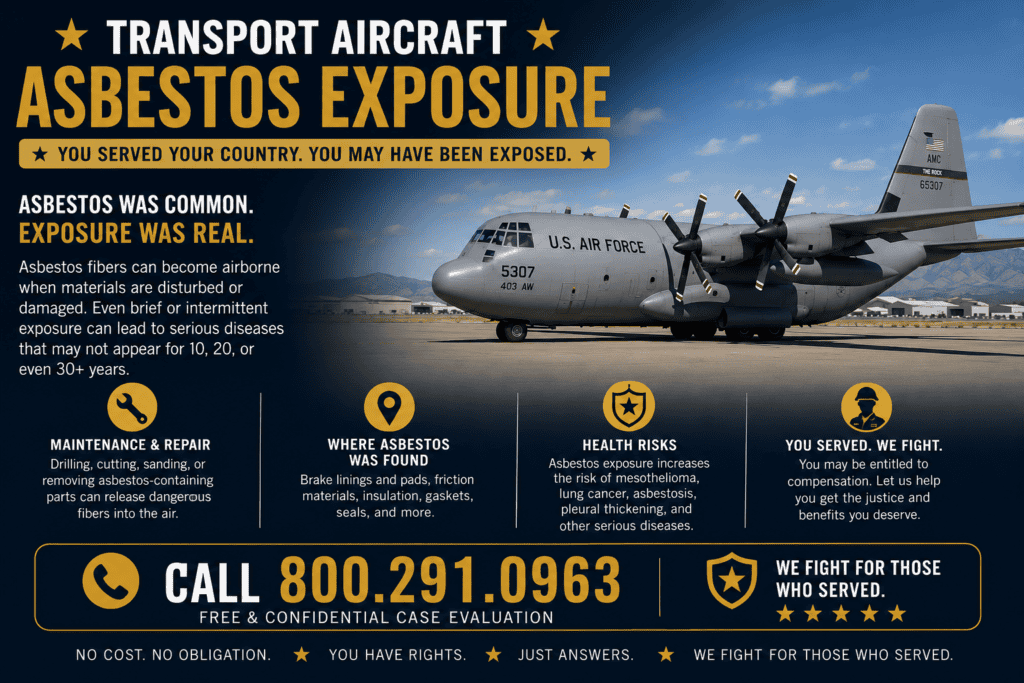
Transport Aircraft Asbestos Exposure
Transport aircraft asbestos exposure may have occurred during historical military aviation work involving brakes, landing gear, engines, gaskets, insulation, cargo areas, hangars, and ground-support equipment. The aircraft model, component, supplier, service period, and maintenance history determine what evidence should be investigated.
Veterans, aircraft mechanics, aircrew, loadmasters, flight engineers, and ground-support personnel can strengthen an exposure history by identifying exact transport aircraft, duties, bases, dates, part numbers, technical orders, and maintenance records. A transport-aircraft assignment or flight alone does not prove asbestos exposure.
Transport aircraft asbestos exposure: identify the source
Military transport missions have relied on cargo planes, passenger-configured aircraft, tankers, and ground facilities. Historic friction products, insulation, gaskets, and some building materials could contain asbestos, but a transport assignment alone does not show that a specific aircraft or flight released fibers. The model, installed component, maintenance history, task, and date matter.
Aircraft and support settings to investigate
| Setting | Possible work event | Evidence to request |
|---|---|---|
| Brakes and landing gear | Removing or cleaning a historical friction part. | Part number, supplier, maintenance card, material specification. |
| Engines and heated systems | Replacing identified insulation, seal, gasket, or heat-protective material. | Engine variant, dated technical order, overhaul record. |
| Cabin and cargo areas | Repair to a verified insulated component or handling an identified damaged load. | Configuration diagram, repair order, cargo record if relevant. |
| Ground equipment and hangars | Servicing older equipment or working near building renovation. | Equipment and facility records, worksite survey. |
The EPA identifies historical asbestos in some friction products, insulation, and gaskets and explains that fibers can be released by disturbance. These categories are research leads and do not establish the content of any specific transport plane. See aircraft brake systems, ground support crews, and aircraft hangars.
Compare C-130, C-141, tankers, and other transports
Record the exact aircraft model and variant, unit, base, dates, and tail number if known. The C-130 Hercules and C-141 Starlifter pages provide model-focused leads. The KC-135 Stratotanker page is relevant when service involved tanker support, but its component history must be researched separately. Different aircraft and variants can use different suppliers and receive different replacement parts over time.
Do not assume that material documented in a C-130 was also installed on a C-141 or a passenger-configured aircraft. Match the actual part and maintenance date to the person’s assignment.
For compare c-130, c-141, tankers, and other transports, ask what the available evidence proves on its own. A record may place a person at the aircraft, shop or hangar while saying nothing about a product, task or clinical decision. Another record may identify a material or diagnosis without placing the individual there. Join these pieces only when dates and identities align. If a necessary record cannot be located, describe the gap directly and pursue a narrower request rather than filling it with an assumption.
Passengers, aircrew, and mechanics have different histories
Passengers and routine aircrew may be able to document travel or time aboard an aircraft, but flight records alone do not prove airborne asbestos exposure. Mechanics may have a more specific task history involving an identified component. Load crews and ground workers should distinguish an aircraft part from cargo, ground equipment, or hangar materials.
Document who handled the material, what was done to it, where each person stood, how often the task occurred, and whether the space was ventilated. A claim of exposure should be grounded in a documented product and plausible contact pathway rather than a mission label.
Do cargo or passenger flights establish contact?
Carrying cargo does not mean the cargo contained asbestos; even a documented asbestos-containing shipment does not automatically show that fibers escaped its packaging. A passenger manifest or flight log establishes travel, not the composition or condition of nearby parts. If a particular load or incident matters, seek its manifest, packaging and damage reports, handling notes, and firsthand accounts.
For cabin equipment, request configuration and repair records that identify the actual material. Keep cargo and cabin events distinct from engine or brake maintenance so the facts do not become conflated.
Build a dated record for each exposure event
- Service records with unit, military specialty, aircraft assignments, base and deployment dates.
- Maintenance work cards, technical orders, overhaul records, component part numbers and supplier specifications.
- Flight, passenger, or cargo records when they establish time or location, with separate proof of the suspected material.
- Ground-equipment records and hangar asbestos surveys if those are the actual exposure source.
- Firsthand coworker accounts identifying material, task, date range, and position.
- Medical records and an accurate history of civilian and household exposure.
See military service records. Mark uncertainties as such; a general fleet history cannot replace evidence about the aircraft and time at issue.
Health questions and clinical evaluation
The CDC notes asbestos causes most mesothelioma cases, though exposure does not guarantee disease. Chest symptoms or other persistent concerns require evaluation because they have many possible causes. Tell a clinician what transport work you actually performed and disclose other exposure sources.
Retain pathology, biopsy, imaging, and treatment records if diagnosed. Seek needed medical care without waiting to locate every old maintenance record.
VA benefits and other possible claims
VA guidance identifies medical records, service records listing job or specialty, and a doctor’s statement linking a condition to military asbestos contact as relevant evidence. Transport-aircraft service is not an automatic exposure presumption. See VA mesothelioma claim for filing steps.
Potential civil or trust claims turn on product, responsible company, dates, evidence, and applicable law. Keep aircraft, facility, cargo, and civilian exposure sources separate when seeking an individualized review.
Frequently asked questions
Did every military transport aircraft contain asbestos?
No. Determine material content by model, component, supplier, and relevant dates.
Does flying as a passenger prove exposure?
No. A flight record alone does not identify asbestos or fiber release.
Can transport-aircraft brake maintenance matter?
Potentially, when a specific historical part contained asbestos and the veteran worked with or near its disturbance.
Is cargo automatically an asbestos source?
No. Identify a particular shipment, material, condition, and handling event.
Does a C-130 part record apply to a C-141?
No. Verify each aircraft and installed component independently.
Could hangar work be the actual exposure source?
Yes, if records identify disturbed asbestos-containing material and the veteran’s presence.
What does a manifest establish?
Usually a route, passenger, or shipment; separate evidence is needed for material content and contact.
Does mesothelioma automatically establish VA service connection?
No. VA also reviews military asbestos contact and a medical connection.
Should civilian aviation work be included?
Yes. Give clinicians and reviewers a complete timeline.
📞 Review Your Aircraft and Service History
If a veteran or family member is investigating transport aircraft asbestos exposure, organize aircraft or installation assignments, maintenance dates, part numbers, coworker information and medical records. Identify uncertain details clearly. A case review can help identify which records may be useful, but cannot guarantee a benefit or legal outcome.
Call 800.291.0963 for a no-obligation case evaluation and to speak with a real person 24/7, 365 days a year. Mesothelioma Help Center is not a law firm or medical provider.
📝 Summary
Transport Aircraft Asbestos Exposure requires a person-specific review. Identify the relevant service or care period, tasks or decisions, and reliable records before drawing conclusions. Medical and legal eligibility depend on distinct evidence and rules. Keep uncertainty visible, request missing documents and seek qualified advice when a diagnosis or deadline makes the matter urgent.
🔗 Confirmed Sources
Disclaimer: General information only—not legal or medical advice. This website is not a law firm. Exposure, VA eligibility, liability and deadlines vary by case and jurisdiction. Do not disturb suspected asbestos. Past results do not guarantee future outcomes.