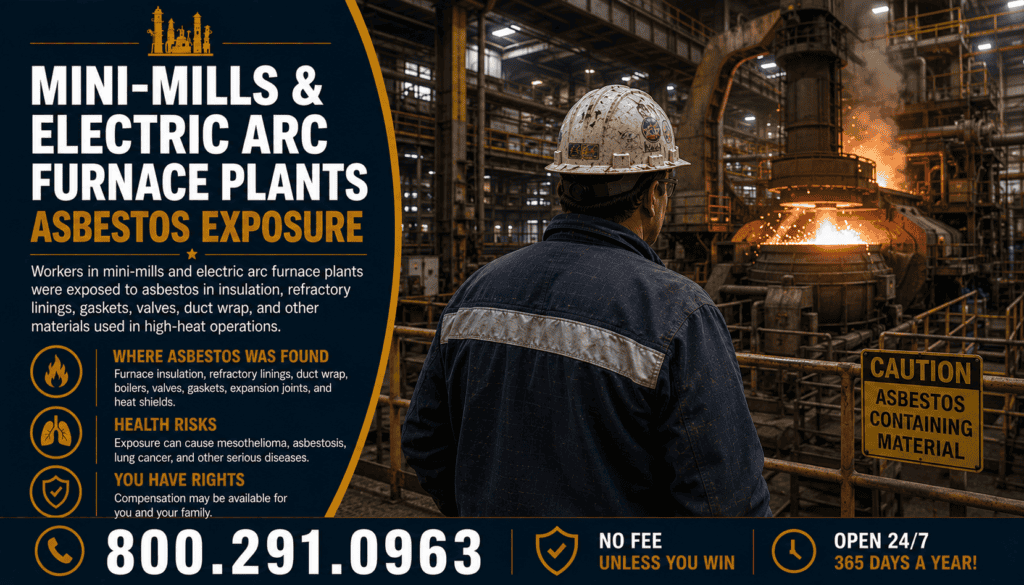
🏭 Mini-Mills & Electric Arc Furnace Plants Asbestos Exposure
For workers at mini-mills and electric arc furnace steel plants, understanding historical asbestos exposure means looking beyond the steel-mill name. Certain older insulation, packing, gasket and heat-resistant products used asbestos, but exposure depends on the product, work period, maintenance task and how material was disturbed.
This guide explains mini-mills & electric arc furnace plants asbestos exposure, the work areas and records that may matter, and the medical and legal questions that arise after mesothelioma or asbestos-related lung cancer. It distinguishes steelmaking dust from asbestos fibers and avoids treating every furnace or machine as an asbestos source.
🏭 Steel Mill Locations And Facilities
Steel plants operated furnaces, rolling lines, finishing shops and utility buildings, but their configurations differed widely. steel mill asbestos exposure is the broad starting point; the narrower plant type and the worker’s department should guide any exposure history. A maintenance crew in a steam plant had different materials and tasks from a production worker at a casting line.
Plant layout matters: integrated steel mills could have coke ovens and blast furnaces, while mini-mills using electric arc furnaces generally followed a different melting process. Neither plant type proves that a particular gasket, insulation layer or protective product contained asbestos.
Facility Layout And Work Zones
Useful records include department maps, equipment lists, old photographs, plant safety reports and contractor permits. Note whether the person worked in a melt shop, rolling mill, boiler house, pipe gallery, mechanical shop or finishing department. Equipment sometimes moved between departments or was replaced during modernization.
The Importance Of Plant Era
steel mill renovation and upgrade work can involve different disturbance patterns than ordinary production. Replacing an insulated steam line, for example, is more relevant to asbestos analysis than simply operating a furnace. Historical product catalogs and abatement surveys can help distinguish old materials from later substitutes.
👷 Jobs And Production Tasks
Occupational titles can be misleading because steel mills assigned employees to production, utility, maintenance and contractor crews. steel-mill occupations provides a way to distinguish these groups, while a personal history should identify actual duties rather than rely on the title alone.
Electric Arc Furnace Operations
Electrodes generate heat to melt scrap steel; furnace linings, covers and nearby hot-service equipment are distinct material categories. Refractory products were not uniformly asbestos-containing. The central question is whether a particular material was disturbed during the job, and whether the person worked close enough to inhale any resulting fibers. Work orders, coworker accounts and equipment drawings can narrow the answer.
Ladle And Tundish Handling
Molten metal was transferred through ladles and, at some plants, continuous casting equipment. Heat shields, seals and maintenance insulation require identification by time and product. The central question is whether a particular material was disturbed during the job, and whether the person worked close enough to inhale any resulting fibers. Work orders, coworker accounts and equipment drawings can narrow the answer.
Workers in the same facility might have very different exposure histories. steel-mill maintenance and repair workers often performed intrusive equipment work, while operators might be present during those repairs without handling materials directly. Record both the direct work and any nearby contractor activity.
Trades And Overlapping Work
pipefitters and insulators in steel mills sometimes worked on steam lines and hot-service equipment during outages. steelworkers and millwrights could instead dismantle mechanical drives or replace seals. Distinguishing who removed insulation, who scraped gaskets and who remained in the area is important.
⚙️ Equipment And Asbestos Products
Asbestos was historically incorporated into some thermal insulation, woven textiles, packing, gaskets and other heat-resistant products. However, refractory brick, furnace dust, slag and ordinary steelmaking residue should not automatically be called asbestos. Product composition must be supported by a manufacturer specification, reliable testing or other evidence.
Water-Cooled And Hydraulic Systems
Electric arc furnace shops relied on cooling circuits, pumps, valves, hoses and hydraulic equipment. Packing, flange gaskets and adjacent pipe insulation could be disturbed during repair. The location of the component and the maintenance method help explain whether fibers could have become airborne; age alone cannot establish its formulation.
Dust Collection And Plant Maintenance
Baghouses, ductwork, cranes and electrical systems were serviced near the melt shop. Furnace dust is not automatically asbestos dust; specific asbestos-containing materials must be established. The location of the component and the maintenance method help explain whether fibers could have become airborne; age alone cannot establish its formulation.
steel-mill equipment and systems includes multiple potential work areas. More specifically, piping, valves and gaskets should be examined where crews opened flanges, replaced packing or stripped nearby lagging. A valve’s existence does not establish that its packing contained asbestos.
In boiler houses, steel-mill boilers and steam systems may be relevant to insulation on steam drums, headers and breeching. Furnace maintenance is a different topic: blast furnaces and refractory materials illustrates why material identification matters before attributing a fiber hazard to a hot-work operation.
🌫️ How Asbestos Exposure Occurred
Disturbance And Airborne Dust
Potential exposure generally requires a credible pathway from asbestos-containing material to inhaled airborne fibers. Cutting, chipping, scraping or stripping an asbestos-containing product can release dust; merely walking past intact equipment may not. Workers should describe ventilation, duration, distance and whether dust was visible without assuming visible dust was asbestos.
Maintenance Shutdowns And Overhauls
Large repair projects could involve insulation contractors, millwrights, pipefitters and electricians in shared spaces. steel-mill demolition may involve more extensive disturbance than routine servicing, and each task should be evaluated separately. A contractor’s presence is not proof that asbestos was disturbed during a particular shift.
Nearby Workers And Secondary Exposure
Workers who did not remove a product themselves might still have been nearby when another crew performed dusty maintenance. That possibility depends on actual proximity and dust movement. Family members sometimes ask about fibers carried home on work clothing; clothing practices, laundering and the time period should be documented without assuming take-home exposure occurred.
industrial insulation, gaskets and packing offers context for related products in high-temperature metalworking, but steel-mill and foundry records should not be treated as interchangeable. Material specifications and department-specific work are stronger than general industry labels.
🩺 Mesothelioma And Medical Evaluation
Recognizing A Long-Latency Disease
Mesothelioma is a cancer of the mesothelial lining, commonly involving the pleura around the lungs. It can appear decades after asbestos exposure. Symptoms may include shortness of breath, chest pain, fatigue or fluid around the lung; those symptoms also occur in other conditions and require clinical evaluation.
Diagnosis generally involves imaging, tissue sampling and specialist pathology review. A medical team can distinguish mesothelioma from other diseases and discuss treatment based on cell type, extent of disease and overall health. A work history is useful to clinicians but is not a substitute for medical testing.
Treatment And Medical Documentation
Treatment may include surgery for selected patients, systemic therapies, radiation or supportive care depending on the case. Preserve pathology reports, imaging, oncology notes and discharge summaries. The medical record establishes the diagnosis; worksite and product records separately address the possible exposure source.
steel-mill mesothelioma lawsuits involve legal questions beyond diagnosis, including the identification of responsible products and applicable state law. A diagnosis alone does not prove that any particular company caused the illness.
🫁 Asbestos-Related Lung Cancer
Asbestos-Related Lung Cancer
Asbestos exposure can cause lung cancer. Smoking is another major risk factor, and combined exposures can increase risk. A clinician should receive an accurate smoking and occupational history and evaluate symptoms promptly; no website can determine an individual cancer’s cause.
A lung cancer diagnosis does not by itself identify an asbestos product, manufacturer or legally responsible party. Medical causation and legal proof are separate questions. The worker’s other jobs, military service, household exposures and health history may also be relevant.
Why Exposure Histories Matter
A useful chronology records employment dates, shifts, departments and the type of material handled. When the product cannot be identified, state that clearly. Witness recollections can help locate a repair event, but a witness should not guess whether an unknown insulation or gasket contained asbestos.
📋 Records And Exposure Evidence
Start with the employer’s full name, mill address, department, union local and dates of employment. Collect available pay stubs, pension statements, work orders, maintenance logs, safety records and equipment manuals. Old catalogs and purchase orders may identify a component supplier, but do not necessarily establish the formulation installed at a given time.
| Record | Potential Value |
|---|---|
| Personnel, union and payroll files | Place a worker at a mill and department during specific years |
| Maintenance orders and shutdown schedules | Identify equipment opened or insulation removed |
| Supplier invoices and product manuals | Help establish product model, brand and material specifications |
| Photos, maps and coworker accounts | Explain proximity, ventilation and tasks observed |
| Pathology and treatment records | Document disease and medical care |
Separating Evidence From Assumptions
A coworker may recall that an insulated pipe was stripped during a shutdown but not remember its brand. An invoice may show that asbestos-containing gaskets were purchased without proving that a particular worker handled them. Record each fact with its source and avoid combining uncertain details into a false certainty.
If the person also worked at other metal facilities, foundry workers and foundry furnace machinery may help identify separate exposure pathways. Do not import another plant’s materials or work practices into a steel-mill claim without evidence.
Records For Families
Family members may need help locating union pensions, old employment documents, death certificates or medical records. Keep copies with dates and sources. If the worker can describe past jobs, preserve the account in their own words rather than replacing it with assumptions from general industry articles.
⚖️ Lawsuits And Compensation Options
Potential Personal Injury Claims
steel-mill mesothelioma lawsuits and compensation explains general legal avenues. Depending on the facts and jurisdiction, cases may involve product manufacturers, suppliers or other responsible entities. Workers’ compensation, civil litigation and asbestos bankruptcy trust claims have different eligibility requirements and can interact.
Wrongful Death And Trust Claims
Families who lost a worker can review steel-mill wrongful-death claims. Who can file, which losses are recoverable and when a claim must be brought depend on state law. A death certificate alone does not identify a responsible product or establish legal liability.
Certain bankrupt asbestos manufacturers established compensation trusts, but each trust has its own medical and exposure criteria. Evidence of working at a steel mill does not automatically qualify someone for a particular trust. A qualified attorney can explain applicable procedures, deadlines and potential interactions with lawsuits.
Deadlines And Jurisdiction
Asbestos filing deadlines vary by state and type of claim. Some jurisdictions apply discovery-related rules to latent diseases; wrongful-death claims may have separate triggers. Work location, residence, defendants and prior claims can complicate the analysis. Seek state-specific legal advice promptly rather than assuming one nationwide time limit.
❓ Frequently Asked Questions
Did Every Steel Mill Use Asbestos?
No. Certain historical products contained asbestos, but specific materials, years and tasks must be established.
Were Electric Arc Furnaces Made Of Asbestos?
A furnace is a complex system; its refractory, seals, insulation and auxiliary components had different formulations. The furnace type alone proves nothing about asbestos content.
Can Millwrights Have Been Exposed During Repairs?
Possibly, where confirmed asbestos-containing gaskets, packing or insulation were disturbed during work or nearby maintenance.
Does Steelmaking Dust Mean Asbestos Dust?
No. Metal, slag and refractory dust should not be assumed to contain asbestos without product or sampling evidence.
Can A Family File After A Worker Dies?
Potentially. State law governs wrongful-death and survival claims, authorized claimants and deadlines.
What Should I Do With Suspected Asbestos Material?
Do not cut, sample or disturb it yourself. Consult qualified professionals and follow applicable safety requirements.
🧭 Summary
Mini-Mills & Electric Arc Furnace Plants Asbestos Exposure concerns specific steelmaking and maintenance activities, not an automatic conclusion about every mill. A reliable history identifies the worker, plant, dates, materials and dust-producing tasks. Medical diagnosis and legal eligibility require separate professional assessment; keep records and seek timely advice.
📚 Confirmed Sources
These government resources establish general asbestos health and workplace-safety background, not the asbestos content of a particular steel-mill product or an individual claim.
- OSHA — Asbestos Overview
- OSHA — General Industry Asbestos Standard
- OSHA — Construction Asbestos Standard
- National Cancer Institute — Asbestos Exposure And Cancer Risk
Get The Compensation You Deserve
Find out if you may qualify for asbestos compensation today. Call 800.291.0963 or Submit Your Case Here.
Help is available 24/7/365. 25+ years of experience.
Disclaimer: Mesothelioma Help Center is not a law firm or medical provider and does not determine legal or VA eligibility. This information is not individualized medical or legal advice.