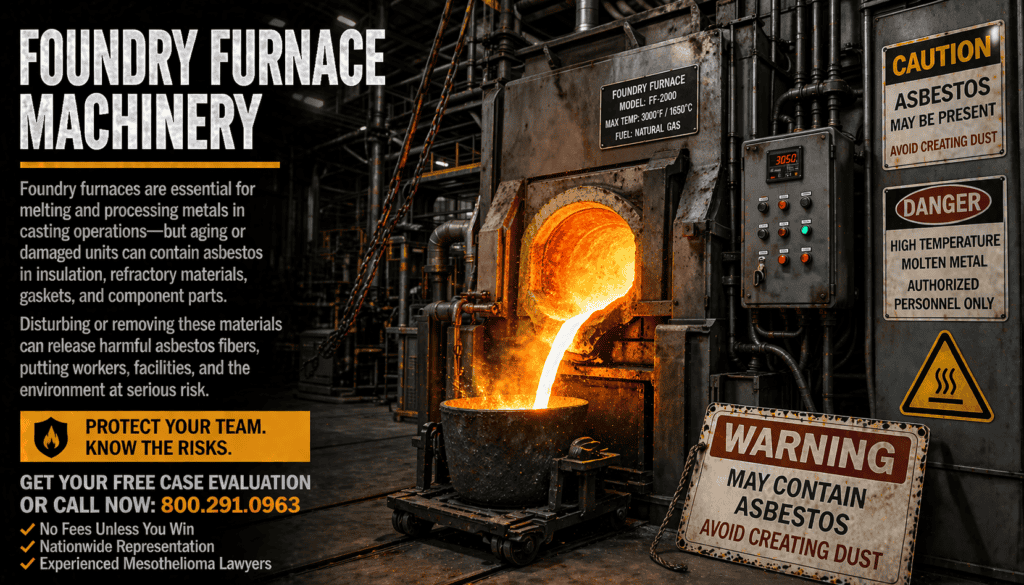
🔥 Foundry Furnace Machinery Asbestos Exposure
Foundry furnace machinery operated in high-temperature metalcasting environments where some historical insulation, gaskets, and heat-resistant products contained asbestos. Exposure depended on the specific materials installed and whether workers disturbed them during maintenance, repairs, or demolition.
This article explains potential furnace-related exposure pathways, affected trades, useful records, health conditions, and compensation considerations. It also connects relevant machinery articles naturally within the sections where their equipment and maintenance practices are discussed.
On This Page
🔥 How Asbestos Exposure Occurred
Foundry furnaces melted iron, steel, aluminum, and other metals before casting. The furnace vessel and molten metal were not themselves asbestos. Historical exposure concerns involve particular insulation, heat-resistant seals, packing, boards, and associated piping that may have contained asbestos. Whether those materials were present depended on the furnace design, supplier, and years of operation.
Workers removing deteriorated insulation or scraping an old door seal could release fibers if the material contained asbestos. Comparable repair practices occurred on industrial furnace machinery, but a separate facility’s equipment history cannot establish what was installed in a particular foundry.
Routine production dust from sand molds, metal fumes, and refractory demolition can involve hazards other than asbestos. A credible exposure history separates silica-containing sand, non-asbestos refractory dust, and asbestos-containing insulation instead of treating every dusty furnace job as asbestos exposure.
Exposure could affect the person removing a product and coworkers nearby, particularly during maintenance shutdowns. The distance to the work, duration, ventilation, material condition, and cleanup practices all matter when reconstructing events that occurred decades ago.
🧱 Furnace Components and Heat-Resistant Materials
Older furnace doors sometimes used heat-resistant rope or gasket materials to limit heat loss. Where a particular gasket contained asbestos, scraping or replacement could release fibers. Material labels, service manuals, and surviving spare parts are more reliable evidence than assumptions based on equipment age.
Thermal insulation around furnace shells, ducts, and adjacent hot piping was another potential source. In some plants the insulation was installed by a separate contractor rather than the furnace manufacturer, making purchasing and contractor records especially useful for product identification.
Foundry crews often worked alongside refractory mixing and gunning machinery used to install or repair heat-resistant linings. Refractory products varied considerably; many did not contain asbestos. The product formulation, not merely the fact that refractory was disturbed, determines whether asbestos was involved.
Casting operations sometimes used additional heat-treatment systems. Heat-treating furnaces could have different door seals and insulation arrangements from melting furnaces, so their materials should be documented separately.
Hot exhaust passages, expansion joints, burner connections, and access covers also required servicing. When records mention insulation or gasket replacements, look for the exact brand, grade, and date, because later replacements may have been asbestos-free.
📍 Where Exposure May Have Occurred
The most informative exposure descriptions identify a physical area and a particular job. A furnace bay where workers charged metal is not automatically equivalent to a maintenance zone where insulation was stripped. The table below distinguishes activities that might disturb asbestos-containing components.
Facilities with more than one furnace may have used different suppliers. Record the furnace number, metal processed, location of service platforms, and whether maintenance occurred during normal shifts or scheduled shutdowns.
Workers sometimes remembered insulation being removed while other teams remained in the building. The timing of those jobs matters: a shutdown with barriers and controlled cleanup differs from an uncontained repair during production. Notes about ventilation, who entered the work zone, and how debris was collected can help clarify possible exposure routes.
| Work Area | Why Exposure May Have Occurred |
|---|---|
| Melting furnace doors | Removing or scraping historical heat-resistant rope or gasket material, if asbestos-containing |
| Furnace shell and nearby hot piping | Stripping older insulation during repair or equipment replacement |
| Refractory relining zones | Breaking out lining or backing materials; composition must be confirmed |
| Exhaust and duct connections | Replacing thermal seals or insulated expansion joints |
| Maintenance staging and cleanup | Handling debris from a documented asbestos-containing product removal |
👷 Workers and Occupations
Furnace operators monitored temperatures and loading, while maintenance mechanics opened access doors, adjusted burners, and replaced worn components. Their exposure circumstances differed even when they worked in the same building.
Millwrights and industrial mechanics might have worked on adjacent heat exchanger machinery or cooling systems. A worker’s testimony should distinguish furnace repairs from unrelated equipment servicing, especially when several trades shared the maintenance area.
Insulators, refractory installers, and outside contractors may have handled suspect products directly. Electricians and instrument technicians sometimes worked near those activities without handling insulation themselves. Their location, timing, and tasks are essential to evaluating potential bystander exposure.
Foundry laborers and cleanup crews could encounter debris left after repairs. However, sweeping foundry dust alone does not establish that asbestos fibers were present. Evidence about the removed material is needed before linking a cleanup task to asbestos.
Workers also moved between furnaces and plant utility rooms. When a work history includes boiler machinery, document boiler insulation and gaskets independently of the foundry furnace.
⚙️ Related Machinery and Maintenance Systems
Foundries often maintained multiple thermal systems. Steam boiler machinery supplied process heat in some facilities, but its gaskets and insulation were distinct from materials used inside a melting furnace.
In certain production settings, exhaust heat recovery involved economizer machinery. Workers servicing insulated ducting or related piping should record the component they actually touched rather than assuming that the economizer itself contained asbestos.
Industrial furnaces and glass furnaces can operate at high temperatures while using different refractory specifications. Glass furnace machinery is therefore a useful comparison for repair practices, not proof of a foundry furnace’s materials.
High-temperature plants may also have used superheater and reheater machinery in their steam systems. Product identification should be performed separately for each system because insulation composition changed across manufacturers and decades.
Where waste burning equipment was located on site, incinerator machinery had its own access seals and lining history. Distinguishing these systems prevents a broad plant-level exposure narrative from obscuring the specific material source.
📁 Records and Evidence
An exposure record becomes stronger when it connects the worker to a specific product and disturbance event. Payroll records establish presence; maintenance orders can establish a task; invoices and product specifications can help identify material composition. No single document necessarily proves all three.
Photographs of old machinery can help identify models, access panels, and piping arrangements. They rarely establish asbestos content by themselves. A product data sheet or historical manufacturer specification may be necessary to determine whether a pictured insulation or seal contained asbestos.
Former coworkers may recall shutdowns, contractor names, and the brands on cartons or drums. Memories should be compared with dates and contemporaneous records where possible. Material testing, when available, should be interpreted by qualified professionals.
If the furnace was later rebuilt, the replacement date matters. An asbestos-containing material may have been removed before a worker arrived, or it may have remained in place during a later period. Avoid applying a single exposure assumption to every year of operation.
When older records use vague terms such as insulating board, cement, packing, or refractory, they may not disclose composition. Seek a dated specification, supplier catalog, or contemporaneous product label before classifying the material. In the absence of that evidence, describe the product as unidentified rather than asbestos-containing.
| Record | What It Can Establish |
|---|---|
| Maintenance and shutdown orders | Identify furnace numbers, repair dates, and disturbed components |
| Purchasing invoices and specifications | Identify suppliers, product names, and possible asbestos formulations |
| Employment and union records | Place a worker in a department during relevant maintenance |
| Contractor records and witness accounts | Identify crews, work practices, and proximity to repairs |
| Photographs, manuals, and product sheets | Clarify equipment models and potential insulation or seal types |
🫁 Mesothelioma and Asbestos-Related Lung Cancer
Mesothelioma is a cancer of the mesothelium, most often involving the pleura around the lungs. Asbestos exposure is an established cause, but a diagnosis does not by itself identify which workplace product was responsible. Medical diagnosis and occupational exposure reconstruction are separate steps.
Asbestos-related lung cancer is distinct from mesothelioma. Lung cancer has multiple possible causes, including smoking and occupational exposures. Clinicians evaluate the diagnosis and relevant history; legal exposure analysis may then consider documented asbestos-containing materials and the timing of work.
Asbestosis is a noncancerous fibrotic lung disease associated with substantial asbestos exposure. Pleural plaques and pleural thickening can also occur in exposed people, but they do not mean a person has mesothelioma. Symptoms such as shortness of breath deserve medical evaluation rather than self-diagnosis.
Asbestos-related disease can appear many years after exposure. People recalling old foundry work should tell their treating clinician about past insulation, gasket, and furnace repair tasks, even when they are no longer employed at that facility.
⚖️ Compensation and Filing Considerations
People diagnosed with mesothelioma or asbestos-related lung cancer may wish to review legal options if there is evidence of exposure to an identifiable asbestos-containing product. The existence of a furnace, by itself, does not establish eligibility for a lawsuit or asbestos trust claim.
Potential claims depend on the manufacturer, product, exposure circumstances, applicable law, and available documentation. Some manufacturers have bankruptcy trusts; others do not. Never assume that a furnace maker or a refractory supplier has an active trust without checking the relevant trust documentation.
Filing deadlines differ by jurisdiction and claim type. The date of diagnosis, residence, work location, and other facts may affect the analysis. An attorney experienced in asbestos matters can assess those issues without promising a specific outcome.
Families should preserve work histories, Social Security employment records, union records, medical records, and any surviving photographs or product paperwork. Organizing information early can reduce the difficulty of reconstructing a long-closed plant or a company that has changed names.
❓ Frequently Asked Questions
Did every foundry furnace contain asbestos? No. Materials varied by model, manufacturer, product, and date. A furnace’s age alone is insufficient to establish asbestos content.
Could a worker be exposed without installing insulation? Possibly. If asbestos-containing materials were disturbed nearby, a coworker might have inhaled fibers; the work setting and evidence still need examination.
Was all refractory dust asbestos? No. Refractory products have varied compositions, and foundries also have significant silica and metal-related hazards. The material must be identified.
What documents help most? Maintenance logs, invoices, specifications, employment records, contractor records, photographs, and credible witness accounts can help connect a worker to a specific product.
Does a mesothelioma diagnosis guarantee compensation? No. Eligibility depends on exposure evidence, legal requirements, and the circumstances of a particular claim.
📌 Summary and Next Steps
Foundry furnace asbestos exposure is most accurately evaluated by identifying historical insulation, sealing, and other products that actually contained asbestos, then determining when and how those materials were disturbed. General statements about furnace heat or workplace dust are not a substitute for product-specific evidence.
Workers and families can begin by listing facilities, dates, furnace departments, job duties, maintenance shutdowns, and names of contractors or suppliers. These details can support both a medical occupational history and a more focused review of possible legal options.
A useful timeline separates the year equipment was installed, the period when a particular worker was present, and the dates when insulation or seals were replaced. A decades-old furnace may have undergone several overhauls. Without that chronology, a statement that asbestos was used at some point does not establish exposure for every employee. Record the most specific details available, even if the original brand is uncertain.
For related context, the boilers, furnaces, and heat-process machinery section explains how different high-temperature systems were maintained. Each machine and product should still be evaluated on its own evidence.
📚 Confirmed Sources
The following organizations provide background on asbestos health risks, occupational exposure, and related diseases. They do not establish that a particular furnace or job site contained asbestos.
National Cancer Institute — Asbestos Exposure and Cancer Risk
Find out if you may qualify for asbestos compensation today.
Call 800.291.0963 — Help is available 24/7/365. 25+ years of experience.
This information is educational, not medical or legal advice. Mesothelioma Help Center is not a law firm or medical provider and does not determine legal or VA eligibility.