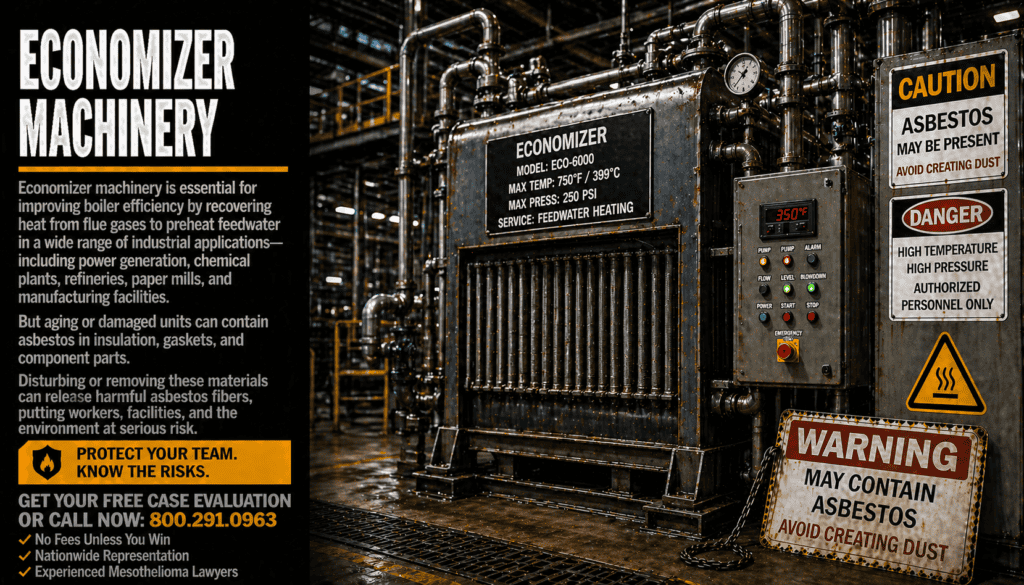
🔥 Economizer Machinery Asbestos Exposure
Economizer machinery was used in boiler rooms, power stations, factories, and other industrial facilities to recover heat and improve energy efficiency. In some older installations, nearby thermal insulation and replaceable sealing materials contained asbestos, creating possible exposure during repair or removal.
Workers seeking to understand past exposure should identify the particular economizer, adjacent boiler systems, maintenance tasks, and materials used at the facility. Those details also help distinguish documented asbestos contact from the mere presence of high-temperature machinery.
⚙️ How Economizer Machinery Worked
An economizer is a heat-recovery device that transfers heat from boiler exhaust gases into feedwater or another process stream. It improves energy efficiency but is not, by definition, made from asbestos. Historical exposure concerns arise from insulation, nearby boiler equipment, and replaceable sealing materials used in some installations. The specific equipment model, installation date, and maintenance history matter.
In a conventional steam plant, hot flue gas passes through a heat-transfer section while cooler feedwater flows through tubing. Heat is recovered before exhaust exits the system. This equipment could be mounted within a boiler train or connected through ductwork.
The metal tubes themselves should not be described as asbestos products merely because insulation was installed nearby. Distinguishing structural equipment from consumable insulation and gaskets is essential when reviewing historical records.
An economizer is normally part of a boiler installation, so maintenance records for Boiler Machinery Mesothelioma Lawsuit can help identify the broader worksite and the contractors responsible for replacing insulation and sealing materials. The presence of a boiler alone does not establish that asbestos was used.
Where the plant relied on a steam network, Steam Boiler Machinery Asbestos Exposure provides context for the hot piping, valves, and access points that maintenance crews worked around during planned shutdowns.
⚙️ Asbestos-Containing Materials Around Economizers
Some older facilities used asbestos-containing thermal lagging on hot pipes and equipment casings, insulating cement at transitions, and certain gaskets or packing at flanged connections. Asbestos was not necessarily present in every economizer. An equipment specification, product label, procurement record, or laboratory analysis is stronger evidence than an assumption based solely on machinery age.
Lagging, insulation blankets, block insulation, and insulating cement were used for different thermal purposes. Some historic products contained asbestos, while other products did not. Later replacement material may also differ from the original installation.
Gasket composition depended on temperature, pressure, service fluid, and purchasing practices. A plant may have used different gasket suppliers at different times. Therefore, evidence identifying the actual gasket brand and service period is especially valuable.
In some installations, workers also serviced Heat Exchanger Machinery Asbestos Exposure near economizer connections. Heat-exchanger gaskets and surrounding insulation should be assessed separately rather than assuming all components used identical materials.
High-temperature boiler installations could include a Superheater – Reheater Machinery Asbestos Exposure system. Its insulation and access arrangements differed from those around the economizer, which matters when reviewing work orders and exposure histories.
⚙️ Where Exposure May Have Occurred
Maintenance work could involve opening access doors, removing thermal insulation, disconnecting feedwater lines, changing gaskets, cleaning debris, or replacing adjacent boiler components. Disturbance of asbestos-containing material may release respirable fibers. The greatest concern is the task and material disturbed, not simply being near an operating economizer.
Routine operations generally differ from intrusive maintenance. Workers replacing an intact component without disturbing suspect material may have had a different exposure profile from workers stripping old insulation or scraping deteriorated flange gaskets.
Demolition and major overhaul activities can involve multiple trades working in the same confined area. Worksite controls, containment, and the condition of the material can affect airborne fiber concentrations.
📍 Where Exposure May Have Occurred
| Work Area or Task | Why Exposure May Have Occurred |
|---|---|
| Economizer access doors | Older door seals or nearby insulation could be disturbed when panels were opened. |
| Feedwater piping connections | Removing flanges could involve scraping historical gasket material. |
| Boiler exhaust duct transitions | Repairing thermal lagging or insulating cement could release dust. |
| Shutdown maintenance area | Multiple crews may have worked near insulation removal and debris cleanup. |
| Equipment replacement projects | Demolition could disturb insulation around adjacent boiler components. |
At industrial sites with process-heat operations, Industrial Furnace Machinery Asbestos Exposure may be relevant to a worker’s broader job history, although furnace work should not be confused with economizer maintenance.
Metal-processing facilities sometimes operated Heat Treating Furnace Machinery Asbestos Exposure in separate production areas. Identifying the building and shift assignments can help distinguish furnace-related work from boiler-house tasks.
⚙️ Workers and Occupations Around Economizer Systems
Boilermakers, stationary engineers, pipefitters, industrial mechanics, insulators, electricians, and plant maintenance personnel may have worked near economizers. Contractors may have handled insulation removal while operators remained nearby. Job duties, work orders, and dates can distinguish direct disturbance from possible bystander exposure.
Insulators may have removed or installed lagging. Boilermakers may have accessed economizer tube banks. Pipefitters may have broken flanged joints, while custodial or cleanup personnel could have handled debris after maintenance.
A job title alone is not proof of exposure. Records showing actual tasks, dates, location within the plant, and the products handled provide a more reliable picture.
Building services personnel may also have maintained Water Heater Machinery Asbestos Exposure equipment. The scale and materials of a water-heating installation can differ substantially from an industrial economizer.
Where boiler systems supplied a foundry, work histories might also mention Foundry Furnace Machinery Asbestos Exposure. Employment records should identify whether the person worked in the boiler room, production area, or both.
⚙️ Mesothelioma and Asbestos-Related Lung Cancer
Asbestos exposure is an established cause of mesothelioma and can cause lung cancer. The likelihood of disease depends on exposure history and other factors. Symptoms can emerge decades after exposure, but symptoms alone cannot identify the source of asbestos fibers. Anyone with concerning symptoms or a significant past exposure should discuss appropriate evaluation with a qualified clinician.
Mesothelioma affects the lining of the lungs or other organs. It is distinct from lung cancer, which arises in lung tissue. Asbestosis is a nonmalignant scarring disease associated with substantial asbestos exposure.
Clinicians may use imaging, pulmonary testing, pathology, and occupational history depending on the suspected condition. A person should not interpret a normal screening test as proof that no historical exposure occurred.
For further medical context, see What Is Mesothelioma? and Diagnosed With Lung Cancer. The latter destination should be checked before publication.
⚙️ Records and Evidence for an Exposure History
An effective exposure history links a worker, a location, a time period, a task, and a particular asbestos-containing product where possible. Useful sources include maintenance logs, union records, plant diagrams, specifications, purchasing files, photographs, and coworker statements. Medical records establish diagnosis, but ordinarily do not identify the specific manufacturer responsible for an exposure.
Facility ownership and contractor arrangements sometimes changed while machinery remained in service. Identifying the employer, facility operator, and product supplier for each relevant period helps avoid conflating different organizations.
Preserve copies of employment documents and photographs where lawful, and write down coworker names and maintenance tasks while memories are available. Do not disturb suspected asbestos material to obtain evidence.
📁 Records and Evidence
| Record | What It Can Establish |
|---|---|
| Boiler and economizer specifications | Equipment model, construction date, insulation requirements, and component types. |
| Purchasing invoices | Potential suppliers of insulation, gaskets, or replacement parts. |
| Work orders and outage schedules | Who worked on which components and when materials were disturbed. |
| Union and employment histories | Trade, employer, facility, and dates of employment. |
| Photographs and coworker accounts | Equipment locations, work practices, and product markings. |
| Pathology and clinical records | Medical diagnosis and the basis for disease classification. |
For an overview of how these installations fit together, the Boilers, Furnaces & Heat-Process Machinery Asbestos Exposure section organizes related machinery by equipment type. The strongest exposure history still identifies specific products, dates, and tasks.
⚙️ Compensation and Legal Options
A diagnosis does not automatically establish eligibility for a lawsuit or asbestos bankruptcy trust claim. Legal options depend on documented exposure, responsible entities, diagnosis, jurisdiction, and filing deadlines. Different trust programs have different eligibility requirements. A qualified attorney can assess potentially applicable claims without assuming that every economizer manufacturer established an asbestos trust.
Potential routes may include personal-injury claims, wrongful-death claims brought by eligible survivors, or bankruptcy trust claims where a responsible company has an applicable trust. The correct route is fact-specific.
Filing periods vary by state and claim type. Individuals considering a claim should seek jurisdiction-specific guidance promptly, especially when the exposure occurred decades earlier.
Learn more about mesothelioma lawsuits and asbestos trust funds. A claim must be evaluated on its own evidence.
⚙️ Frequently Asked Questions
Economizer systems varied considerably by manufacturer and era. Answers about a specific workplace should be based on product documentation and work history, not general descriptions of industrial equipment.
Can an economizer contain asbestos? Some older installations used asbestos-containing materials around the machinery, but asbestos cannot be assumed in every unit.
Can someone exposed decades ago still develop illness? Yes. Asbestos-related diseases can have long latency periods; a clinician can evaluate current symptoms and medical history.
Can a worker file a trust claim? Possibly, if the worker meets a particular trust’s medical and exposure criteria. There is no universal economizer trust.
Are all industrial gaskets asbestos-containing? No. Composition varies by manufacturer, application, and year. Product-specific evidence matters.
📚 Confirmed Sources
For general occupational asbestos hazards, see OSHA asbestos information. For health effects and disease evaluation, see National Cancer Institute asbestos information. These sources explain asbestos hazards generally; they do not prove a specific economizer contained asbestos.
Find out if you may qualify for asbestos compensation today.
Call 800.291.0963 — Help is available 24/7/365. 25+ years of experience.
This information is educational, not medical or legal advice. Mesothelioma Help Center is not a law firm or medical provider and does not determine legal or VA eligibility.