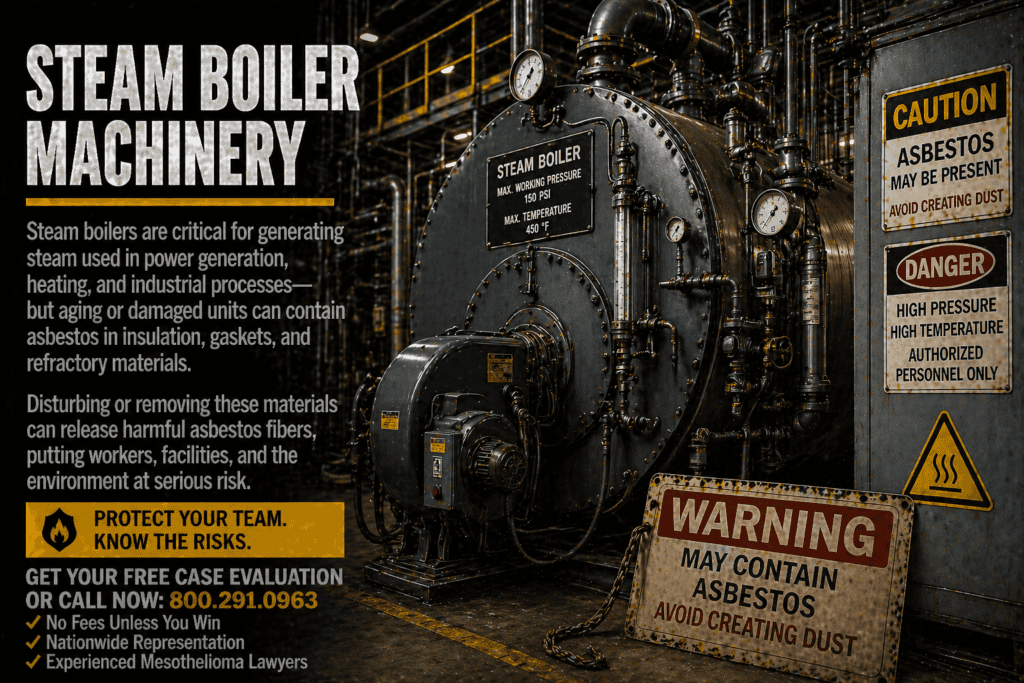
🔥 Steam Boiler Machinery Asbestos Exposure
Steam boiler machinery was common in power plants, factories, hospitals, schools, ships, and municipal buildings. Older boiler systems sometimes used asbestos-containing insulation, gaskets, packing, and heat-resistant materials. People who installed, operated, repaired, or worked near those systems may have encountered airborne asbestos when contaminated materials were disturbed.
Understanding a possible exposure history means identifying the specific boiler, service dates, replacement parts, work practices, and job site. This page explains where asbestos may have been present, which workers faced exposure opportunities, what records can help, and how a diagnosis of mesothelioma or asbestos-related lung cancer may affect available options.
On This Page
🔥 How Asbestos Exposure Occurred
Steam generation involves high-temperature surfaces, pressure-retaining joints, valves, piping, and access openings. Historically, some boilers were covered in asbestos-containing block insulation or lagging to conserve heat. When that covering deteriorated or was removed for a tube repair, it could produce dust. The hazard came from the particular asbestos-containing material, not simply from operating a boiler.
Boiler mechanics also opened manholes and handholes to inspect the pressure vessel. Scraping an old asbestos-containing gasket, brushing residue from a flange, or cutting replacement packing could disturb fibers. The related boiler machinery asbestos exposure page discusses the broader family of boiler equipment and associated legal questions.
Maintenance crews often performed this work during shutdowns, when insulation contractors, welders, mechanics, and inspectors worked in close quarters. Exposure was not limited to the employee holding the tool: bystanders could encounter airborne dust, especially when contaminated debris was swept dry or carried through shared spaces.
Risk varied widely by era, product, condition, ventilation, and controls. A modern boiler should not be assumed to contain asbestos; conversely, the absence of an asbestos label on an old machine does not establish that all installed insulation and replacement components were asbestos-free.
Shutdowns, Repairs, and Replacement Parts
A planned outage might involve draining the vessel, opening inspection covers, removing damaged thermal covering, replacing gaskets, and reconnecting pipework. Those tasks should be evaluated separately because each could involve a different manufacturer or contractor. Old maintenance logs and purchase orders sometimes identify the components used during particular shutdowns.
A worker may recall handling gasket sheet, removing friable wrapping, or watching insulation stripped from a boiler shell. These descriptions can help reconstruct potential exposure, but the specific asbestos content must be established through records, credible product evidence, or other appropriate documentation.
🧱 Steam Boiler Components and Asbestos Materials
Asbestos historically appeared in some boiler insulation blankets, block insulation, cement coatings, gaskets, valve packing, and adjacent steam-line insulation. A boiler manufacturer did not necessarily make every installed product. Building owners and service contractors sometimes bought insulation and replacement sealing materials from separate suppliers.
A boiler system also depends on piping and heat-transfer equipment. For instance, the economizer machinery recovered heat from exhaust gases to preheat boiler feedwater. Insulation or gaskets on an older economizer assembly could present a separate exposure question during maintenance.
Manhole and Handhole Seals
Pressure-vessel access covers require reliable seals. During older boiler overhauls, workers sometimes removed hardened gaskets by scraping, chipping, or wire brushing. Whether a removed gasket contained asbestos depends on its actual formulation and date of installation; no conclusion should be drawn solely from the presence of a gasket.
Insulation, Lagging, and Refractory Areas
Thermal covering on boiler drums, headers, steam lines, and fittings could be damaged by leaks or repeated service. Maintenance sometimes involved cutting through layers of covering to reach a failed joint. Internal refractory or furnace-wall repairs presented different dust sources, not all of which were asbestos. The industrial furnace machinery article explains why refractory dust and asbestos exposure should not be treated as interchangeable.
Steam boilers also used feedwater controls, pumps, valves, and burners. Even when a main pressure vessel lacked asbestos, installed peripheral equipment may have had separate insulation or packing products. Identifying the exact component is more useful than treating the entire boiler room as one undifferentiated exposure source.
📍 Where Exposure May Have Occurred
| Work Area or Activity | Why Asbestos Exposure May Have Occurred |
|---|---|
| Boiler drum access | Opening inspection covers and scraping older sealing materials could disturb asbestos-containing gasket residue. |
| Steam header and piping repairs | Insulation removal to expose welds, flanges, or valves could release fibers from older thermal covering. |
| Boiler room shutdown | Several trades working nearby during insulation stripping or cleanup could encounter shared airborne dust. |
| Feedwater and heat-recovery assemblies | Servicing adjacent insulated equipment and flanged connections sometimes involved older sealing materials. |
| Shipboard or institutional plant | Confined mechanical spaces could bring operators close to insulation work during repairs. |
| Boiler demolition or replacement | Removing legacy covering, cutting old pipework, and handling debris could disturb asbestos if present. |
These examples describe possible mechanisms rather than proof that a particular site used asbestos. Records should connect the worker to the location, dates, and relevant products. A building may have undergone multiple boiler replacements, each with different materials and contractors.
At facilities using heat exchanger machinery, maintenance of adjoining heat-transfer units could overlap with boiler outages. Keeping those activities separate in an employment history helps identify the actual work performed and which parts may have been disturbed.
👷 Workers and Occupations
Boilermakers, stationary engineers, boiler operators, pipefitters, maintenance mechanics, insulation workers, and industrial electricians all had reasons to enter steam-generating spaces. Their exposure opportunities differed. Operators might monitor gauges and water levels daily, while repair crews handled gaskets, insulation, and access covers during periodic overhauls.
Welders and tube repair specialists sometimes worked next to insulation removal. Custodial or cleanup employees could handle debris after a repair without knowing what material had been removed. A coworker who observed the work may help describe the setting, although recollection alone does not identify a product manufacturer.
Electricians often serviced burner controls, pumps, motors, and switchgear near hot piping. Their tasks should not automatically be equated with insulation handling. The relevant question is whether they were present during a documented disturbance of asbestos-containing materials, or personally handled contaminated components.
Steam plants operated in public schools and hospitals as well as heavy industry. The timing of renovations, ventilation conditions, and assignment of outside contractors can matter as much as a worker’s job title. A detailed history should include both routine duties and unusual shutdown projects.
Workers Who Changed Job Sites
A person may have maintained several boilers over a career, sometimes at different employers. It helps to list each facility separately, with approximate dates, boiler brands if remembered, coworkers, and the types of repair completed. This can prevent evidence from one location being mistakenly attributed to another.
⚙️ Related Machinery and Maintenance Systems
Steam boiler installations often included other high-temperature equipment, but those machines performed distinct functions. A superheater or reheater raised steam temperature downstream of generation; older insulation on that equipment could be disturbed during tube or header repairs.
Boiler feedwater may pass through a heat-recovery system before entering the steam drum. Workers repairing those assemblies could encounter different gaskets and insulation than those found on the pressure vessel itself. Distinguishing the locations of the components makes a product history more precise.
Some facilities also operated water-heating machinery for domestic hot water. A building might have had both a high-pressure steam boiler and a separate water-heating system, each with different maintenance histories. Their exposures should not be combined without evidence.
At sites with metal processing, heat-treating furnaces could be serviced by the same maintenance department. Workers should identify which equipment they worked on and whether they encountered insulation, sealing materials, or refractory products in each area.
Older industrial steam plants sometimes shared maintenance resources with incinerator machinery. Similar temperatures did not mean identical materials. The equipment name, installation year, and repair task remain essential to assessing any asbestos connection.
During major plant overhauls, workers might also encounter refractory mixing and gunning machinery used to install or repair heat-resistant linings. Refractory products are not uniformly asbestos-containing; product specifications and historical materials records matter.
The Boilers, Furnaces & Heat-Process Machinery section provides a broader view of how different heat systems were used at industrial and institutional sites. Here, the focus remains the steam boiler and components directly involved in its operation.
📁 Records and Evidence
| Record or Evidence | What It May Help Establish |
|---|---|
| Employment and union records | Facility, dates of work, assigned trade, and potential coworkers. |
| Boiler inspection reports | Equipment identifiers, inspection dates, access openings, and recorded repair needs. |
| Maintenance work orders | Specific outage tasks, gasket changes, insulation removal, and contractor involvement. |
| Purchase orders and product specifications | Manufacturers, brands, materials, and possible asbestos content for particular components. |
| Historic plant photographs and drawings | Boiler-room layout, steam lines, nearby machinery, and work-area proximity. |
| Medical records and pathology | Diagnosis and clinical history; they do not by themselves identify a responsible product. |
| Witness accounts | Observed practices, job assignments, and the timing of repairs, subject to corroboration. |
Evidence is often incomplete decades after a job ended. A practical starting point is a timeline of employers, work locations, job duties, and known maintenance events. Family members may have retained union cards, pay stubs, photographs, or correspondence that identify facilities or contractors.
The strongest product evidence is specific: an invoice, material specification, archived manual, or reliable testimony connecting a named product to a location and period. Generic statements that a boiler was old or that an employer used asbestos somewhere on site are less informative.
When records are missing, an experienced professional can help determine whether additional archives, bankruptcy-trust records, or litigation materials are relevant. No single record automatically establishes liability or eligibility for compensation.
🫁 Mesothelioma and Asbestos-Related Lung Cancer
Mesothelioma
Mesothelioma is a cancer of the mesothelial lining, most commonly the pleura surrounding the lungs. Asbestos exposure is a major established cause. Symptoms may include persistent chest pain, shortness of breath, cough, or unexplained fluid around a lung, although symptoms vary and can overlap with other conditions.
A person diagnosed after working around steam boilers should share a detailed occupational history with their medical team. Imaging and tissue pathology, rather than a work history alone, are used to establish a diagnosis. The time between exposure and disease can be many decades, so older employment details may remain important.
Asbestos-Related Lung Cancer
Asbestos exposure can increase lung-cancer risk, and smoking can further increase that risk. Lung cancer is not diagnosed as asbestos-related merely because someone once worked in a boiler room. Clinicians consider the cancer diagnosis, occupational and exposure history, and other relevant risk factors.
Other asbestos-related conditions include asbestosis and certain pleural abnormalities. These conditions are not interchangeable with cancer, and their clinical significance and treatment differ. Anyone with new or worsening respiratory symptoms should seek medical evaluation rather than assume a particular cause.
For reliable medical background, the National Cancer Institute explains the association between asbestos and cancer, while the CDC/NIOSH provides occupational information about asbestos hazards. These sources help distinguish established health effects from assumptions about an individual worksite.
⚖️ Compensation and Filing Considerations
A person diagnosed with mesothelioma or another asbestos-related disease may wish to ask about legal options tied to identifiable asbestos-containing products and exposures. Depending on the facts and jurisdiction, options can include personal-injury litigation, wrongful-death claims, or submissions to asbestos bankruptcy trusts. Eligibility is never automatic.
An asbestos trust generally requires evidence satisfying that trust’s disease and exposure criteria. Not every boiler maker or supplier has a trust, and a trust’s presence does not prove that its products were used at a particular plant. A claim should identify relevant companies using documents or other credible evidence.
Filing deadlines depend on state law and the type of claim. Some deadlines begin in relation to diagnosis or death, but rules and exceptions vary. A timely review matters because a person may have worked in several states or for multiple employers.
Military service may involve separate benefits questions when boiler-related exposure occurred during qualifying service. VA benefits and civil legal claims use different standards and procedures. The existence of one avenue does not establish entitlement under the other.
The most useful preparation is to gather a diagnosis summary, employment history, dates and locations of boiler work, available product records, and contact information for coworkers. A qualified attorney can explain what additional evidence is needed without promising a particular outcome.
❓ Frequently Asked Questions
Did every steam boiler contain asbestos?
No. Asbestos use depended on the equipment era, the specific insulation and sealing products, and later repairs or replacements. The boiler name alone does not establish asbestos content.
Could an operator be exposed without replacing a gasket?
Possibly. Nearby insulation stripping, repairs, or cleanup could create opportunities for bystander exposure if asbestos-containing materials were disturbed. The circumstances need evidence.
Are all boiler gaskets asbestos-containing?
No. Gasket compositions vary. Manufacturer information, product specifications, and the installation period are important for determining what was used.
How can someone identify a boiler from decades ago?
Inspection records, plant drawings, maintenance orders, photographs, purchasing files, and coworker accounts may help identify equipment and components.
Does a mesothelioma diagnosis prove a particular boiler caused exposure?
No. Diagnosis and exposure attribution are separate questions. The person’s full occupational history and product evidence must be considered.
Can an asbestos trust claim and lawsuit both be possible?
Sometimes, depending on the responsible parties, trust criteria, applicable law, and disclosures required in the legal process. There is no universal entitlement.
What if the employer or boiler manufacturer no longer operates?
Historical records, successor-company information, and relevant trust procedures may still be worth reviewing. Availability depends on the specific entities involved.
📌 Summary and Next Steps
Steam boiler asbestos exposure concerns generally involve historical insulation, gaskets, packing, and nearby piping or heat-process components disturbed during repair or removal. A useful assessment connects a specific material and activity to a worker, job site, and time period rather than assuming all steam boilers posed the same risk.
People facing a serious diagnosis can begin by organizing employment dates, maintenance tasks, available product evidence, and medical records. Those details can help clinicians understand an exposure history and allow legal professionals to assess any potentially available claims.
📚 Confirmed Sources
The following public-health and occupational sources provide background on asbestos risks and disease. They do not verify asbestos use at any particular boiler installation or establish legal eligibility.
- National Cancer Institute — Asbestos Exposure and Cancer Risk
- CDC/NIOSH — Asbestos and Occupational Health
- OSHA — Asbestos
- U.S. EPA — Asbestos
Find out if you may qualify for asbestos compensation today.
Call 800.291.0963 — Help is available 24/7/365. 25+ years of experience.
This information is educational, not medical or legal advice. Mesothelioma Help Center is not a law firm or medical provider and does not determine legal or VA eligibility.