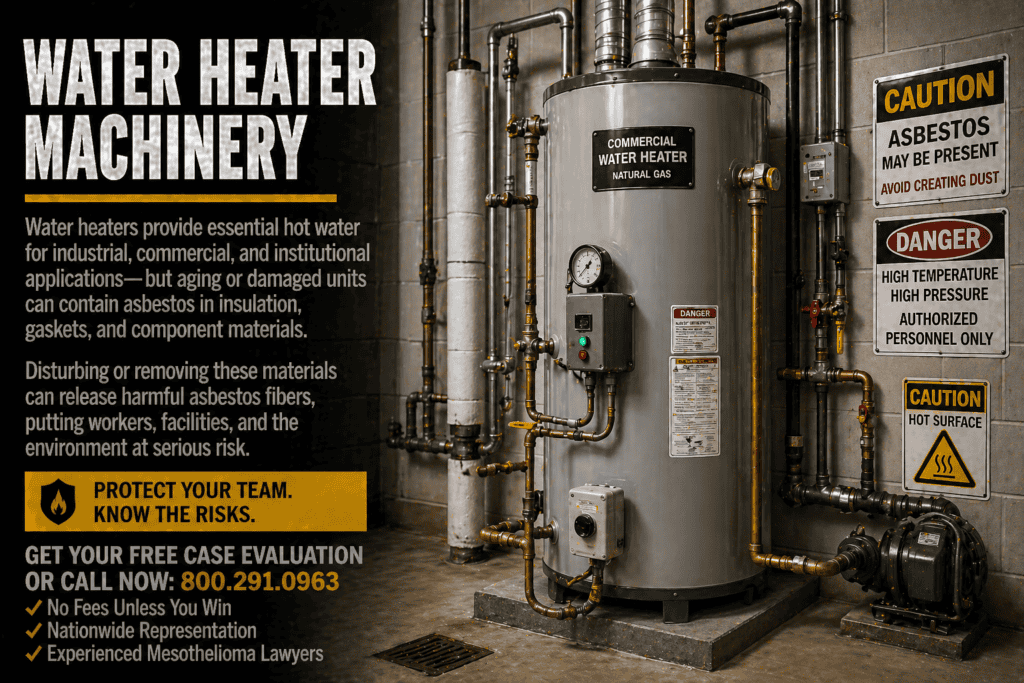
🔥 Water Heater Machinery Asbestos Exposure
Older water-heating installations sometimes operated alongside asbestos-containing pipe insulation, gaskets, and other thermal materials. Exposure depended on the actual products and maintenance work, not simply on the presence of a water heater.
This article explains historical exposure circumstances, worker activities, medical concerns, evidence, and potential compensation options for people affected by asbestos-related diseases.
⚙️ Water Heater Machinery and Historical Use
Water heaters provide hot water for domestic, commercial, and industrial uses. Some older systems used storage tanks with burners, heating coils, circulation pumps, control valves, and nearby steam or hot-water piping. Their design and surrounding insulation differed considerably by building, era, fuel, and service temperature. A water heater should not be assumed to contain asbestos solely because it is old.
In large factories, hospitals, apartment buildings, and institutional campuses, hot-water production could be part of a central mechanical plant. Maintenance personnel sometimes worked beside insulated boilers, steam distribution lines, and other equipment. The steam boiler machinery used to generate heat may have been a separate source of insulation and sealing materials from the water heater itself.
Historical asbestos concerns generally relate to certain thermal insulation, gaskets, packing, cementitious coatings, and nearby building materials rather than the water flowing through the tank. Modern equipment often uses different materials. Determining whether asbestos was present requires product-specific evidence and dates, not generalizations about every heater made in a particular decade.
Water heater repairs can involve disconnecting pipes, removing fittings, replacing valves, opening access panels, or replacing equipment. If asbestos-containing material was present and disturbed during these activities, workers nearby could have inhaled released fibers. The type and extent of disturbance, the material condition, and the work environment are all important.
🧱 Asbestos-Containing Materials Near Water Heaters
Older water-heating installations sometimes shared mechanical rooms with asbestos-containing pipe covering, boiler insulation, thermal cement, or insulating blankets. Such materials may have been installed by contractors after the equipment arrived. The water heater manufacturer was not necessarily the manufacturer or supplier of any surrounding insulation.
Pipe elbows and fittings were frequently repaired separately from tanks and burners. In systems that also included heat exchangers, gaskets or insulation around related equipment could present distinct product-identification questions. The existence of one asbestos-containing component does not establish that all neighboring components contained asbestos.
Some historical gaskets and valve packing incorporated asbestos because of heat resistance. Whether a particular seal contained asbestos depends on the model, supplier, replacement history, and year. A service invoice identifying a gasket is useful, but an actual product specification or other supporting evidence may be necessary to determine composition.
Asbestos was also used in some older building materials that workers might disturb during equipment replacement. Wall penetrations, flooring, ceiling materials, and fire-resistant assemblies can be separate exposure sources. Workers should not remove or sample suspect materials themselves; qualified asbestos professionals can assess them before renovation or demolition.
📍 Where Exposure May Have Occurred
Potential exposure is tied to tasks that disturbed actual asbestos-containing material. Replacing a water heater without disturbing such material is different from cutting away aged pipe covering, scraping a historical gasket, or demolishing an insulated mechanical enclosure. Worksite records should identify the task, room, and approximate date.
Large facilities may have used water heaters alongside boilers and other heat-process machinery. A worker stationed in the same room may have encountered materials from several systems, making it important to distinguish the heater, connected piping, and neighboring equipment.
An industrial installation can also include a heat-recovery economizer or similar equipment elsewhere in the plant. These systems are not interchangeable with a water heater, and their historical insulation and maintenance records should be evaluated separately.
Exposure histories should describe whether a person handled suspect material directly, stood near other workers disturbing it, or merely occupied the area. The last circumstance alone may not demonstrate meaningful asbestos exposure without further evidence.
| Area or Task | Potential Historical Exposure Circumstance |
|---|---|
| Water-heater mechanical rooms | Repair of old insulated piping or associated valves |
| Commercial hot-water systems | Removal of pipe coverings during system replacement |
| Industrial utility areas | Nearby work disturbing insulation on steam equipment |
| Building renovation projects | Demolition of suspect thermal or construction materials |
| Tank and flange maintenance | Removal of historically asbestos-containing sealing materials, if present |
👷 Workers and Maintenance Activities
Plumbers, pipefitters, mechanical maintenance workers, boiler operators, building engineers, insulators, and demolition crews may have serviced hot-water equipment or its connected systems. Their actual duties matter more than job titles alone. For example, a plumber replacing a valve may have different exposure circumstances from a building engineer who monitored equipment without opening insulation.
When steam supplied the heating system, workers may also have maintained other steam-system machinery at the same facility. The fact that several kinds of equipment shared a plant does not mean the same workers handled each material.
Repair tasks could involve loosening flange bolts, replacing packing, removing old pipe covering, or opening access to a burner. The likelihood of airborne fibers depends on whether the disturbed material actually contained asbestos, how it was handled, and whether controls were in place.
Contractors who replaced equipment during major renovations may have encountered materials left by earlier installers. Employee rosters, project specifications, contractor invoices, and building permits can help reconstruct who was present and which parts of the mechanical system were altered.
🩺 Mesothelioma and Asbestos-Related Lung Cancer
Mesothelioma is a cancer strongly associated with asbestos exposure. Symptoms may develop many years after exposure and can include breathlessness, chest pain, fatigue, and fluid around the lungs. A diagnosis requires clinical assessment and often imaging, pathology, and specialist review; symptoms alone cannot establish the disease.
Asbestos exposure also increases the risk of lung cancer. Smoking independently increases lung cancer risk, and the combination of smoking and asbestos exposure can be particularly harmful. A clinician considers the full medical history, occupational exposures, imaging, and pathology when evaluating a patient.
For someone who worked on older water-heating equipment, the medical diagnosis and the exposure history answer different questions. Medical records may establish the illness, while job records and product evidence help assess whether asbestos-containing material was disturbed at the relevant location.
People experiencing new or worsening breathing symptoms should seek medical advice. Those with known or suspected historical asbestos exposure can tell their healthcare professional about the work, materials, and dates involved. This article cannot determine an individual diagnosis or risk.
📁 Records and Evidence for Exposure History
A detailed exposure history can begin with employer names, facility addresses, dates, job titles, and the specific mechanical rooms or projects where work occurred. Maintenance logs may show replacement of pipe insulation or tank connections. Purchase records may identify a product but not necessarily establish that a particular worker encountered it.
Equipment manuals, photographs, serial numbers, specifications, and invoices can help identify a historical water-heater model and related materials. Some companies supplied only the tank while other businesses provided gaskets, piping, insulation, or replacement parts. Distinguishing those suppliers matters for accurate documentation.
If the heater was part of a larger boiler installation, the boiler machinery lawsuit information explains why claims may require product identification and proof of exposure. A lawsuit is not established merely because a company manufactured equipment at a worksite.
Preserve original documents, identify the source of photographs, and write down witnesses who directly observed maintenance tasks. Avoid guessing product brands. Attorneys and other qualified professionals can evaluate how the evidence fits applicable legal standards.
| Record | What It May Help Establish |
|---|---|
| Work and union records | Employment dates, roles, and locations |
| Maintenance work orders | Repair activities and the parts serviced |
| Equipment manuals and serial numbers | Model and historical product identification |
| Invoices and contractor contracts | Suppliers, materials, and installation dates |
| Witness accounts | Firsthand descriptions of tasks and nearby disturbance |
| Pathology and medical records | Diagnosis and treatment history, not product identity |
⚖️ Compensation and Legal Options
People diagnosed with mesothelioma or asbestos-related lung cancer may wish to speak with an attorney about whether their exposure history supports a legal claim. Possible avenues can include civil lawsuits, asbestos bankruptcy trust claims, or benefits available to eligible veterans, depending on the circumstances.
Legal responsibility depends on the particular product, defendant, exposure pathway, jurisdiction, and available proof. A heater brand does not automatically establish responsibility for insulation installed by another company. Laws and filing deadlines vary, and some claims involve multiple locations or employers.
An attorney may review work history, pathology reports, old equipment specifications, contractor records, and testimony. Families should ask about legal fees, expenses, filing deadlines, and how prior trust claims may affect a lawsuit. No settlement amount or approval can be guaranteed.
Workers may also have been exposed during renovations involving refractory installation machinery elsewhere at an industrial site. That equipment is a separate possible source that should be documented only when supported by the actual work history.
❓ Frequently Asked Questions
Did all older water heaters contain asbestos? No. Historical use varied by manufacturer, product, installation, and year. Surrounding pipe insulation or replacement gaskets may have come from other suppliers.
Can asbestos be released when a heater is replaced? It is possible if asbestos-containing insulation, gaskets, or nearby building materials are disturbed. Replacement alone does not prove exposure.
Does a water-heater manufacturer make every connected component? No. Pipe covering, valves, gaskets, and replacement materials may have been supplied or installed separately.
Can a family investigate an old installation? Families can preserve records and photographs, but should not disturb suspect material. Qualified professionals can assess material safety.
What records are useful for a claim? Work dates, employer records, maintenance logs, specifications, medical documents, and firsthand witnesses can help establish a supported history.
Does an asbestos-related diagnosis guarantee compensation? No. Eligibility and potential recovery depend on the evidence, legal requirements, and applicable deadlines.
For older buildings, property records and renovation permits may establish when a hot-water system was installed or replaced. They rarely prove the composition of a particular gasket or insulation layer by themselves. Where records conflict, preserve both versions and note the source rather than selecting the more convenient date. A qualified attorney may also seek documents from plumbing contractors, equipment distributors, or facility maintenance departments. When several workers remember the same repair, record each person’s account independently. This approach helps separate firsthand observations from later assumptions and creates a clearer history for medical and legal review.
📝 Summary
Historical asbestos exposure involving water-heater machinery generally depended on particular insulation, gaskets, packing, or nearby materials and the tasks that disturbed them. Not every older heater contained asbestos. A reliable exposure history distinguishes the heater from connected piping and neighboring industrial equipment, and matches work dates to documented materials.
📚 Confirmed Sources
The U.S. Environmental Protection Agency explains asbestos risks in buildings and why suspected materials should be evaluated by trained professionals. The National Cancer Institute summarizes asbestos-related cancer risks. The Occupational Safety and Health Administration provides workplace asbestos information. These sources support general safety and medical context, not asbestos content in a specific water-heater model.
Find out if you may qualify for asbestos compensation today.
Call 800.291.0963 — Help is available 24/7/365. 25+ years of experience.
This information is educational, not medical or legal advice. Mesothelioma Help Center is not a law firm or medical provider and does not determine legal or VA eligibility.