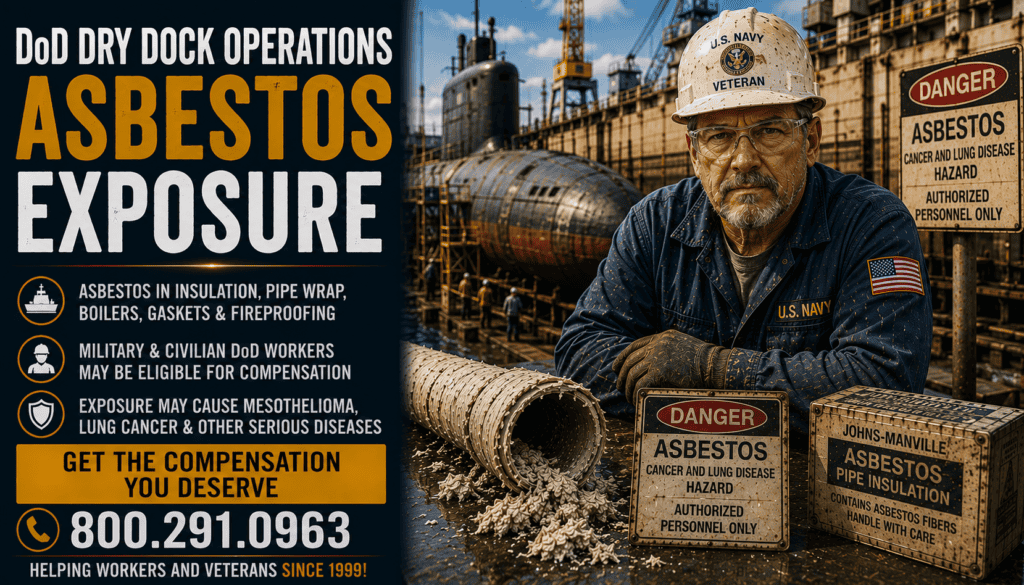
🛡️ DoD Dry Dock Operations Asbestos Exposure
DoD Dry Dock Operations Asbestos Exposure concerns possible occupational and environmental contact with asbestos in ship repair, hull access, machinery work, and vessel maintenance during dry-dock periods. Older defense facilities and equipment sometimes incorporated asbestos insulation, heat-resistant components, and construction products; the specific materials, dates, and work activities matter.
People who worked or lived in naval dry docks, shipyards, and vessel repair spaces may need to reconstruct where and when dust-producing work occurred. This article explains relevant settings, records, asbestos-related diseases, and potential compensation paths without assuming that a job title or military assignment establishes exposure.
📍 Understanding the Exposure Setting
Ship repair, hull access, machinery work, and vessel maintenance during dry-dock periods are part of the larger history of asbestos use in defense infrastructure. Asbestos was valued for heat resistance and durability, but inhaling airborne fibers can cause serious disease. Whether a particular person encountered asbestos depends on the worksite, products, conditions, and duration of exposure.
Service members and civilians may have had overlapping responsibilities. A former worker should identify actual tasks rather than rely on a broad military title. Related articles on DoD Base Housing & Barracks Asbestos Exposure and DoD Civilian Maintenance Workers Asbestos Exposure describe nearby defense activities that may help establish the surrounding workplace context.
The distinction between exposure and disease is important: a diagnosis does not automatically identify the source of exposure, and working near older equipment does not itself prove exposure. An accurate history combines dates, places, coworkers, materials, and medical evidence. Readers may also compare Military Occupations Asbestos Exposure and Military Bases Asbestos Exposure to identify occupational and location details.
What Makes This Setting Distinct
In naval dry docks, shipyards, and vessel repair spaces, the exposure history should describe not only the location but the sequence of events: which project was underway, whether equipment or building material was intact or being removed, who performed the work, and how close other personnel were to it. A person may remember the name of a facility but not the manufacturer of a material. Maintenance schedules, contracts, and colleagues’ recollections may help fill that gap. It is equally important to record periods when no dusty work occurred, because a balanced chronology is more reliable than assuming constant exposure throughout an assignment.
For shipfitters, pipefitters, machinists, electricians, insulators, and dock crews, responsibility and physical proximity may have differed substantially. Some personnel operated equipment, some supervised work, and others occupied adjoining spaces. These differences matter when describing potential airborne dust. Historical use of asbestos in a type of product is not proof that the particular product at the site contained asbestos. A careful account avoids treating all installations, ships, or buildings as interchangeable and makes clear where documentary evidence is still missing.
🏗️ Where Exposure May Have Occurred
These work areas are examples of settings worth examining in historical records. They are not a determination that asbestos was present at every location or during every year.
| Work Area | Why Exposure May Have Occurred |
|---|---|
| Engine rooms and propulsion machinery | Older insulation, seals, or building products could be disturbed during repairs or upgrades in engine rooms and propulsion machinery. |
| Steam and hot-water piping | Equipment replacement or renovation could create dust if asbestos-containing components were present in steam and hot-water piping. |
| Boiler rooms and thermal insulation | Work orders and materials lists may clarify whether heat-resistant products were handled in boiler rooms and thermal insulation. |
| Hull access and confined workspaces | Adjacent trades could share a workspace while insulation or worn components were removed in hull access and confined workspaces. |
| Pump, valve, and gasket repairs | Historical conditions may differ substantially from current controls and materials used in pump, valve, and gasket repairs. |
| Shore-side power and dock utilities | Exposure analysis should identify the exact dates, tasks, and products associated with shore-side power and dock utilities. |
Some exposure pathways overlap with DoD Construction Contractors Asbestos Exposure and DoD Depot-Level Equipment Overhaul Asbestos Exposure. The broader Military Products Asbestos Exposure resource may also help identify product types. None of these cross-references substitutes for site-specific proof.
👷 Workers, Duties & Exposure Pathways
Potentially affected groups include shipfitters, pipefitters, machinists, electricians, insulators, and dock crews. The most relevant distinction is usually whether the person directly handled a material, worked nearby while it was disturbed, or encountered dust brought into shared spaces.
Direct Handling and Nearby Work
Direct handling can include cutting, scraping, drilling, stripping, or replacing insulation, gaskets, friction materials, and older building products. Nearby personnel may have encountered dust during the same activity even if their own duties were administrative or supervisory. The existence and intensity of exposure cannot be determined from job titles alone.
Shared Workspaces and Historical Practices
Large defense installations often contained overlapping military, civilian, and contractor workforces. Work crews moved among mechanical rooms, shops, vessels, housing, and construction sites. Ventilation, enclosure, protective practices, and materials changed over time. This is why historical duty descriptions and coworkers can be useful when identifying possible exposure pathways.
Related context appears in Commissioned Officers O-1–O-3 and DoD Aircraft Hangars, especially where facilities and personnel were shared. U.S. Navy Asbestos Exposure provides additional background on Navy-related work environments.
⚙️ Asbestos-Containing Materials & Equipment
Historically, some insulation, cement products, flooring, fireproofing, thermal blankets, pipe coverings, gaskets, packing, brakes, and clutches contained asbestos. Product composition varied by manufacturer, model, installation date, and replacement history. Modern materials should not be assumed to contain asbestos solely because they serve the same function.
Heat, Friction, and Building Materials
High-temperature systems were a common reason asbestos was used. Boiler and steam piping insulation, machinery seals, and friction components may be relevant in maintenance records. Buildings could also contain asbestos in certain floor tiles, ceiling systems, and thermal insulation. Disturbance during maintenance, removal, or demolition is particularly relevant to an exposure history.
Identifying Specific Products
Where possible, record manufacturer names, part numbers, ship or building identifiers, purchase orders, equipment models, and installation dates. Photographs and manuals can sometimes help connect a general recollection to a particular material. Product identification is especially important when considering claims against bankrupt asbestos companies or other potentially responsible parties.
For adjacent topics, review DoD Aircraft Maintenance and DoD Asbestos Trust Fund Claims. These links provide context for other DoD activities, not confirmation that a particular product was used at this site.
📁 Records & Evidence
A useful exposure timeline lists the installation, building or vessel, unit or employer, job title, dates, equipment, materials, and witnesses. Records may be incomplete, so several independent sources can be more informative than a single personnel document.
| Record | What It May Establish |
|---|---|
| Ship repair and overhaul schedules | The location, dates, and scope of the person’s assignment or work. |
| Vessel and shipyard assignment records | Which duties or projects took place in the relevant period. |
| Work packages and job cards | The facility, vessel, or equipment involved in the reported work. |
| Insulation removal and safety reports | Whether a specific product, component, or contractor can be identified. |
| Equipment and ship system manuals | Who may be able to corroborate the circumstances. |
| Service, employment, and medical records | How the claimed exposure fits the person’s broader medical and work history. |
Building a Chronological Record
Begin with the earliest plausible exposure and move forward by year. Include periods of reassignment, major renovations, overhaul projects, or changes in equipment. Separate firsthand memories from information learned later. If the person served at multiple installations or worked for several contractors, record those separately to avoid combining distinct exposure histories.
The related DoD Aviation Support Equipment article may help identify another category of defense equipment or work. General resources on Military Veterans Asbestos Exposure can help organize military-service details.
🩺 Mesothelioma & Asbestos-Related Lung Cancer
Mesothelioma
Mesothelioma is a cancer associated with asbestos exposure that most often affects the lining around the lungs. Symptoms can include shortness of breath, chest pain, persistent cough, and unexplained weight loss, but these symptoms can have many causes. Diagnosis requires clinical evaluation and often imaging and tissue testing. People with a history of possible asbestos exposure should discuss it with a qualified clinician.
Asbestos-Related Lung Cancer
Asbestos exposure also increases the risk of lung cancer. Smoking and asbestos exposure can interact to raise lung cancer risk further. A person’s diagnosis, pathology, smoking history, and exposure timeline are separate pieces of information; no single work assignment proves that a particular cancer was caused by asbestos.
Latency and Medical Documentation
Asbestos-related diseases may develop decades after exposure. Medical records, pathology reports, and a carefully documented occupational history are important when clinicians and claim reviewers evaluate a case. This page provides general information and is not a substitute for medical advice or individualized diagnosis.
⚖️ Compensation, Trust Funds & VA Benefits
Depending on the circumstances, people diagnosed with an asbestos-related disease may consider asbestos bankruptcy trust claims, civil claims, workers’ compensation or other employment-related remedies, and benefits available through the Department of Veterans Affairs. These options have different eligibility rules and evidence requirements; some may not apply to civilians or to a particular exposure setting.
Asbestos Trust Fund Claims
Trusts were established through certain asbestos company bankruptcies to process qualifying claims. Eligibility usually depends on the trust’s criteria, diagnosis, and evidence connecting exposure to relevant products or worksites. The related DoD Asbestos Trust Fund Claims article covers this subject in greater detail. A Department of Defense work history does not itself create a dedicated government asbestos trust.
VA Benefits and Civilian Claims
Veterans may seek VA disability compensation when they can establish the required connection between a current disability and military service. Civilian DoD employees and private contractors are not automatically eligible for VA benefits because they worked at a military installation. Separate compensation paths may be available depending on employment status, applicable law, diagnosis, and responsible entities.
Time Limits and Case Review
Claim deadlines and filing rules vary by jurisdiction and claim type. People considering a claim should preserve records promptly and obtain advice from a qualified professional familiar with asbestos cases. No article can determine legal eligibility from an occupation or jobsite description alone.
❓ Frequently Asked Questions
Why were dry docks important to naval maintenance?
Some older facilities and equipment used asbestos-containing materials, but actual exposure requires a specific worksite, product, task, and time period to be evaluated.
What asbestos materials could be encountered during repairs?
Relevant work may include insulation removal, equipment repair, demolition, maintenance, or nearby duties when dust-producing tasks occurred.
Does a dry-dock assignment prove asbestos exposure?
No. Employment, service, or assignment alone does not prove contact with airborne asbestos fibers.
Could shore-side workers be exposed?
Records such as assignment files, contracts, maintenance logs, plans, and witness statements may help reconstruct the exposure history.
What shipyard records may help establish exposure?
Yes, asbestos-related work could involve several employers and trades at the same installation; each person’s circumstances still require individual review.
Can a Navy veteran and a civilian worker have similar exposures?
Historical renovation or demolition may disturb asbestos-containing materials, but testing and project records are needed to establish what was present.
What compensation options should be reviewed?
Depending on diagnosis, product evidence, and applicable rules, a person may have trust, civil, employment-related, or VA benefit options.
How does exposure history differ from a diagnosis?
Exact dates and product identification help distinguish a general historical possibility from evidence relevant to a medical or legal review.
📚 Summary & Confirmed Sources
DoD Dry Dock Operations Asbestos Exposure should be assessed through a detailed history of places, duties, materials, and dates. Historical asbestos use at defense installations is well documented, but exposure for an individual is not established simply by association with the DoD. The most useful next step is to organize records and discuss medical or legal questions with appropriate professionals.
For general public-health information, consult the National Cancer Institute asbestos fact sheet, ATSDR asbestos resources, and VA asbestos exposure information. These sources explain general risks and benefit criteria; they do not verify conditions at any individual facility.
Find Out If You May Qualify for Asbestos Compensation Today
Call 800.291.0963 — help is available 24/7/365. 25+ years of experience.
Disclaimer: Mesothelioma Help Center is not a law firm or medical provider and does not determine legal or VA eligibility. This page provides general information and is not legal or medical advice.