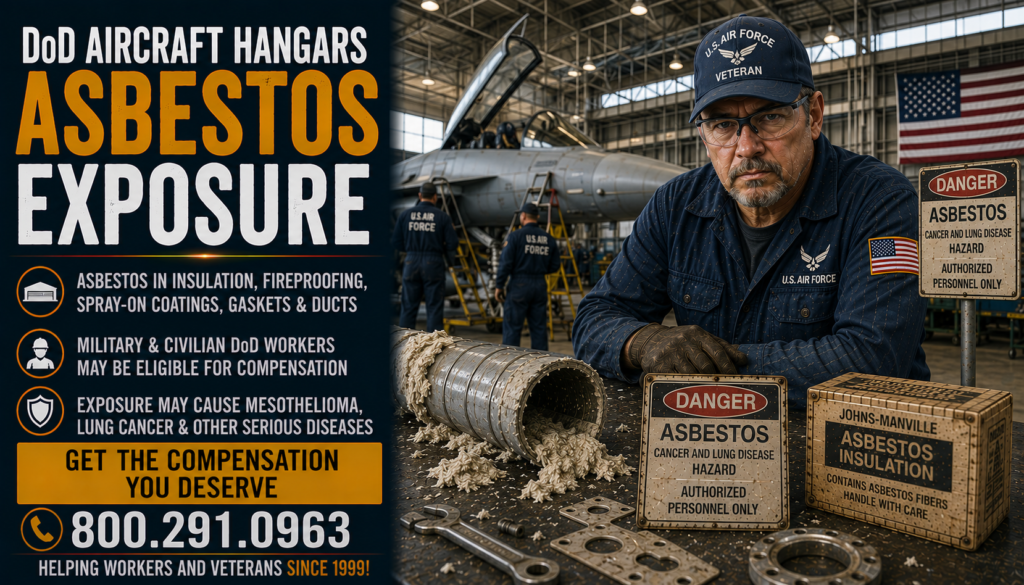
🏗️ DoD Aircraft Hangars Asbestos Exposure
DoD Aircraft Hangars Asbestos Exposure concerns historical military or civilian service in settings where asbestos-containing materials were used. Understanding the work performed, dates of service, equipment and facilities is more useful than relying on a job title alone.
People diagnosed with mesothelioma or asbestos-related lung cancer may need help connecting a past assignment to a specific product or worksite. This article explains exposure circumstances, supporting records and possible benefit or compensation paths.
📌 On This Page
- Overview
- Where Exposure May Have Occurred
- Equipment, Materials and Duties
- Personnel and Assignments
- Mesothelioma and Lung Cancer
- Records and Evidence
- Compensation and VA Benefits
- Frequently Asked Questions
- Confirmed Sources
🔎 Overview
Asbestos was used historically in some military facilities, ships, aircraft-related systems and industrial equipment for heat resistance, insulation and friction applications. Exposure is not automatic for every Department of Defense assignment. The strongest history identifies where someone worked, what was disturbed, and whether the materials contained asbestos.
📍 Where Exposure May Have Occurred
| Work Area | Why Exposure May Have Occurred |
|---|---|
| Aircraft hangars and repair bays | Older building insulation, fireproofing and repair activities could release dust when asbestos-containing material was disturbed. |
| Mechanical rooms and utility corridors | Maintenance on older insulated piping, boilers, valves and gaskets could disturb asbestos materials. |
| Flight lines and ground-support shops | Repair of historical engines, brakes, generators and support machinery could involve asbestos-containing components. |
| Ships and waterfront facilities | Certain older vessel and shore installations used insulation, packing, gaskets and thermal barriers. |
| Storage and renovation areas | Handling deteriorated material or removing older building products could release dust. |
⚙️ Hangar Areas and Materials
Hangar Construction Materials
Some older hangars used asbestos-containing fireproofing, pipe insulation, floor tile, roofing, or wall materials. Disturbance during repair or renovation was an important potential exposure pathway.
Heating and Mechanical Rooms
Boilers, steam lines, valves, gaskets, and mechanical insulation in older facilities could contain asbestos. Maintenance workers and people nearby could encounter dust during removal or repair.
Aircraft Work Inside Hangars
Aircraft maintenance could involve older heat-resistant parts, brakes, seals, and equipment. Whether a specific aircraft or part contained asbestos requires records rather than assumptions.
Equipment and construction specifications changed over time. A reliable exposure history distinguishes a documented asbestos-containing product from a product merely suspected of containing asbestos. Manufacturer records, technical manuals, maintenance logs and witness accounts can help establish that distinction.
👷 Personnel and Assignments
Potentially affected groups include service members, civilian maintenance employees, contractors, electricians, mechanics, engineers, safety personnel, supervisors and people working near repairs. Supervising a job does not necessarily mean direct material handling, but repeated presence in a dusty repair area can be relevant. Duties, location and duration should be recorded individually.
🩺 Mesothelioma and Asbestos-Related Lung Cancer
Hangar Construction and Renovation
Historic hangars were large industrial buildings with roofing systems, floor coverings, fire-resistant assemblies, heating infrastructure, and mechanical service rooms. Some older building products contained asbestos. Risk arises primarily when asbestos-containing materials deteriorate or are cut, drilled, scraped, demolished, or otherwise disturbed. Simply working inside a hangar does not establish that asbestos fibers were airborne.
Overhead Systems and Mechanical Areas
Heating plants, steam distribution lines, valves, boilers, and pipe insulation sometimes ran through hangar utility spaces. Electricians, plumbers, HVAC workers, and building maintenance crews could work around these systems. Workers stationed in adjacent areas may also need to consider the timing and location of major repairs, particularly where containment practices were absent or inadequate.
Hangar Floor and Aircraft Repair Activities
Aviation mechanics and ground-support teams used hangars for inspections, engine work, wheel and brake servicing, and equipment repair. Historical friction and heat-resistant components warrant product-specific review. The presence of an aircraft or a brake system alone does not prove its components contained asbestos; technical manuals, procurement records, and component identification are important.
Documenting a Specific Hangar
A useful exposure account identifies the installation, hangar number, years, employer or squadron, construction or maintenance projects, and nearby work. Base engineering files, contracting records, building surveys, work orders, and coworkers may help establish whether asbestos-containing materials were present and disturbed.
Explore related military work and facilities
Military assignments crossed occupational and installation boundaries. For a broader context, see Commissioned Officers Asbestos Exposure O 1 O 3 and Dod Aircraft Maintenance Asbestos Exposure; those pages explain how duties and locations can affect a historical exposure account.
Compare related Department of Defense articles
The related topics Dod Asbestos Trust Fund Claims and Dod Aviation Support Equipment Asbestos Exposure may help distinguish work performed inside a facility from work on aircraft or equipment. Follow only the subjects that match the individual’s actual duties.
Build a stronger records trail
Records often need to connect a person, place, time, and material. The resources Department of Defense Asbestos Exposure and Military Occupations Asbestos Exposure provide additional context for organizing an exposure history.
Related work settings
Different service members and civilian workers could share buildings and maintenance areas. Read Military Products Asbestos Exposure alongside Military Bases Asbestos Exposure when those subjects overlap the service record.
Compensation and supporting evidence
For further context, review DoD Base Housing and Barracks and Navy and DoD Environmental Health Reports. A documented diagnosis and product-specific exposure evidence matter more than a generic assumption based on military service.
Mesothelioma
Mesothelioma is a cancer associated with asbestos exposure, often diagnosed decades after the exposure occurred. A medical diagnosis does not by itself identify the responsible manufacturer or exact exposure site.
Asbestos-Related Lung Cancer
Asbestos exposure can increase lung cancer risk. Smoking and other exposures can also influence risk. Medical records and an individualized occupational history are important when assessing potential asbestos contribution.
Anyone experiencing concerning symptoms should consult a qualified medical professional. This page cannot determine a diagnosis or causation for an individual.
When reconstructing an old assignment, separate firsthand recollection from documentary confirmation. Note the precise activity, the date range, the building or equipment involved, and whether an asbestos-containing material has been identified. This helps avoid attributing an exposure to the wrong installation or manufacturer.
The strongest case history often combines medical evidence with service or employment records, technical specifications, and accounts from people who witnessed the same work. Missing records do not automatically defeat a claim, but unsupported assumptions can create confusion and should be clearly labeled as uncertain.
📁 Records and Evidence
| Record | What It Can Establish |
|---|---|
| DD Form 214 and service personnel records | Service dates, branch, rank, units and occupational specialty. |
| Duty orders and installation histories | Where the person served and when. |
| Maintenance logs and technical manuals | Equipment serviced, component specifications and repair activities. |
| Employment and contractor records | Civilian job duties, employers, locations and dates. |
| Medical and pathology records | Diagnosis, treatment history and relevant clinical findings. |
| Coworker or witness statements | Descriptions of specific materials, dusty work and shared spaces. |
Preserve original records where possible. If documents are missing, request service or employment records through the appropriate custodian and write down names, dates, work areas and products while they can still be recalled.
⚖️ Compensation and VA Benefits
Possible options may include VA disability benefits for qualifying veterans, claims against responsible asbestos product manufacturers, asbestos bankruptcy trust claims, and certain survivor benefits. Eligibility depends on the facts, applicable rules and filing deadlines. Military service alone does not guarantee compensation.
Families may also have questions about wrongful death or survivor claims. Time limits vary, and an appropriate legal professional can explain which rules apply to a specific case. A VA-accredited representative can assist with VA benefits questions.
❓ Frequently Asked Questions
Does serving in the Department of Defense prove asbestos exposure?
No. Service or employment history is a starting point; specific locations, materials and work tasks are needed.
Can someone be exposed without personally removing insulation?
Potentially. People working near disturbance of asbestos-containing materials may have shared contaminated air, depending on conditions.
How long after exposure can disease appear?
Asbestos-related diseases can appear many years or decades after exposure. Timing varies by condition and individual.
Can veterans apply for VA benefits and pursue a trust claim?
Potentially, yes. These are separate systems with different eligibility and evidence rules.
Are all aircraft and hangars asbestos-containing?
No. Materials varied by era, model, construction and repair history; documentation is necessary.
What should families collect first?
Gather diagnosis records, service or employment dates, unit and base names, equipment details, and available witnesses.
Are there filing deadlines?
Yes. Deadlines and eligibility rules differ by jurisdiction and claim type; seek individualized guidance promptly.
Does rank or job title establish eligibility?
No. Rank and title can guide record searches, but actual exposure and diagnosis evidence are essential.
📚 Confirmed Sources
The following authoritative resources explain general asbestos health risks, military benefits and asbestos trust administration. They do not verify a particular product or assignment.
- National Cancer Institute — Asbestos Exposure and Cancer Risk
- U.S. Department of Veterans Affairs — Asbestos Exposure
- U.S. Environmental Protection Agency — Asbestos
- U.S. Department of Justice — Asbestos Trust Information
📌 Summary
Exposure history depends on the actual materials, duties, work locations and time period. Medical records and historical product evidence can help a veteran, civilian employee or family member understand whether a claim is worth evaluating.
Find Out If You May Qualify for Asbestos Compensation Today
Call 800.291.0963 — help is available 24/7/365. 25+ years of experience.
Disclaimer: Mesothelioma Help Center is not a law firm or medical provider and does not determine legal or VA eligibility. This page provides general information and is not legal or medical advice.