🏭 Industrial Equipment Manufacturers
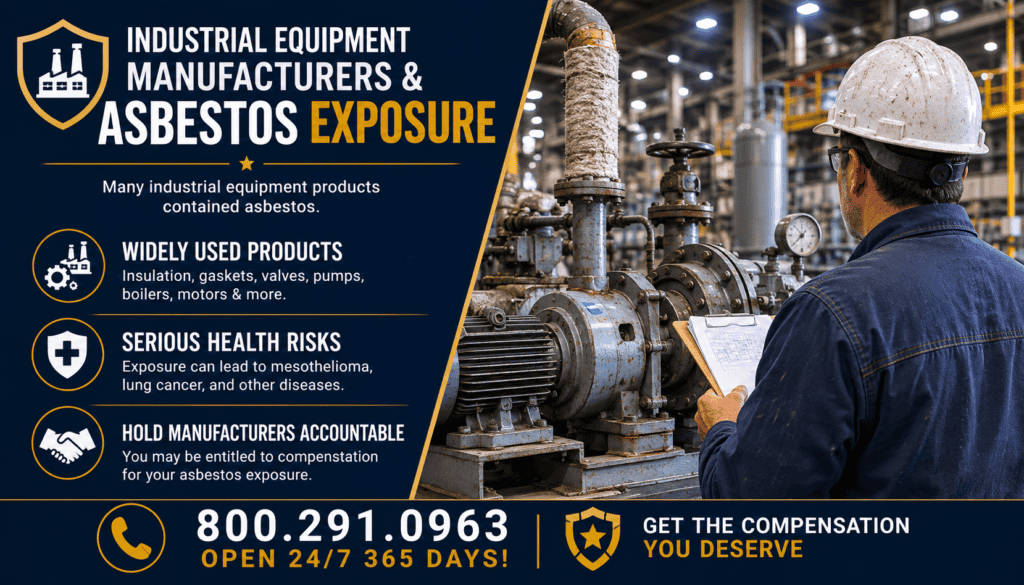
Industrial equipment manufacturers played one of the largest roles in the widespread use of asbestos throughout American industry. From massive boilers and turbines to pumps, compressors, valves, generators, furnaces, and HVAC systems, thousands of companies incorporated asbestos into equipment because it resisted heat, fire, electricity, corrosion, and chemical damage.
For decades, workers who installed, manufactured, repaired, maintained, rebuilt, or removed industrial equipment unknowingly inhaled asbestos fibers released during normal work. Many later developed mesothelioma, lung cancer, asbestosis, or other asbestos-related diseases decades after exposure.
Why Industrial Equipment Manufacturers Used Asbestos
Throughout much of the twentieth century, industrial equipment operated under extreme conditions that demanded materials capable of withstanding intense heat, steam pressure, friction, electrical loads, vibration, and corrosive chemicals.
Few materials matched asbestos for these applications.
Manufacturers incorporated asbestos into equipment because it was:
- Highly resistant to heat
- Fireproof
- Excellent electrical insulation
- Durable under heavy mechanical stress
- Resistant to acids and chemicals
- Relatively inexpensive
- Easy to mold into seals, insulation, cement, cloth, rope, and gaskets
As industrialization accelerated after World War II, asbestos became a standard engineering material rather than an exception.
Factories, power stations, refineries, steel mills, chemical plants, military facilities, paper mills, and manufacturing plants all relied upon industrial equipment that frequently incorporated asbestos components.
⚙️ Types of Industrial Equipment That Commonly Contained Asbestos
Industrial equipment manufacturers produced thousands of products containing asbestos components.
Some of the most common included:
- Industrial boilers
- Steam generators
- Heat exchangers
- Industrial furnaces
- Kilns
- Pressure vessels
- Compressors
- Industrial pumps
- Steam turbines
- Gas turbines
- Hydraulic systems
- HVAC equipment
- Cooling towers
- Industrial ovens
- Industrial dryers
- Air handling units
- Blowers
- Dust collection systems
- Valves
- Pipe fittings
- Expansion joints
- Industrial fans
- Electrical switchgear
- Generators
- Motors
- Industrial brakes
- Clutches
- Conveyor systems
- Industrial mixers
- Processing equipment
Many of these machines remained in service for forty to sixty years, meaning workers continued encountering asbestos long after manufacturers stopped installing it in new equipment.
🔥 Where Asbestos Was Found Inside Industrial Equipment
Industrial equipment rarely consisted entirely of asbestos.
Instead, asbestos was integrated into numerous individual components throughout each machine.
Examples included:
Thermal Insulation
Manufacturers wrapped boilers, turbines, pipes, steam lines, and pressure vessels with asbestos insulation to reduce heat loss and protect workers from burns.
Maintenance often disturbed this insulation.
Gaskets
Thousands of industrial machines relied upon asbestos gaskets capable of sealing high-pressure steam, chemicals, oils, and hot water.
Mechanics routinely scraped away deteriorated gasket material during repairs.
Packing Material
Pump shafts, valve stems, and compressors frequently contained braided asbestos packing.
Replacing worn packing often required pulling out deteriorated asbestos fibers by hand.
Cement
Boilers and furnaces frequently used asbestos cement around combustion chambers, refractory linings, and insulation panels.
Repairs released significant amounts of airborne dust.
Cloth and Blankets
Maintenance crews wrapped hot machinery with asbestos blankets and cloth during repairs.
These materials frayed with repeated use.
Millboard
Electrical equipment and heating systems frequently incorporated asbestos millboard for insulation.
Cutting or drilling these panels generated dust.
Rope
Boilers and industrial ovens commonly used asbestos rope to seal doors, access panels, and high-temperature openings.
Workers often removed deteriorated rope during maintenance.
Brake Components
Large industrial machinery sometimes incorporated asbestos brake linings similar to those used in automobiles.
Grinding and replacing brake materials released fibers.
Clutches
Industrial clutch systems frequently contained asbestos friction materials designed for heavy-duty operation.
Wear over time created hazardous dust.
🏗️ Industries That Relied on Industrial Equipment Manufacturers
Industrial equipment appeared in nearly every major sector of the American economy.
Exposure therefore extended well beyond manufacturing plants.
Major industries included:
- Power generation
- Oil refining
- Petrochemical processing
- Chemical manufacturing
- Steel production
- Aluminum smelting
- Mining
- Pulp and paper mills
- Food processing
- Textile manufacturing
- Cement production
- Glass manufacturing
- Shipbuilding
- Railroad maintenance
- Aerospace manufacturing
- Defense contracting
- Military bases
- Municipal utilities
- Water treatment facilities
- Wastewater treatment plants
Many facilities combined dozens of asbestos-containing systems in one location.
Workers often encountered multiple sources of exposure during a single workday.
👷 Occupations Most Frequently Exposed
Industrial equipment manufacturers supplied products used by hundreds of occupations.
Among the highest-risk workers were:
- Boiler operators
- Boiler mechanics
- Pipefitters
- Steamfitters
- Millwrights
- Industrial mechanics
- Maintenance mechanics
- Power plant workers
- Refinery workers
- Chemical plant operators
- Electricians
- Instrument technicians
- HVAC technicians
- Pump mechanics
- Valve mechanics
- Welders
- Insulators
- Machinists
- Stationary engineers
- Utility workers
- Plant engineers
- Industrial construction workers
- Demolition workers
Many workers handled asbestos-containing equipment daily for decades.
Others experienced repeated secondary exposure by working near maintenance activities.
Readers looking for occupation-specific exposure histories can also explore the Military Occupations Asbestos Exposure, Navy Occupations Asbestos Exposure, Air Force Jobs & Occupations Asbestos Exposure, and other occupation-focused resources throughout MesotheliomaHelp.center.
🕰️ Historical Timeline of Industrial Equipment Asbestos Use
Early 1900s
Industrial expansion dramatically increased demand for durable insulation materials.
Manufacturers began incorporating asbestos into boilers, steam engines, turbines, pumps, and industrial heating equipment.
Asbestos rapidly became an engineering standard.
1920s–1940s
Heavy manufacturing expanded across:
- Steel mills
- Chemical plants
- Refineries
- Electric utilities
- Railroads
- Shipyards
Industrial equipment manufacturers dramatically increased asbestos use in response to growing demand.
World War II
Industrial production reached unprecedented levels.
Factories producing military equipment operated around the clock.
Boilers, turbines, pumps, compressors, generators, and steam systems containing asbestos became essential to wartime manufacturing.
Shipyards and military facilities consumed enormous quantities of asbestos-containing industrial equipment.
1950s–1970s
This period marked the peak of asbestos use.
Industrial equipment manufacturers produced millions of asbestos-containing products.
Nearly every major industrial facility constructed during these decades included extensive asbestos equipment systems.
Many of today’s mesothelioma patients worked during this era.
Late 1970s–1980s
Medical research increasingly linked asbestos exposure to serious diseases.
Manufacturers gradually began replacing asbestos with fiberglass, ceramic fibers, graphite, PTFE, and other substitute materials.
However, older equipment remained operational.
1990s–Present
Although new equipment generally no longer contains asbestos, thousands of older industrial facilities continue operating equipment installed decades earlier.
Maintenance, renovation, demolition, and emergency repairs continue exposing workers whenever legacy asbestos materials are disturbed.
🏭 Industrial Equipment Manufacturers Commonly Named in Asbestos Litigation
Many manufacturers supplied equipment later associated with asbestos exposure claims because their products incorporated asbestos-containing insulation, gaskets, packing, refractory materials, or other components.
Examples include companies that manufactured:
- Boilers
- Pumps
- Valves
- Compressors
- Turbines
- Generators
- Industrial furnaces
- Heat exchangers
- Steam systems
- HVAC equipment
- Industrial processing equipment
Some manufacturers produced complete machines, while others manufactured replacement components used throughout the life of the equipment.
Asbestos exposure often resulted from a combination of original equipment, aftermarket replacement parts, and insulation installed by contractors.
Individual company pages within this section examine each manufacturer’s products, historical asbestos use, occupations affected, known exposure pathways, and litigation history in greater detail.
⚡ Boilers: One of the Largest Sources of Occupational Exposure
Industrial boilers remain one of the most significant categories of asbestos-containing equipment.
Boilers generated steam used to power factories, ships, electrical generating stations, refineries, and countless manufacturing operations.
Because boiler temperatures routinely exceeded several hundred degrees, manufacturers extensively relied upon asbestos insulation and sealing materials.
Typical asbestos-containing boiler components included:
- Insulation
- Block insulation
- Pipe covering
- Door insulation
- Refractory cement
- Gaskets
- Packing
- Rope seals
- Burner insulation
- Access panels
Boiler maintenance frequently required removing worn insulation, scraping gaskets, replacing packing, and rebuilding combustion chambers.
These activities often generated substantial airborne asbestos dust, placing boiler mechanics, pipefitters, millwrights, and nearby trades at particularly high risk.
🔧 Pumps and Pump Manufacturers: A Common Source of Asbestos Exposure
Industrial pumps were among the most widely used pieces of equipment in American industry. Nearly every manufacturing plant, refinery, power station, chemical facility, ship, military installation, paper mill, and municipal utility relied on pumps to move water, oil, steam, chemicals, fuels, and other fluids.
Because many pumps operated under high temperatures and pressures, manufacturers routinely incorporated asbestos into critical sealing components.
Workers often encountered asbestos during:
- Pump installation
- Routine maintenance
- Seal replacement
- Packing replacement
- Gasket replacement
- Complete pump rebuilds
- Emergency repairs
Even when the pump housing itself contained no asbestos, maintenance frequently disturbed asbestos-containing internal components.
Common asbestos-containing pump components included:
- Shaft packing
- Flange gaskets
- Internal seals
- Insulation around connected piping
- Pump housing insulation
- Heat shields
- Thermal barriers
Pump mechanics often removed deteriorated packing using picks, screwdrivers, and extraction tools before installing new packing. Old packing frequently crumbled into dry dust that became airborne.
Because pumps required regular servicing, workers could repeat this process hundreds or even thousands of times throughout a career.
🚰 Valve Manufacturers and Asbestos Exposure
Industrial valves controlled the movement of steam, gas, oil, chemicals, compressed air, and water throughout industrial facilities.
Virtually every refinery, power plant, chemical plant, military installation, shipyard, and manufacturing facility contained thousands of valves.
Valve manufacturers commonly incorporated asbestos into:
- Stem packing
- Bonnet gaskets
- Flange gaskets
- Internal insulation
- Heat-resistant seals
Valve maintenance was especially hazardous because mechanics routinely disassembled valves, scraped away deteriorated gasket material, removed old packing, wire-brushed sealing surfaces, and installed replacement components.
Many workers performed this work in confined mechanical rooms where asbestos fibers accumulated in poorly ventilated spaces.
Valve repair was one of the most common maintenance activities performed in industrial facilities.
💨 Compressors and Compressed Air Systems
Compressed air powered countless industrial operations.
Large compressors operated continuously inside:
- Manufacturing plants
- Refineries
- Chemical facilities
- Steel mills
- Shipyards
- Power stations
- Military bases
Manufacturers frequently used asbestos components because compressors generated significant heat during operation.
Asbestos could be found in:
- Gaskets
- Packing
- Insulation
- Heat shields
- Thermal blankets
- Friction materials
Maintenance personnel often dismantled compressors during scheduled overhauls.
Cleaning, grinding, scraping, wire brushing, and replacing asbestos-containing components released airborne fibers.
⚡ Turbines and Power Generation Equipment
Steam turbines represented some of the largest and most complex industrial machines ever manufactured.
Power plants, naval vessels, paper mills, and refineries depended upon turbines for electricity generation and industrial processes.
Because steam temperatures often exceeded 900 degrees Fahrenheit, manufacturers extensively used asbestos insulation.
Workers encountered asbestos in:
- Turbine insulation
- Steam piping
- Flange gaskets
- Expansion joints
- Valve packing
- Thermal blankets
- Refractory materials
Major turbine overhauls often involved dozens of maintenance workers simultaneously removing insulation, replacing gaskets, and rebuilding connected systems.
These large shutdown projects frequently produced significant asbestos exposure throughout turbine halls.
🔥 Industrial Furnaces and High-Temperature Equipment
Manufacturers producing industrial furnaces relied heavily upon asbestos because few materials could withstand extreme temperatures.
Industrial furnaces appeared throughout:
- Steel mills
- Foundries
- Glass plants
- Ceramic manufacturing
- Cement plants
- Aluminum smelters
- Chemical facilities
Asbestos materials included:
- Firebrick backing
- Insulation blocks
- Refractory cement
- Thermal blankets
- Rope seals
- Expansion joints
- Door gaskets
Maintenance crews periodically demolished worn refractory linings before rebuilding furnace interiors.
This work created heavy concentrations of airborne asbestos dust.
🌡️ Heat Exchangers and Process Equipment
Heat exchangers transferred heat between liquids and gases throughout industrial facilities.
Manufacturers frequently incorporated asbestos-containing materials into:
- Gaskets
- Insulation
- Packing
- Expansion joints
- Flange seals
Workers servicing heat exchangers routinely disconnected piping, removed deteriorated insulation, replaced gaskets, and cleaned surfaces.
These maintenance procedures often disturbed aged asbestos materials.
❄️ HVAC Equipment Manufacturers
Large industrial heating, ventilation, and air-conditioning systems frequently contained asbestos.
Commercial and industrial HVAC equipment manufacturers used asbestos because of its insulating and fire-resistant qualities.
Common asbestos-containing HVAC components included:
- Duct insulation
- Boiler insulation
- Air handler insulation
- Furnace insulation
- Gaskets
- Fireproof panels
- Pipe insulation
- Vibration dampening materials
HVAC technicians frequently cut, drilled, removed, and replaced these materials during renovations.
Buildings constructed before the 1980s often still contain original HVAC systems with asbestos-containing components.
⚙️ Industrial Generators and Electrical Equipment
Industrial generators supplied emergency and continuous electrical power to hospitals, military installations, manufacturing facilities, and utilities.
Electrical equipment manufacturers commonly incorporated asbestos into:
- Arc barriers
- Insulation panels
- Electrical boards
- Heat shields
- Wiring insulation
- Switchgear
- Generator insulation
- Electrical gaskets
Electricians and maintenance workers often disturbed asbestos while replacing electrical components or upgrading aging systems.
Exposure also occurred during demolition of electrical rooms and power distribution facilities.
🏭 Industrial Ovens, Dryers, and Processing Equipment
Many manufacturing operations required controlled heating processes.
Industrial equipment manufacturers built ovens and dryers for:
- Food processing
- Textile production
- Rubber manufacturing
- Chemical processing
- Paint production
- Paper manufacturing
These systems frequently contained:
- Thermal insulation
- Door seals
- Rope gaskets
- Cement
- Heat-resistant panels
Routine maintenance exposed mechanics whenever deteriorated insulation required replacement.
🧰 Maintenance Work Created the Greatest Exposure Risk
Although manufacturing asbestos-containing equipment exposed factory workers, many mesothelioma cases involved individuals who never worked for equipment manufacturers.
Instead, they maintained the equipment after installation.
Routine maintenance often included:
- Opening insulated machinery
- Removing old gaskets
- Pulling worn packing
- Scraping flange surfaces
- Sanding gasket residue
- Grinding sealing surfaces
- Cutting insulation
- Replacing refractory materials
- Installing replacement components
These seemingly ordinary repair tasks frequently generated invisible asbestos dust.
Workers often completed these jobs without respiratory protection because the dangers of asbestos were not adequately communicated.
🏗️ Installation and Construction Exposure
Industrial equipment installation also created substantial exposure.
Construction workers installing new facilities frequently handled asbestos-containing:
- Boilers
- Pumps
- Turbines
- Compressors
- Furnaces
- Pipe systems
- Electrical equipment
- HVAC systems
During installation, workers routinely:
- Cut insulation
- Fit asbestos pipe covering
- Trim gaskets
- Install packing
- Mix asbestos cement
- Drill insulated panels
Construction sites often involved multiple trades working simultaneously, exposing electricians, pipefitters, welders, laborers, insulators, and supervisors to airborne asbestos released by nearby work.
🚢 Industrial Equipment in Shipyards and the Maritime Industry
Industrial equipment manufacturers supplied thousands of components used aboard commercial ships, Navy vessels, Coast Guard cutters, submarines, tankers, cargo ships, tugboats, and passenger vessels.
Marine environments demanded equipment capable of operating continuously under high heat, vibration, moisture, and saltwater conditions. Asbestos became a preferred engineering material because it insulated steam systems, resisted fire, and helped prevent equipment failure.
Shipboard industrial equipment commonly included:
- Marine boilers
- Steam turbines
- Diesel generators
- Pumps
- Compressors
- Valves
- Heat exchangers
- Condensers
- Auxiliary machinery
- HVAC systems
Shipyard workers, Navy veterans, merchant mariners, Coast Guard personnel, and civilian marine mechanics frequently worked in cramped engine rooms where asbestos dust accumulated during maintenance and overhauls.
Readers interested in maritime exposure can also explore the related Railroad, Marine & Transportation Companies hub, as well as the military branch sections covering Navy, Coast Guard, Merchant Marine, and other service-specific asbestos exposure histories.
🏭 Industrial Equipment in Power Plants
Power plants contained some of the largest concentrations of asbestos-containing industrial equipment ever assembled in one location.
Whether fueled by coal, oil, natural gas, or nuclear energy, these facilities relied on extensive steam systems operating under extreme temperatures and pressures.
Industrial equipment manufacturers supplied:
- Steam boilers
- Steam turbines
- Condensers
- Feedwater pumps
- Cooling systems
- Heat exchangers
- Compressors
- Industrial valves
- Electrical switchgear
- Emergency generators
- HVAC systems
Asbestos was found throughout these systems because it reduced heat loss, prevented fires, insulated electrical components, and improved equipment efficiency.
Power plant maintenance outages often required hundreds of contractors to simultaneously remove insulation, replace gaskets, rebuild turbines, repair valves, and overhaul boilers.
These shutdowns created widespread airborne asbestos dust that exposed multiple trades working nearby.
🛢️ Industrial Equipment in Refineries and Chemical Plants
Oil refineries and chemical processing facilities depended on industrial equipment capable of handling highly corrosive chemicals, pressurized gases, and extremely hot petroleum products.
Manufacturers incorporated asbestos into equipment such as:
- Distillation units
- Heat exchangers
- Industrial pumps
- Steam systems
- Compressors
- Reactors
- Process heaters
- Boilers
- Industrial furnaces
- Valve systems
Routine maintenance frequently involved shutting down processing units, opening insulated equipment, replacing worn gaskets, removing packing, and rebuilding machinery.
These planned maintenance events—often called “turnarounds”—placed refinery mechanics, pipefitters, welders, electricians, insulators, and contractors among the highest-risk occupational groups for asbestos exposure.
🏗️ Industrial Equipment in Manufacturing Facilities
Nearly every manufacturing industry relied upon equipment manufactured by companies that historically used asbestos-containing materials.
Facilities included:
- Automobile factories
- Steel mills
- Foundries
- Textile mills
- Paper mills
- Food processing plants
- Pharmaceutical facilities
- Aerospace manufacturers
- Defense contractors
- Cement plants
- Glass manufacturers
- Rubber plants
- Plastics manufacturers
Workers often encountered asbestos during routine equipment servicing rather than production itself.
Because maintenance occurred year after year, cumulative exposure often became substantial over a working lifetime.
⚠️ Secondary Exposure from Industrial Equipment
Asbestos exposure was not limited to mechanics and maintenance personnel.
Many employees developed disease after working nearby while equipment repairs were underway.
Secondary workplace exposure affected:
- Machine operators
- Production workers
- Supervisors
- Engineers
- Electricians
- Welders
- Inspectors
- Quality control personnel
- Warehouse employees
- Office workers located near industrial operations
Asbestos fibers released during maintenance could remain airborne for extended periods before settling onto floors, clothing, equipment, and ventilation systems.
Family members also experienced take-home asbestos exposure when workers unknowingly carried fibers home on:
- Work clothing
- Boots
- Jackets
- Gloves
- Hair
- Skin
- Tool bags
- Vehicle interiors
Spouses and children who laundered contaminated work clothes have also been diagnosed with mesothelioma decades after these exposures.
Readers interested in household exposure should also review the related MesotheliomaHelp.center resources covering secondhand and family asbestos exposure.
🩺 Diseases Associated with Industrial Equipment Exposure
Exposure to asbestos from industrial equipment manufacturers has been linked to several serious illnesses.
Mesothelioma
Mesothelioma is a rare but aggressive cancer that develops in the lining surrounding the lungs, abdomen, heart, or testes.
It is considered the signature disease of asbestos exposure.
Even relatively limited occupational exposure may contribute to its development because there is no known safe level of asbestos exposure.
Symptoms often appear 20 to 60 years after exposure and may include:
- Persistent chest pain
- Shortness of breath
- Chronic cough
- Pleural effusion
- Fatigue
- Unexplained weight loss
Readers seeking more information can explore the MesotheliomaHelp.center sections covering diagnosis, symptoms, treatment options, and prognosis.
Lung Cancer
Workers heavily exposed to asbestos also face an increased risk of lung cancer.
The risk becomes significantly higher among individuals who both smoked and experienced prolonged asbestos exposure, although asbestos-related lung cancer also occurs in nonsmokers.
Asbestosis
Asbestosis is a chronic scarring of lung tissue caused by inhaling asbestos fibers over time.
Symptoms may include:
- Progressive shortness of breath
- Persistent dry cough
- Reduced exercise tolerance
- Chest tightness
- Permanent lung damage
Although there is no cure, early diagnosis and medical management may help reduce complications.
Other Asbestos-Related Diseases
Industrial equipment exposure has also been associated with:
- Pleural plaques
- Pleural thickening
- Pleural effusions
- Rounded atelectasis
- Laryngeal cancer
- Ovarian cancer
- Other respiratory disorders linked to occupational asbestos exposure
Because symptoms may not appear for decades, workers with a history of industrial equipment exposure should inform their healthcare providers about their occupational history.
⚖️ Legal Options for Individuals Exposed Through Industrial Equipment
Thousands of lawsuits have been filed against manufacturers whose industrial equipment or replacement components allegedly exposed workers to asbestos.
Depending on an individual’s work history, available legal options may include:
- Personal injury lawsuits
- Wrongful death lawsuits filed by surviving family members
- Claims against established asbestos bankruptcy trust funds
- Veterans’ benefits for military service-related exposure
- Workers’ compensation benefits in some situations
Eligibility depends on many factors, including:
- Occupational history
- Dates of exposure
- Products handled
- Manufacturer identification
- Medical diagnosis
- Applicable state laws
Because many industrial facilities used equipment from numerous manufacturers simultaneously, experienced legal investigators often reconstruct decades-old job sites using employment records, invoices, maintenance logs, blueprints, coworker testimony, and historical product documentation.
Readers interested in compensation options can also visit the MesotheliomaHelp.center resources covering Asbestos Manufacturers, Asbestos Trust Funds, and Mesothelioma Lawsuits.
🗂️ Company Profiles Within This Hub
This Industrial Equipment Manufacturers authority hub serves as the parent page for detailed profiles of individual companies associated with asbestos-containing industrial equipment.
Each company profile explores topics such as:
- Company history
- Equipment manufactured
- Historical asbestos use
- Products containing asbestos
- Industries served
- Occupations affected
- Exposure pathways
- Litigation history
- Bankruptcy trust information (when applicable)
- Related asbestos diseases
- Additional resources
Together, these profiles provide readers with a comprehensive reference library for identifying historical occupational asbestos exposure linked to specific manufacturers.
❓ Frequently Asked Questions
Which industrial equipment most commonly contained asbestos?
Some of the most common examples include boilers, pumps, valves, turbines, compressors, heat exchangers, industrial furnaces, generators, HVAC systems, electrical equipment, and steam piping. Asbestos was often used in gaskets, packing, insulation, refractory materials, and thermal barriers rather than the equipment housing itself.
Why did manufacturers use asbestos in industrial equipment?
Asbestos offered excellent resistance to heat, fire, electricity, friction, and many chemicals. It also improved durability and was relatively inexpensive, making it a common engineering material throughout much of the twentieth century.
Which workers faced the highest exposure risks?
Boiler mechanics, pipefitters, steamfitters, millwrights, maintenance mechanics, refinery workers, power plant employees, electricians, welders, pump mechanics, valve technicians, insulators, industrial construction workers, and demolition crews experienced some of the highest occupational exposure risks.
Can workers still be exposed today?
Yes. Although new industrial equipment generally no longer contains asbestos, many older facilities continue operating equipment installed decades ago. Renovation, maintenance, emergency repairs, and demolition can still disturb legacy asbestos-containing materials.
Could family members also have been exposed?
Yes. Workers sometimes carried asbestos fibers home on contaminated clothing, shoes, tools, or vehicles. This secondary or take-home exposure has been linked to mesothelioma and other asbestos-related diseases among spouses and family members.
How long after exposure can mesothelioma develop?
Mesothelioma often develops between 20 and 60 years after asbestos exposure, which is why many diagnoses occur long after retirement.
📞 What You Should Do Next
If you worked with or around industrial equipment manufactured before the 1980s, do not assume your exposure was insignificant. Routine maintenance involving pumps, boilers, valves, turbines, compressors, generators, furnaces, HVAC systems, or other industrial machinery may have released asbestos fibers without your knowledge.
Start by documenting:
- The facilities where you worked
- Your job titles and responsibilities
- The types of equipment you maintained or operated
- Approximate years of employment
- Coworkers who may remember the equipment used
- Any medical diagnoses involving asbestos-related disease
Continue exploring the related company profiles within this section, along with the Asbestos Manufacturers, Construction Materials Companies, Oil, Gas & Chemical Companies, Power, Utility & Electrical Companies, Industrial Contractors & Engineering Companies, and Railroad, Marine & Transportation Companies hubs to help identify additional sources of historical exposure.
📞 Contact Our Team
If you or a loved one has been diagnosed with mesothelioma or another asbestos-related disease after working with industrial equipment, understanding where exposure occurred is an important first step.
Our team can help review your occupational history, identify potential asbestos-containing products and equipment encountered during your career, and explain available legal and compensation options.
Call 800.291.0963 to speak with an asbestos case specialist or complete the form below to learn more.