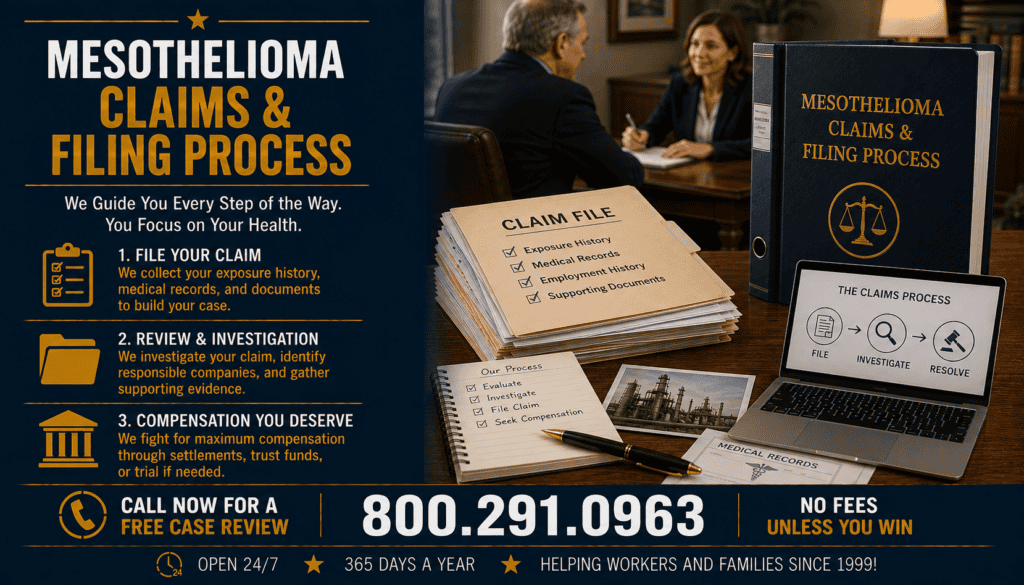
Mesothelioma Claims Filing Process
The mesothelioma claims filing process begins before a complaint is filed. A careful case review usually starts with the diagnosis, work and military history, possible asbestos exposure locations, products and equipment, potential witnesses, filing deadlines and the companies that may be legally connected to the exposure.
No single filing process applies to every mesothelioma case. Civil lawsuits are governed by the law and procedural rules of the court hearing the case, while asbestos bankruptcy trust claims follow separate trust-specific procedures. A family may also need to address wrongful-death, estate or representative-authority issues when the diagnosed person has died.
⚖️ How the Mesothelioma Claims Filing Process Works
The U.S. Courts explains that a federal civil action begins when a plaintiff files a complaint. The complaint describes the alleged injury, explains how the defendant allegedly caused the harm, establishes why the court has jurisdiction and asks for relief.
Mesothelioma litigation often requires substantial investigation before that filing because exposure may have occurred decades earlier and may involve several jobsites, products and companies.
🩺 Step 1: Confirm and Organize the Diagnosis
Begin with records documenting the mesothelioma diagnosis. Depending on the case, these may include pathology or cytology reports, biopsy records, imaging, operative reports, oncology notes and treatment records.
A diagnosis is essential medical evidence, but it does not by itself identify where asbestos exposure occurred or which company may be legally responsible.
⏳ Step 2: Review Filing Deadlines Early
Do not wait until every historical record has been located before reviewing filing deadlines. Statutes of limitations vary by jurisdiction and claim type, and wrongful-death claims can require a separate deadline analysis.
Important dates can include diagnosis, death, residence, exposure and prior litigation events. See Legal Deadlines for Asbestos Claims.
🏭 Step 3: Build the Exposure and Work History
Create a chronological history of employers, jobsites, military assignments, trades, departments, tasks and possible asbestos-containing products. Include approximate dates when exact dates are unavailable, but clearly identify estimates.
A structured timeline can reveal gaps and help connect witnesses and records to particular periods. See How Exposure Timelines Strengthen Mesothelioma Claims.
📂 Step 4: Gather Supporting Evidence
Potential evidence includes employment records, Social Security earnings information, military records, union files, invoices, purchase orders, specifications, product catalogs, photographs, maintenance records and witness testimony.
Evidence should be used for what it actually establishes. Employment at a facility does not prove exposure to every asbestos product used there, and an invoice does not automatically prove that a claimant personally encountered the purchased product.
🏢 Step 5: Identify Potentially Responsible Companies
The investigation may identify product manufacturers, suppliers, premises owners, contractors or other entities with a legally supportable connection to the alleged exposure.
Federal Rule of Civil Procedure 11 requires factual contentions presented to a federal court to have evidentiary support or, when specifically identified, to be likely to obtain evidentiary support after a reasonable opportunity for investigation or discovery. A company should not be added merely because it operated in the asbestos industry.
🗺️ Step 6: Determine Where a Claim May Be Filed
A mesothelioma history can involve exposure in one state, residence in another and defendants located elsewhere. The appropriate court depends on jurisdictional and venue rules, while a separate choice-of-law analysis may determine which substantive law governs particular issues.
The jurisdiction should be selected from legally available forums based on the facts—not simply because another plaintiff received a large verdict there.
📋 Step 7: Identify the Appropriate Claim Type
| Potential route | General purpose |
|---|---|
| Personal-injury lawsuit | Claim brought by the diagnosed person when legally available |
| Wrongful-death lawsuit | Claim arising after death under applicable state law |
| Survival claim | Preserves qualifying claims belonging to the deceased under state law |
| Asbestos trust claim | Administrative claim against a qualifying bankruptcy trust |
More than one route may potentially apply, but each has separate requirements and should not be treated as interchangeable.
⚖️ Step 8: Case Review and Pre-Filing Investigation
Before filing, counsel may review the diagnosis, exposure history, defendants, jurisdiction, damages, deadlines and available evidence. Missing historical records do not necessarily prevent an initial case evaluation.
Rule 11’s reasonable-inquiry requirement recognizes that some factual support may be developed through later investigation or discovery, but it does not permit unsupported claims against parties without a factual basis.
📝 Step 9: Prepare and File the Complaint
The complaint formally begins a civil lawsuit. According to the U.S. Courts, it describes the alleged injury or damages, explains how the defendant allegedly caused the harm, states the basis for jurisdiction and requests relief.
The exact allegations, causes of action and required pleading details depend on the jurisdiction and governing law.
📨 Step 10: Serve the Defendants
After filing, defendants generally must receive legally sufficient notice of the action through service of process. Federal and state systems have rules governing how and when service occurs.
Filing and service are distinct procedural steps. The requirements should be followed for each defendant rather than assuming that filing alone provides legally sufficient notice.
🛡️ Step 11: Defendant Responses and Early Motions
Defendants can respond to allegations, assert defenses and raise procedural or substantive issues. Some cases involve early motions addressing jurisdiction, pleadings, venue or other legal questions.
A defense or motion does not by itself determine the ultimate merits of the case. The court applies the governing law to the issues properly presented.
🔍 Step 12: Discovery and Evidence Exchange
Federal Rule of Civil Procedure 26 permits discovery of nonprivileged information relevant to a party’s claim or defense and proportional to the needs of the case. In covered federal cases, initial disclosures can include likely witnesses, documents or electronically stored information and damages information.
Discovery can uncover historical corporate records, product evidence and testimony unavailable to a family before filing.
🎙️ Step 13: Depositions and Witness Testimony
A deposition allows a witness to answer questions under oath before trial. In mesothelioma cases, testimony may address work history, products, jobsites, tasks, household exposure, diagnosis and damages.
Because a claimant’s health may affect scheduling, counsel can evaluate whether procedural options are available to preserve testimony promptly. The applicable court controls scheduling and procedure.
🧪 Step 14: Expert Evidence
Some cases require expert testimony concerning medicine, industrial hygiene, product issues or other specialized subjects. In federal court, Rule 26 contains disclosure requirements for expert testimony, while admissibility is governed by the applicable evidence rules.
Expert testimony supplements rather than replaces the need for a factual foundation connecting the claimant, exposure and defendants.
🏦 Step 15: Coordinate Asbestos Trust Claims
Bankrupt asbestos companies may have trusts established to compensate qualifying claimants. These claims are administrative rather than lawsuits against the reorganized company and operate under trust-specific Trust Distribution Procedures.
Trust submissions can overlap factually with lawsuit exposure histories. Preserve exact copies and keep dates, products and jobsites consistent with the underlying evidence. Explore What Are Asbestos Trust Funds?.
🤝 Step 16: Settlement Negotiations
Many civil cases resolve without trial. Settlement negotiations can occur at different stages, and different defendants may settle separately.
A settlement should be evaluated as a complete agreement, including gross amount, release language, payment timing, liens and expected net recovery. An offer is not the same as received compensation.
🏛️ Step 17: Trial if the Case Does Not Resolve
If a case is not resolved through settlement, dismissal or other court rulings, it may proceed to trial. The U.S. Courts explains that parties present evidence and witnesses, and the factfinder resolves disputed factual issues under the applicable law.
Trial outcomes are inherently case-specific. Prior verdicts do not guarantee the result of a new mesothelioma case.
🕊️ Filing After a Claimant’s Death
When a claimant dies before or during litigation, state wrongful-death and survival law can determine who may continue or bring claims. Probate or representative-authority documents may be needed.
A death does not automatically restart every legal deadline. See Probate and Asbestos Claims: Executor Responsibilities.
🌎 Claims Involving Multiple States
Workers frequently lived or worked in several states during long careers. Preserve a location-by-location timeline showing residences, employers, jobsites and exposure periods.
Multiple-state facts can affect jurisdiction, governing law and filing deadlines. See How to File Claims in Multiple States.
❓ Filing When the Exposure Source Is Not Yet Known
Families do not always remember the manufacturer or exact asbestos source at the beginning of an investigation. Work history, tasks, coworkers, historical records and discovery can sometimes help identify additional evidence.
Do not guess at product or defendant names to fill gaps. See Filing a Mesothelioma Lawsuit Without Knowing the Exposure Source.
🔐 Evidence Preservation and Consistency
Preserve original records and digital files, including metadata when available. Keep copies of prior trust claims, lawsuits, exposure histories and witness statements.
If new evidence requires correcting an earlier statement, preserve the earlier version and document the reason for the correction. Federal Rule 26 requires supplementation or correction of covered federal disclosures and discovery responses when materially incomplete or incorrect information becomes known under the rule’s conditions.
🚫 Common Filing Mistakes
- Waiting for perfect records before checking filing deadlines.
- Assuming a diagnosis identifies the liable company.
- Guessing at products, manufacturers or exposure dates.
- Failing to preserve original documents and digital files.
- Assuming employment at a facility proves exposure to every product there.
- Choosing a jurisdiction solely because of another case’s verdict.
- Ignoring prior trust claims or inconsistent exposure histories.
- Assuming wrongful-death and personal-injury deadlines are identical.
- Counting unresolved settlement offers as compensation already received.
- Failing to update materially incorrect evidence when required.
📅 Filing Process at a Glance
| Stage | Primary focus |
|---|---|
| 1. Diagnosis | Organize medical proof |
| 2. Deadline review | Identify potentially applicable time limits |
| 3. Exposure history | Reconstruct jobs, tasks and locations |
| 4. Evidence | Collect records and witnesses |
| 5. Defendant research | Identify legally supportable parties |
| 6. Jurisdiction | Determine legally available forum |
| 7. Filing | Prepare complaint and initiate lawsuit |
| 8. Service/response | Notify defendants and address responses |
| 9. Discovery | Exchange and develop evidence |
| 10. Resolution | Settlement, court ruling or trial |
🧭 Explore Claims Filing Process Topics
This hub connects detailed resources for families preparing, filing and documenting a mesothelioma claim.
❓ Frequently Asked Questions
What is the first step in filing a mesothelioma claim?
Organize the diagnosis and promptly review possible filing deadlines while beginning to reconstruct the work and asbestos exposure history.
Do I need to know the exact asbestos product before seeking a case review?
No. Historical records, witnesses and later investigation may help identify products, but unsupported product names should not be guessed.
Do I need every record before a lawsuit can be evaluated?
No. Missing historical records are common. A case can be evaluated using currently available information while additional evidence is investigated.
Where is a mesothelioma lawsuit filed?
The legally appropriate forum depends on jurisdiction, venue and case-specific connections such as exposure, residence and defendants.
Can a claim involve several companies?
Potentially. Each defendant should have an independent factual and legal basis.
What happens after the complaint is filed?
Defendants are served, may respond or file motions, and the case can proceed into discovery and other pretrial stages.
What is discovery?
Discovery is the process through which parties obtain relevant, nonprivileged information and evidence under applicable procedural rules.
Can asbestos trust claims be filed with a lawsuit?
Potentially, when each claim independently satisfies its requirements. Trust and lawsuit disclosure, timing or offset rules may interact.
What happens if the claimant dies during the case?
Representative substitution, survival and wrongful-death rules may become relevant. The exact procedure depends on governing law and the court.
Does every mesothelioma lawsuit go to trial?
No. Cases can resolve through settlement, dismissal, motion practice or other procedures before trial.
📞 Submit Your Case for Evaluation
You do not need a perfect file before requesting a mesothelioma case review. Start with the diagnosis, employment and military history, known jobsites, exposure tasks, possible products, witnesses and any records already available. Clearly identify uncertain details rather than guessing.
Call 800.291.0963 for a no-obligation case evaluation and to talk to a real person 24/7, 365 days a year. Many mesothelioma law firms handle qualifying cases on a contingency-fee basis; confirm the fee agreement and terms directly with the firm you retain. Submit your case here.
📝 Summary
The mesothelioma claims filing process begins with diagnosis, deadline review and reconstruction of the asbestos exposure history. The investigation then focuses on supporting evidence, potentially responsible companies, jurisdiction and the appropriate type of claim. After a civil complaint is filed and defendants are served, litigation can involve responses, discovery, depositions, expert evidence, settlement negotiations and, when necessary, trial. Trust claims follow separate administrative procedures. Because asbestos cases frequently involve old records and multiple states or companies, families should preserve evidence and review deadlines without waiting for a perfect file.
🔗 Confirmed Sources
- United States Courts — Civil Cases
- Federal Rule of Civil Procedure 11 — Signing Pleadings and Representations to the Court
- Federal Rule of Civil Procedure 26 — Disclosures and Discovery
Disclaimer: General information only—not legal or medical advice. This website is not a law firm. Filing requirements, deadlines, jurisdiction, liability standards, discovery procedures and available claims vary by jurisdiction and case-specific facts. No filing strategy, evidence item or prior result guarantees compensation or a particular outcome.