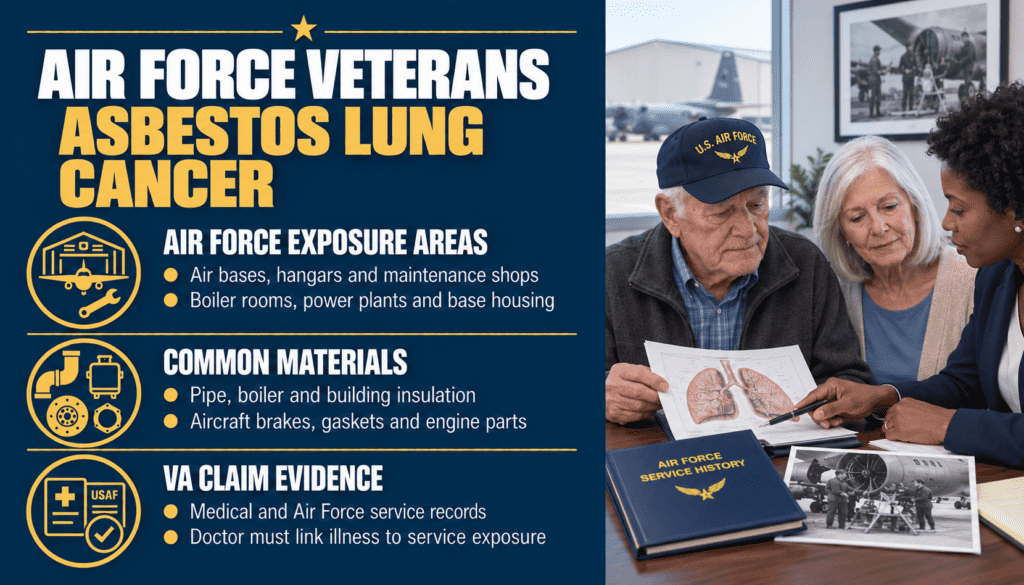
✈️ Air Force Veterans Asbestos Lung Cancer
U.S. Air Force veterans may develop lung cancer decades after asbestos exposure during military service. Historically, some asbestos-containing materials were used in aircraft components, maintenance facilities, hangars, boiler rooms, power systems, barracks, housing, vehicles, and other older Air Force buildings and equipment.
Air Force service alone does not prove asbestos exposure, and a lung cancer diagnosis alone does not establish that asbestos caused an individual veteran’s cancer. A careful investigation considers the veteran’s Air Force specialty, bases, aircraft or equipment, actual duties, service dates, facility history, specific materials involved, and other lung cancer risk factors.
For broader military lung cancer information, see Veterans Asbestos Lung Cancer. For service-specific exposure information, see U.S. Air Force Asbestos Exposure.
✈️ Air Force Asbestos Exposure and Lung Cancer
Asbestos is a known cause of lung cancer. Historically, asbestos was used in some aviation, mechanical, electrical, friction, insulation, and construction products because of its resistance to heat and fire.
Depending on the era and assignment, potential Air Force exposure pathways may have involved:
- Aircraft brakes, gaskets, seals, and selected heat-resistant components
- Aircraft and engine maintenance
- Ground-support equipment
- Vehicle brake and clutch work
- Boilers, pipes, pumps, valves, and utility systems
- Electrical and power-generation equipment
- Older hangars, shops, barracks, housing, and support buildings
- Construction, renovation, maintenance, and demolition
Exposure becomes a concern when asbestos-containing material is damaged or disturbed and fibers can become airborne. Not every aircraft, component, building, or piece of equipment contained asbestos.
🛩️ Aircraft Maintenance and Potential Exposure
Aircraft maintenance is an important area to investigate for Air Force veterans because some historical aviation components used friction- or heat-resistant materials that could contain asbestos.
| Aircraft or Maintenance Area | Possible Historical Exposure Pathway | Evidence to Review |
|---|---|---|
| Brake systems | Servicing certain historical friction materials | Aircraft model, brake assembly, parts records, technical orders |
| Engines and exhaust systems | Work involving certain gaskets, seals, insulation, or heat-resistant materials | Component records, overhaul history, maintenance procedures |
| Electrical systems | Work around certain historical heat-resistant electrical materials | Aircraft specifications, repair records, parts documentation |
| Ground-support equipment | Maintenance of certain brakes, clutches, gaskets, generators, or mechanical systems | Equipment records, parts lists, occupational duties |
The presence of a brake, gasket, engine, or electrical component does not automatically establish asbestos exposure. The specific model, component, manufacturer, replacement history, era, and maintenance task should be investigated.
See Air Force Aircraft Asbestos Exposure for more detailed aircraft information.
🏢 Hangars, Flight Lines and Repair Facilities
Potential exposure was not limited to the aircraft itself. Some older hangars, maintenance bays, repair shops, warehouses, and utility spaces may have contained asbestos-containing building or mechanical materials.
Areas worth investigating can include:
- Aircraft hangars and maintenance bays
- Engine and component repair shops
- Vehicle maintenance facilities
- Boiler and utility rooms
- Power-generation facilities
- Electrical rooms
- Warehouses and support buildings
- Renovation and demolition areas
Bystander exposure may also be relevant when a veteran worked near another person disturbing asbestos-containing material. Proximity, frequency, duration, ventilation, and the actual product involved are important.
See Air Force Hangars & Aircraft Maintenance Asbestos Exposure.
🛠️ Air Force Jobs and Duties to Investigate
Certain technical and maintenance occupations may have created more opportunities for direct or nearby contact with asbestos-containing materials, depending on the veteran’s era and actual duties.
| Air Force Work | Possible Exposure Pathway |
|---|---|
| Aircraft mechanics | Historical brakes, gaskets, seals, engines, and heat-resistant materials |
| Vehicle mechanics | Historical brake, clutch, gasket, and equipment maintenance |
| Electricians | Electrical systems and nearby insulating or heat-resistant materials |
| Power-production personnel | Generators, boilers, piping, pumps, valves, and utility systems |
| Facility maintenance personnel | Older insulation, flooring, mechanical rooms, and renovation work |
| Civil engineering personnel | Construction, demolition, utility work, roofing, flooring, and insulation |
An Air Force Specialty Code or job title is a useful starting point, but it is not proof of exposure. The veteran’s actual work environment and tasks should be documented whenever possible.
🏠 Air Force Bases, Housing and Mechanical Facilities
Older Air Force installations can also be relevant when veterans maintained, renovated, or worked near buildings containing asbestos-containing materials.
Potential settings include barracks or dormitories, base housing, administrative buildings, boiler rooms, power plants, radar and communications facilities, maintenance shops, warehouses, and training facilities.
Materials worth investigating can include certain historical pipe insulation, flooring, roofing, fire-resistant products, cement materials, gaskets, packing, and mechanical insulation.
A building’s age does not prove that asbestos was present or that fibers were released. Facility specifications, asbestos surveys, renovation histories, maintenance records, and the veteran’s duties can help clarify possible exposure.
For broader facility research, see Air Force Base Asbestos Exposure.
⏳ Latency and Lung Cancer Diagnosis After Air Force Service
Asbestos-related lung cancer can develop many years after exposure. That long latency can make military exposure easy to overlook when a veteran is diagnosed decades after leaving active duty.
Veterans should give healthcare professionals a complete occupational and military exposure history, including asbestos, tobacco use, other workplace exposures, and relevant environmental exposures.
Exposure history does not diagnose lung cancer or prove that asbestos caused a particular cancer. Medical evaluation may include imaging, biopsy or other tissue or cell testing, pathology, staging studies, and additional testing selected by the treating medical team.
📁 Documenting Air Force Asbestos Exposure
Veterans often do not remember exact product or manufacturer names decades later. Military and historical records can help reconstruct the exposure history.
| Evidence | What It May Help Establish |
|---|---|
| DD Form 214 and personnel records | Service dates, specialty, units, and assignments |
| Duty-station records | Bases, deployments, and periods of service |
| Aircraft records | Aircraft types and maintenance environments |
| Technical orders and maintenance records | Parts, systems, procedures, and equipment serviced |
| Facility records | Building materials, renovations, boilers, utilities, and construction history |
| Witness statements | Work practices, equipment, dust conditions, and nearby maintenance |
| Medical records | Lung cancer diagnosis, pathology, staging, and treatment history |
A strong reconstruction identifies the veteran’s base, unit, specialty, aircraft or equipment, work task, time period, and material whenever the evidence allows.
🩺 Treatment, VA Benefits and Legal Claims
Air Force veterans with lung cancer are treated according to the cancer’s type, stage, molecular and biomarker findings, tumor location, lung function, overall health, and other individual factors. Treatment can include surgery, chemotherapy, immunotherapy, radiation therapy, targeted therapy, supportive care, or combinations of approaches when medically appropriate.
Asbestos exposure does not create a separate universal treatment plan or survival rate. Treatment decisions should be made with qualified oncology professionals.
Veterans may also investigate VA disability benefits when evidence supports the applicable service-connection requirements. Separate civil lawsuits or asbestos bankruptcy trust claims may be available when their own medical, exposure, product, company, jurisdictional, and filing requirements are met.
A successful VA claim does not automatically establish civil liability, and a civil or trust claim does not automatically establish VA eligibility.
For Air Force-specific legal information, see Air Force Asbestos Legal Options and Air Force Veterans Asbestos Trust Fund Claims.
❓ Frequently Asked Questions
Can Air Force veterans develop lung cancer from asbestos exposure?
Yes. Asbestos is an established cause of lung cancer. Whether asbestos contributed to an individual veteran’s cancer depends on the actual exposure history, medical evidence, and other risk factors.
Where could Air Force asbestos exposure have occurred?
Potential settings include aircraft maintenance areas, hangars, vehicle shops, boiler and utility rooms, power facilities, older base buildings, barracks, housing, and construction or renovation projects.
Which Air Force jobs may have involved asbestos exposure?
Aircraft mechanics, vehicle mechanics, electricians, power-production personnel, facility maintenance workers, and civil engineering personnel are among the occupations worth investigating depending on era and duties.
Does working on an older aircraft prove asbestos exposure?
No. The aircraft model and maintenance role can identify a reason to investigate, but exposure should be supported by evidence that a relevant component contained asbestos and was disturbed.
Can an Air Force veteran who smoked still have an asbestos-related lung cancer claim?
Potentially. Smoking and asbestos are both established lung cancer risk factors. A smoking history does not by itself determine whether a veteran has a valid asbestos-related legal or VA claim.
Can Air Force veterans file asbestos trust fund claims?
Potentially. Eligibility depends on the requirements of the specific trust and evidence connecting exposure to qualifying products, companies, or locations.
Can Air Force veterans pursue VA benefits and private legal claims?
Potentially. VA benefits, civil lawsuits, and asbestos trust claims are separate systems with different eligibility and evidence requirements.
What records can help document Air Force asbestos exposure?
Personnel records, specialty codes, duty stations, aircraft records, technical orders, maintenance records, facility documents, historical product information, and witness statements may help reconstruct exposure.
✈️ Help for Air Force Veterans With Lung Cancer
Review military exposure history, medical evidence and potential claim options
A focused review can examine:
- Air Force specialties, bases, aircraft, equipment, buildings, and actual duties
- Historical products, manufacturers, maintenance records, witnesses, and other exposure evidence
- Medical records, VA benefits, asbestos trust claims, lawsuits, survivor options, and filing requirements
Call 800.291.0963 to discuss Air Force veterans asbestos lung cancer and possible exposure history. Live chat is available 24/7, 365 days a year. You can also Submit Your Case.
No medical causation determination, VA eligibility decision, trust payment, lawsuit outcome, settlement, verdict, or compensation amount is guaranteed.
⚕️ Legal & Medical Information Disclaimer
This page provides general educational information and is not medical or legal advice. It does not establish asbestos exposure, diagnosis, medical causation, legal liability, VA eligibility, trust eligibility, claim eligibility, or compensation. Consult qualified medical and legal professionals about your circumstances.