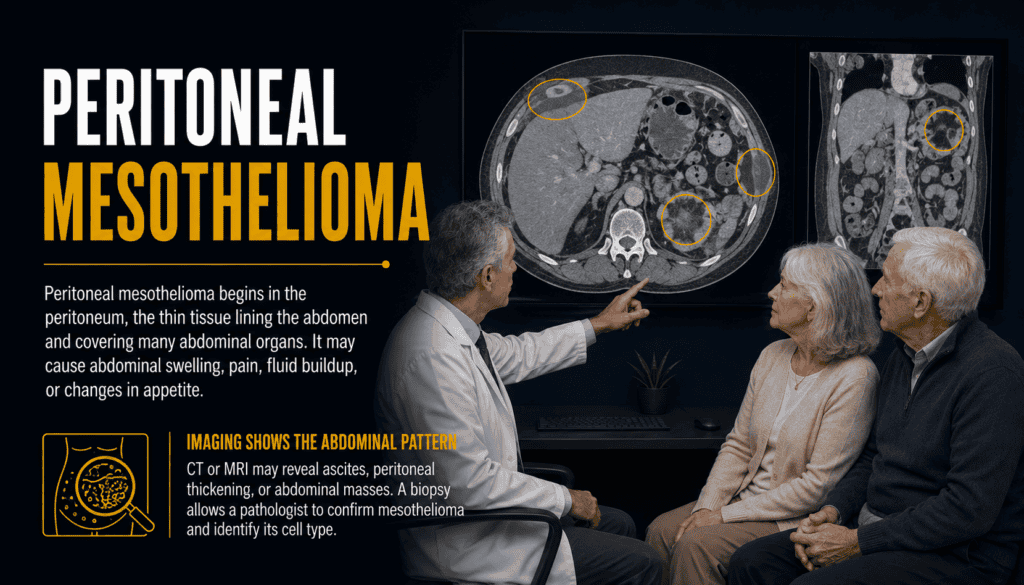
Peritoneal Mesothelioma
Symptoms, Diagnosis, Treatment With Surgery and HIPEC, and Prognosis
Peritoneal mesothelioma is a rare cancer that develops in the peritoneum, the thin membrane lining the abdominal cavity and covering many abdominal organs. It is different from pleural mesothelioma, which begins in the lining around the lungs.
Abdominal swelling, pain, ascites, appetite changes and unexplained weight loss can occur, but these symptoms have many possible causes. Diagnosis generally requires imaging followed by a tissue biopsy and specialist pathology review. Treatment should be planned by clinicians experienced with this uncommon disease.
🩺 What Is Peritoneal Mesothelioma?
The peritoneum has two main layers. The parietal peritoneum lines the abdominal wall, while the visceral peritoneum covers many abdominal organs. Peritoneal mesothelioma begins when malignant mesothelial cells grow in this lining. Tumor deposits may develop across peritoneal surfaces and can interfere with normal movement and function of abdominal organs.
Peritoneal mesothelioma is one of several anatomical types of mesothelioma. It is less common than pleural mesothelioma but more common than the rare pericardial and testicular forms. “Peritoneal” identifies where the cancer began; it does not describe a separate benign abdominal condition or a cancer that spread to the abdomen from another organ.
| Feature | Peritoneal mesothelioma | Pleural mesothelioma |
|---|---|---|
| Where it begins | Peritoneum lining the abdominal cavity | Pleura surrounding the lungs |
| Common symptom pattern | Abdominal swelling, pain, ascites, appetite or bowel changes | Shortness of breath, chest pain, cough and pleural fluid |
| Key diagnostic area | Abdominal and pelvic imaging with tissue biopsy | Chest imaging with pleural tissue biopsy |
| Specialized local treatment | Cytoreductive surgery with HIPEC may be considered for selected patients | Pleural surgery may be considered for selected patients using different procedures |
The diagnosis is usually malignant peritoneal mesothelioma. Other rare mesothelial tumors can occur in the peritoneum, so the pathology report and exact diagnosis matter when treatment is selected.
⚠️ Peritoneal Mesothelioma Symptoms and Warning Signs
Symptoms can develop gradually and may resemble gastrointestinal, liver, ovarian or other abdominal conditions. The presence of one symptom does not mean a person has mesothelioma. Persistent, worsening or unexplained symptoms deserve medical evaluation, especially when several occur together.
| Possible symptom | How it may appear | Why medical evaluation matters |
|---|---|---|
| Abdominal swelling or distention | The abdomen feels enlarged, tight or increasingly uncomfortable | Swelling may reflect ascites, tumor growth or another medical problem. |
| Abdominal or pelvic pain | Persistent aching, pressure, tenderness or localized discomfort | Pain has many causes and cannot identify mesothelioma by itself. |
| Ascites | Abnormal fluid accumulation inside the abdomen | Fluid can cause pressure, early fullness, breathing discomfort and reduced mobility. |
| Digestive or bowel changes | Nausea, vomiting, constipation, diarrhea or changes in bowel habits | Persistent changes may require imaging and other tests to identify the cause. |
| Appetite loss or early satiety | Feeling full after eating a small amount | Reduced intake can contribute to weakness, dehydration and weight loss. |
| Unexplained weight loss | Losing weight without intentionally changing diet or activity | Unintentional weight loss should be discussed with a clinician. |
| Fatigue | Persistent exhaustion that does not improve with normal rest | Fatigue may be related to cancer, anemia, poor nutrition or another condition. |
| Abdominal mass or pressure | A new lump, firmness or pressure sensation | A clinician may recommend examination and imaging. |
Because symptoms overlap with many conditions, a clinician evaluates the complete pattern rather than one complaint. The site’s broader mesothelioma symptoms guide explains why symptoms differ depending on where the disease develops.
🧱 Causes, Asbestos Exposure and Risk Factors
Asbestos exposure is the major established risk factor for malignant mesothelioma. Exposure may have occurred decades before symptoms began and may have involved work, military service, contaminated clothing brought home by another household member, or older asbestos-containing products and buildings.
How asbestos fibers reach or contribute to disease in the peritoneum is not fully understood in every case. Proposed pathways include fibers being swallowed after inhalation or moving through the body. A person may not remember a specific exposure, and not every individual with peritoneal mesothelioma has a clearly documented asbestos history.
Questions that can help reconstruct an exposure history
- What jobs, military assignments or industries were involved?
- Were insulation, boilers, pipes, gaskets, cement products, brakes or other older materials handled nearby?
- Did work create visible dust during cutting, sanding, repair, removal or demolition?
- Were dusty work clothes, shoes or tools brought into the home?
- Which buildings, plants, ships, bases or worksites were involved, and during what years?
- Could former coworkers or employment records help confirm past conditions?
Exposure history can support medical and legal evaluation, but it does not replace pathology. Mesothelioma is diagnosed through medical testing, not by occupational history alone. Conversely, an uncertain exposure history does not rule out the disease when biopsy findings support the diagnosis.
🔬 How Peritoneal Mesothelioma Is Diagnosed
Diagnosis often begins when symptoms prompt abdominal imaging. Blood tests can help assess general health and organ function, but no routine blood test can independently confirm peritoneal mesothelioma. The final diagnosis generally depends on examining tumor tissue.
| Diagnostic step | What it may show | Important limitation or next step |
|---|---|---|
| Medical and exposure history | Symptom timeline, prior illnesses, surgeries and possible asbestos exposure | History guides testing but cannot confirm the cancer. |
| Physical examination | Abdominal distention, tenderness, a mass or signs of fluid buildup | These findings can occur with many diseases. |
| CT scan of the abdomen and pelvis | Peritoneal thickening, nodules, masses, ascites or disease distribution | Imaging can suggest malignancy but usually cannot identify the exact tumor type. |
| MRI or PET/CT | Additional information about soft tissue, metabolic activity or possible spread in selected cases | Use depends on the clinical question and specialist recommendation. |
| Paracentesis and fluid testing | Fluid characteristics and abnormal cells; drainage may also relieve pressure | Fluid cytology can be inconclusive, so a negative result may not exclude mesothelioma. |
| Core needle or surgical biopsy | Tissue architecture and tumor cells | Adequate tissue is usually needed for immunohistochemistry and a confident diagnosis. |
| Specialist pathology review | Cell type and marker pattern supporting mesothelioma while excluding look-alike cancers | Review by a pathologist experienced in mesothelial tumors can be important because the disease is rare. |
Pathologists use the appearance of the tissue together with a panel of immunohistochemical markers. No single marker is sufficient in every case. Additional molecular or genetic tests may be used when the distinction between malignant mesothelioma, reactive mesothelial changes and another cancer remains difficult.
🧬 Cell Types, Disease Extent and Staging
Peritoneal mesothelioma may be described as epithelioid, sarcomatoid or biphasic. Epithelioid tumors are the most common peritoneal form and often have a more favorable outlook than sarcomatoid or biphasic disease, but cell type is only one part of an individual treatment assessment.
| Cell type | General description | Why it matters |
|---|---|---|
| Epithelioid | Cells usually grow in organized patterns that may resemble other gland-forming cancers | Often associated with better treatment options and outlook than other histologies, although results vary. |
| Sarcomatoid | Spindle-shaped cells with a more aggressive growth pattern | Rare in peritoneal disease and may be harder to treat. |
| Biphasic | Contains both epithelioid and sarcomatoid components | Behavior can depend partly on the proportion and distribution of each component. |
Unlike pleural mesothelioma, peritoneal mesothelioma does not have one universally adopted staging system used by every center. Specialists often describe disease extent using imaging, findings during surgery, whether disease is confined to the abdominal cavity, and measures such as the Peritoneal Cancer Index. They also assess whether surgeons could remove visible tumors safely and how much disease remains after surgery.
A general mesothelioma stages guide can explain common cancer-staging concepts, but patients should ask their specialist which peritoneal-specific method is being used. If disease has spread to distant organs, clinicians may describe it as metastatic mesothelioma.
💊 Peritoneal Mesothelioma Treatment Options
Treatment depends on disease distribution, cell type, whether complete or near-complete tumor removal appears possible, prior operations, nutrition, heart and lung function, other health conditions and the patient’s goals. A plan made at an experienced center may involve several specialties.
Cytoreductive surgery and HIPEC
For selected patients whose disease is considered operable, specialists may recommend cytoreductive surgery followed by hyperthermic intraperitoneal chemotherapy, commonly called CRS with HIPEC. During cytoreduction, surgeons remove visible tumor from peritoneal surfaces and may remove involved tissue or organs when necessary. HIPEC circulates heated chemotherapy inside the abdominal cavity during the operation to treat microscopic disease that surgery cannot visibly remove.
CRS with HIPEC is a major procedure and is not appropriate for everyone. Potential complications can include infection, bleeding, blood clots, digestive problems, organ injury, nutritional challenges and a lengthy recovery. Outcomes depend heavily on patient selection, disease burden, completeness of cytoreduction and the experience of the treatment team.
Systemic therapy
Systemic chemotherapy may be considered when surgery is not appropriate, before or after surgery in selected cases, or if the cancer progresses. Pemetrexed with a platinum drug is one regimen clinicians may discuss, although evidence and treatment standards for peritoneal disease are less extensive than for pleural mesothelioma.
Immunotherapy, targeted approaches or other drugs may be considered for certain patients, sometimes through a clinical trial. Approvals and evidence established for pleural mesothelioma do not automatically apply in the same way to peritoneal disease. Ask the treating oncologist what evidence supports the proposed treatment for the specific diagnosis.
Symptom-directed and supportive care
Supportive care can be used alongside cancer-directed treatment at any stage. It may include:
- Draining ascites to relieve pressure and discomfort
- Medication for pain, nausea, constipation or other symptoms
- Nutrition assessment and strategies for early fullness or weight loss
- Physical activity or rehabilitation tailored to strength and safety
- Palliative care for symptom control and quality of life
- Psychological, social-work and caregiver support
The broader mesothelioma treatment guide explains how surgery, drug therapy, clinical trials and supportive care may fit into an individualized plan.
📊 Prognosis, Survival Factors and Follow-Up
Peritoneal mesothelioma prognosis varies substantially. Published survival statistics describe groups of patients and cannot predict how long one person will live. Statistics may also combine patients treated in different eras, with different cell types and at centers with different experience.
| Factor | How it may influence the outlook |
|---|---|
| Cell type | Epithelioid disease generally has a more favorable outlook than sarcomatoid or biphasic disease. |
| Disease distribution | Lower abdominal disease burden and absence of distant spread may allow more treatment options. |
| Resectability | The ability to remove visible disease completely or nearly completely is important when surgery is considered. |
| Overall health | Nutrition, strength, organ function and other medical conditions affect treatment tolerance. |
| Response to treatment | Imaging, symptoms and laboratory findings help the team assess whether treatment is controlling disease. |
| Specialist experience | Evaluation at a center familiar with peritoneal surface malignancies can clarify eligibility for specialized treatment. |
Follow-up may include physical examinations, symptom review, blood tests and repeat imaging. The schedule varies based on treatment, disease status and the center’s protocol. Report new or worsening abdominal swelling, pain, vomiting, bowel changes, appetite loss or weight loss rather than waiting for the next planned appointment.
Ask the oncologist to explain prognosis as a range and to identify which features of the individual case drive that estimate. A second opinion can be useful when the proposed plan involves major surgery, when pathology is uncertain or when the patient wants to explore clinical trials.
🏥 Finding Specialists and Preparing for an Appointment
Because peritoneal mesothelioma is rare, a community oncologist may coordinate care with a surgical oncologist and medical oncologist at a center experienced in peritoneal surface cancers. A multidisciplinary review can help determine whether surgery and HIPEC, systemic therapy, a clinical trial or symptom-focused care is most appropriate.
Records to gather
- Pathology report, biopsy slides and tissue-block information
- CT, MRI or PET images—not only the written radiology reports
- Operative reports and hospital discharge summaries
- Medication list, allergies and major medical history
- Previous cancer-treatment records
- A timeline of symptoms and possible asbestos exposure
- Insurance authorization requirements and referral information
Questions to ask the specialist
- Has an experienced pathologist confirmed the diagnosis and cell type?
- How are you measuring the amount and distribution of disease?
- Am I a candidate for cytoreductive surgery and HIPEC? Why or why not?
- How many procedures like this does the center perform?
- What benefits, risks, recovery needs and alternatives should I consider?
- Should systemic treatment be given before or after surgery?
- Are any clinical trials appropriate for my diagnosis and treatment history?
- Who should I contact if abdominal swelling or other symptoms worsen?
Patients and families may also use mesothelioma support resources for caregiver planning, emotional support and practical help during treatment.
❓ Frequently Asked Questions
Where does peritoneal mesothelioma develop?
It develops in the peritoneum, the membrane lining the abdominal cavity and covering many abdominal organs. It is different from pleural mesothelioma, which begins around the lungs.
What are the most common warning signs?
Possible signs include increasing abdominal swelling, abdominal or pelvic pain, ascites, appetite loss, early fullness, nausea, bowel changes, fatigue and unexplained weight loss. These symptoms can have many other causes and require medical evaluation.
How is peritoneal mesothelioma confirmed?
Imaging may reveal suspicious abdominal changes, but confirmation generally requires a biopsy. A pathologist examines the tissue and uses immunohistochemical markers to distinguish mesothelioma from other cancers and noncancerous mesothelial changes.
Can testing abdominal fluid confirm the disease?
Fluid analysis may detect abnormal cells and help evaluate ascites, but it can be inconclusive. A negative fluid-cytology result does not always exclude mesothelioma, so doctors may still recommend a tissue biopsy.
Is surgery with HIPEC available to everyone?
No. CRS with HIPEC is a major treatment considered for selected patients based on disease distribution, cell type, overall health, prior procedures and whether surgeons believe visible tumor can be removed safely.
Does peritoneal mesothelioma use the same stages as pleural mesothelioma?
Not necessarily. There is no single universally accepted peritoneal staging system used by every center. Specialists may describe disease extent using imaging, surgical findings, the Peritoneal Cancer Index, spread beyond the abdomen and the completeness of tumor removal.
Should a patient seek a second opinion?
A second opinion can be especially helpful when pathology is uncertain, when major surgery is proposed, when a patient was told surgery is not possible, or when the family wants information about specialized treatment and clinical trials.
Can peritoneal mesothelioma be cured?
Some selected patients achieve long periods of disease control after specialized treatment, but no treatment can guarantee a cure. The outlook depends on cell type, disease burden, resectability, response to treatment and overall health.
📚 Authoritative Medical Sources
- National Cancer Institute: Treatment for Mesothelioma
- Centers for Disease Control and Prevention: Mesothelioma Basics
- American Cancer Society: Signs and Symptoms of Mesothelioma
- PubMed Central: Treatment of Patients With Malignant Peritoneal Mesothelioma
- ClinicalTrials.gov: Search Current Mesothelioma Studies
📞 Get Help After a Mesothelioma Diagnosis
Call 800.291.0963. Live chat is available 24 hours a day, 7 days a week, 365 days a year.
Submit Your Case
⚕️ Medical and Legal Information Disclaimer
This page provides general educational information and is not medical or legal advice. Symptoms, diagnosis, treatment eligibility and outcomes vary. Consult qualified medical professionals about care and a licensed attorney about legal questions.