Testicular Mesothelioma
Symptoms, diagnosis and treatment of mesothelioma of the tunica vaginalis
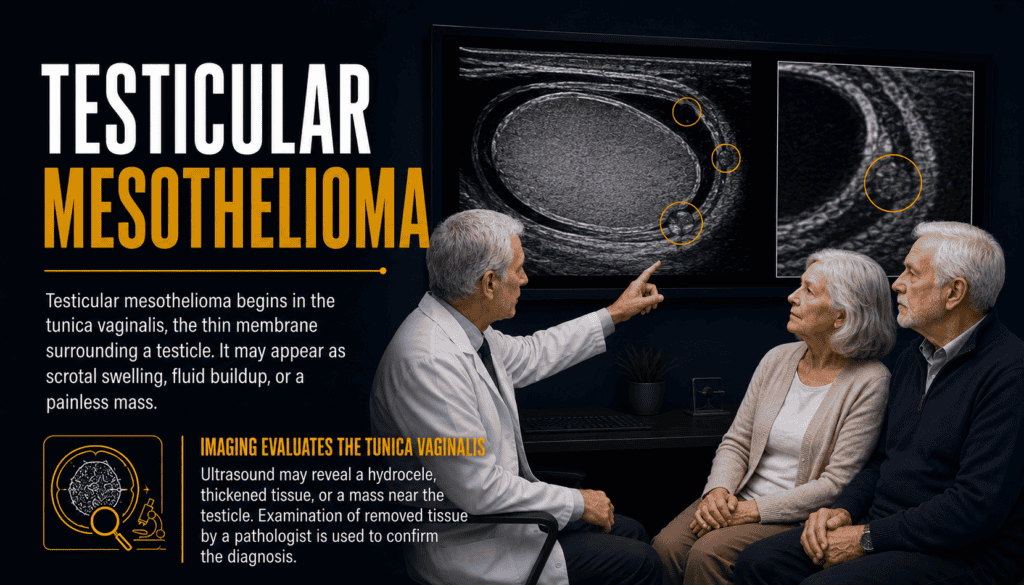
Testicular mesothelioma is an extremely rare cancer that usually begins in the tunica vaginalis, the thin membrane surrounding the testicle. Its medical name is malignant mesothelioma of the tunica vaginalis testis. It is different from the more common germ-cell cancers that arise inside a testicle.
Because this disease is so uncommon and can resemble a hydrocele, hernia or other benign scrotal condition, diagnosis may not occur until surgery and laboratory examination of tissue. Anyone with a new scrotal mass or persistent swelling should arrange a prompt medical evaluation.
What Is Testicular Mesothelioma?
Testicular mesothelioma develops from mesothelial cells in the tunica vaginalis, a two-layered sac of membrane that partially covers each testicle. The tunica vaginalis is continuous in origin with the lining of the abdominal cavity, but a tumor in this membrane is classified by its paratesticular location.
The name can be confusing: the cancer generally starts in tissue around a testicle rather than in the testicular tissue that produces sperm and hormones. Clinicians may also call it tunica vaginalis mesothelioma or paratesticular mesothelioma.
This is the rarest recognized anatomic form discussed among the main types of mesothelioma. Most mesotheliomas form in the pleura around the lungs; others arise in the peritoneum of the abdomen or the pericardium around the heart. Learn how it differs from pleural mesothelioma, peritoneal mesothelioma and pericardial mesothelioma.
Testicular Mesothelioma Symptoms and Warning Signs
Reported mesothelioma symptoms in this location are often nonspecific. The most common presentations in published case reports and series include:
- Painless swelling on one side of the scrotum
- A scrotal or paratesticular lump
- A hydrocele, which is a collection of fluid around a testicle
- Scrotal heaviness, discomfort or pain
- Thickening or nodules in the tissue around the testicle
- An inguinal, or groin, mass or suspected hernia
These signs can occur with many noncancerous conditions, including infection, inflammation, cysts and hernias. Mesothelioma cannot be identified from symptoms alone.
When to Seek Urgent Care
Sudden, severe testicular or scrotal pain is an emergency because testicular torsion can permanently damage the testicle if treatment is delayed. Seek immediate medical care for abrupt pain, rapid swelling, nausea or vomiting, a high-riding testicle, fever, or redness and warmth of the scrotum.
Causes and Risk Factors
Asbestos is the principal established cause of malignant mesothelioma overall. However, the evidence linking asbestos specifically to tunica vaginalis mesothelioma is limited and less certain than it is for pleural disease. Some published patients had occupational or environmental exposure, while many had no documented exposure.
Researchers have also discussed chronic inflammation, recurrent hydrocele, trauma and prior hernia-related conditions as possible associations. The rarity of the cancer makes it difficult to determine whether these factors cause the disease. Having a hydrocele or hernia does not mean a person has or will develop mesothelioma.
Questions About Possible Asbestos Exposure
A medical history should include current and past jobs, military service, home renovations, work around asbestos-containing products and possible household exposure through a family member’s work clothes. A specialist can evaluate the history, but exposure history by itself cannot confirm the diagnosis.
How Testicular Mesothelioma Is Diagnosed
There is no routine screening test for tunica vaginalis mesothelioma. Evaluation usually begins after a person notices swelling or a mass, or when a clinician identifies an abnormality during an examination.
Physical Examination and Ultrasound
A clinician examines the testicles, scrotum, groin and nearby lymph-node areas. Scrotal ultrasound is generally the first imaging test because it can distinguish solid from fluid-filled findings and show whether a lesion is within or outside the testicle. Findings such as nodules along the scrotal lining or complex fluid may prompt additional evaluation, but imaging cannot prove that a tumor is mesothelioma.
Blood Tests and Additional Imaging
Doctors may order blood tests for markers associated with common testicular germ-cell tumors, including alpha-fetoprotein, beta-human chorionic gonadotropin and lactate dehydrogenase. Normal results do not rule out cancer, and these markers do not diagnose mesothelioma.
CT or MRI may help define the local tumor and evaluate lymph nodes or distant disease. Chest, abdominal and pelvic imaging can be used when doctors need to assess whether the cancer has spread or whether a mesothelioma elsewhere in the body could be involved.
Tissue Diagnosis
A definitive diagnosis requires a pathologist to examine tissue. In many reported cases, mesothelioma was found only after surgery for what appeared to be a hydrocele or hernia. When cancer is suspected, the care team plans the approach carefully because cutting through the scrotum or disrupting a tumor may complicate later surgery.
Get Help Understanding Your Next Steps
A rare mesothelioma diagnosis can bring medical, practical and financial questions. Our team can help connect you with information and explain possible legal options related to asbestos exposure.
Call 800.291.0963 Submit Your Case
Live chat is available 24/7/365.
Pathology and Cell Types
Tunica vaginalis mesothelioma can resemble several benign and malignant tumors under the microscope. Diagnosis should ideally be reviewed by a pathologist experienced in mesothelial and genitourinary tumors.
Pathologists assess the tumor’s growth pattern, invasion into surrounding tissue and cell appearance. They use a panel of immunohistochemical stains—not one marker alone—to support mesothelial origin and exclude other cancers. Molecular tests such as BAP1 protein loss or CDKN2A deletion may help in selected cases, but results must be interpreted with the tissue findings.
Reported malignant patterns include epithelioid, sarcomatoid and biphasic features. Epithelioid describes cells that tend to grow in sheets, tubules or papillary structures. Sarcomatoid tumors contain spindle-shaped cells, while biphasic tumors contain both components. Pathology reports may also describe well-differentiated papillary mesothelial tumor, a distinct mesothelial neoplasm whose behavior and management differ from invasive malignant mesothelioma.
Why an Expert Pathology Review Matters
Because so few cases occur, an expert second review can confirm the diagnosis, clarify whether invasion is present and help distinguish mesothelioma from adenocarcinoma, adenomatoid tumor, serous tumor and reactive mesothelial changes. That distinction directly affects treatment planning.
Staging and How Testicular Mesothelioma Spreads
There is no universally accepted staging system created specifically for tunica vaginalis mesothelioma. Doctors instead describe the extent of disease using the primary tumor, nearby tissues, lymph nodes and distant sites. General information about mesothelioma stages can provide context, but it does not replace an individualized specialist assessment.
Local disease may involve the tunica vaginalis, epididymis, spermatic cord, scrotal tissues or structures in the groin. Cancer can spread through lymphatic channels to inguinal, pelvic or retroperitoneal lymph nodes. Distant recurrence or metastasis has been reported in organs and membranes outside the scrotum. When mesothelioma travels beyond its original site, it may be described as metastatic mesothelioma.
Staging workup may include CT of the chest, abdomen and pelvis, MRI for local detail, and other imaging selected by the oncology team. The findings help determine whether surgery could remove all visible disease and whether systemic treatment should be considered.
Testicular Mesothelioma Treatment Options
There is no single standard treatment supported by large clinical trials because the disease is exceptionally rare. Care is generally individualized by a multidisciplinary team that may include a urologic oncologist, medical oncologist, radiation oncologist, pathologist and radiologist with relevant experience.
Surgery
For cancer that appears localized and removable, surgery is the main treatment described in the medical literature. Radical inguinal orchiectomy removes the affected testicle and spermatic cord through an incision in the groin. A high ligation of the cord is often used to reduce the chance of leaving tumor behind.
The exact operation depends on tumor location, prior procedures and whether the cancer involves the scrotal wall or surgical margins. Some patients may need removal of involved scrotal tissue or additional surgery after an initial hydrocele procedure. Retroperitoneal lymph-node surgery is considered selectively; its role is not established for every patient.
Chemotherapy, Immunotherapy and Radiation
Evidence for drug therapy and radiation in this location comes mainly from individual cases, small series and experience with mesothelioma in other sites. A medical oncologist may consider pemetrexed-based chemotherapy or other systemic treatments when disease cannot be fully removed, recurs or has spread. Immunotherapy may be discussed in advanced disease, but its benefits specifically for tunica vaginalis mesothelioma are not defined by large studies.
Radiation therapy may be considered for selected surgical areas, positive margins, local recurrence or symptom relief. Its use depends on tumor extent and the nearby organs that could be exposed. Patients can review the broader range of mesothelioma treatments with a specialist and ask whether a clinical trial is appropriate.
Fertility and Hormone Considerations
Removing one testicle does not automatically cause infertility or low testosterone. A healthy remaining testicle can often maintain sperm and hormone production, but age, baseline fertility, other treatments and the function of the remaining testicle matter. People who may want biological children should ask about semen analysis and sperm banking before treatment when timing allows. Symptoms such as fatigue, reduced libido or erectile changes should be discussed with the care team rather than assumed to be an unavoidable result of surgery.
Prognosis, Follow-Up and Support
Prognosis varies substantially and cannot be predicted from the diagnosis name alone. Important factors may include whether the tumor is confined to the tunica vaginalis, whether surgery achieves clear margins, the pathology pattern, lymph-node involvement and distant spread. Published survival estimates are based on small, mixed groups of patients and may not accurately predict an individual’s outcome.
Local and distant recurrence can occur, including years after initial treatment. Follow-up typically includes physical examinations and periodic imaging on a schedule chosen by the oncology team. Patients should report new scrotal or groin changes, unexplained pain, abdominal symptoms, breathing changes, weight loss or other persistent symptoms.
Building a Rare-Cancer Care Team
A second opinion at a center familiar with mesothelioma or rare genitourinary cancers may help confirm pathology and identify treatment options. Patients can request copies of pathology slides, imaging files, operative reports and treatment summaries. Practical and emotional help is also available through mesothelioma support resources.
Medical Sources
- Centers for Disease Control and Prevention: Incidence of Malignant Mesothelioma
- Mayo Clinic: Mesothelioma Symptoms and Causes
- BMC Cancer: Malignant Mesothelioma of the Tunica Vaginalis Testis—Case and Literature Review
- Environmental Health: Asbestos Exposure and Tunica Vaginalis Mesothelioma—Systematic Review
- European Radiology: Imaging of Mesothelioma of the Tunica Vaginalis Testis
- Cancers: Diagnostic and Therapeutic Challenges of Tunica Vaginalis Mesothelioma
Frequently Asked Questions About Testicular Mesothelioma
Is testicular mesothelioma the same as testicular cancer?
No. Testicular mesothelioma generally begins in the tunica vaginalis, the membrane around a testicle. Most cancers called testicular cancer begin in germ cells inside the testicle. Their tumor markers, pathology and treatment can differ.
What is usually the first sign of testicular mesothelioma?
Many reported patients first noticed painless scrotal swelling, a hydrocele or a lump. These findings are far more often caused by noncancerous conditions, but a new or persistent change should be examined.
Does asbestos cause every case of testicular mesothelioma?
No. Some patients have documented asbestos exposure, but many do not. Current evidence supports a possible association while remaining less conclusive than the link between asbestos and pleural mesothelioma.
Can an ultrasound diagnose testicular mesothelioma?
No. Ultrasound can reveal fluid, nodules or a mass and help doctors locate an abnormality. A definitive diagnosis requires examination of tissue by a pathologist, usually with immunohistochemical testing.
What is the main treatment for localized disease?
Surgery is the main treatment reported for localized, removable disease. Radical inguinal orchiectomy with removal of the affected testicle and spermatic cord is commonly described, but the operation must be tailored to each patient’s anatomy, prior procedures and tumor extent.
Can testicular mesothelioma come back after surgery?
Yes. Recurrence may occur in the scrotum, groin, lymph nodes or distant sites. Long-term follow-up is important even after the visible tumor has been removed.
Will removal of one testicle cause infertility or low testosterone?
Not necessarily. If the remaining testicle is healthy, it can often produce enough testosterone and sperm. Individual risks depend on baseline health, age and any additional treatment, so fertility preservation and hormone testing should be discussed before therapy when possible.
Should I get a second opinion?
A second opinion is reasonable because the disease is exceptionally rare and can be difficult to distinguish from other tumors. Expert pathology review and consultation with a multidisciplinary cancer team may confirm the diagnosis and broaden the treatment discussion.
Talk With Our Mesothelioma Support Team
If you or a loved one has been diagnosed with mesothelioma, we can help you find information, organize questions for your doctors and understand possible legal options. There is no obligation.
Call 800.291.0963 Submit Your Case
Live chat is available 24/7/365.
Medical and legal disclaimer: This page provides general educational information and is not a substitute for advice from a licensed physician or attorney. Diagnosis and treatment decisions must be made with qualified health professionals. Case eligibility and legal rights depend on individual facts and applicable law; contacting us does not create an attorney-client relationship.