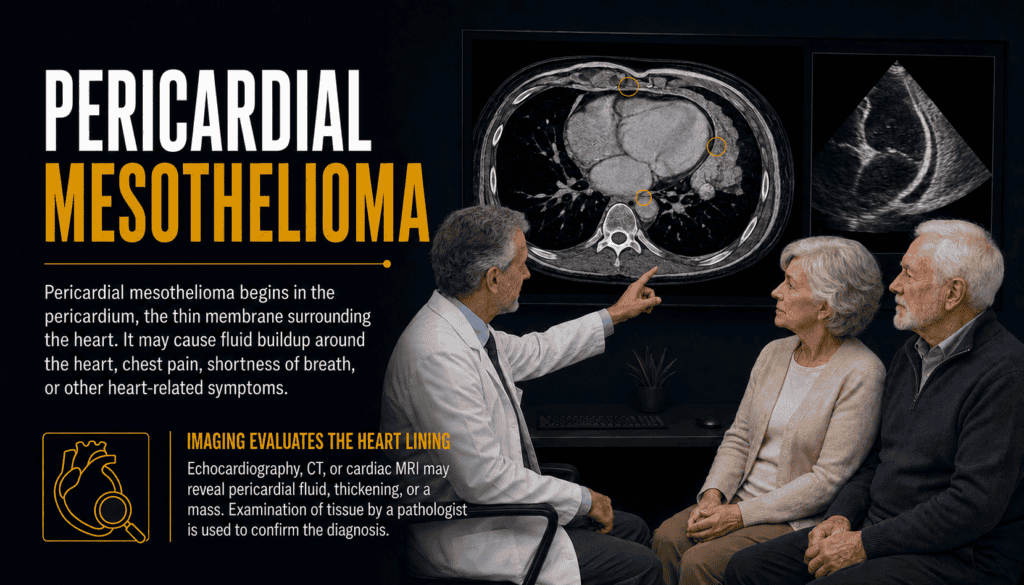
Pericardial Mesothelioma
Symptoms, Heart Complications, Diagnosis, Treatment and Prognosis
Pericardial mesothelioma is an exceptionally rare cancer that begins in the pericardium, the membrane surrounding the heart. Tumor growth, pericardial thickening and fluid accumulation can restrict the heart and cause symptoms that resemble more common cardiac conditions.
Diagnosis usually requires advanced heart imaging and examination of tumor tissue by an experienced pathologist. Because so few cases have been documented, there is no single universally accepted staging system or standard treatment plan. Care should be coordinated by specialists familiar with cardiac tumors and mesothelioma.
🫀 What Is Pericardial Mesothelioma?
The pericardium is a flexible, double-layered sac that surrounds the heart. A small amount of fluid between its layers normally reduces friction as the heart beats. Primary pericardial mesothelioma develops from mesothelial cells in this membrane rather than spreading there from a cancer that began elsewhere.
Pericardial disease is one of the rare anatomical types of mesothelioma. It differs from pleural mesothelioma, which begins around the lungs, and peritoneal mesothelioma, which develops in the abdominal lining.
| Feature | Pericardial mesothelioma | Why it matters |
|---|---|---|
| Site of origin | The pericardial membrane surrounding the heart | Symptoms and complications are often cardiac rather than respiratory or abdominal. |
| Rarity | Only a small number of cases have been described in medical literature | Evidence comes largely from case reports and retrospective series rather than large trials. |
| Common effects | Pericardial effusion, thickening, constriction or a mass around the heart | These changes can interfere with the heart’s ability to fill and pump normally. |
| Confirmation | Tissue biopsy with histology and immunohistochemistry | Imaging and fluid testing alone may not establish the diagnosis. |
| Treatment planning | Individualized multidisciplinary evaluation | There is no universally accepted treatment protocol specific to this rare cancer. |
A tumor involving the pericardium is not automatically pericardial mesothelioma. Other cancers can spread to the pericardium, and several noncancerous conditions can cause pericardial fluid or inflammation. The primary site and pathology must be established carefully.
⚠️ Pericardial Mesothelioma Symptoms and Warning Signs
Symptoms are often nonspecific and may resemble pericarditis, heart failure, coronary disease, infection or another cardiac problem. Some people first seek care because of shortness of breath or chest discomfort; others present with recurrent fluid around the heart.
| Possible symptom | How it may appear | Possible explanation |
|---|---|---|
| Shortness of breath | Breathing difficulty during activity, at rest or when lying flat | Fluid, constriction or reduced cardiac filling may contribute. |
| Chest pain or pressure | Aching, heaviness, tightness or discomfort that may change with position | Pericardial irritation or impaired heart function can cause pain, but urgent causes must also be excluded. |
| Heart palpitations | A racing, pounding, fluttering or irregular heartbeat | Pressure, inflammation or involvement of nearby structures may affect heart rhythm. |
| Persistent cough | A dry or unexplained cough | Cardiac effects, nearby chest involvement or another condition may be responsible. |
| Fatigue and weakness | Unusual exhaustion or reduced ability to complete normal activities | Reduced cardiac output, cancer, anemia or poor nutrition may contribute. |
| Leg, ankle or abdominal swelling | New fluid retention or tightness in shoes and clothing | Restricted heart function may cause venous congestion. |
| Dizziness or fainting | Lightheadedness, near-fainting or loss of consciousness | These symptoms may indicate reduced blood flow and require prompt evaluation. |
| Fever, night sweats or weight loss | General symptoms without another clear explanation | These can occur with cancer but are not specific to mesothelioma. |
These symptoms cannot diagnose pericardial mesothelioma. Anyone experiencing new chest pain, breathing difficulty, fainting or rapidly worsening symptoms needs medical evaluation rather than trying to determine the cause at home. The broader mesothelioma symptoms guide explains how signs differ according to tumor location.
🚨 Pericardial Effusion, Cardiac Tamponade and Other Complications
Pericardial mesothelioma can cause fluid to accumulate between the pericardial layers. This is called a pericardial effusion. A small or slowly developing effusion may cause few symptoms, while a rapidly growing or large effusion can compress the heart.
Cardiac tamponade occurs when pressure from pericardial fluid prevents the heart from filling and pumping enough blood. It is a medical emergency. The disease can also produce constrictive pericarditis, in which thickened or scarred pericardial tissue restricts normal heart movement.
| Complication | What happens | Possible management |
|---|---|---|
| Pericardial effusion | Fluid collects around the heart | Monitoring, pericardiocentesis, a drainage catheter or a surgical pericardial window may be considered. |
| Cardiac tamponade | Fluid pressure severely limits heart filling and circulation | Emergency drainage and stabilization are generally required. |
| Constrictive pericarditis | A stiff or thickened pericardium restricts the heart | Specialists may consider symptom management or pericardial surgery depending on the cause and extent. |
| Arrhythmia | The heart beats too fast, too slowly or irregularly | Monitoring and treatment depend on the rhythm and its effect on circulation. |
| Heart failure symptoms | Reduced cardiac function causes breathlessness, fatigue or fluid retention | Management may involve drainage, medication and cancer-directed or supportive care. |
🧱 Causes, Asbestos Exposure and Risk-Factor Questions
Asbestos exposure is the major established cause of pleural mesothelioma and an important risk factor for mesothelioma overall. However, the relationship between asbestos and primary pericardial mesothelioma remains uncertain and debated. The cancer is so rare that researchers have not been able to establish its causes with the same confidence available for pleural disease.
Some reported patients had occupational or environmental asbestos exposure, while many did not have a documented history. An exposure history is still worth collecting because it may be medically and legally relevant, but it should not be presented as proof that asbestos caused an individual pericardial tumor.
Information worth documenting
- Past occupations, military service and worksites
- Work around insulation, boilers, pipes, gaskets, brakes, cement products or demolition
- Dust brought home on work clothes, shoes or tools
- Older homes, schools or buildings where asbestos-containing materials were disturbed
- Prior chest radiation or other major medical exposures
- Family medical history and any previous cancers
🔬 How Pericardial Mesothelioma Is Diagnosed
Diagnosis often begins with evaluation of chest pain, shortness of breath, pericardial effusion or abnormal heart function. Because more common diseases can produce the same findings, clinicians generally use several imaging methods and obtain tissue whenever safely possible.
| Diagnostic step | What it can show | Important limitation or next step |
|---|---|---|
| Medical history and examination | Symptoms, heart findings, fluid retention, previous cancer and possible exposures | History guides testing but cannot identify the tumor type. |
| Electrocardiogram | Heart rhythm and electrical changes that may accompany effusion or cardiac strain | Findings are not specific to mesothelioma. |
| Echocardiogram | Pericardial fluid, heart compression, impaired filling and sometimes a mass | It evaluates heart function well but may not define the full tumor extent. |
| CT scan | Pericardial thickening, nodules, masses, fluid and possible chest involvement | Imaging can raise suspicion but usually cannot confirm histology. |
| Cardiac MRI | Detailed soft-tissue information and the relationship between a mass, heart and nearby structures | Use depends on stability, implanted devices and the clinical question. |
| PET/CT | Metabolically active disease and possible spread in selected patients | Inflammation can also be active, so results must be interpreted with other findings. |
| Pericardial fluid testing | Fluid characteristics, infection testing and sometimes malignant cells | Cytology may be negative or inconclusive even when a tumor is present. |
| Tissue biopsy | Tumor architecture and cells for histology, immunohistochemistry and additional testing | Obtaining tissue near the heart requires careful procedural planning. |
Pathologists use tissue appearance and a panel of immunohistochemical markers to support mesothelioma and exclude metastatic carcinoma, angiosarcoma, synovial sarcoma and other tumors. Adequate tissue and review by a pathologist experienced with mesothelial and cardiac tumors can be critical.
Ask whether the diagnosis is primary pericardial mesothelioma, whether another primary cancer has been excluded, what cell type was identified and whether specialist pathology review is recommended.
🧬 Cell Types, Disease Extent and Staging
Pericardial mesothelioma may show epithelioid, sarcomatoid or biphasic patterns. The pathology report may also describe more specific microscopic features. Cell type can affect how aggressively the tumor behaves and which diagnoses must be excluded.
| Cell pattern | General description | Clinical importance |
|---|---|---|
| Epithelioid | Cells may form tubules, papillary structures or other organized patterns | Can resemble metastatic adenocarcinoma, making immunohistochemistry important. |
| Sarcomatoid | Spindle-shaped cells with a connective-tissue-like appearance | Can resemble other primary cardiac sarcomas and may behave aggressively. |
| Biphasic | Contains both epithelioid and sarcomatoid components | An adequate tissue sample is needed to identify both components. |
There is no universally accepted stage 1–4 system specifically validated for primary pericardial mesothelioma. Specialists instead assess where the tumor is located, whether it encases or invades the heart and major vessels, whether complete removal appears possible, and whether disease has reached lymph nodes or distant organs.
General information about mesothelioma staging can help patients understand common cancer terms, but the treating team should explain how it is describing this particular disease. If distant spread is documented, the care team may also discuss metastatic mesothelioma.
💊 Pericardial Mesothelioma Treatment Options
There is no single standard treatment supported by large clinical trials. The plan depends on tumor location, invasion of heart structures, spread outside the pericardium, cell type, symptoms, heart function, overall health and the patient’s goals. Reported approaches include surgery, systemic therapy, radiation in selected circumstances and procedures to relieve fluid or pressure.
Surgery
When disease appears localized and the patient can tolerate an operation, a specialized cardiac or thoracic surgical team may consider removing visible tumor and part or all of the involved pericardium. Complete removal is often difficult because the tumor may surround or invade the heart, coronary vessels, major veins or other critical structures.
Surgery may also be performed to establish a diagnosis, create a pericardial window, drain fluid or relieve constriction even when all cancer cannot be removed. The expected goal—diagnostic, symptom-relieving or tumor-directed—should be clear before the procedure.
Systemic treatment
Clinicians may consider chemotherapy regimens used for other mesothelioma sites, such as pemetrexed with cisplatin or carboplatin. Evidence for primary pericardial disease is limited, so treatment is commonly based on individual case factors and extrapolation from other forms of mesothelioma.
Immunotherapy, targeted therapy or other drugs may be considered in selected circumstances, particularly through a clinical trial or after molecular testing. A drug approved for pleural mesothelioma is not automatically proven to have the same benefit for a primary pericardial tumor.
Radiation and supportive care
Radiation may be considered for selected localized problems or symptom relief, but protecting the heart and nearby organs limits how it can be delivered. Supportive and palliative care can be provided alongside cancer-directed treatment and may include:
- Drainage of recurrent pericardial fluid
- Treatment for pain, breathlessness, cough, nausea or fatigue
- Management of arrhythmias, edema or heart-failure symptoms
- Nutrition, rehabilitation and activity guidance
- Emotional support for the patient and caregivers
- Advance-care planning based on the patient’s wishes
The broader mesothelioma treatment guide explains common treatment categories, but every recommendation must be evaluated for this rare cardiac location.
📊 Prognosis, Specialist Care and Family Support
Pericardial mesothelioma is generally aggressive and often discovered after it has affected critical heart structures. However, published survival figures come from small, highly varied case collections and cannot predict an individual outcome. Some patients have localized disease that can be treated more extensively, while others are too ill for major surgery or have disease that cannot be removed safely.
| Factor | Why it may affect the outlook |
|---|---|
| Timing of diagnosis | Earlier recognition may allow more treatment choices before major cardiac compromise develops. |
| Tumor location and invasion | Involvement of the heart muscle, coronary vessels or major veins can limit surgery. |
| Disease spread | Localized disease may offer different options than lymph-node or distant spread. |
| Cell type | Histology may influence tumor behavior and treatment response. |
| Heart function and overall health | Cardiac reserve, nutrition and other illnesses affect treatment safety. |
| Response to treatment | Symptoms, imaging and heart-function testing help show whether treatment is helping. |
A second opinion is reasonable because diagnosis and treatment are unusually complex. The ideal review may include a cardiac tumor team, medical oncologist, cardiothoracic surgeon, cardio-oncology specialist, radiologist and pathologist experienced with mesothelioma.
Records to gather for a specialist review
- Pathology report, biopsy slides and tissue-block information
- Echocardiogram reports and image files
- CT, MRI and PET images with radiology reports
- Pericardial-fluid testing and procedure reports
- Operative notes and hospital discharge summaries
- Medication list, cardiac history and prior cancer treatments
- A concise occupational, military and possible asbestos-exposure history
Patients and caregivers can also use mesothelioma support resources to prepare questions, organize practical help and locate emotional support.
❓ Frequently Asked Questions
Where does pericardial mesothelioma develop?
It begins in the pericardium, the membrane surrounding the heart. It is different from a cancer that started elsewhere and later spread to the pericardium.
What symptoms can pericardial mesothelioma cause?
Possible symptoms include shortness of breath, chest pain or pressure, palpitations, cough, fatigue, swelling, dizziness and fainting. These symptoms have many more common causes and require medical evaluation.
Is pericardial mesothelioma caused by asbestos?
The relationship is not firmly established. Some patients have documented asbestos exposure, but many do not. Because the cancer is exceptionally rare, available research has not shown the same clear causal relationship established for pleural mesothelioma.
Can pericardial-fluid testing confirm the diagnosis?
Sometimes malignant cells are detected, but fluid cytology may be negative or inconclusive. A tissue biopsy with specialist pathology review is generally more reliable for confirming the tumor type.
What is cardiac tamponade?
Cardiac tamponade is dangerous pressure on the heart caused by fluid in the pericardial sac. It can prevent the heart from filling and pumping normally and requires emergency medical treatment.
Is there a standard treatment for pericardial mesothelioma?
No single standard has been established through large clinical trials. Specialists may consider surgery, chemotherapy, radiation in selected situations, fluid-control procedures and supportive care based on the individual case.
Does pericardial mesothelioma have stages 1 through 4?
There is no universally accepted stage 1–4 system specifically validated for this disease. Doctors often describe the tumor’s location, invasion, resectability, lymph-node involvement and distant spread.
Should a patient obtain a second opinion?
A second opinion is often valuable because both diagnosis and treatment are highly specialized. Ask for review by clinicians and pathologists experienced with cardiac tumors and mesothelioma.
📚 Authoritative Medical Sources
- Centers for Disease Control and Prevention: Mesothelioma Basics
- National Cancer Institute: Types of Cancer Treatment
- PubMed: Treatment and Outcomes of Primary Pericardial Mesothelioma
- PubMed Central: Primary Malignant Pericardial Mesothelioma—Case Report
- PubMed Central: Primary Malignant Pericardial Mesothelioma With Prolonged Survival
- ClinicalTrials.gov: Search Current Mesothelioma Studies
📞 Get Help After a Mesothelioma Diagnosis
Call 800.291.0963. Live chat is available 24 hours a day, 7 days a week, 365 days a year.
Submit Your Case
⚕️ Medical and Legal Information Disclaimer
This page provides general educational information and is not medical or legal advice. Symptoms, diagnosis, treatment eligibility and outcomes vary. Consult qualified medical professionals about care and a licensed attorney about legal questions.