Mesothelioma Doctors: How to Find Specialists and Choose a Care Team
A practical guide to specialist roles, referrals, second opinions, and questions to ask before treatment.
Mesothelioma is an uncommon cancer. Finding a physician who treats this disease—and a coordinated team that can review your pathology, scans, health, and goals—can help you understand the options available in your situation. There is no single doctor who is right for every patient: the appropriate expertise depends on where the cancer began, its cell type and extent, your health, and your preferences.
What Does a Mesothelioma Doctor Do?
A mesothelioma doctor may diagnose cancer, interpret test results, deliver treatment, manage symptoms, or coordinate several specialists. Start by asking who will be your primary contact and which clinician has experience treating your particular form of mesothelioma. A doctor with broad oncology expertise may work with a mesothelioma-focused team at another institution.
Before comparing clinicians, confirm the diagnosis and disease location. Explore mesothelioma diagnosis and learn about second opinions.
| Your need | A useful first step |
|---|---|
| New or uncertain diagnosis | Request review of the biopsy and pathology report. |
| Treatment decision | Ask for a multidisciplinary review of imaging and treatment options. |
| Symptoms affecting daily life | Request symptom-management and supportive-care expertise. |
| Unclear next step | Ask your current doctor for a specific referral and timeline. |
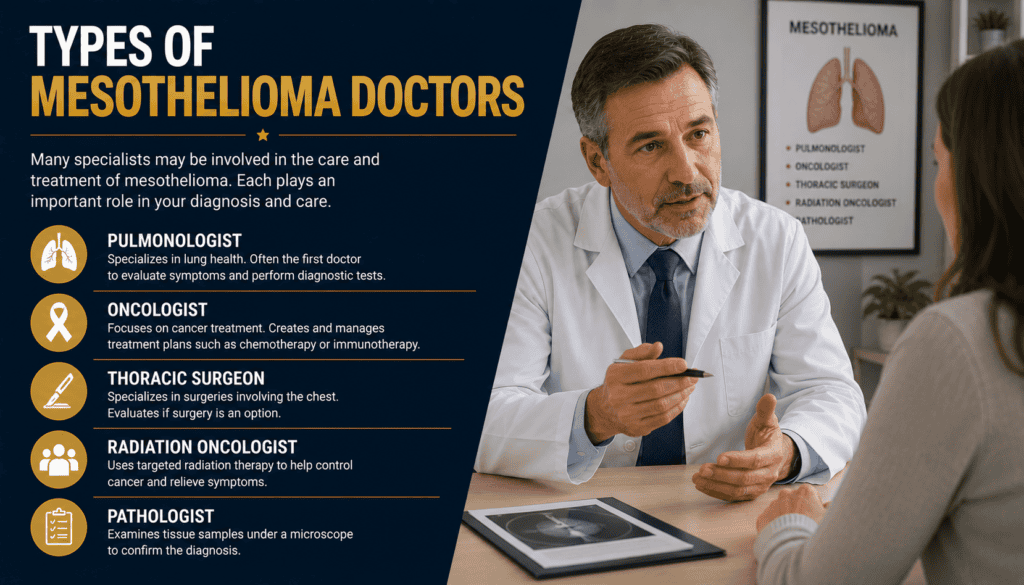
Types of Mesothelioma Specialists
Different physicians contribute different expertise. Titles alone do not establish mesothelioma experience, and not every patient needs every specialist. Ask what role each doctor would play in your case.
| Specialist | Typical role | Question to ask |
|---|---|---|
| Medical oncologist | Plans and manages drug treatments and monitors response. | How often do you treat mesothelioma? |
| Thoracic surgeon | Evaluates selected patients with chest disease for procedures or surgery. | What are the likely benefits and risks for my situation? |
| Surgical oncologist / abdominal cancer surgeon | Assesses selected patients with abdominal disease. | Do you evaluate peritoneal mesothelioma specifically? |
| Radiation oncologist | Assesses radiation for selected treatment or symptom-control goals. | What benefit is expected and what tissue is at risk? |
| Pathologist | Examines tissue and performs tests to establish the diagnosis and cell type. | Has a mesothelioma-experienced pathologist reviewed the slides? |
| Pulmonologist | Evaluates breathing problems, pleural fluid, and lung function. | How can symptoms be assessed and relieved? |
Some centers offer mesothelioma-specific programs, while others coordinate care across thoracic, abdominal, and oncology services. For information about available treatments, see mesothelioma treatments.
Why a Multidisciplinary Care Team Matters
Mesothelioma decisions may involve pathology, imaging, surgery, systemic treatment, radiation, and supportive care. A multidisciplinary team can discuss these perspectives together, especially when a diagnosis is uncertain or a major procedure is being considered. Ask whether your case will be discussed at a tumor board, who participates, and how the recommendation will be shared with you.
| Team member | How they may help |
|---|---|
| Oncology nurse or navigator | Explains scheduling, treatment education, and contact pathways. |
| Palliative-care clinician | Treats pain, breathlessness, fatigue, and other burdens alongside cancer-directed care. |
| Social worker | Helps identify transportation, lodging, caregiver, and financial resources. |
| Dietitian | Addresses nutrition challenges and weight changes. |
| Clinical-trial coordinator | Explains screening steps and study logistics when a trial is appropriate. |
Palliative care is supportive care and does not automatically mean stopping cancer treatment. Ask for it whenever symptoms or treatment side effects are difficult.
How to Find a Mesothelioma Doctor or Cancer Center
Ask your primary care physician or current oncologist for a referral to a team that treats mesothelioma. The National Cancer Institute offers a directory of NCI-designated cancer centers and guidance on finding cancer care. NCI designation recognizes a center’s research program; it does not by itself prove that an individual physician has extensive mesothelioma experience. Confirm that the center treats your disease type and accepts new patients.
| Where to look | What to verify |
|---|---|
| Your existing medical team | Referral name, specialty, urgency, and record-transfer process. |
| NCI cancer-center directory | Clinical services for mesothelioma, rather than designation alone. |
| Hospital specialist clinic | Experience with pleural or peritoneal disease as appropriate. |
| Insurance directory | Network status, prior authorization, and out-of-network options. |
| Clinical trial resources | Eligibility and travel requirements; enrollment is never guaranteed. |
A local oncologist and a distant specialist may be able to coordinate some care. Ask both offices what can be performed close to home and what requires travel.
How to Evaluate Credentials and Experience
Board certification, relevant specialty training, hospital privileges, and experience with mesothelioma are useful topics to discuss. There is no universal patient-facing score that identifies the best doctor. Rather than relying on marketing claims or an unsupported ranking, ask concrete questions about the physician’s role and the center’s approach.
| Question | Why it matters |
|---|---|
| Do you regularly evaluate patients with my type of mesothelioma? | Experience should match pleural or peritoneal disease and the decision at hand. |
| Will my pathology be reviewed by an experienced pathologist? | A confirmed diagnosis guides subsequent decisions. |
| Will the team review my scans and discuss options together? | Helps clarify the rationale for a proposed plan. |
| What alternatives and clinical trials should I consider? | Makes the discussion broader than one proposed treatment. |
| What outcomes and complications can you discuss for patients like me? | Supports informed consent without promising a result. |
| Who responds to urgent symptoms or treatment problems? | Clarifies practical access to care. |
Ask for a plain-language explanation of expected benefits, side effects, and uncertainty. A clinician should be able to explain why a treatment is—or is not—appropriate for you.
Referrals, Pathology Reviews, and Second Opinions
A second opinion can confirm the diagnosis or offer a different interpretation of the treatment choices. The NCI advises sharing medical results, pathology slides, and scans with the reviewing doctor. Ask your current team to help transfer the actual images and tissue materials, not only written summaries. Keep treatment timing in mind: discuss with your current doctor whether any planned care should proceed while a consultation is arranged.
| Record | Why the receiving team may request it |
|---|---|
| Pathology report and slides or tissue blocks | Review of diagnosis and cell type. |
| CT, PET/CT, or MRI images and reports | Independent assessment of disease extent. |
| Operative and procedure reports | Details of previous biopsies or treatment. |
| Medication and treatment history | Safety and sequencing decisions. |
| Recent labs and functional assessments | Evaluation of overall health and treatment tolerance. |
See collecting medical records and getting a mesothelioma second opinion.
Need help now? Call 800.291.0963 / Live chat available 24/7, 365 days a year / Submit Your Case.
How to Prepare for Your First Specialist Appointment
Bring a written timeline of symptoms, test dates, previous treatments, other medical conditions, medications, and your most important questions. If helpful, invite someone to take notes. Ask permission before recording the visit. Make sure you know who will communicate the next steps and when you should expect a decision.
| Ask the doctor | What to listen for |
|---|---|
| Is my diagnosis confirmed? | Whether additional pathology review or biopsy is needed. |
| Where did the cancer start and how extensive is it? | Clear explanation of findings and remaining uncertainty. |
| What treatment options fit my goals and health? | Benefits, risks, alternatives, and supportive care. |
| Do I need a surgical evaluation? | Reason for or against referral, not an assumption that surgery is appropriate. |
| Could a clinical trial be relevant? | Eligibility, alternatives, and travel considerations. |
| When should I call urgently? | Specific symptom warnings and an after-hours contact. |
For a deeper overview of test results, read understanding your mesothelioma diagnosis.
Insurance, Travel, and Access to Care
Confirm that the specialist, hospital, imaging center, and proposed treatment are covered separately. Ask whether you need a referral, prior authorization, or a formal out-of-network exception. A hospital social worker or patient navigator may help identify transportation, lodging, and financial-assistance resources. Programs differ by institution and eligibility, so do not assume assistance or coverage is guaranteed.
| Barrier | Practical action |
|---|---|
| Long wait for consultation | Tell both offices about your diagnosis and ask about cancellation lists or triage. |
| Travel distance | Ask which visits can be virtual and which tests can be done locally. |
| Insurance uncertainty | Request network and authorization details in writing. |
| Record transfer delays | Identify the records department and confirm receipt of images and slides. |
| Cost concerns | Request an estimate and speak with a financial counselor before nonurgent services. |
For additional steps, see mesothelioma referrals and access to care and financial planning after diagnosis.
Frequently Asked Questions
What kind of doctor treats mesothelioma?
A medical oncologist commonly coordinates drug treatment, but care may also involve surgeons, pathologists, pulmonologists, radiation oncologists, and supportive-care specialists. The team depends on your disease and needs.
Should I see a mesothelioma specialist instead of my local oncologist?
You can ask whether a specialist consultation would clarify diagnosis or treatment while your local oncologist remains involved. The best arrangement depends on your circumstances and access.
How can I tell whether a doctor has mesothelioma experience?
Ask how frequently they evaluate your disease type, which colleagues participate in decisions, and whether pathology and imaging receive specialist review. Credentials alone do not answer every question.
Do I need a referral?
Referral and authorization requirements vary by insurance plan and clinic. Call the specialist office and insurer before scheduling.
Can I request a second opinion before treatment?
Yes. Discuss the timing with your treating doctor, particularly if care is urgent. A second-opinion team may request pathology slides, scans, and prior records.
Does an NCI-designated center guarantee mesothelioma expertise?
No. NCI designation reflects cancer-center research standards. Confirm that the specific clinical program and physician treat your form of mesothelioma.
Can a mesothelioma doctor see me by telehealth?
Some consultations may be virtual, but availability, licensing, insurance rules, and the need for examination or testing vary. Ask the clinic what can be completed remotely.
What if I cannot afford to travel?
Ask the cancer center about navigation, social work, financial counseling, lodging resources, and shared care with a local oncology team. Assistance depends on availability and eligibility.
Confirmed Medical Sources and Related Reading
- NCI: Finding Cancer Care
- NCI: Find a Cancer Center
- NCI: Mesothelioma Diagnosis and Prognosis
- NCI: Mesothelioma Treatment
- NCI: Questions to Ask Your Doctor
Related: Diagnosis overview · Treatment options · Second opinions.
Speak With Mesothelioma Help Center
Call 800.291.0963. Live chat is available 24/7, 365 days a year. Submit Your Case.
Our team can discuss your request for information and available next steps. Contacting us does not guarantee a medical referral, legal representation, compensation, or a particular outcome.
⚕️ Legal & Medical Information Disclaimer
This page provides general information, not individualized medical or legal advice. Consult licensed medical professionals for diagnosis and treatment and qualified legal counsel for legal questions. Services, eligibility, and insurance coverage vary.