Extrapleural Pneumonectomy (EPP) for Mesothelioma: Surgery, Risks and Recovery
A patient-focused guide to an extensive operation for pleural mesothelioma, including important limits in the evidence.
Extrapleural pneumonectomy (EPP) is an unusually extensive operation that removes the affected lung and nearby tissue in an effort to remove visible pleural mesothelioma. It is not routine treatment. Because the procedure carries substantial risks and its survival benefit remains uncertain, decisions should involve a specialist multidisciplinary team and an informed discussion of non-surgical options. The National Cancer Institute and updated American Society of Clinical Oncology (ASCO) guidance describe EPP as a consideration only for highly selected patients. NCI treatment evidence; ASCO guideline update.
What Is Extrapleural Pneumonectomy?
Pleural mesothelioma begins in the lining around the lung. Because the cancer often spreads over broad pleural surfaces rather than forming one neatly separated mass, removing every microscopic cancer cell is difficult. EPP is a type of maximal surgical cytoreduction: surgeons attempt to remove all visible tumor by removing the lung and involved surrounding structures together. This does not mean that the disease is cured or that surgery will extend life.
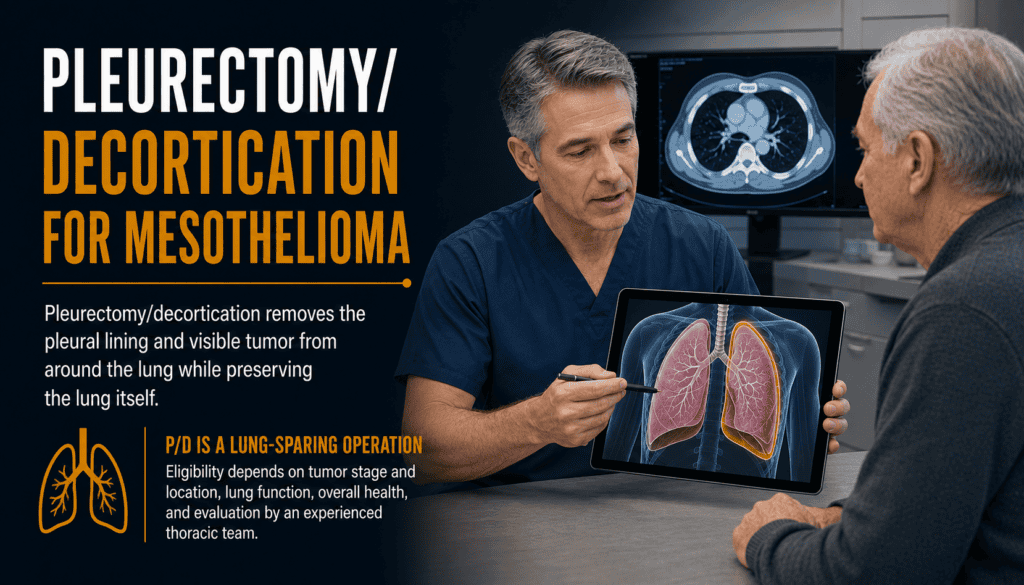
EPP is different from a standard pneumonectomy performed for some lung cancers. The operation removes more than the lung because mesothelioma affects the pleura. It is also different from lung-sparing pleurectomy/decortication (P/D).
| Term | Meaning | Why it matters |
|---|---|---|
| EPP | Removal of the affected lung plus pleura and other involved tissues. | Major loss of lung capacity and substantial perioperative risk. |
| Cytoreduction | Attempt to remove all cancer visible to the surgeon. | Microscopic cancer may remain. |
| Multimodality treatment | A plan combining different treatments when appropriate. | Additional treatment is not automatic; risks and benefit require individual review. |
What Does EPP Remove?
The exact extent depends on anatomy and the surgical plan. EPP generally removes the lung on the affected side, its pleural coverings, and portions of the diaphragm and pericardium (the sac surrounding the heart). Surgeons may reconstruct the diaphragm and pericardium using surgical patches. The other lung remains in place.
| Structure | Typical EPP approach | Patient question |
|---|---|---|
| Affected lung | Removed in full. | How well can my remaining lung support daily activity? |
| Parietal and visceral pleura | Removed with the specimen to address visible pleural tumor. | Is the disease confined enough for surgery to be considered? |
| Diaphragm on affected side | A portion may be removed and reconstructed. | Will reconstruction change breathing or mobility? |
| Pericardium | A portion may be removed and reconstructed. | What heart-related complications should I understand? |
Ask the surgeon to draw or show an image of the planned resection. The surgical report, not a generic description, documents what was actually removed.
Who May Be Considered for EPP?
Being technically able to remove a tumor is not enough to justify EPP. The 2025 ASCO guideline update advises against routinely offering cytoreductive surgery based on anatomic resectability alone. It limits consideration to highly selected people with favorable features, such as clinical early-stage epithelioid tumors, and states that EPP should be performed only in experienced centers when offered. Read the guideline recommendations.
| Assessment | What the team considers |
|---|---|
| Pathology | Confirm mesothelioma subtype; histology affects whether radical surgery is appropriate. |
| Stage and spread | Assess chest disease, lymph nodes and any cancer outside the chest. |
| Heart and lung function | Determine whether the remaining lung and heart can tolerate the operation. |
| General health and priorities | Review frailty, other conditions, quality-of-life goals and patient preferences. |
A patient who is not offered EPP has not necessarily run out of treatment options. Systemic therapy and symptom-focused care can remain appropriate. Consider a second opinion at a center experienced in pleural mesothelioma before deciding.
Tests and Preparation Before Surgery
Preoperative assessment can involve a pathology review, chest imaging, staging studies, pulmonary-function testing, assessment of how well the remaining lung will work, cardiac evaluation, nutritional screening and an anesthesia consultation. The exact tests vary. Patients should bring an up-to-date medication list and tell clinicians about blood thinners, supplements, prior chemotherapy or radiation, oxygen use and existing heart or lung disease.
| Before surgery | Practical action |
|---|---|
| Specialist review | Ask whether the case was discussed by thoracic surgery, medical oncology, radiation oncology and supportive-care clinicians. |
| Risk discussion | Request individualized estimates of death, serious complications and expected functional change. |
| Home arrangements | Plan transportation, help with meals, mobility and follow-up visits. |
| Treatment alternatives | Ask what would happen with systemic therapy or a lung-sparing approach instead. |
Do not stop prescribed medicines, start exercise programs or change oxygen settings without instructions from your own clinical team.
What Happens During the Operation?
EPP is performed under general anesthesia by a specialist thoracic surgical team. The team accesses the affected side of the chest, removes the lung and involved pleural tissue, assesses adjacent structures, and reconstructs the diaphragm or pericardium as needed. Patients then require close monitoring, often initially in a high-acuity unit. Exact surgical steps, drains and length of stay depend on the individual case and complications.
| Phase | What to expect |
|---|---|
| Day of surgery | Anesthesia, major chest operation and close monitoring afterward. |
| Early postoperative period | Pain control, breathing support as needed, monitoring for bleeding and heart rhythm problems. |
| Before discharge | Mobility assessment, wound care teaching, medication review and an individualized activity plan. |
Ask in advance who will call the family after surgery, how updates will be communicated and what circumstances might change the planned operation.
Risks, Evidence and Outcomes
EPP is high-risk surgery. Possible complications include bleeding, infection, pneumonia, blood clots, heart rhythm disturbances, respiratory failure, problems with reconstructed tissues and death around the time of surgery. Patients may experience lasting shortness of breath or reduced exercise tolerance. The NCI notes substantial variability in published operative mortality estimates, which are not an individual prediction. NCI evidence review.
Evidence does not establish that EPP improves overall survival for most patients. A small 2011 randomized feasibility study raised concerns about harm from EPP but was not designed to settle every patient-selection question. The 2024 MARS 2 randomized trial examined extended P/D, not EPP; it found worse survival and more serious adverse events with that lung-sparing operation plus chemotherapy than with chemotherapy alone. Those results should not be misrepresented as a direct EPP trial, but they reinforce the need to scrutinize claims about major cytoreductive surgery. MARS EPP study; MARS 2 trial.
| Question | Evidence-aware answer |
|---|---|
| Does EPP cure mesothelioma? | No cure can be promised; microscopic disease may remain. |
| Is survival benefit proven? | A reliable overall-survival advantage has not been established for most patients. |
| Are surgical results comparable across hospitals? | No; case selection and center experience affect reported outcomes. |
| Does MARS 2 directly test EPP? | No. It tested extended P/D plus chemotherapy against chemotherapy alone. |
Hospital Recovery and Life With One Lung
Recovery involves healing from major surgery while adapting to one lung. Some people require supplemental oxygen, pulmonary rehabilitation or additional assistance at home; others do not. Recovery speed depends on baseline fitness, complications, other treatments and personal circumstances. Patients should receive a written plan for pain medicines, activity, wound care, breathing exercises if prescribed, and follow-up.
| Issue | Home plan or warning |
|---|---|
| Breathlessness | Follow the individualized breathing and activity plan; report worsening symptoms. |
| Pain | Take medications as prescribed and discuss uncontrolled pain promptly. |
| Mobility | Increase activity only as directed; request rehabilitation support when appropriate. |
| Emergency symptoms | Call emergency services for sudden severe breathlessness, chest pain, fainting or other severe acute symptoms. |
Fever, new wound drainage, a rapidly worsening cough, new leg swelling or inability to manage at home warrants prompt contact with the surgical team. Do not assume new breathing symptoms are simply normal recovery. For broader rehabilitation information, see breathing therapy and long-term lung health and recovery after mesothelioma treatment.
EPP Versus Other Treatment Options
The central decision is not simply EPP versus doing nothing. Patients should compare the realistic goals, burdens and uncertainties of each approach with a specialist team. Lung-sparing P/D still involves major surgery and does not automatically confer a survival benefit. Systemic treatments may include chemotherapy or immunotherapy, depending on disease features and current approvals. Symptom-focused procedures can help with pleural fluid and discomfort without attempting radical tumor removal.
| Option | Primary distinction | Discussion point |
|---|---|---|
| EPP | Removes affected lung and adjacent tissues. | High operative risk and permanent loss of one lung. |
| P/D or extended P/D | Attempts tumor removal while preserving the lung. | Still major surgery; discuss randomized trial evidence and risks. |
| Systemic therapy | Treats cancer throughout the body with medicines. | Ask about treatment eligibility, expected benefits and side effects. |
| Pleural fluid procedures and palliative care | Aim to relieve symptoms and improve comfort. | Can be offered alongside appropriate cancer treatment. |
Read more about surgery for mesothelioma, chemotherapy expectations, immunotherapy and palliative care. A second opinion can help clarify whether a proposed operation aligns with current evidence and the patient’s priorities.
Frequently Asked Questions
What does EPP stand for?
Extrapleural pneumonectomy. It removes the lung on the affected side along with pleural tissue and often parts of the diaphragm and pericardium.
Is EPP the same as pleurectomy/decortication?
No. EPP removes the affected lung; P/D aims to remove pleural tumor while keeping the lung. Both can be major operations.
Who qualifies for EPP?
Only a small, highly selected group may be considered after detailed staging, pathology review and heart/lung assessment at an experienced center.
Can someone live with one lung?
Some people can, but breathing capacity and exercise tolerance may be reduced. The team must assess whether the remaining lung can provide adequate function.
Does EPP cure pleural mesothelioma?
No cure can be guaranteed. Visible tumor removal does not ensure microscopic cancer is gone, and survival benefit remains uncertain.
How long does recovery take?
It varies widely. Hospitalization and rehabilitation depend on complications, preoperative fitness and the care plan; ask the surgeon for an individualized estimate.
Is the MARS 2 trial about EPP?
No. MARS 2 studied extended pleurectomy/decortication and chemotherapy versus chemotherapy alone, not EPP.
What should I ask before agreeing to EPP?
Ask about the goal, alternatives, center experience, individualized risk, expected quality of life, likely follow-up treatment and what happens if you decline surgery.
Confirmed Medical Sources
- National Cancer Institute: Malignant Mesothelioma Treatment (PDQ), health professional version.
- National Cancer Institute: Mesothelioma Treatment.
- ASCO: Treatment of Pleural Mesothelioma, guideline update (2025).
- MARS randomized feasibility study of EPP (2011).
- MARS 2 randomized trial of extended P/D (2024)—not an EPP trial.
Speak With Our Team
Questions about asbestos exposure and available resources? Call 800.291.0963. Live chat is available 24/7, 365 days a year. Submit Your Case. Contacting us does not guarantee eligibility or compensation.
⚕️ Legal & Medical Information Disclaimer
This article provides general information, not medical or legal advice. Treatment choices require an individualized discussion with qualified clinicians; legal questions require advice from an appropriately licensed professional.