Herbal Medicines for Mesothelioma: Evidence, Risks and Questions to Ask
A patient-centered guide to claims, clinical evidence, supplement safety and coordinated mesothelioma care.
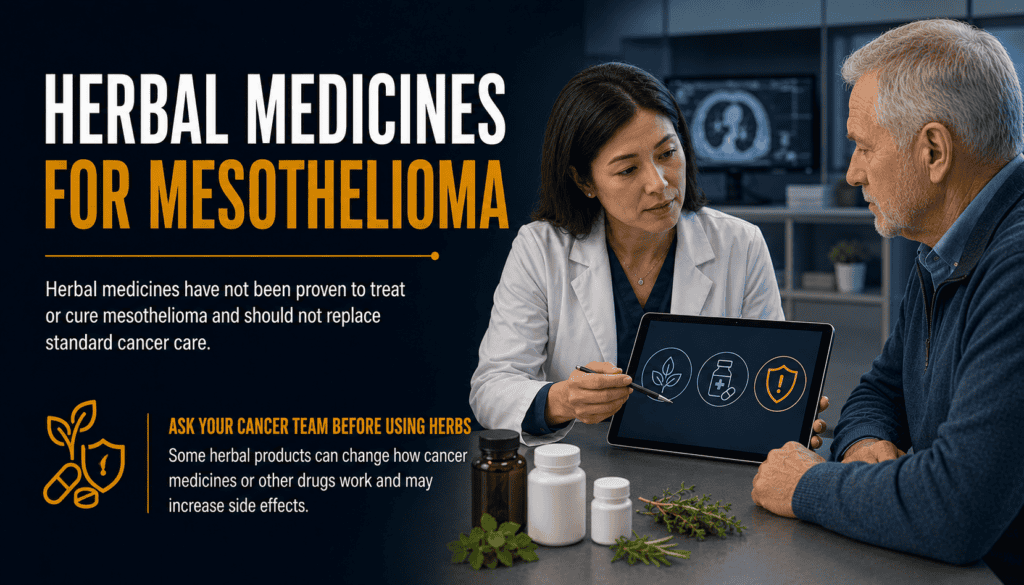
Key takeaway: No herbal medicine has been shown to cure mesothelioma, shrink its tumors, or replace established cancer treatment. Some supplements may interact with medicines or create additional health risks. Tell your oncology team about every herb, tea, extract, powder and supplement you use or plan to use.
What Herbal Medicine Can—and Cannot—Do
After a mesothelioma diagnosis, it is understandable to explore every possible way to feel better. Herbal medicine refers to preparations made from plants, including capsules, tinctures, extracts, powders and concentrated teas. The word natural does not establish that a product is safe, effective or compatible with cancer treatment.
There is an important distinction between complementary care, used alongside oncology treatment after a safety review, and alternative treatment, used in place of evidence-based care. Delaying surgery, systemic treatment or other recommended care for an unproven herbal product can eliminate time-sensitive options. See the site’s mesothelioma treatments overview for established treatment approaches.
| Claim or goal | What patients should know |
|---|---|
| Cure mesothelioma | No herb has been shown to cure mesothelioma in rigorous clinical evidence. |
| Prevent recurrence | No herbal regimen has been proven to prevent recurrence. |
| Ease symptoms | Some complementary approaches are studied for symptoms, but evidence for individual herbal products varies and is often limited. |
| Improve immunity | Broad “immune boosting” claims do not establish benefit and may matter during immunotherapy. |
What Research Actually Shows
Laboratory studies may show that a plant compound affects cancer cells in a dish. That does not demonstrate that swallowing an herb will deliver a safe, effective dose to a person with mesothelioma. Animal experiments and small studies in other cancers also cannot establish a mesothelioma survival benefit.
The National Cancer Institute reports that no special food, supplement, herb or combination has been proven to slow, cure or prevent cancer from returning. The NIH National Center for Complementary and Integrative Health likewise advises against replacing or delaying cancer care with unproven products. These findings do not mean every supportive practice is useless; they mean each claim needs evidence for its particular outcome.
| Evidence type | What it can establish | What it cannot establish |
|---|---|---|
| Cell experiment | A possible biological mechanism | Safety or tumor response in patients |
| Animal study | A hypothesis worth testing | Human benefit or correct dose |
| Uncontrolled patient report | An experience worth discussing | That the herb caused improvement |
| Well-designed human trial | Can assess defined outcomes and harms | Results beyond the patients and treatment studied |
Common Herbs and Products
Products frequently discussed online include turmeric or curcumin, ginger, green tea extracts, ginseng and multi-ingredient “immune support” formulas. None is an established treatment for mesothelioma. A spice used in ordinary food is not equivalent to a concentrated supplement; doses, absorption and contaminants may differ.
| Product | Evidence and practical caution |
|---|---|
| Turmeric / curcumin | Laboratory interest does not prove mesothelioma treatment benefit; review concentrated products with oncology staff. |
| Ginger | Research on chemotherapy-related nausea is mixed; do not substitute it for prescribed anti-nausea medication. |
| Green tea extract | Concentrated extracts differ from ordinary beverages; some products may interact with medications. |
| Ginseng | Potential drug interactions are incompletely understood; disclose the exact product and dose. |
| Multi-herb blends | Several ingredients make interactions, ingredient quality and adverse effects harder to assess. |
Beware testimonials that claim a “secret cure,” promises of guaranteed tumor shrinkage, and sellers who advise stopping prescribed medication. Request published human evidence in mesothelioma, not merely marketing materials.
Drug Interactions and Safety
Herbal products can change how medicines are absorbed, metabolized or removed. Others may affect bleeding, liver function, sedation or the interpretation of symptoms. Many proposed interactions have limited clinical evidence, so a pharmacist must evaluate the specific product and medication rather than assuming that all herbs are dangerous or safe.
| Safety issue | Why it matters | What to do |
|---|---|---|
| Drug metabolism | A supplement can increase or reduce exposure to certain medicines. | Ask an oncology pharmacist to review the full medication list. |
| Bleeding or procedures | Some supplements may affect bleeding risk or perioperative care. | Tell surgeons and procedural teams before biopsies or operations. |
| Liver injury | Some botanical products can harm the liver or complicate abnormal test results. | Report new jaundice, dark urine or persistent vomiting promptly. |
| Product quality | Actual ingredients and concentrations may vary. | Bring the bottle, label, dose and manufacturer details. |
| Treatment delay | Unproven products may displace effective care. | Do not stop or postpone treatment without discussing it with the treating team. |
For example, the NCI documents interactions involving St. John’s wort and certain anticancer drugs, but that does not establish an interaction with every mesothelioma regimen. Avoid extrapolating from a different drug to your own regimen; request an individualized review.
Need help now? Call 800.291.0963 / Live chat available 24/7, 365 days a year / Submit Your Case.
Herbs During Cancer Treatment
Mesothelioma treatment may involve immunotherapy, chemotherapy, surgery, radiation or a combination. A supplement’s risk profile depends on the specific regimen, other prescriptions, organ function and planned procedures. Never assume that an “immune stimulating” herb improves immunotherapy; the phrase is not a clinical measure of effectiveness.
| Treatment setting | Discussion to have before taking an herb |
|---|---|
| Chemotherapy | Could the product change drug exposure, worsen nausea or affect blood counts? |
| Immunotherapy | Could it confuse evaluation of new symptoms or cause organ toxicity? |
| Surgery or biopsy | Should supplements be held, and for how long, under the surgeon’s instructions? |
| Radiation therapy | Could it interfere with the care plan or cause side effects? |
| Clinical trial | Does the protocol restrict herbal or other nonprescription products? |
Do not independently stop prescribed medicines or supplements before a procedure; obtain the treating team’s specific instructions. Patients considering combined treatments can also read about multimodal therapy.
Safer Symptom-Support Options
If your goal is to control nausea, anxiety, sleep difficulties, pain or fatigue, ask your team about options with evidence for that specific symptom. A palliative care team can work alongside cancer-directed treatment; palliative care is not limited to end-of-life care. Some non-drug complementary practices, such as appropriately adapted mindfulness or relaxation, may help certain symptoms, but they also require attention to the patient’s condition.
| Concern | A safer first conversation |
|---|---|
| Nausea | Ask about prescribed antiemetics, hydration and a dietitian; discuss ginger only after medication review. |
| Pain | Request a structured pain assessment and symptom-management plan. |
| Anxiety or sleep | Discuss counseling, relaxation practices and sleep problems with the care team. |
| Poor appetite or weight loss | Ask for oncology nutrition support rather than a marketed cancer diet. |
| Shortness of breath | Seek medical assessment; fluid drainage or other treatment may be needed. |
Severe or rapidly worsening breathlessness, chest pain, fainting or confusion needs urgent medical attention. Do not attempt to manage these symptoms with herbs.
Before Taking Any Supplement
Before buying or continuing an herbal product, write down exactly what you are taking and why. Bring the packaging to the next appointment or send a clear photo through the clinic’s approved patient portal. An oncology pharmacist may be especially helpful for a complicated medication list.
| Checklist item | Information to record |
|---|---|
| Product identity | Brand, full ingredient list and manufacturer |
| Amount | Dose, frequency, formulation and start date |
| Reason | The symptom or outcome you hope to address |
| Other medicines | Prescriptions, over-the-counter medicines and other supplements |
| Treatment schedule | Upcoming infusion, surgery, radiation or clinical trial visit |
| Possible effects | New rash, bleeding, dizziness, stomach upset or other symptoms |
If a supplement was recommended by a friend, online group or practitioner, tell your doctor without embarrassment. A complete list helps the team protect you while respecting your preferences.
Questions for Your Care Team
Use the following prompts at an oncology visit. If the team cannot answer immediately, ask whether an oncology pharmacist or integrative medicine clinician can review the product before you begin it.
| Ask your clinician | Why the question helps |
|---|---|
| Is there human evidence for this herb in mesothelioma? | Separates laboratory hypotheses from clinical outcomes. |
| Could it interact with my exact drugs? | Focuses on the actual treatment regimen. |
| Could it affect surgery, blood tests or bleeding? | Identifies procedure-related risks. |
| What symptom am I trying to treat? | Opens discussion of proven symptom care. |
| What side effects should make me stop and call? | Creates a clear safety plan. |
| Can you refer me to an oncology pharmacist? | Provides specialized interaction review. |
For broader appointment preparation, see what to ask your mesothelioma doctor.
Frequently Asked Questions
Can herbal medicine cure mesothelioma?
No herbal medicine has been shown to cure mesothelioma. Do not replace or delay evidence-based oncology care with an unproven product.
Is turmeric or curcumin a proven mesothelioma treatment?
No. Laboratory interest does not establish clinical benefit for patients. Ask your care team before using concentrated curcumin supplements.
Can I drink herbal tea during chemotherapy?
It depends on the ingredients, amount and drugs you receive. Share the tea label and frequency with your oncology team.
Does natural mean an herbal product is safe?
No. Natural products can cause side effects, vary in composition and interact with prescription medicines.
Can ginger help with chemotherapy nausea?
Studies have mixed findings. Discuss ginger with your team and continue prescribed anti-nausea treatment unless your clinician changes it.
Should I stop supplements before surgery?
Tell the surgeon and anesthesiology team everything you take and follow their specific instructions about which products to stop and when.
Are herbs safe with immunotherapy?
Safety cannot be assumed. Ask your oncologist or oncology pharmacist to review the exact product and immunotherapy regimen.
Who can help check supplement interactions?
Your oncologist and oncology pharmacist can review products, medicines, procedures and other health conditions together.
Primary Medical Sources and Further Reading
- NIH NCCIH: Cancer and Complementary Health Approaches
- National Cancer Institute: Cancer Therapy Interactions With Foods and Dietary Supplements
- National Cancer Institute: Complementary and Alternative Medicine
- National Cancer Institute: Popular Diets, Supplements, and Cancer
Research summaries are updated over time. Review these sources and your individual treatment plan with a qualified clinician.
Speak With Mesothelioma Help Center
Call 800.291.0963 to discuss asbestos-exposure and legal-information questions. Live chat is available 24/7, 365 days a year. Submit Your Case to request assistance. No compensation or case outcome is guaranteed.
⚕️ Legal & Medical Information Disclaimer
This page is educational and is not medical or legal advice. Herbal products may interfere with cancer treatment; consult your oncology team before using them. A qualified attorney can advise on legal questions.