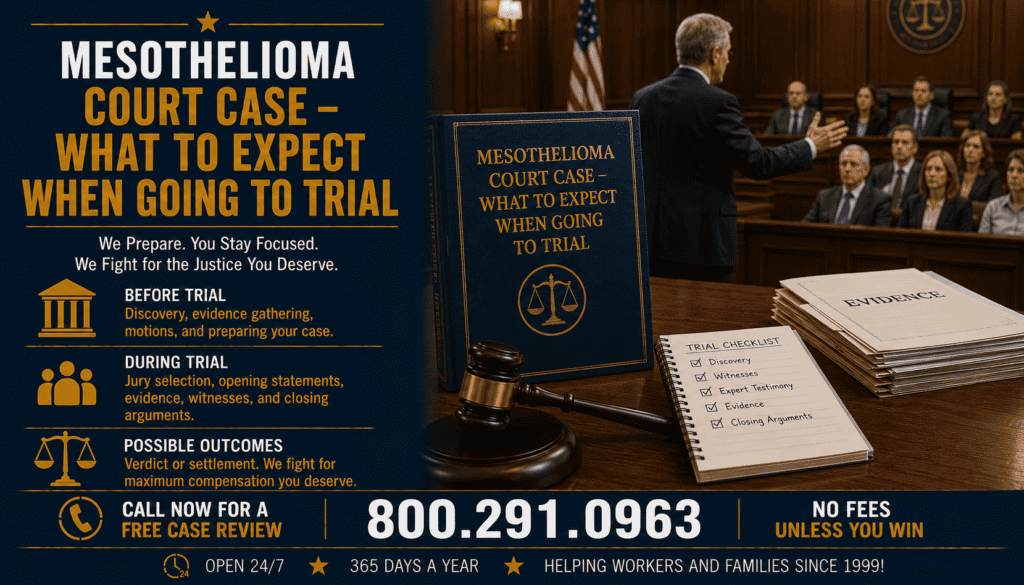
Mesothelioma Court Case
A mesothelioma court case is a civil lawsuit seeking legal relief for an asbestos-related injury. Understanding how a mesothelioma lawsuit moves from investigation and filing to discovery, settlement, or trial can help patients and families prepare records, ask informed questions, and distinguish a case evaluation from a lawsuit actually filed in court.
Each asbestos court case depends on the person’s diagnosis, exposure evidence, possible defendants, and the law of the court hearing the dispute. This guide explains common stages, including depositions, expert testimony, motions, and verdicts, while identifying practical documents to preserve and why filing deadlines and case timelines require separate, individualized review.
⚖️ What Is a Mesothelioma Court Case?
A mesothelioma court case is a civil lawsuit alleging that one or more defendants bear legal responsibility for asbestos-related injury. The complaint identifies the parties, describes the alleged harm, and requests relief. A case review or completed intake form is not a filed lawsuit. Learn the broader step-by-step claims process and lawsuit eligibility questions before assuming a particular route applies.
| Term | What it means | Important limit |
|---|---|---|
| Complaint | Document filed to begin a civil lawsuit. | Its allegations are not established findings. |
| Plaintiff | Person or authorized party bringing the action. | Authority after a death depends on law. |
| Defendant | Party against whom relief is requested. | Being named does not establish liability. |
| Docket | Court record of filings and orders. | Some records may be restricted or sealed. |
🗂️ Investigation Before a Complaint
A case review may start with a diagnosis, employment or military history, job-site dates, product information, and possible witnesses. Investigators may need to distinguish a suspected asbestos source from a documented one. The evidence and documentation hub and guide to building exposure timelines explain how records can be organized before filing.
| Record | Potential use | Limit |
|---|---|---|
| Pathology and clinical records | Document diagnosis and relevant medical history. | Do not identify a product manufacturer. |
| Payroll, union, or service records | Place a person at work or a duty station. | May not identify material handled. |
| Purchase orders and product labels | Help identify a material or supplier. | Must be tied to the relevant place and time. |
| Coworker statements | Describe tasks and nearby work. | Recollections should be checked against records. |
Preserve originals and record where each document came from. The guide to evidence preservation letters explains one possible tool for seeking retention of relevant material; it does not replace an individualized preservation plan.
📄 Filing the Complaint and Serving Defendants
In federal civil court, a plaintiff begins an action by filing a complaint and generally must serve defendants under the applicable rules. A court must have jurisdiction, and the allegations must have a legally and factually supportable basis. State-court procedures, pleading requirements, and service rules can differ. A qualified attorney can evaluate the forum and filing requirements rather than assuming a federal rule governs every asbestos lawsuit.
| Question | Why it matters |
|---|---|
| Which court? | Jurisdiction and venue affect where a case may proceed. |
| Who can file? | The injured person or a legally authorized party may differ by claim type. |
| Which defendants? | Each named party needs a supportable connection to the alleged harm. |
| Was service completed? | Filing and service are distinct procedural steps. |
🔎 Discovery and Exchange of Evidence
Discovery allows parties to request and exchange relevant information subject to governing rules and court orders. It may involve documents, written questions, depositions, and expert disclosures. Federal Rule 26 governs important aspects of federal discovery; state rules can differ. See the discovery phase of a mesothelioma lawsuit for a closer look.
| Tool | Typical purpose | What to ask |
|---|---|---|
| Document requests | Seek relevant records and electronically stored information. | Which custodians and date ranges matter? |
| Interrogatories | Obtain written answers to permitted questions. | What details must be verified? |
| Depositions | Record sworn testimony before trial. | Who will testify and how is it arranged? |
| Expert disclosures | Identify opinions and their supporting bases. | Which issues require specialized expertise? |
🎙️ Depositions and Witness Testimony
A deposition is sworn testimony taken before trial, often transcribed by a court reporter. Questions may address work assignments, material identification, frequency of contact, medical history, and other relevant facts. A witness should distinguish direct knowledge from uncertainty instead of guessing about a product or date. Read what happens during a mesothelioma deposition and why witness statements matter.
| Topic | Useful preparation |
|---|---|
| Work history | Review employers, sites, dates, and tasks. |
| Products | Separate personally observed labels from later recollections. |
| Medical records | Know which documents are available; do not infer clinical conclusions. |
| Practical arrangements | Ask counsel about breaks, location, and any accommodation request. |
🏛️ Motions and Court Hearings
Parties may ask the court to resolve disputes about evidence, procedure, or whether a claim can proceed. Some hearings concern scheduling or discovery rather than a trial on the merits. A motion is a request for a ruling, not itself a decision. The guide to mesothelioma court hearings explains questions to ask about the purpose of a scheduled appearance.
| Activity | Possible issue | Not necessarily |
|---|---|---|
| Scheduling conference | Deadlines and case management. | A trial. |
| Discovery motion | Access to documents or testimony. | A finding of liability. |
| Summary-judgment motion | Whether a claim or issue can be decided without trial under the governing standard. | An automatic dismissal. |
| Pretrial conference | Evidence, witnesses, and trial logistics. | A guaranteed trial date. |
🤝 Settlement, Trial, and Verdict
Some lawsuits resolve through negotiated settlement; others proceed to trial, and claims against different defendants may resolve differently. A settlement is an agreement, while a verdict is a fact-finder’s decision that may be followed by further court proceedings. Compare the settlements and compensation hub with the mesothelioma verdicts hub without treating a reported award as a forecast for another case.
| Outcome | What to confirm | Do not assume |
|---|---|---|
| Settlement | Parties, release terms, payment schedule, and expenses. | Every defendant is covered. |
| Trial verdict | Case name, court, date, claims decided, and award. | The amount is final or already paid. |
| Post-trial order or appeal | Whether judgment or award changed. | The verdict ended all proceedings. |
| Dismissal | Grounds and whether claims may be refiled. | Every dismissal decides factual innocence. |
Expert testimony may address medical, product, or exposure questions; see the role of expert witnesses.
⏳ How Long Can a Court Case Take?
There is no reliable nationwide timeline for a mesothelioma court case. Duration can depend on court scheduling, the number of parties, evidence disputes, health-related scheduling requests, settlement discussions, and appeals. Filing deadlines are a separate question: they can expire before any court case begins. Review the deadlines and statutes of limitations hub promptly with a qualified attorney.
| Stage | Question |
|---|---|
| Before filing | Which deadline applies to this person and claim? |
| After filing | Has service occurred, and what are the court-ordered dates? |
| Discovery | What testimony and records are still needed? |
| Resolution | Are settlement terms final or are post-trial steps pending? |
👨👩👧 If the Patient Dies During a Case
A death can change who has authority to continue a pending claim and may create separate questions about wrongful-death and survival claims. Those claims are not interchangeable, and state law governs who may bring them, applicable deadlines, and available damages. See the wrongful-death lawsuits hub and ask counsel whether substitution, probate, or a separate filing is required.
❓ Frequently Asked Questions
Does submitting a case evaluation start a court case?
No. A lawsuit begins with a court filing under applicable rules; an inquiry is not a complaint.
Will I have to testify in court?
Not necessarily. Whether testimony is needed depends on the case, any deposition, settlement, and court requirements.
Does every mesothelioma lawsuit go to trial?
No. Cases may settle or end through other rulings; outcomes vary by claim and defendant.
Can a lawsuit involve more than one company?
It may, if there is a supportable basis to name each defendant and the procedural rules permit it.
Can a deposition be taken before trial?
Yes. Depositions are a common discovery tool, subject to applicable rules and orders.
Is a verdict the same as receiving money?
No. Judgment, post-trial proceedings, appeals, collection, and payment are separate matters.
What if I cannot identify an asbestos product?
Preserve what you know about sites, dates, and tasks for investigation; uncertainty alone does not establish a claim against a particular company.
What if the patient dies while the lawsuit is pending?
Ask counsel promptly about the applicable survival, substitution, probate, and wrongful-death rules.
📞 Submit Your Case
For a case review, gather diagnosis records, employment or military dates, job-site information, potential product leads, and any existing court documents. Ask about the filing deadline and whether a complaint has already been filed.
Call 800.291.0963 to speak with a real person. Live chat is available 24/7, 365 days a year. Submit your case for a no-obligation evaluation. An inquiry does not file a lawsuit, stop a deadline, or create an attorney-client relationship.
📝 Summary
A mesothelioma court case has distinct stages: investigating the claim, filing and serving a complaint, exchanging evidence, resolving motions, and potentially negotiating a settlement or going to trial. No particular timeline or outcome is guaranteed. Preserve records and confirm filing requirements under the law that applies to the individual claim.
🔗 Confirmed Sources
- U.S. Courts — Civil Cases
- Federal Rule of Civil Procedure 26 — Discovery
- Federal Rule of Civil Procedure 3 — Commencing an Action
- Federal Rule of Civil Procedure 25 — Substitution of Parties
This page provides general legal information, not legal or medical advice. Court rules, eligibility, deadlines, and potential compensation depend on individual facts and applicable law.