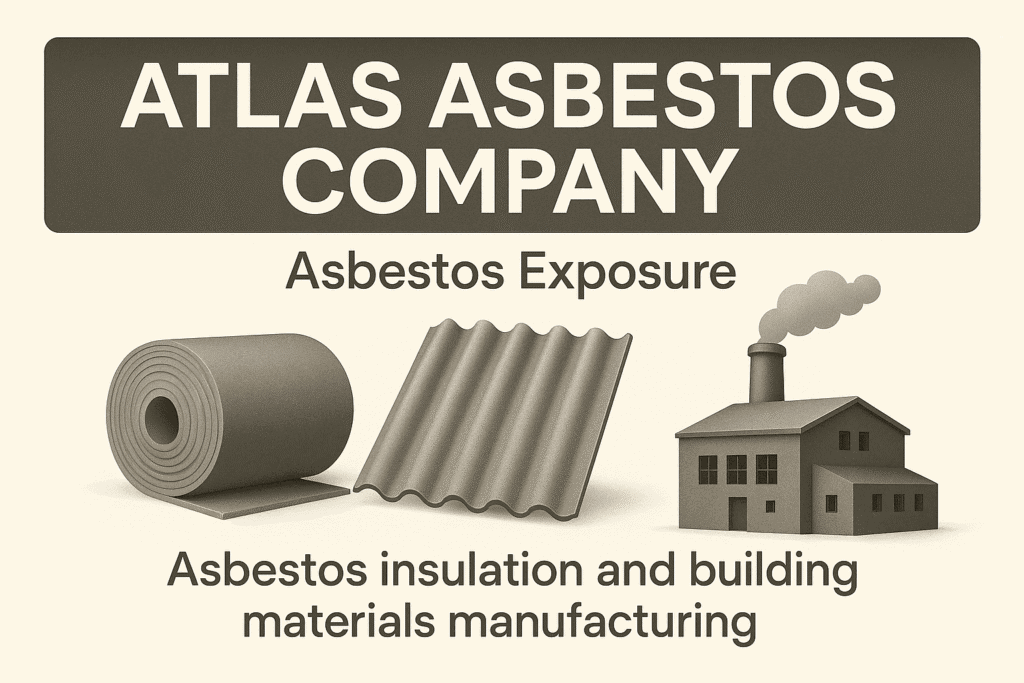
Atlas Asbestos Company Exposure & Mesothelioma Claims
Atlas Asbestos Company exposure questions require precise company identification and a product-specific work history. Canadian government records identify the historical Atlas Asbestos Company Limited and list asbestos-related goods. A familiar Atlas name alone does not establish that a modern business with similar wording manufactured the material a worker encountered.
For someone diagnosed with mesothelioma, useful records may connect Atlas products to a Canadian factory, distributor, construction project, or later renovation. Record the actual company name, product, location, task, and dates. Keep historical cement products and other listed materials separate rather than describe the company solely as an equipment manufacturer.
🏭 Atlas Asbestos Company and Historical Names
A Canadian government trademark record names Atlas Asbestos Company Limited as the registered owner and records a later Atlas Turner name. Historical statistical directories also identify the Montreal business. These sources help distinguish the company from unrelated businesses sharing Atlas in their names; they do not establish every transaction or corporate responsibility.
The asbestos company information provides wider company context. Preserve exact wording and addresses from original records, including French-language versions where present. Do not translate or abbreviate a business name in a way that removes distinctions needed to match a contract, package, or employment entry to the correct entity.
Create separate entries for the manufacturer, seller, employer, installer, and customer site. A merchant’s invoice can name Atlas goods without showing that Atlas employed the worker. Conversely, employment with a historical company does not identify which product the person handled or which department they worked in.
Where names changed during a career, keep the earlier and later names with their supported dates. A later corporate label should not overwrite an original payslip. If a record contains only Atlas and no address or product information, preserve it as an unresolved lead rather than assign it automatically to this company.
🧱 Asbestos-Cement Sheets, Roofing, and Building Products
The Canadian trademark record lists asbestos-related building goods, including flat and corrugated siding, boards, roofing, and other categories. A historical architectural advertisement specifically promotes Atlas Turnall Trafford Tile as asbestos-cement. Such sources identify product leads but do not prove that every listed item was sold to a particular building or worker.
The cement product information provides broader material context. Cement products are not interchangeable with loose insulation, and ordinary cement should not be assumed to contain asbestos. Identify the particular sheet, panel, pipe, or other component and the evidence connecting it to an Atlas label or documented supply record.
For a roofing or siding project, record the building address, installation or repair dates, contractor, and precise material description. Flat boards, corrugated sheets, and layered roof materials can have different histories. A company name on one delivery does not identify every layer or component used throughout the project.
The building exposure information addresses the larger setting. Preserve specifications and survey reports with their location details. A positive finding in one sampled panel does not establish every room or exterior elevation, and a survey of later replacement material may not describe the original installation a former worker remembers.
🧵 Gaskets, Cloth, and Other Historical Material Categories
A 1937 Canadian industry directory lists Atlas asbestos gaskets and cloth. The trademark record describes a broader range of goods. These records should be read with their dates and purposes intact: a trademark goods list is not a delivery ledger or proof that each product was manufactured continuously throughout the company’s history.
For gasket-related work, identify the actual seal, packaging, and task separately from other materials at the site. An Atlas reference associated with cloth should not automatically be transferred to a nearby gasket. Similar supplier names can cover different items whose composition and use require their own evidence.
The equipment exposure information concerns machinery around which such materials may have been used. A pump or boiler nameplate does not identify every accessory or replacement material fitted to it. Keep a possible Atlas material reference separate from the equipment maker unless the records show the specific connection.
If an account includes sprayed coatings or insulation, seek product and contract records appropriate to that material. Do not assume every sprayed surface at an older Canadian facility was an Atlas product. The observed task and dated supplier evidence need to fit the actual area where the person worked.
👷 Factory Departments, Warehouses, and Material Handling
For direct employment, begin with the plant address, department, job title, actual duties, and years. Manufacturing, warehouse, clerical, delivery, and maintenance assignments can involve different conditions. A company’s product range should not become a list of tasks supposedly performed by everyone on its payroll.
Ask how materials moved through the work area and what the person actually saw or handled. Packaging, stock references, order books, and equipment descriptions may distinguish one operation from another. If the person remembers dust but not the material, preserve that uncertainty instead of identifying all dust as asbestos.
Warehouse evidence can be useful even when it does not describe manufacturing. A worker may remember receiving labeled goods from another facility or loading a customer shipment. Record where the goods came from and went when known, without assuming that a warehouse manufactured every product stored there.
Maintenance and temporary assignments need separate entries. A worker might spend years in one department and only a short period assisting repairs elsewhere. Dates and duration help preserve that distinction. Where employment records are incomplete, use an honest range and identify whether it comes from documents or recollection.
🏗️ Installation, Renovation, and Demolition Histories
At commercial construction projects, describe the material and task: carrying sheets, installing panels, working nearby, repairing a component, or cleaning after another crew where applicable. These examples are questions to explore, not a finding that every Atlas-related project involved each activity or exposed every trade in the same way.
Renovation can involve older material long after its original sale. Keep the date of original installation separate from the later removal period. A worker’s employment date may establish when a repair occurred without identifying when the material was manufactured, who supplied it, or whether it had already been replaced.
For demolition work, preserve the building area, contractor, work package, survey scope, and actual duties. A permit may show a project existed but not identify the manufacturer of every component removed. Room-specific records and firsthand accounts can help connect broad project information to a particular assignment.
Do not disturb surviving material to identify a brand or collect a sample for a claim. Existing labels, photographs, plans, and professional survey records may be reviewed without cutting a sheet or opening insulation. Qualified professionals can advise on assessment where material remains and the composition is unresolved.
📂 Canadian Product Records and Worksite Evidence
Useful records include original catalogs, complete package photographs, contractor invoices, purchase orders, shipping addresses, employment records, and material schedules. Retain dates and page context. A directory establishes historical business information but generally needs other evidence to connect a listed product to a worker’s actual location and task.
The exposure evidence information discusses records used in claim reviews. For Canadian histories, keep the province, municipality, facility address, and employer distinct. If a person later moved to another country, preserve both the original work location and current residence rather than assume they answer the same legal question.
The jobsite information can help organize several employers or projects into a chronology. Keep confirmed facts, direct recollections, and research leads separate. A product name found in an archive after a worker’s death should not be attributed to the worker as though they personally recalled it.
Possible household asbestos exposure needs its own account of clothing, household handling, and time period. Describe what happened without assuming every family member had the same contact. Keep old clothing or residue undisturbed; photographs and documentary records are more appropriate starting points than transporting potentially contaminated items.
🩺 Mesothelioma Records and Continuing Medical Care
A mesothelioma diagnosis requires medical documentation. Historical Atlas product records can help describe possible exposure sources, but they cannot diagnose disease or determine which source caused a particular person’s illness. Clinical evidence and the occupational chronology should be preserved as related but separate parts of the record.
Keep pathology reports, diagnosis dates, relevant imaging summaries, and treating-provider details. Ask the medical team how to obtain complete copies and how records can be shared securely. Continue care while historical documents are gathered; medical appointments should not depend on finding an old supplier invoice or architectural catalog.
For another asbestos-related diagnosis, use the actual condition named by clinicians. Do not substitute mesothelioma for every lung cancer or breathing problem. A reviewer may need different medical evidence depending on the condition and the program or legal route, so family summaries should be checked against the available records.
For a deceased worker, preserve medical and death documents and any earlier legal papers. Clarify who can authorize records and who knows the work history firsthand. Those roles may belong to different relatives or representatives. An accurate partial chronology is preferable to invented details that could contradict records found later.
⚖️ Jurisdiction, Compensation Routes, and Individual Review
Potential mesothelioma legal options need assessment based on the actual companies, work locations, evidence, and applicable law. This company’s Canadian history should not be presented as an automatic US claim. Likewise, a shared historical business relationship does not establish that every compensation program accepts every Atlas-related exposure account.
The asbestos trust overview describes a general mechanism, not a finding that Atlas has a standalone trust or that a person qualifies for another company’s program. A qualified representative should verify the responsible entities and current governing documents before suggesting a route or discussing potential payments.
For trust and lawsuit coordination, preserve earlier applications, settlements, releases, and employment statements. A cross-border history may require review by professionals familiar with the relevant jurisdictions. Do not assume a payment, workers’ compensation decision, or filing in one place automatically resolves or preserves every other potential claim.
Ask promptly about filing deadlines and any claim following a family member’s death. This site’s general information should not be used as a Canadian deadline calculation. Clarify legal authority, document needs, costs, and the proposed route before interpreting a historical product reference as proof of eligibility or a compensation guarantee.
❓ Frequently Asked Questions
Is Atlas Asbestos Company the Same as Every Atlas Business?
No. Preserve the full historical name, address, product reference, and dates. Canadian government records identify a particular business; a similar modern name does not prove a connection. Do not attribute asbestos products or legal responsibility to an unrelated company based on the shared word Atlas.
Did Atlas Sell Only Industrial Equipment?
No. Historical Canadian records identify asbestos-related building goods and other material categories. The article’s URL location does not define the company’s entire product range. A particular exposure account still needs to identify the actual product and work rather than rely on a category label.
Does a Trademark List Prove a Product Was at My Jobsite?
No. It identifies registered goods associated with the mark, not every shipment, production period, or installation. Purchase orders, invoices, project records, and firsthand evidence may be needed to connect a specific product to the place and time where the person worked.
Can Canadian Exposure Automatically Support a US Claim?
No automatic conclusion is appropriate. The work location, entities, evidence, and applicable legal or program rules need individual assessment. Preserve the complete Canadian history and seek advice from professionals familiar with the relevant jurisdictions rather than assume residence alone determines the route.
What If the Original Atlas Product Is Gone?
Existing employment records, catalogs, invoices, photographs, surveys, and witness accounts may still help. Keep the evidence’s limits clear and avoid guessing the missing product details. Do not disturb remaining material or select a brand merely because a similar item appears in an old advertisement.
Sources
- Canadian Intellectual Property Office — Historical Atlas Trademark and Goods
- Government of Canada — 1937 Asbestos Products Industry Directory
- Archived 1947 Architectural Journal — Atlas Turnall Trafford Tile Advertisement
- Health Canada — Asbestos and Your Health
- National Cancer Institute — Mesothelioma Care
📞 Get the Mesothelioma Help & Compensation You Deserve — Contact Us Today!
After a mesothelioma diagnosis, contact us for help organizing medical and exposure information and understanding potential compensation options. Eligibility depends on the evidence and the applicable claim requirements.
We have 25+ years helping veterans, workers, and families seek information and assistance after asbestos-related diagnoses.
📲 Contact Us Today — Three Easy Ways!
CALL: 800.291.0963 — Request a free case review.
LIVE CHAT: Available 24/7/365 through the website’s chat feature.
CONTACT FORM: Send your information using the form below.
Disclaimer: This information is not be considered as legal or medical advice. Mesothelioma Help Center is not a law firm or medical provider and does not determine legal or VA eligibility.