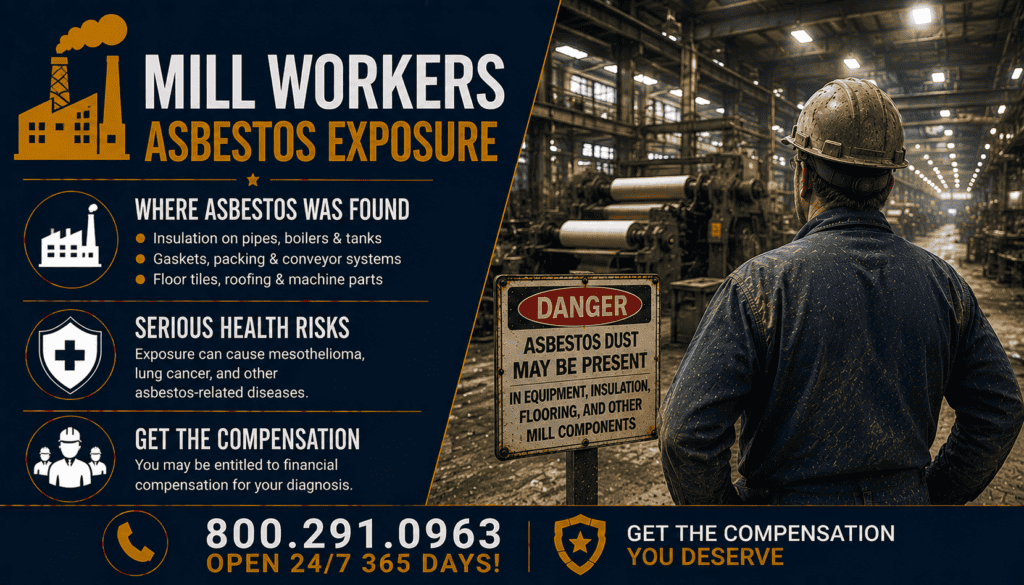
Mill Workers Asbestos Exposure
The term “mill worker” can describe employees in paper, lumber, textile, mineral, steel and other processing facilities. These workplaces had very different raw materials and hazards, so mill employment alone does not establish asbestos exposure. Some workers may have encountered asbestos through documented insulation, gaskets, packing, friction products or asbestos-contaminated minerals.
NIOSH evidence shows why mill type matters. Federal research documents asbestos-related hazards among miners and millers exposed to talc containing asbestiform minerals, while textile research identifies cotton dust and endotoxin as separate respiratory hazards. A strong asbestos history identifies the specific mill, department, equipment, material, task and time period rather than treating all industrial dust as asbestos.
Mill Workers and Occupational Asbestos Exposure
Mill workers can include machine operators, production employees, millwrights, maintenance mechanics, electricians, pipefitters, boiler operators, material handlers and other trades. The potential for asbestos exposure depends heavily on the type of mill and the worker’s actual duties.
NIOSH describes asbestos as a group of naturally occurring mineral fibers historically used in industrial processes and products because of heat resistance, flexibility and other properties. Examples of products that may contain asbestos include brakes, insulation materials and cement.
In some mills, the asbestos question centers on industrial equipment and thermal insulation. In others, a raw mineral itself may have contained asbestiform fibers. NIOSH’s study of New York talc miners and millers, for example, found talc samples containing tremolite, anthophyllite and chrysotile and reported elevated exposure to asbestiform amphiboles in many mine and mill operations.
That evidence should not be generalized to unrelated paper, lumber, textile or grain mills. Each facility and material stream requires its own exposure investigation.
Related resources include agricultural, forestry and natural resource workers asbestos exposure, paper mill workers asbestos exposure, lumber mill workers mesothelioma lawsuits and millwrights asbestos exposure.
Different Mills and Different Exposure Sources
“Mill worker” is too broad to describe one uniform asbestos exposure. The first step is identifying what the facility processed and what the worker did there.
Paper and Pulp Mills
Potential historical exposure may involve documented asbestos-containing insulation, gaskets, packing or other materials associated with boilers, steam systems, piping and maintenance operations. See paper mill workers asbestos exposure.
Lumber and Wood-Products Mills
Wood dust is not asbestos. Potential asbestos exposure should be investigated separately through identified boiler, pipe, mechanical or building materials. See lumber mill workers mesothelioma lawsuits.
Textile Mills
NIOSH has extensively studied cotton dust and endotoxin in textile workers. Cotton dust is a distinct occupational respiratory hazard and should not be labeled asbestos. An asbestos claim involving a textile mill needs a separate documented asbestos source.
Mineral Mills
Some mineral-processing operations present a more direct asbestos question. NIOSH found excessive tremolite asbestos-fiber exposure in a batch-mixing operation during one refractory-material evaluation and separately documented asbestiform minerals in talc mining and milling. Those findings are facility- and material-specific.
Boilers, Piping, Machinery and Asbestos Materials
Older industrial mills often relied on heat, steam and mechanical systems. Potential asbestos-containing materials should be identified through product records, specifications, asbestos surveys, testing or other reliable evidence.
Materials worth investigating can include:
- Documented asbestos-containing boiler and thermal insulation
- Pipe insulation and lagging confirmed to contain asbestos
- Asbestos-containing gaskets or packing identified through product evidence
- Friction products on machinery where asbestos content is documented
- Asbestos-containing cement or other building materials disturbed during renovation or demolition
- Raw or processed minerals documented to contain asbestiform fibers
NIOSH identifies insulation, automobile brakes and cement among examples of products that may contain asbestos. When asbestos fibers are released into the air during handling or disturbance, they can be inhaled.
Related mechanical resources include boilermakers asbestos exposure, pipefitters asbestos exposure, valve workers asbestos exposure and boiler room operators asbestos exposure.
Maintenance, Repair and Shutdown Work
Workers who directly disturbed asbestos-containing materials can have different exposure histories from production employees who did not perform maintenance.
- Insulation work: cutting, stripping or removing confirmed asbestos insulation
- Boiler repair: disturbing documented asbestos thermal materials or gaskets
- Pipe work: removing insulation or opening systems containing identified asbestos products
- Pump and valve repair: scraping or replacing documented asbestos gaskets or packing
- Millwright work: dismantling machinery containing identified asbestos components
- Shutdown work: working near several trades while insulated equipment was opened or repaired
- Renovation or demolition: disturbing confirmed asbestos-containing building materials
Nearby workers could also have had an exposure opportunity if asbestos-containing material was disturbed in their immediate work area. Proximity alone, however, does not prove asbestos exposure.
Related maintenance resources include maintenance workers asbestos exposure, maintenance mechanics asbestos exposure and millwrights asbestos exposure.
Need help now? Call 800.291.0963
Live chat available 24/7, 365 days a year.
Submit Your Case
Asbestos Versus Other Mill Dusts
Industrial mills can be dusty without involving asbestos. Correctly identifying the dust is important medically, legally and scientifically.
Cotton Dust
NIOSH describes byssinosis as an airway disease associated with cotton-dust exposure and has studied endotoxin exposure in textile workers. Cotton dust and endotoxin are not asbestos.
Wood Dust
Lumber and wood-products workers may experience substantial wood-dust exposure. Sawdust and wood fibers are not asbestos unless a separate asbestos source is documented.
Silica and Mineral Dust
Mineral mills can involve silica or other mineral fibers. NIOSH’s refractory-material investigation measured both silica and tremolite asbestos, illustrating why different dusts must be identified separately rather than grouped together.
Asbestos Fibers
NIOSH’s Pocket Guide identifies asbestos as a carcinogenic occupational hazard. Asbestosis specifically results from inhaling asbestos fibers, while silicosis results from silica and byssinosis is associated with cotton dust.
Mesothelioma and Other Asbestos-Related Diseases
NIOSH states that asbestos exposure is associated with lung cancer, asbestosis and mesothelioma. Its research among workers exposed to asbestos-contaminated minerals also demonstrates why the identity of the mineral source matters.
In NIOSH’s study of talc miners and millers, exposure to talcs containing asbestiform minerals was associated with increased risks of pleural changes, bronchogenic cancer and nonmalignant respiratory disease. That study should not be used to claim the same risk pattern for workers in mills processing unrelated materials.
Asbestos-related diseases can develop after long latency periods. Historical personnel records, department assignments, product specifications, purchasing files and coworker statements may therefore become important decades after the work occurred.
Medical questions about past occupational exposure, symptoms, screening or diagnosis should be discussed with a qualified healthcare professional.
Documenting Mill Worker Asbestos Exposure
A useful exposure investigation begins by defining what “mill” means in the worker’s history and then reconstructing the actual materials and tasks.
- Facility: paper, lumber, textile, mineral, steel or another type of mill
- Employment: employer, years, department, craft, payroll, pension, union and Social Security records
- Raw materials: wood, pulp, cotton, minerals, metals or other feedstock
- Equipment: boilers, steam lines, pumps, valves, kilns, conveyors and process machinery
- Products: insulation, gaskets, packing, friction materials, brands and manufacturers
- Tasks: production, maintenance, insulation removal, repair, shutdown work and cleanup
- Facility evidence: asbestos surveys, abatement records, engineering drawings and purchasing records
- Witnesses: millwrights, operators, mechanics, pipefitters, electricians, supervisors and coworkers
Questions That Can Strengthen an Exposure History
What did the mill process? Which years and department? What equipment did the worker operate or repair? Was insulation removed? Were gaskets or packing scraped? Were raw minerals handled? Which manufacturers or products can be identified? Are asbestos surveys, invoices, maintenance records, photographs or witnesses available?
Lawsuits, Trust Funds and Compensation
A mill worker diagnosed with mesothelioma or another asbestos-related disease may have potential legal or compensation options when evidence supports asbestos exposure and applicable requirements are met. Mill employment alone does not establish liability, causation, trust eligibility or compensation.
Potential evidence may identify an asbestos-product manufacturer, supplier, contractor, premises-related party or company associated with an asbestos bankruptcy trust. Each trust has its own medical and exposure requirements. Compensation is not guaranteed.
Related Industrial Resources
Industrial workers: Industrial & Manufacturing Factory Workers Asbestos Exposure · Industrial Workers Asbestos Exposure Lawsuit
Mill trades: Millwrights Asbestos Exposure · Maintenance Mechanics Asbestos Exposure
Authoritative Sources
This page was researched using NIOSH government evidence. The sources demonstrate why “mill worker” cannot be treated as a single asbestos exposure category: federal research documents asbestos-contaminated mineral milling, while other mill research identifies distinct hazards such as cotton dust.
- NIOSH — Workplace Exposure to Asbestos: Review and Recommendations
- NIOSH — Pocket Guide to Chemical Hazards: Asbestos
- NIOSH — Occupational Exposure to Talc Containing Asbestos: Miners and Millers
- NIOSH — HHE 72-43-57, Tremolite Asbestos and Silica Exposure
- NIOSH — Lung Disease in Textile Workers
- NIOSH — Asbestos Occupational Health Information
Mill Workers Asbestos Exposure FAQ
Were all mill workers exposed to asbestos?
No. Mill type, raw materials, equipment, products, tasks and time period must be investigated. Employment at a mill alone does not establish asbestos exposure.
Which types of mills may involve asbestos exposure questions?
Paper, lumber, mineral, textile and other industrial mills can present different questions. Potential asbestos exposure must be tied to an actual asbestos-containing or asbestos-contaminated material.
Is cotton dust asbestos?
No. NIOSH identifies cotton dust and endotoxin as distinct textile-worker respiratory hazards. They are not asbestos.
Is wood dust asbestos?
No. Wood dust is a separate occupational exposure. Lumber-mill dust does not prove asbestos exposure.
Could mineral mill workers encounter asbestos?
Potentially. NIOSH documented asbestiform minerals in certain talc mining and milling operations and tremolite asbestos in a specific refractory-material operation. Those findings should not be generalized to all mineral mills.
Which mill jobs may have disturbed asbestos materials?
Depending on the facility, millwrights, maintenance mechanics, boilermakers, pipefitters, insulators and other trades may have repaired equipment or disturbed documented asbestos-containing materials.
What evidence can document historical mill asbestos exposure?
Employment and union records, raw-material information, product invoices, equipment specifications, maintenance files, asbestos surveys, photographs and coworker statements can be useful.
Can mill workers qualify for asbestos trust fund claims?
Some may qualify if they meet a trust’s medical and exposure requirements and can connect their work to a covered company, product, site or qualifying exposure period. Mill employment alone does not establish eligibility.
Get Help Reviewing Mill Worker Asbestos Exposure
Call 800.291.0963
Live chat is available 24/7, 365 days a year.
Prior mill work does not automatically prove asbestos exposure, disease causation, liability, claim eligibility or compensation. Each situation depends on the type of mill, employer, dates, department, raw materials, equipment, products, maintenance tasks, asbestos-content evidence, medical evidence and applicable legal requirements. Compensation is not guaranteed.
⚕️ Legal & Medical Information Disclaimer
This page provides general educational information and is not medical or legal advice. The information does not establish asbestos exposure, diagnosis, causation, liability, claim eligibility or compensation. Medical concerns should be discussed with a qualified healthcare professional, and legal questions should be reviewed with a qualified attorney.