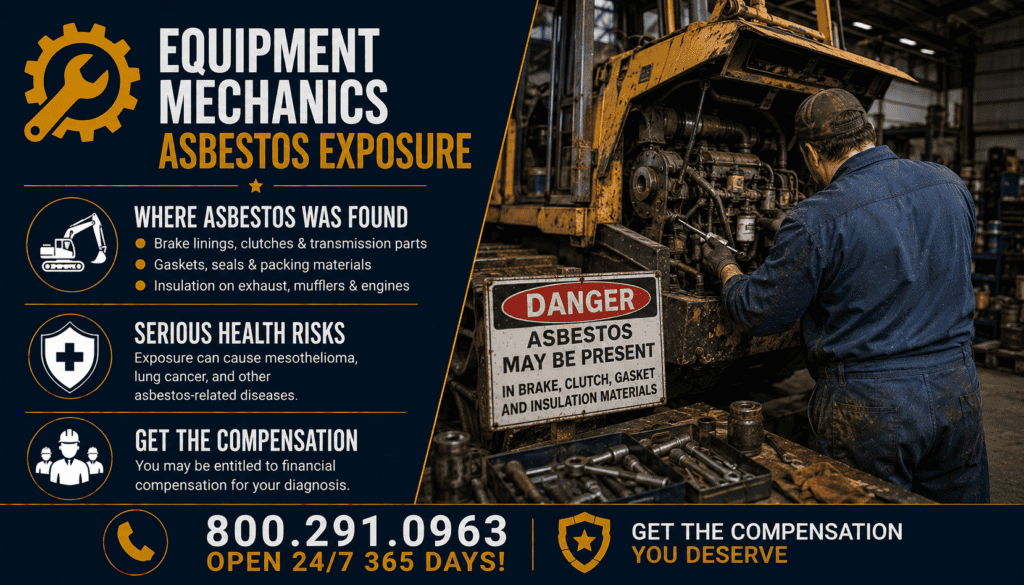
Equipment Mechanics Asbestos Exposure
Equipment mechanics maintain and repair mobile, industrial and heavy-duty machinery used in construction, transportation, manufacturing, public works and other industries. Some older brakes, clutches, gaskets and heat-resistant components contained asbestos, creating potential exposure when mechanics inspected, disassembled, cleaned, rebuilt, ground or replaced those parts.
Federal evidence supports a component-specific approach. EPA states that brake and clutch dust can be released from a car, truck or other equipment and may contain asbestos fibers when the friction component contains asbestos. NIOSH also documented truck brake and clutch rebuilding operations where a large percentage of components were refurbished or relined with asbestos material. Equipment-mechanic employment alone, however, does not prove asbestos exposure.
Equipment Mechanics and Occupational Asbestos Exposure
Equipment mechanics may service construction machinery, fleet vehicles, industrial equipment, mobile equipment, trucks, material-handling systems and other mechanical assets. Their duties can include brake and clutch repair, driveline work, engine maintenance, gasket replacement, welding, lubrication and preventive maintenance.
EPA’s brake-and-clutch guidance expressly discusses dust released when a brake disk, drum, clutch cover or wheel is removed from a car, truck or other equipment. The agency explains that some, but not all, brakes and clutches may contain asbestos and that dust from an asbestos-containing component may contain inhalable fibers.
NIOSH Health Hazard Evaluation 83-040-1356 provides strong heavy-duty repair evidence. At a Wyoming operation rebuilding truck brakes, clutches, drivelines, transmissions and other mechanical parts, NIOSH reported that a large percentage of brakes and clutches and some other products were refurbished or relined with asbestos material.
OSHA’s general-industry asbestos standard specifically requires controls for covered automotive brake and clutch operations. For equipment outside that regulatory wording, the actual component, work activity and applicable OSHA standard must be evaluated rather than assuming every machine repair falls under the automotive provision.
Related resources include automotive mechanics and heavy equipment workers asbestos exposure, truck mechanics asbestos exposure, maintenance mechanics asbestos exposure and millwrights asbestos exposure.
Potential Asbestos Sources in Equipment Repair
Potential asbestos sources depended on the machine, manufacturer, replacement components, facility and era. Relevant sources can include:
- Older asbestos-containing brake linings, brake shoes and friction materials
- Older asbestos-containing clutch facings
- Older gaskets and packing where asbestos content is documented
- Heat-resistant insulation or shielding on equipment where asbestos is confirmed
- Asbestos-containing thermal-system insulation on nearby pipes, boilers or mechanical systems
- Legacy asbestos-containing building materials disturbed during maintenance or renovation
OSHA’s asbestos technical appendix identifies automotive brake and clutch linings among historical asbestos uses and also notes asbestos in pipe and boiler insulation and multiple building materials. These examples establish recognized historical uses but do not prove that a specific piece of equipment contained asbestos.
For brakes and clutches, EPA warns that asbestos-containing and non-asbestos components cannot necessarily be distinguished simply by looking at them. Manufacturer literature, part numbers, packaging, invoices, service manuals and laboratory evidence can therefore be important.
Ordinary steel, hydraulic oil, grease, diesel exhaust, welding fumes and non-asbestos brake dust are not asbestos. They should be evaluated as separate occupational hazards.
How Equipment Mechanics Could Encounter Asbestos
When asbestos-containing components were actually present, exposure could occur during direct servicing or disturbance of accumulated residue.
- Brake inspection: opening drums or assemblies containing residue from asbestos-containing friction material
- Brake rebuilding: removing, fitting or replacing asbestos-containing shoes or linings
- Clutch repair: opening housings and replacing asbestos-containing clutch facings
- Cleaning: disturbing asbestos-containing brake or clutch residue
- Grinding or machining: mechanically altering confirmed asbestos-containing friction components
- Gasket work: scraping or removing older gaskets when asbestos content is documented
- Insulation maintenance: disturbing confirmed asbestos-containing thermal insulation on machinery, piping or nearby systems
- Adjacent work: working near another mechanic who disturbed asbestos-containing components
NIOSH’s brake-drum research recommends engineering controls and work practices to reduce asbestos exposure during brake maintenance. EPA similarly warns against compressed-air cleaning and other practices that can disperse brake and clutch dust.
The amount of visible dust does not establish asbestos content. Product identification and task-specific evidence are more reliable than assuming every dusty repair involved asbestos.
Equipment Shops, Fleets and Maintenance Areas
A credible exposure history identifies the employer, facility, equipment, dates, components and repair practices.
Heavy Equipment Repair Shops
Mechanics may service braking, clutch and driveline systems on heavy-duty machinery. Exposure depends on whether the serviced friction components actually contained asbestos.
Truck and Fleet Garages
NIOSH documented asbestos-related concerns in truck brake and clutch rebuilding. Fleet purchasing records, parts inventories and shop procedures can help identify the products used during a mechanic’s employment.
Construction Equipment Maintenance
Mechanics working on construction machinery can encounter many hazards, but the equipment category alone does not establish asbestos exposure. Brake, clutch, gasket or insulation components should be researched individually.
Industrial Maintenance Departments
Equipment mechanics inside factories may repair machinery while also working near older pipes, boilers and thermal systems. Separately documented asbestos-containing insulation can create an exposure pathway if disturbed.
Government and Public Works Garages
Public fleets may include trucks, road-maintenance equipment and other mobile machinery. Historical purchasing records and maintenance manuals can help identify friction products and servicing practices.
Vehicle and Mobile Equipment Facilities
NIOSH occupational safety materials recognize vehicle/mobile equipment mechanics and repairers and specifically identify asbestos during brake and clutch service work as a potentially applicable safety topic.
Related resources include automotive mechanics and heavy equipment workers asbestos exposure, truck mechanics asbestos exposure, bus mechanics asbestos exposure, auto mechanics brake and clutch dust exposure, maintenance mechanics asbestos exposure and high-risk jobs asbestos exposure.
Secondary or Household Exposure
If a mechanic’s clothing or belongings became contaminated during actual asbestos-containing repair work, fibers could historically be carried away from the workplace. A household exposure history still requires evidence of the original asbestos source and a plausible contamination pathway.
Need help now? Call 800.291.0963
Live chat available 24/7, 365 days a year.
Submit Your Case
Mesothelioma and Other Occupational Health Risks
Asbestos inhalation is associated with serious diseases including mesothelioma, lung cancer and asbestosis. For an equipment mechanic, these risks become relevant to an occupational history when actual exposure to asbestos-containing components or materials can be supported.
EPA notes that if a brake contains asbestos, brake dust may contain asbestos fibers that can be inhaled. The agency also emphasizes that some, but not all, brakes and clutches contain asbestos.
Equipment mechanics can face many other occupational hazards, including diesel exhaust, solvents, fuels, welding fumes, noise, hydraulic systems, moving machinery and heavy loads. Those hazards are separate from asbestos and should not be used as evidence that asbestos exposure occurred.
Medical questions about prior asbestos exposure, symptoms, screening or diagnosis should be discussed with a qualified healthcare professional.
Documenting an Equipment Mechanic Exposure History
A useful investigation identifies the employer, dates, facility, machines, components and servicing methods associated with possible asbestos exposure.
- Employment evidence: repair shop, fleet, contractor, factory, government agency, payroll, W-2, union and Social Security records
- Equipment evidence: machine type, manufacturer, model, serial number and approximate year
- Part evidence: brake linings, shoes, clutch facings, gaskets, packing, insulation, manufacturers and part numbers
- Task evidence: drum removal, cleaning, grinding, fitting, clutch replacement, gasket scraping or insulation disturbance
- Product evidence: parts catalogs, service manuals, invoices, packaging, safety data and laboratory analyses
- Shop evidence: maintenance procedures, ventilation, HEPA systems, wet-cleaning methods and industrial-hygiene records
- Witness evidence: mechanics, supervisors, parts employees, operators and coworkers
Historical equipment manuals and parts records can be particularly valuable because a mechanic may remember servicing a machine but not know whether a specific friction, gasket or insulation component contained asbestos.
Questions That Can Strengthen an Exposure History
Which employer and years? What machines were repaired? Which brakes, clutches or gaskets were replaced? How were assemblies cleaned? Were friction parts ground or fitted? Were insulated pipes or equipment disturbed? What brands and part numbers were used? Are manuals, invoices, shop records or coworker statements available?
Asbestos Lawsuits, Trust Funds and Compensation
An equipment mechanic diagnosed with mesothelioma or another asbestos-related disease may have potential legal or compensation options when evidence supports occupational asbestos exposure and applicable requirements are met. Possible avenues can include claims involving legally responsible companies and asbestos bankruptcy trusts.
Equipment-mechanic employment alone does not establish liability or asbestos trust eligibility. Each claim has separate medical, exposure, company, product and filing requirements. Evidence connecting the worker to an asbestos-containing friction product, gasket, insulation material or another covered source may be necessary.
Potential evidence includes employment and Social Security records, union files, equipment manuals, parts invoices, manufacturer catalogs, product packaging, industrial-hygiene studies, maintenance records, photographs, coworker statements and medical documentation. Applicable law and filing deadlines should be reviewed individually.
Related Equipment and Mechanic Resources
Automotive and heavy equipment: Automotive Mechanics & Heavy Equipment Workers Asbestos Exposure · Auto Mechanics Brake & Clutch Dust Exposure
Heavy-duty mechanics: Truck Mechanics Asbestos Exposure · Bus Mechanics Asbestos Exposure
Maintenance mechanics: Maintenance Mechanics Asbestos Exposure · Millwrights Asbestos Exposure
Authoritative Sources
This page was researched using OSHA, NIOSH and EPA government sources. The strongest heavy-equipment evidence includes a NIOSH investigation of truck brake, clutch and driveline rebuilding where asbestos-containing friction materials were documented, together with federal brake-and-clutch exposure-control guidance.
- NIOSH — HHE 83-040-1356, Truck Brake and Clutch Reconditioning
- NIOSH — HHE 81-0135-0912, Heavy-Duty Vehicle Preparation and Brake Work
- NIOSH — Control of Asbestos Exposure During Brake Drum Service
- OSHA — Mandatory Appendix F for Automotive Brake and Clutch Work
- OSHA — Substance Technical Information for Asbestos
- EPA — Current Best Practices for Brake and Clutch Repair Workers
Equipment Mechanics Asbestos Exposure FAQ
Were all equipment mechanics exposed to asbestos?
No. Equipment-mechanic employment alone does not prove exposure. The actual machine, component, era and repair task must be investigated.
Could heavy-equipment brakes and clutches contain asbestos?
Some historical friction components did. NIOSH documented truck brake and clutch rebuilding where many components were refurbished or relined with asbestos material.
Is all brake or clutch dust asbestos?
No. EPA states that some, but not all, brakes and clutches may contain asbestos. Dust from a non-asbestos component should not be described as asbestos dust.
Could equipment mechanics encounter asbestos in gaskets or insulation?
Potentially, when reliable product, maintenance or laboratory evidence confirms asbestos in the specific gasket, insulation or other component being disturbed.
Did NIOSH investigate asbestos during heavy-duty vehicle repair?
Yes. NIOSH evaluated truck brake and clutch reconditioning and separately evaluated heavy-duty vehicle preparation areas where brake assembly inspection and rebuilding could create potential asbestos exposure.
What records can document an equipment mechanic’s exposure?
Employment records, equipment manuals, parts invoices, manufacturer catalogs, service records, product packaging, industrial-hygiene reports and coworker statements can help reconstruct exposure.
Could equipment mechanics have household asbestos exposure concerns?
Potentially, if clothing became contaminated during actual asbestos-containing repair work and fibers were carried home. Evidence of the original workplace source and contamination pathway is still needed.
Can equipment mechanics qualify for asbestos trust fund claims?
Some may qualify if they meet a trust’s medical and exposure criteria and can connect their work to a covered asbestos product, company or qualifying exposure period. Equipment-mechanic employment alone does not establish eligibility.
Get Help Reviewing an Equipment Mechanic Exposure History
Call 800.291.0963
Live chat is available 24/7, 365 days a year.
Prior equipment, fleet or machinery maintenance work does not automatically prove asbestos exposure, disease causation, liability, claim eligibility or compensation. Each situation depends on the employer, dates, machines, components, repair methods, asbestos-content evidence, medical evidence and applicable legal requirements. Compensation is not guaranteed.
⚕️ Legal & Medical Information Disclaimer
This page provides general educational information and is not medical or legal advice. The information does not establish asbestos exposure, diagnosis, causation, liability, claim eligibility or compensation. Medical concerns should be discussed with a qualified healthcare professional, and legal questions should be reviewed with a qualified attorney.